


The emperor was gone just like his autumn breeze;
At night his steed would neigh, at dawn no trace was seen.
By painted rails fragrance still wafts over laurel trees,
His thirty palaces overgrown with mosses green.
Wei eunuch drove a dray to go a long, long way;
In Eastern Pass the sour wind stung the bronze's eyes.

Only the moon of yore saw him leave palace door;
Thinking of his dear lord, he shed tears and heaved sighs.
Withered orchid would say, "Farewell and go your way."
Heaven would have grown old if it could feel as man.

He went with moon-shaped plate beneath the moon desolate;
The waves unheard, far from the town the horses ran.
Original Poem
「金铜仙人辞汉歌」
李贺
茂陵刘郎秋风客,夜闻马嘶晓无迹。
画栏桂树悬秋香,三十六宫土花碧。
魏官牵车指千里,东关酸风射眸子。
空将汉月出宫门,忆君清泪如铅水。
衰兰送客咸阳道,天若有情天亦老。
携盘独出月荒凉,渭城已远波声小。
Interpretation
Yuanhe, Eighth Year (813 AD), Li He, aged twenty-seven. This year, he made a difficult decision: to resign from his post as Ritual Ceremonialist, leave Chang'an, and return to his hometown, Changgu. The Ritual Ceremonialist was a lowly ninth-rank official, responsible for managing ceremonial tablets and directing sacrifices, dealing daily with spirits and rituals. For a poet whose spirit soared to the heavens, this was nothing less than a spiritual exile. After three years in the post, he finally resolved to end this dispiriting sojourn in the capital. En route, he passed through Luoyang, the former Eastern Han capital, and the place from which Emperor Ming of Wei, Cao Rui, ordered the Han Palace's bronze statue relocated. History records that Emperor Wu of the Han Dynasty had a bronze statue cast before the Jianzhang Palace, its hands holding a bronze plate to catch dew, called the "Dew-Receiving Stand"; dew mixed with powdered jade consumed with it was said to confer immortality. Centuries later, Emperor Ming of Wei ordered the statue moved to Luoyang, but it was abandoned by the Ba River during transport because it was too heavy. Legend says the bronze statue shed tears as it was about to be loaded.
Standing on the ruins of history, gazing in the direction of the long-gone bronze statue, a double sorrow welled up in Li He's heart: one layer belonged to Emperor Wu of Han—that "Guest of the Autumn Wind," once unrivaled, in the end nothing but a mound of earth at Maoling; the other layer belonged to the Golden Bronze Immortal—that forcibly relocated statue, bearing longing for its native land, could only depart sorrowfully under the "sour wind that shoots into the pupils." And he himself, was he not another kind of "leaver of Han"? He was leaving Chang'an, the illusion of fame and success, that youth that could never be reclaimed. "If heaven had feelings, heaven too would grow old"—these seven words were written for the bronze statue, for himself, and for all lives throughout time abandoned by its passage.
First Couplet: "茂陵刘郎秋风客,夜闻马嘶晓无迹。"
Sir Liu of Maoling, guest of the autumn wind;
At night you hear his horse’s whinny, at dawn no trace.
The opening addresses him as "Sir Liu" rather than "Emperor Wu of Han," pulling the great ruler back to the level of an ordinary man. He is an emperor, but also a "Sir," also a guest destined to be swept away by the autumn wind. "At night you hear his horse’s whinny, at dawn no trace" uses an imagined supernatural scene to describe his spirit patrolling his old haunts at night, vanishing by dawn. This horse's whinny is history's echo, and also the poet's inner auditory hallucination—a golden age is now past, a hero is now dust.
Second Couplet: "画栏桂树悬秋香,三十六宫土花碧。"
Painted balustrades, cassia trees hang autumn fragrance;
Thirty-six palaces, green with mossy bloom.
This couplet creates a strong contrast between "hang autumn fragrance" and "green with mossy bloom." The cassia trees bloom yearly, their fragrance remains, as if time has stood still here; but the thirty-six palaces have long been empty, overgrown with moss, desolate. "Hang" describes the fragrance suspended, stagnant; "green" describes the moss's cold desolation—splendor and ruin are thus juxtaposed in the same scene.
Third Couplet: "魏官牵车指千里,东关酸风射眸子。"
Wei officials point the oxcart a thousand miles ahead;
Through the East Gate, sour wind shoots into the pupils.
This couplet shifts from the Han palaces to the bronze statue, from a static to a moving scene. "Point the oxcart a thousand miles ahead" describes the statue's fate of forced relocation; the word "point" conveys the vast obscurity and inevitability of the road ahead. The next line, "sour wind shoots into the pupils," uses personification to describe the statue's pain—the wind, originally a thing without feeling, becomes "sour" from the statue's sorrow, shooting straight into its eyes. "Shoots" is powerful; "pupils" implies emotion, prefiguring the statue's tears.
Fourth Couplet: "空将汉月出宫门,忆君清泪如铅水。"
Only the Han moon, useless now, goes with it out the gate;
In memory of its lord, clear tears—a stream of molten lead.
"Only the Han moon, useless now" describes the statue's sole companion as it leaves the palace—only the moon that once witnessed the Han palaces' splendor still accompanies it. The next line, "In memory of its lord, clear tears—a stream of molten lead," is one of the poem's most startling similes. Lead is heavy, cold, and gray, perfectly matching the statue's material and state of mind. "Clear tears" called "a stream of molten lead" fits the statue's identity while also materializing and concretizing sorrow, giving formless tears a tangible weight.
Fifth Couplet: "衰兰送客咸阳道,天若有情天亦老。"
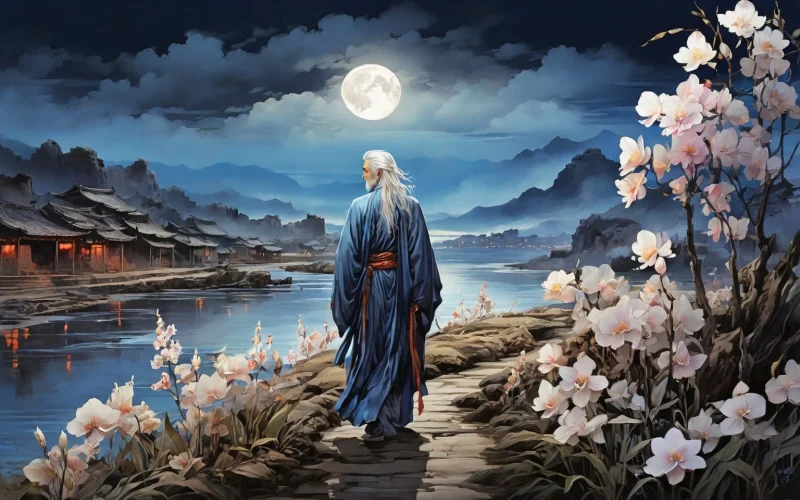
Withered orchids see the traveler off on the Xianyang road;
If heaven had feelings, heaven too would grow old.
This couplet places the parting scene on the ancient Xianyang way, with "withered orchids" as the escort, adding to the desolation. And the seven words, "If heaven had feelings, heaven too would grow old," burst forth, pushing the poem's emotion to its limit. Heaven is originally without feeling, thus eternal; if humans have feelings, they inevitably age, die, disperse. This line expresses the sorrow of the statue, the sorrow of the poet, and the shared fate of all who have feelings.
Sixth Couplet: "携盘独出月荒凉,渭城已远波声小。"
Bearing the plate alone it leaves, the moonlight desolate;
Wei city far now, the river’s sound grows faint.
The final couplet concludes with a distant view. "Bearing the plate alone" echoes the earlier image of the statue holding the dew plate; "the moonlight desolate" merges moonlight and mood. "Wei city far now, the river’s sound grows faint" uses spatial distance to convey temporal passage, uses the fading sound to convey the dissipation of emotion. That gradually inaudible sound of the river is history's dying echo, and also the poet's receding figure.
Overall Appreciation
This is a divine work among Li He's poems and a model in Chinese literary history of using an object to express emotion and antiquity to reflect the present. The entire poem takes the golden bronze statue's removal from the Han palaces as its main thread, fusing the rise and fall of history, the poet's personal circumstances, and the cosmos's having or lacking feeling, reading it stirs the soul.
Structurally, the poem divides into three layers. The first four lines describe the desolation of the Han palaces and the passing of history, using "Sir Liu of Maoling" and "thirty-six palaces" to establish the poem's historical tone. The middle four lines describe the statue's pain at parting, using "sour wind shoots into the pupils" and "clear tears—a stream of molten lead" to personify and express emotion, merging object and human. The last four lines describe the scene and sentiment of the parting journey, using "If heaven had feelings, heaven too would grow old" to sublimate the poem, and "the river’s sound grows faint" to conclude with lingering resonance. Between the three layers, the poem progresses from history to the individual, from the individual to the cosmos, each layer expanding the realm and deepening the sorrow.
Conceptually, the poem's core lies in the contrast between "feeling" and "lack of feeling." Heaven lacks feeling, thus is eternal; the bronze statue has feeling, thus sheds tears; humans have feeling, thus age, die, and suffer from parting. The poet does not articulate the meaning of this contrast, merely juxtaposing the two, letting the reader comprehend the profound desolation.
Artistically, the poem's most moving aspect is the extreme use of "personification" and "symbolism." The bronze statue, originally a thing without feeling, is endowed with the deepest human emotions; the Han palaces, originally dead architecture, are endowed with the most vivid historical memory. And the line "If heaven had feelings, heaven too would grow old" pushes this technique to its extreme—bringing the cosmos into the realm of emotion, making heaven a feeling witness.
Artistic Features
- Startling Imagination and Personification: Taking the bronze statue as the protagonist, endowing it with human emotions like "sour wind shoots into the pupils" and "clear tears—a stream of molten lead," merging object and self, past and present.
- Profound Historical Consciousness: Using the Han to allude to the Tang, using the statue's removal to write of dynastic rise and fall, integrating the poet's personal sense of circumstance into a grand historical narrative.
- Refined Language and Unique Imagery: Images like "sour wind," "stream of molten lead," "withered orchids," and "green with mossy bloom" are both novel and apt, becoming hallmark language of Li He's poetry.
- Strong Lyricism: Though the statue is the protagonist throughout, the poet's own shadow is visible everywhere. The "lord" in "In memory of its lord" is both Emperor Wu of Han and all the irretrievable beauty in the poet's heart.
- Tight Structure, Progressive Emotion: Progressing from history to the individual, from the individual to the cosmos, culminating in the sublimation of "If heaven had feelings, heaven too would grow old" and concluding with "the river’s sound grows faint," leaving a long-lasting resonance.
Insights
This poem, through the fate of a bronze statue, speaks to humanity's deepest sorrow: those who have feelings must suffer; the feelingless attain eternity. It shows us the cost of "feeling." The bronze statue sheds tears from "memory of its lord," suffers from parting, all because it "has feelings." And heaven does not grow old precisely because it is "without feeling." This is the cosmos's cruelest law: to have feeling is to suffer; to lack feeling is to endure. The poet offers no path to liberation, merely presenting this law for the reader to comprehend.
The line "天若有情天亦老" elevates individual emotion to cosmic compassion. In that moment, the statue's tears are no longer just the statue's tears, but the shared tears of all who have feelings; heaven's "growing old" is no longer a celestial anomaly, but the cosmos's response to human suffering. This line allows the poem to transcend the specific sense of dynastic rise and fall, attaining a universal human significance.
On a deeper level, this poem also makes us contemplate: in the face of feelingless time, what meaning does a feeling-filled life have? The statue will ultimately be moved, the Han palaces will ultimately lie in ruins, the poet will ultimately leave the capital. But it is precisely the pain of the "sour wind shoots into the pupils," the weight of the "clear tears—a stream of molten lead," and the sigh of "If heaven had feelings, heaven too would grow old" that gives it all warmth, weight, and a reason to be remembered. **Perhaps this is the answer: though having feelings brings suffering, it is the only proof that we have lived.
Poem translator
Xu Yuanchong (许渊冲)
About the Poet
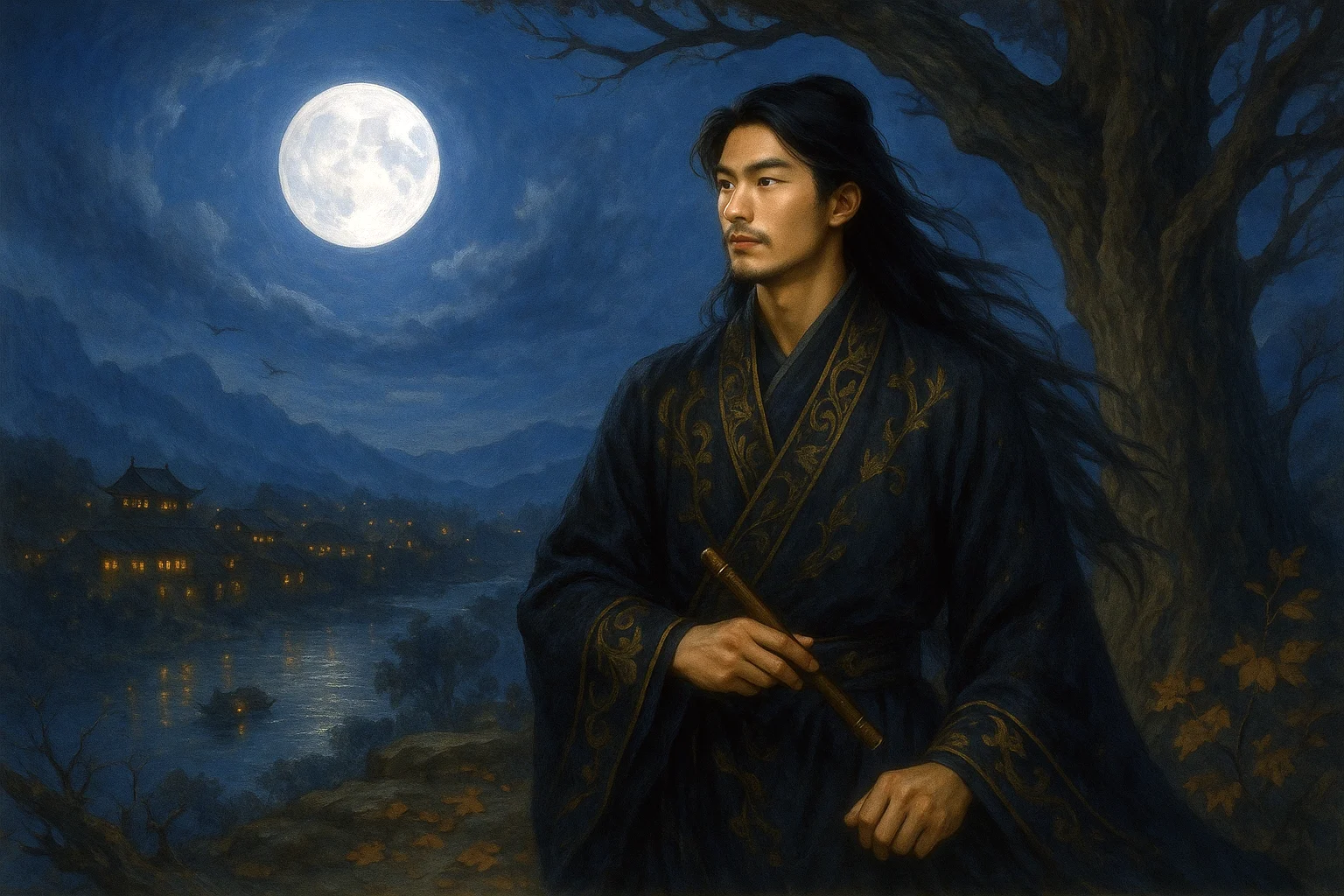
Li He (李贺 790 - 816), a native of Yiyang, Henan, was a Romantic poet of the Mid-Tang dynasty. A descendant of the Tang imperial clan, he was barred from taking the national jinshi civil service examination due to a naming taboo (his father's name contained a character homophonous with "Jin"), which led to a life of frustration and poverty. He died at the age of twenty-seven. His poetry, renowned for its bizarre grandeur, chilling elegance, and fantastical imagination, earned him the title "Ghost of Poetry." He pioneered the distinctive "Changji Style" within Tang poetry, exerting a profound influence on later poets like Li Shangyin and Wen Tingyun and on the expansion of poetic imagery in subsequent eras.