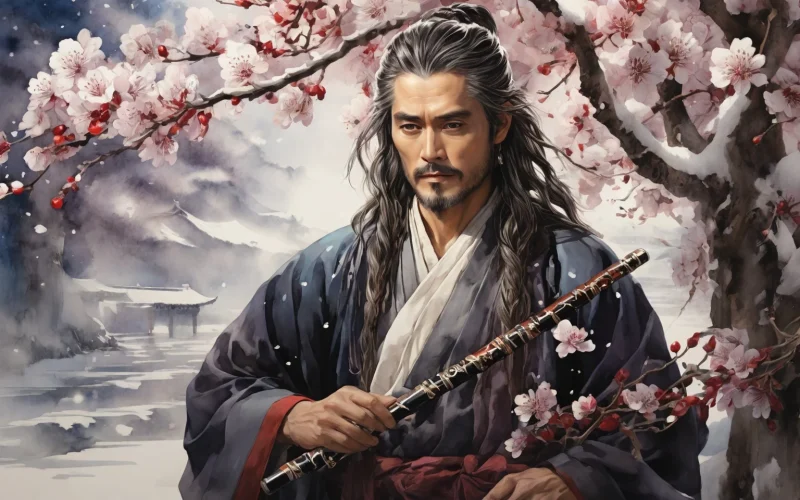
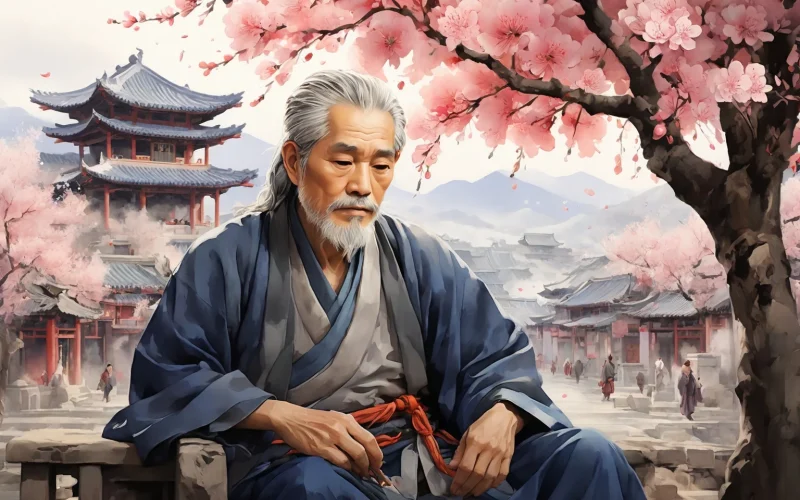
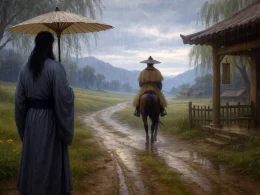
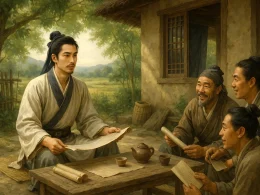
I've sharpened my sword for ten years;
I do not know if it will pierce.
I show its blade to you today.
O who has any grievance? Say!
Original Poem
「剑客」
贾岛
十年磨一剑,霜刃未曾试。
今日把示君,谁为不平事?
Interpretation
This poem was composed by the Tang Dynasty poet Jia Dao, likely during his period of hardship in Chang'an after returning to secular life. Jia Dao became a monk in his youth, taking the Dharma name "Wuben" (Without Origin). Later, encouraged by Han Yu, he returned to secular life, but his official career was fraught with difficulty, marked by repeated examination failures and a life of poverty. He possessed a desire to serve the world, yet was never able to fulfill this wish; his heart was filled with the frustration and longing of one who has "forged a sword for ten years" yet has "never put it to the test." The "sword" in classical poetry often symbolizes talent and ambition. In this poem, Jia Dao uses the sword as a metaphor for himself: "forging a sword for ten years" subtly alludes to his years of dedicated self-cultivation and arduous discipline, while "never put it to the test" expresses the anguish of unrecognized talent and having no avenue to serve his country. Yet, the poem carries no air of dejection. Instead, in the bold declaration of "Today I hold it out to you, my lord," it reveals a powerful confidence and yearning—he awaits only an opportunity, a chance for this "frost-like blade" to prove its edge.
Regarding this poem, there have traditionally been two interpretations: "declaring one's aspiration" and "seeking patronage." Some say the poet used this poem to state his own ambition, expressing his desire to apply his talents; others say it was a work of self-recommendation presented to a certain dignitary or examiner, using the sword as a metaphor to earnestly request a chance to prove himself. Regardless of the interpretation, the poem's surging heroic spirit and its sense of responsibility in asking "Where is a cause that cries for redress?" are enough to stir the blood.
First Couplet: "十年磨一剑,霜刃未曾试。"
Shí nián mó yī jiàn, shuāng rèn wèi céng shì.
For ten long years I sharpened this one sword;
Its frost-like blade has never been put to the test.
The poem opens by juxtaposing "ten years" and "one sword," creating a powerful tension between the vast span of time and the singularity of the result. The five characters "for ten long years I sharpened this one sword" convey not only the hardship and duration of the forging but also subtly imply the poet's confidence in his own talent—this sword is the fruit of ten years' effort, no ordinary thing. The next line, "Its frost-like blade has never been put to the test," uses "frost" as a metaphor for the blade's sharpness, chillingly cold; "never been put to the test" points out the regret that, though the sword is complete, it has never had a chance to show its edge. These three words, "never been put to the test," are precisely a portrayal of the poet's own situation: years of disciplined study, a mind full of talent, yet forever confined to a lowly post, with no path to serve his country.
Second Couplet: "今日把示君,谁为不平事?"
Jīnrì bǎ shì jūn, shuí wèi bùpíng shì?
Today I hold it out to you, my lord, and ask:
Where is a cause that cries for redress?
This couplet shifts from building tension to explosive release, the emotion suddenly soaring. "Today I hold it out to you, my lord"—the poet has finally found an opportunity for display; he solemnly presents this sword, embodying ten years of effort, before "you, my lord." This "lord" might be a discerning dignitary, an examiner, or perhaps fate itself. The word "hold" conveys solemnity and anticipation; the word "out" conveys confidence and composure. The next line, "Where is a cause that cries for redress?" is even more heroic. The poet is willing to take up this sword and stand up for all injustice in the world. This "injustice" refers both to societal unfairness and to the inequity within his own heart; it is both the lofty sentiment of championing justice and the desire for self-realization.
Holistic Appreciation
This poem stands unique among Jia Dao's works. Unlike his typically serene, secluded, and deeply Zen-inspired poems, this piece uses the sword to declare ambition, displaying a heroic, unrestrained side of the poet's character rarely seen.
Structurally, the poem presents a clear progression of "building tension—explosive release." The first two lines build tension with "ten years" and "never been put to the test," fully conveying the hardship of forging and the regret of unrecognized talent. The last two lines release with "today" and "where is," fully expressing the desire to display and the heroism of responsibility. Between the four lines, the mood shifts from restrained to expressive, from stillness to action, the emotion building layer by layer until the climax.
Conceptually, the poem's core lies in the interplay between "testing" (试) and "injustice" (不平事). The sword is forged to test its edge; ten years of painstaking effort exist for the sake of applying one's talent. And what this "test" targets is not trivial—it is the world's "injustice." In this way, personal ambition becomes intertwined with the quest for justice, endowing the poem with profound social meaning.
Artistically, the poem's most moving aspect lies in the aptness of its "using an object to metaphorize a person" and the skill of its "using simplicity to control complexity." The correspondence between sword and person is meticulous: forging the sword symbolizes self-cultivation, the frost-like blade symbolizes talent, "never been put to the test" symbolizes unrecognized talent, "hold it out to you" symbolizes self-recommendation for office, and "injustice" symbolizes social ideals. In just twenty characters, it expresses complex life circumstances and inner longings completely, with no superfluous words, no extraneous strokes.
Artistic Merits
- Using Objects to Express Aspirations, Profound Allegory: Using the sword to metaphorize the person, forging the sword to symbolize self-cultivation, testing the sword to symbolize applying one's talent—abstract ambition is given concrete, tangible form. Object and self become one; allegory feels natural.
- Concise Language, Intense Emotion: The entire poem is twenty characters, with no superfluous words, yet it contains the hardship of ten years of forging, the regret of never being tested, the anticipation of today's display, and the heroic spirit of wishing to right wrongs. Brevity yields comprehensiveness; each word carries immense weight.
- Vivid Contrast, Full of Tension: The contrast between the time of "ten years" and the result of "one sword"; the emotional tension formed between the regret of "never been put to the test" and the anticipation of "today I hold it out." Deep feeling resides in the contrast; heroic spirit is revealed in the tension.
- Concluding with a Question, Enduring Resonance: The final line, "Where is a cause that cries for redress?" concludes with a question, both displaying the poet's heroism and sense of responsibility and leaving the question for the reader to ponder. A single question concludes, its resonance infinite.
- Heroic and Confident, Unyielding in Spirit: The confidence and heroic spirit suffusing the poem are rare in Jia Dao's work, revealing a robust, vigorous side of the poet's character. Heroism reveals strength of character; confidence reveals nobility of spirit.
Insights
This poem, with the sustained perseverance of "十年磨一剑" and the fervent passion of "今日把示君", reveals the life wisdom of profound cultivation and awaiting the right moment. It shows us the value of accumulation over time. True brilliance always requires years of dedicated refinement and tempering. The poet uses "十年" as a measure, weighing the substance of an ideal. It tells us: before reaching the destination lies a long period of silence and self-formation; only by enduring the solitude of the "磨剑" process can one, when opportunity arrives, let the "霜刃" reveal its awe-inspiring edge.
The candid openness of "今日把示君" and the probing question of "谁为不平事" then demonstrate an active stance in transitioning from "building potential" to "serving the world." The poet never doubted himself despite his blade having "未曾试"; his confidence was only strengthened through long preparation. He did not wait passively but actively sought the moment to "示君", intimately linking personal ambition with a concern for "不平事". This reminds us: true preparation involves not only inward honing but also the outward search for a stage; true aspiration inevitably carries a sense of care and responsibility for the world.
Finally, the poem outlines a complete journey of life: from the deep cultivation of "十年磨一剑", to the latent dormancy of "霜刃未曾试", to the assertive advance of "今日把示君", culminating in the questioning and pursuit of "谁为不平事". It gives us this conviction: everyone is potentially a sword being tempered. The long forging may be lonely, the moment for "亮相" (stepping into the light) may be elusive, but as long as one's resolve remains keen as the "霜刃", and one's heart holds that question of injustice, one will ultimately, in one's own time, unleash the light that cuts through the fog.
Poem translator
Xu Yuanchong (许渊冲)
About the Poet

Jia Dao (贾岛 779 - 843), a native of the vicinity of present-day Beijing, was a renowned poet of the Mid-Tang dynasty. In his early years, he became a Buddhist monk under the dharma name Wuben. Later, he returned to lay life to sit for the imperial examinations, but never passed them throughout his life. In his later years, he served as Registrar of Changjiang County, earning him the sobriquet "Jia Changjiang." He was famous for his "painstaking composition" (ku yin), and together with Meng Jiao, they were known as "Meng's cold, Jia's thinness." His poetry pursued meticulous refinement of every word and line. His poems often depict desolate, barren, and lonely landscapes, excelling in the five-character regulated verse form. He exerted a profound influence on later "painstaking" poets such as Li Dong of the Late Tang and the "Four Lings" of the Southern Song.