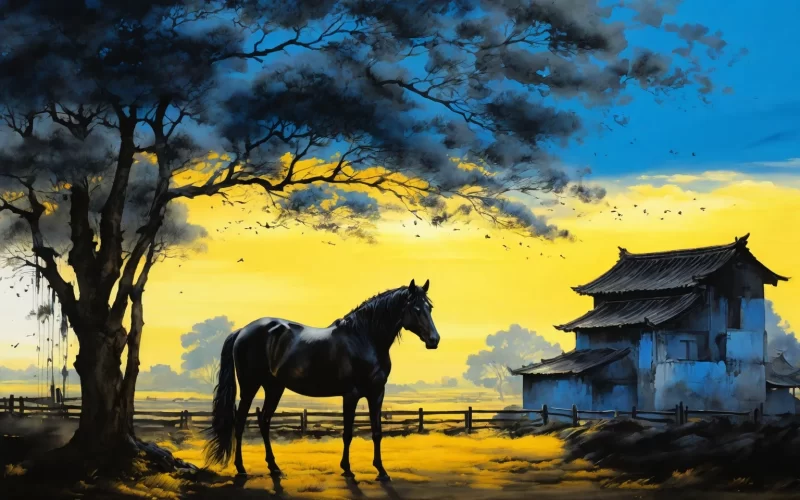

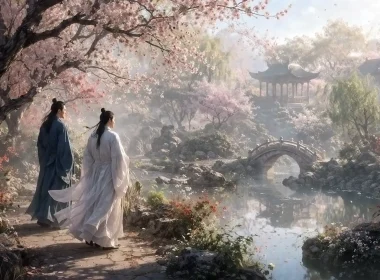
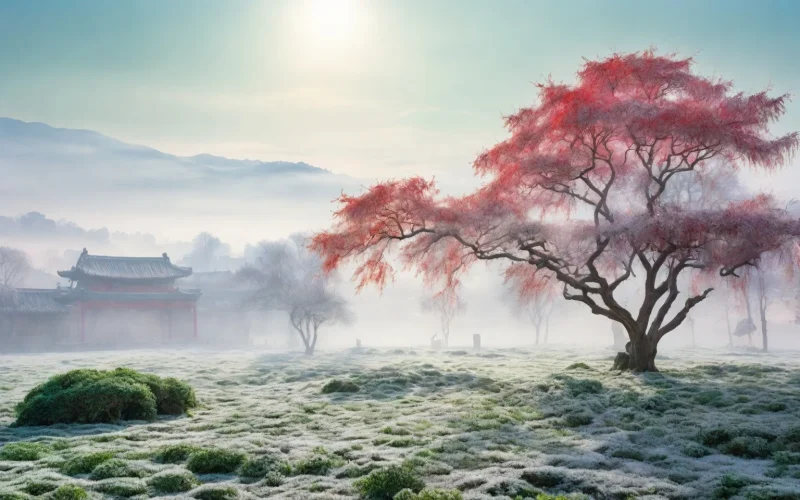
O faint and ruddy light, that from the sun’s low foot doth spill
In a moist, trembling sprinkle, while — beneath the laurel’s bough —
A thin frost, undissolved, upon the chilly branches lies still.

Yet a dim warmth, a breath almost, begins to disallow
The Winter’s rigid frown; and now the lengthening Day has won
His leave from the long Night — their ancient, silent treaty done.
Original Poem
「河南府试十二月乐词」
李贺
日脚淡光红洒洒,薄霜不销桂枝下。
依稀和气排冬严,已就长日辞长夜。
Interpretation
This poem was composed by the mid-Tang poet Li He and is one piece from a series of poems. Li He's life was brief; he died young at the age of twenty-seven, yet with his uniquely extraordinary and magnificent poetic style, he carved a distinct niche in the poetic world, earning the name "Ghost of Poetry." This series was written for the Henan Prefectural Examination; it consists of twelve poems celebrating each month, depicting the seasonal changes throughout the year.
Li He possessed exceptional talent, yet because his father's name, "Jinsu," sounded similar to "jinshi" (進士, presented scholar), he was slandered and forced to abandon the imperial examinations, living a life of frustration and unfulfilled ambitions. However, in this series of examination poems, he does not reveal any resentment. Instead, with keen observation, he captures the subtle transformations in the natural world, rendering the flow of seasons and solar terms with freshness and vitality. This poem celebrates the winter scene of the twelfth lunar month—the early morning light first shines, the thin frost has not yet melted, the cold remains, yet the gradual lengthening of days and shortening of nights quietly heralds the impending arrival of spring.
In classical poetry, winter is often depicted with emphasis on its harsh cold and desolation. Li He's poem, however, offers a unique perspective: within the "pale light" and "thin frost" of a winter morning, he captures the subtle turning point of "a mild air drives off winter's strictness," and in the alternation of "long day takes leave of the long night," he places his hope for the changing seasons, for winter's departure and spring's arrival. This technique of finding warmth within the cold, vitality within stillness, is precisely the embodiment of the unique charm of Li He's poetry.
First Couplet: "日脚淡光红洒洒,薄霜不销桂枝下。"
Rì jiǎo dàn guāng hóng sǎ sǎ, báo shuāng bù xiāo guì zhī xià.
The sun's feet cast a pale, reddish glow, streaming wide;
Beneath the cassia boughs, a thin frost does not subside.
The opening line personifies sunlight with the phrase "the sun's feet," as if the sun walks slowly forth—novel and vivid. The five characters "pale, reddish glow, streaming wide" supremely capture the characteristic of winter morning light: soft, with a faint reddish hue, unlike summer's intensity or autumn's clarity, but a kind of gentle, lazy brightness. The reduplicated "streaming wide" (洒洒) not only depicts the vast spread of sunlight but also lends a dynamic quality to the scene. The next line, "Beneath the cassia boughs, a thin frost does not subside," shifts the gaze from sky to ground. The un-melted thin frost beneath the cassia branches indicates the season is deep winter, the morning chill not yet retreated. These two characters, "does not subside" (不销), form a subtle contrast with the "pale light" above—sunlight has arrived, yet frost remains unmelted, precisely the distinctive scene of a winter morning: light coexists with cold, warmth wrestles with winter's severity.
Second Couplet: "依稀和气排冬严,已就长日辞长夜。"
Yīxī héqì pái dōng yán, yǐ jiù cháng rì cí cháng yè.
A mild air, vague and faint, drives off winter's strictness;
Already the long day takes leave of the long night's stillness.
This couplet shifts from the visual to the tactile and sensory, moving from the immediate scene to the deeper changes of the seasons. "A mild air, vague and faint, drives off winter's strictness"—the two characters "vague and faint" (依稀) are wonderfully apt, conveying that this warmth does not come rushing in but is elusive, indistinct, requiring attentive perception. The character "drives off" (排) is especially refined and forceful, as if the faint mild air is engaging in a silent struggle with winter's severity; though still temporarily at a disadvantage, it is quietly advancing. The next line, "Already the long day takes leave of the long night's stillness," uses the change in day and night length to indicate the winter solstice has passed, the yang energy is beginning to grow. The character "takes leave of" (辞) personifies the night, as if the long night is reluctantly saying farewell, while the daytime gradually returns. This line is both descriptive and symbolic—the long night will eventually pass, light will eventually come.
Holistic Appreciation
This is an excellent work by Li He on the theme of natural phenomena. The entire poem, four lines and twenty-eight characters, takes the winter morning as its point of entry, blending visual light and shadow, tactile temperature, and seasonal change, demonstrating the poet's keen observation and profound insight into natural phenomena.
Structurally, the poem presents a progressive layering from outer to inner, surface to depth. The first couplet describes what is seen—sunlight streaming, frost unmelted—the external scene. The second couplet describes what is felt—the mild air subtly rising, day and night alternating—the internal realization. Between the four lines, it moves from scene to emotion, from emotion to principle, deepening layer by layer, forming a seamless whole.
Conceptually, the poem's core lies in the character for "change" (变). A winter morning is inherently a time of cold and stillness, yet the poet captures within it signs of change: though the sunlight is pale, it is already dispelling the darkness; though the mild air is faint, it is already driving off the cold; though the day is short, it is already gradually lengthening. This vision of perceiving change within constancy, movement within stillness, reflects the poet's deep grasp of natural laws and subtly conveys philosophical reflections on life.
Artistically, the poem's most moving aspect is its "revealing the vast through the minute." The poet does not describe winter's biting wind or swirling snow; he writes only of a wisp of pale morning light, a layer of thin frost, a hint of vague mild air, a slight lengthening of the day. Precisely these minute details constitute the true markers of seasonal transition. This technique of seeing the large in the small, knowing the significant from the subtle, is the highest realm in classical Chinese poetry where "a single flower reveals a world."
Artistic Merits
- Keen Observation, Precise Capture: Descriptions like "the sun's feet cast a pale, reddish glow," "thin frost does not subside," and "mild air, vague and faint" accurately capture the unique atmosphere of a winter morning, impossible to convey without personal experience. Skill is seen in the minute; talent is revealed in precision.
- Refined Diction, Rich Connotation: The character "drives off" (排) portrays the struggle between mild air and winter's severity; "takes leave of" (辞) depicts the alternation of night and day. Within a single character lies infinite tension. Each word carries great weight, inviting contemplation.
- Combination of Movement and Stillness, Clear Layers: The sunlight "streaming wide" is movement; the frost "does not subside" is stillness. The mild air "driving off" is movement; the long night "taking leave" is movement within stillness. Movement and stillness beget each other; the layers are rich.
- Using Scene to Convey Principle, Subtle and Lasting: Through the change in day and night length, the poem subtly contains the natural law of seasonal change, winter's departure and spring's arrival, and also places philosophical reflections on life's circumstances. Principle resides within the scene; emotion is contained within the principle.
- Fresh Language, Serene and Profound Artistic Conception: The entire poem contains no obscure phrases, yet it exhaustively portrays the tranquility and vitality of a winter morning. Reading it is like bathing in morning light, as if present in the scene. Profound meaning is found within freshness; a sublime realm is revealed within serenity.
Insights
This poem, through the subtle changes of a winter morning, speaks of the natural law of seasonal change, of winter's departure and spring's arrival, and offers profound insight. It teaches us to discover signs of warmth within the cold. Facing a winter morning, the poet does not complain of the cold but keenly captures that "vague and faint" mild air, perceives the change of lengthening days. This vision of seeing hope within difficulty, perceiving vitality within stillness, is precisely the mindset we most need when facing the low points in life. It enlightens us: No matter what "winter's strictness" we find ourselves in, as long as we perceive carefully, we can always discover the existence of that "vague and faint mild air"; no matter how long a "long night" we experience, as long as we wait patiently, the arrival of the "long day" will eventually come.
The imagery of "已就长日辞长夜" leads us to contemplate the dialectical relationship between "farewell" and "welcome." The long night takes its leave, the long day returns—this is the law of nature, yet the poet also imbues it with emotional color. Every farewell implies a new beginning; every ending heralds a new departure. It tells us: Every "farewell" in life is for a better "arrival"; every loss may nurture a new gain. Just as winter gives way to spring, just as dawn must follow the night.
On a deeper level, this poem also shows us another side of Li He beyond the "Ghost of Poetry." Those magnificent, extraordinary poems are indeed astonishing; but this small, fresh, natural, subtle, and profound poem equally reveals another realm of his as a poet—one who could both soar to the heavens and plumb the depths, giving free rein to imagination, and also quietly observe all things, perceiving with utmost subtlety. It enlightens us: True talent lies not only in the ability to write startling, extraordinary works, but also in discovering the most profound poetry within the most ordinary scenes.
Poem translator
Xu Yuanchong (许渊冲)
About the Poet
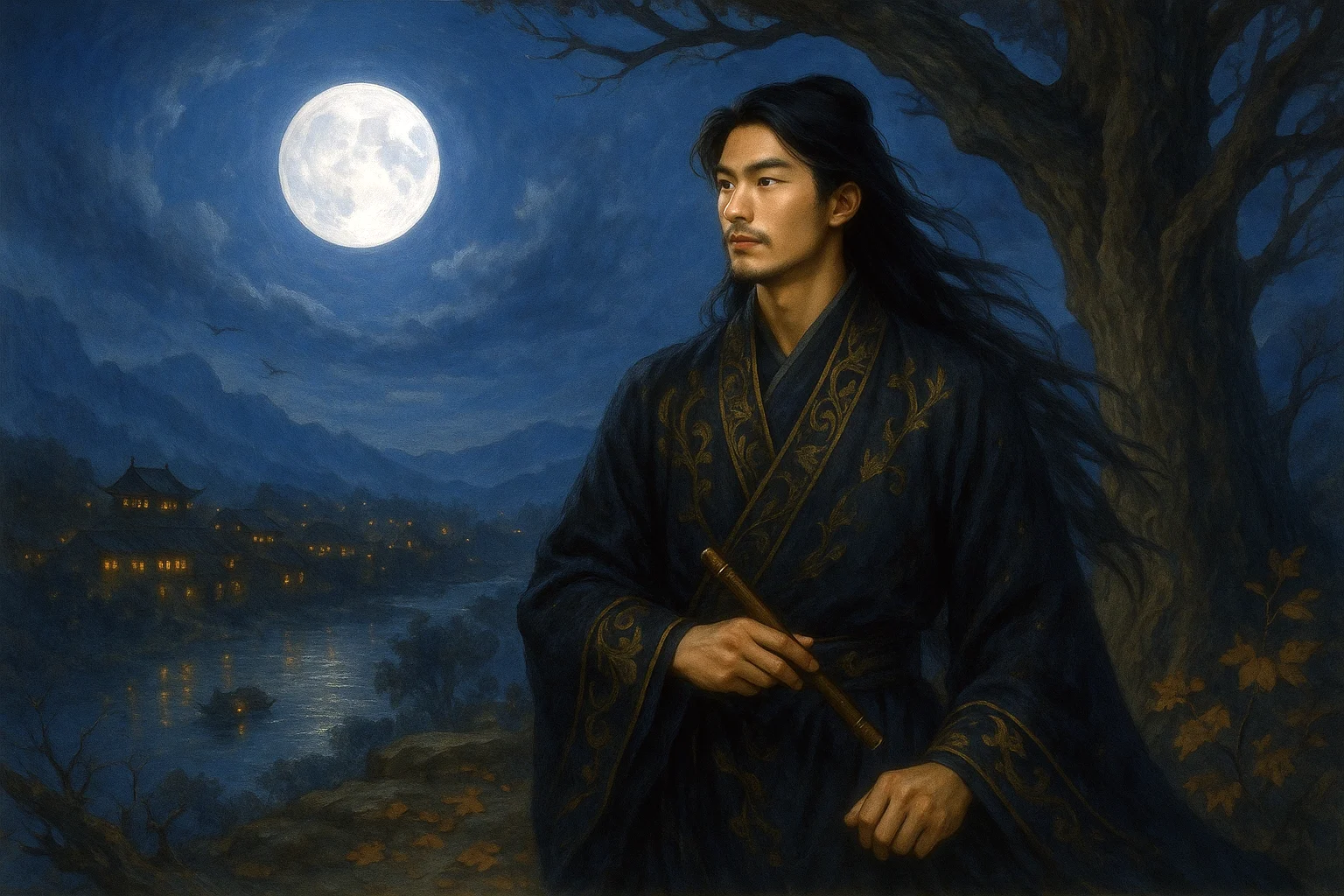
Li He (李贺 790 - 816), a native of Yiyang, Henan, was a Romantic poet of the Mid-Tang dynasty. A descendant of the Tang imperial clan, he was barred from taking the national jinshi civil service examination due to a naming taboo (his father's name contained a character homophonous with "Jin"), which led to a life of frustration and poverty. He died at the age of twenty-seven. His poetry, renowned for its bizarre grandeur, chilling elegance, and fantastical imagination, earned him the title "Ghost of Poetry." He pioneered the distinctive "Changji Style" within Tang poetry, exerting a profound influence on later poets like Li Shangyin and Wen Tingyun and on the expansion of poetic imagery in subsequent eras.