


Preparing me chicken and rice, old friend,
You entertain me at your farm.
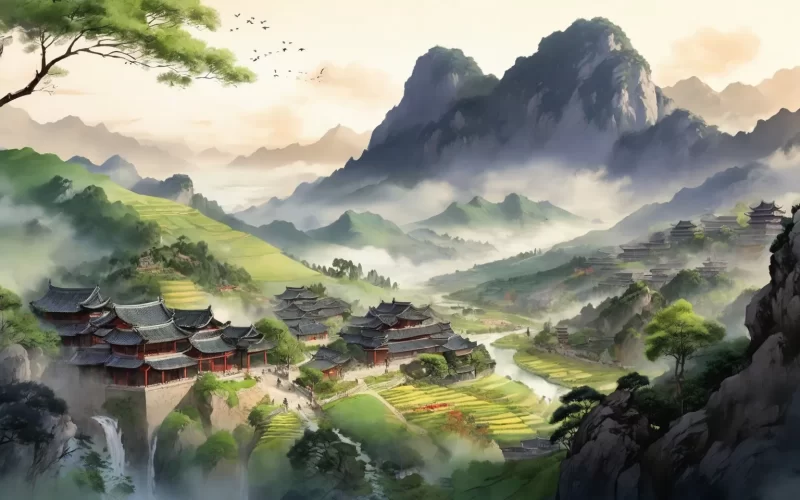
We watch the green trees that circle your village
And the pale blue of outlying mountains.

We open your window over garden and field,
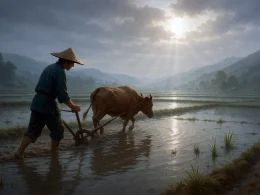
To talk mulberry and hemp with our cups in our hands.
...Wait till the Mountain Holiday --
I am coming again in chrysanthemum time.
Original Poem
「过故人庄」
孟浩然
故人具鸡黍,邀我至田家。
绿树村边合,青山郭外斜。
开轩面场圃,把酒话桑麻。
待到重阳日,还来就菊花。
Interpretation
This poem was composed after Meng Haoran had definitively retired to Xiangyang; the specific year is uncertain. Judging by the poem’s atmosphere, it likely dates from after 730 CE, the final stage of his life following his failure in Chang’an, his wanderings in Wu and Yue, and his ultimate return to Lumen Mountain.
This is a Meng Haoran free from thoughts of service at the "northern gate" and sighs of "longing to cross" the river. He is no longer the office-seeker lamenting "silent, silent—what is there left to await?", nor the drifting traveler who would "send two lines of tears borne by the stream," nor the destitute man whose "gold is all spent." He is simply a commoner outside Xiangyang, in the Lumen hills. An old friend lives in a neighboring village, prepared a meal of chicken and millet, and invited him to visit. The identity of this "old friend" is unknown. From the allusion in "prepared chicken and millet" in the poem, we know Meng Haoran is comparing this friendship to that of the Eastern Han figures Fan Shi and Zhang Shao—Fan Shi promised to visit Zhang Shao in two years, whereupon Zhang asked his mother to "kill a chicken and prepare millet" to await him; when the appointed time arrived, Fan Shi indeed came. This is one of the oldest pledges of friendship in Chinese literary history, with "chicken and millet" as its token and "trust" as its foundation. Meng Haoran infuses this weighty cultural memory into an ordinary invitation to a farmhouse.
He accepts the invitation, enjoys wine and conversation, and upon parting makes plans for the next gathering—on the Double Ninth Festival, to admire the chrysanthemums. The poem concludes, and the appointment is set. This is not a parting poem, not a poem of longing, not a poem seeking patronage, not a poem reflecting on history. It is simply a record of a visit, a testament to a meal. Yet precisely this poem became the pinnacle of Chinese pastoral poetry, the terminus of Meng Haoran's lifelong spiritual journey.
First Couplet: "故人具鸡黍,邀我至田家。"
Gùrén jù jī shǔ, yāo wǒ zhì tián jiā.
My old friend prepared chicken and millet, / And invites me to his farmhouse.
The opening is simple and plain, like ordinary conversation. "Chicken and millet" represents the finest hospitality a farming family can offer—not costly, yet solemn. It is not exotic delicacies or lavish feasts, but taking the grains they grew and the fowl they raised to make a meal placed before a guest. This solemnity lies not in pomp, but in sincerity. "Invites me to his farmhouse"—five words explain the entire origin of this visit. The poet is the invited one, the guest; yet within the poem, he shows none of a guest's formality, none of the polite phrases like "imposing" or "feeling ashamed." He simply came as invited, as if keeping an appointment destined to be kept.
This couplet uses an allusion without seeming allusive. Fan Shi and Zhang Shao's "chicken and millet pact" is the most sacred pledge of friendship in Chinese history; yet Meng Haoran writes of it as if it were merely a casual visit between neighbors. This represents the supreme achievement of his late poetic style: infusing a millennia-old allusion into a simple meal.
Second Couplet: "绿树村边合,青山郭外斜。"
Lǜ shù cūn biān hé, qīng shān guō wài xiá.
Green trees close in on the village, / Blue hills slant beyond the city wall.
This couplet describes the topography of the farm's location, yet it contains the poem's least "realistic" lines. "Close in" describes how the green trees embrace the village—not in straight rows, not scattered randomly, but gathering from all sides to shelter the village in their arms. This is a spatial contraction—the gaze moves from distant to near, settling on this habitation encircled by greenery. "Slant" describes the posture of the blue hills—not towering majestically, not sheer cliffs, but reclining gently, leisurely, on the horizon. This is a spatial expansion—the view pushes outward from the village to the distant hills like dark eyebrows, a wash of faint ink on the sky's edge.
"Close in" and "slant," one contracting, one expanding, together form the complete aura of this pastoral scene: a sense of sheltered security, coupled with an open vista gazing into the distance. Before the poet even touches on human warmth, this land already feels reassuring.
Third Couplet: "开轩面场圃,把酒话桑麻。"
Kāi xuān miàn cháng pǔ, bǎ jiǔ huà sāng má.
Opening the window facing fields and gardens; / Holding wine, we talk of mulberries and hemp.
This couplet presents the most classic depiction of a pastoral scene in pastoral poetry. "Opening the window" is an action, performed by host or guest; it is also the poem's pivot from outward to inward—the previous couplet offers a distant view of village edge and outer wall; this couplet brings a close-up of gardens before the window; the former is a tranquil contemplation of heaven, earth, mountains, and rivers; the latter is the stirring vitality of human life. "Facing fields and gardens": the word "facing" does not mean gazing from afar through the window; it means directly opposite, oriented towards. Opening the window brings the threshing grounds and vegetable gardens right to the mat. This is not architectural truth, but psychological truth—when one truly integrates into pastoral life, there is no longer distance between oneself and the land.
"Talk of mulberries and hemp" is the true emotional anchor of the entire poem. They do not discuss official careers, poetry, or old tales of Chang'an. They simply chat about this year's growth of mulberry leaves, the hemp harvest, whether the rains have been timely. To those pursuing fame, such topics seem trivial; in Meng Haoran's hands, they become the highest form of spiritual dialogue. Because the premise of "talking of mulberries and hemp" is having completely let go of Chang'an. Only one who no longer awaits a ferry can peacefully discuss the crops on the shore.
Fourth Couplet: "待到重阳日,还来就菊花。"
Dài dào Chóngyáng rì, hái lái jiù jú huā.
Until the Double Ninth Festival comes round again, / I'll come back for the chrysanthemums.
The conclusion is an appointment. It is not the polite formula of a lingering farewell, nor the vague "we'll meet again someday." The poet says earnestly: Until the Double Ninth Festival comes round again, I'll come back for the chrysanthemums. "Come back" is an active promise, not a passive acceptance of an invitation. He is no longer an invited guest; he is already a returnee to this pastoral life. The word "for" (lit. "go to/approach") is the poetic eye of the entire poem. It is not "look at," not "admire," not "view." It is "for"—to go near, to move towards, to actively approach. The chrysanthemums are there; the poet wishes to walk over, sit beside them, sit facing them, drink with his old friend. Within this verb lies Meng Haoran's complete active choice of pastoral life. He did not come because he had nowhere else to go; he came because he wanted to, intended to, and will come again next time.
The Double Ninth Festival is a holiday for ascending heights, for remembrance, for wearing dogwood and drinking chrysanthemum wine. Yet in Meng Haoran's appointment, there is no ascent, no gazing afar, no remembrance—because he is already seated at the same table as the object of remembrance. All he intends is, on the next festival day, to keep another appointment, push open that window again, face that garden again, raise that cup again.
Holistic Appreciation
This is Meng Haoran's shortest masterpiece and the highest peak of Chinese pastoral poetry. The astounding quality of this poem lies in its utter absence of contradiction. There is no tension between official service and reclusion, no strain between ideal and reality, no indignation at unrecognized talent, no sorrow of unfulfilled longing, no anguish of decisive departure. It is merely a visit, a meal, a conversation, an appointment.
In forty characters, Meng Haoran achieves the ultimate transcendence of his lifelong spiritual predicament. He no longer needs to choose, because he has arrived; he no longer needs to struggle, because he has let go; he no longer needs to prove, because he is settled.
This was not written on the road from Chang'an to Xiangyang, nor on a boat drifting in Wu and Yue, nor on some sleepless night awaiting dawn. It was written on a certain day after his retirement, invited to a meal at a farmhouse, seated by his old friend's window, facing the gardens, raising a cup of wine, chatting idly of mulberries and hemp. The green trees and blue hills outside the window needed no explanation; the chicken, millet, and rustic wine inside needed no elaboration; the chrysanthemum appointment for Double Ninth needed no justification. He was already living within it.
Artistic Merits
- The Ultimate Realm of Having "Nothing to Write About": The entire poem lacks dramatic conflict, emotional climax, or philosophical升华. It merely records an utterly ordinary visit to a farmhouse. Yet precisely this quality of having "nothing to write about" constitutes Meng Haoran's highest poetic achievement—when life itself is sufficiently complete, poetry need only present it faithfully.
- The Emotional Valuation System of Verbs: "Prepared," "invites," "to," "close in," "slant," "opening," "facing," "talk," "until," "come back," "for"—the poem's eleven verbs contain none that are impassioned, sorrowful; all are calm, quotidian actions oriented towards daily life. These verbs form a fine mesh, weaving the poet firmly together with his old friend, with the pastoral scene, with the chrysanthemums.
- Layered Spatial Construction: The first couplet presents the action of arrival ("to"); the second offers the distant view ("village edge…city wall"); the third brings the close-up ("fields and gardens…window"); the fourth concludes with the appointment ("come back for"). Space contracts from far to near, from outward to inward, from geography to psyche, ultimately converging on the minuscule action of "for the chrysanthemums." This is classical Chinese poetry's most classic spatial composition.
- The Circular Promise of Time: The poem begins with "invites me to" and ends with "come back for"; time does not flow linearly but forms a circle connecting beginning and end. This meal concludes, but the next is already appointed. Meng Haoran did not come just once; he intended to come often from then on.
- Seamless Integration of Allusion: "Chicken and millet" is the millennial symbol of the friendship between Fan Shi and Zhang Shao; "Double Ninth" is the seasonal ritual of ascending heights and remembering kin; "chrysanthemums" is the spiritual emblem of Tao Yuanming's "picking chrysanthemums by the eastern hedge." Meng Haoran dissolves these weighty cultural allusions entirely into an ordinary farmhouse appointment, imbuing the quotidian with the weight of the canonical, and the canonical with the warmth of the quotidian.
- Subtle Reversal of Host-Guest Dynamics: The title is "At the Old Friend's Farm"; the poet is the guest. Yet the final line, "come back for," shows the poet as the one actively making the appointment. From "invites" to "for," from passive to active, from guest to returnee—this shift in identity goes unstated yet is completely written within the forty characters.
Insights
This work tells us: The highest poetry lies not in the distance, but in the place already reached. Meng Haoran spent a lifetime seeking a home. He waited in Chang'an's silence, drifted on Wu and Yue's misty waves, lamented in Qin's chilly winds, sat alone under Xiangyang's moon. He thought he was searching for some ultimate answer called "fame" or "reclusion." But sitting at his old friend's house, facing the gardens, talking of mulberries and hemp, making an appointment for Double Ninth—he suddenly discovered that what he sought had been waiting here all along.
This meal held nothing extraordinary. Chicken and millet were common fare; green trees and blue hills were common scenery; garden talk of mulberries and hemp was common conversation; Double Ninth chrysanthemums were a common appointment. Yet precisely this commonness constituted the fulfillment Meng Haoran never dared hope for in his life. Contemporary life is filled with imaginings of the "distance." We must travel farther, change to better jobs, meet more interesting people, live a life better than the present. We mortgage happiness to the future, project poetry onto distant places, yet remain blind to the people and things beside us in the present. Meng Haoran reminds us with this poem: If one cannot feel happiness in the common meal, the common window, the common view, then reaching any distance will never truly satisfy.
"…Wait till the Mountain Holiday -- I am coming again in chrysanthemum time."—This appointment is so simple, yet so solemn. It is not a grand plan for the future, merely a tender affirmation of the next reunion. Life does not require many distant places; it only needs a few such appointments. That evening a thousand years ago, Meng Haoran walked out from his old friend's farmhouse onto the path back to Lumen Mountain. He took nothing with him, only an appointment. He knew that in a little over twenty days, he would walk the same path, enter that gate again, push open that window, sit in the same seat, raise the same cup.
That was not repetition. It was his finally finding the place where he belonged. The green trees still close in on the village; the blue hills still slant beyond the wall. The old friend prepares chicken and millet each year; the Double Ninth chrysanthemums bloom each autumn. He merely keeps the appointment on time.
Poem translator
Kiang Kanghu
About the poet
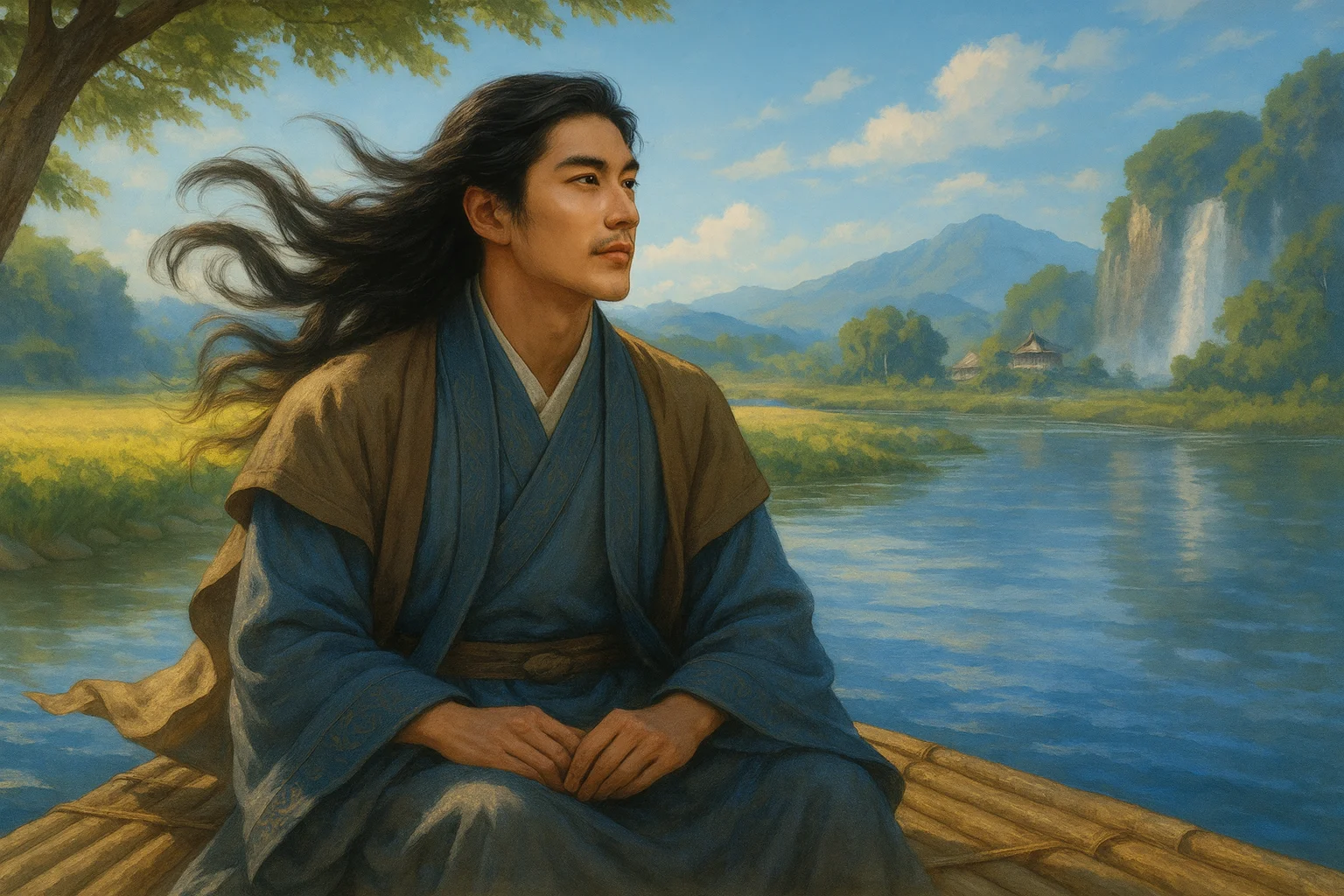
Meng Haoran (孟浩然), 689 - 740 AD, a native of Xiangyang, Hubei, was a famous poet of the Sheng Tang Dynasty. With the exception of one trip to the north when he was in his forties, when he was seeking fame in Chang'an and Luoyang, he spent most of his life in seclusion in his hometown of Lumenshan or roaming around.