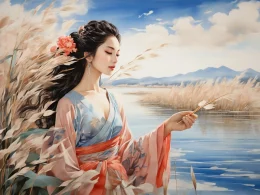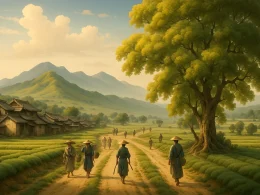



Your grasses up north are as blue as jade,
Our mulberries here curve green-threaded branches;
And at last you think of returning home,
Now when my heart is almost broken...
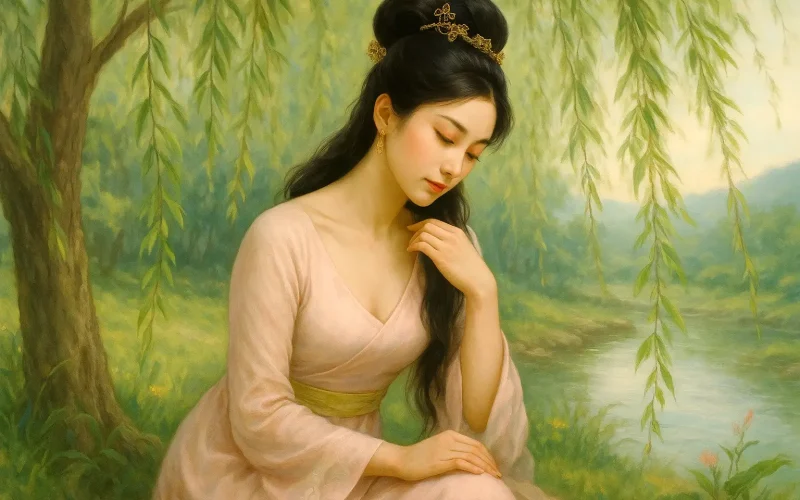
0 breeze of the spring, since I dare not know you,
Why part the silk curtains by my bed?
Original Poem
「春思」
李白
燕草如碧丝,秦桑低绿枝。
当君怀归日,是妾断肠时。
春风不相识,何事入罗帏?
Interpretation
Composed during the Tang Dynasty, the exact year of this poem's creation remains uncertain, yet its emotional core aligns with Li Bai's other works on the theme of longing wives, expressing the sorrow of separation. The poem depicts a young wife in Qin longing for her husband guarding the distant frontier in Yan. Using natural scenery as a thread, it contrasts the different spring landscapes of the two regions, employing the image of the "spring breeze" to convey the melancholy born of separation. This work is not merely a chant of love but also reflects the historical reality of forced separation between soldiers and their wives due to warfare.
First Couplet: "燕草如碧丝,秦桑低绿枝。"
Yān cǎo rú bì sī, Qín sāng dī lǜ zhī.
Yan's grass is like green silk thread; Qin's mulberry bows with leaves widespread.
This couplet opens with exquisite parallelism, painting a contrast of space and time. "Yan" and "Qin" mark the couple's separation, north and south. "Grass like silk" depicts the late arrival of spring in the north, with life just budding, hinting at the desolation of the soldier's environment and the uncertainty of his return; "mulberry bows with leaves" portrays Qin's lush, vibrant spring, highlighting the wife's loneliness amid abundance. Though purely descriptive, these lines subtly contain the tension of longing.
Second Couplet: "当君怀归日,是妾断肠时。"
Dāng jūn huái guī rì, shì qiè duàncháng shí.
Just when you first think of homecoming, Is the moment my heart starts breaking.
The poet shifts directly from scene to emotion, deepening the theme through extreme psychological contrast. Just as the soldier begins to miss home, the wife has long endured torment. "Heart starts breaking" conveys intense anguish, hinting at the prolonged, hopeless nature of her wait. This line reveals the emotional and temporal asymmetry of separation, emphasizing the depth and sorrow of the wife's devotion.
Third Couplet: "春风不相识,何事入罗帏?"
Chūnfēng bù xiāngshí, hé shì rù luówéi?
Spring breeze, we are not acquainted; Why intrude my silk curtain, fate-tinted?
The final couplet constitutes the poem's affective climax, wherein the poet endows the spring breeze with consciousness through a tenderly rhetorical question. By nature an unconscious force, the breeze becomes an unwelcome presence that stirs melancholy and violates the quietude of her inner world. The "silk curtain" represents the boundary of private intimacy, and the breeze's infiltration signifies both literal movement and a symbolic trespass—as the burgeoning life of spring confronts her isolated spirit. The question's poignant irrationality masterfully conveys the wife's intensifying solitude within the season's beauty and the steadfastness of her devotion.
Holistic Appreciation
This poem is a gem among Li Bai's five-character quatrains, showcasing his mastery of conveying profound feeling through subtlety and containing emotional waves within simplicity. The structure is exquisite: the first two lines begin with scenery, implying contrast; the middle two express emotion directly; the final two conclude with scenery, leaving lasting resonance. The poet skillfully uses the phenological difference between "Yan's grass" and "Qin's mulberry" to construct immense temporal-spatial tension, allowing personal longing to carry the universal sorrow of separation. The language is fresh and natural, without artifice, yet it vividly depicts the wife's delicate, deep, and complex emotions.
Artistic Merits
- Exquisite Use of Contrast: The poem contains multiple layers—north-south geographical contrast, early-late seasonal contrast, sequential emotional contrast, and internal-external psychological contrast—each intensifying emotional expression.
- Pivotal Personification: The closing address to the spring breeze is the poem's stroke of genius. It materializes abstract emotion, making the wife's loneliness, melancholy, and fidelity leap from the page with enduring resonance.
- Concentrated Language and Tension: At only thirty characters, every word serves a purpose. "Heart starts breaking" conveys utter pain; "why intrude" questions infinite sorrow, reflecting Li Bai's highly condensed, richly suggestive poetic language.
Insights
Though composed a millennium ago, this work articulates an eternal human dilemma: the torment and endurance of the heart between love and separation, hope and loss. It shows us that genuine emotion can penetrate barriers of time and space, becoming purer through waiting. The wife's emotion is not merely plaintive but active and resilient—her vigilance and query toward the breeze "intruding my silk curtain" are, in essence, an oath of absolute fidelity. In our era, where distance has shrunk through transport and communication yet emotional divides persist, this poem reminds us: the deepest longing springs from the truest feeling; the longest wait merits the most beautiful perseverance.
Poem translator
Kiang Kanghu
About the poet
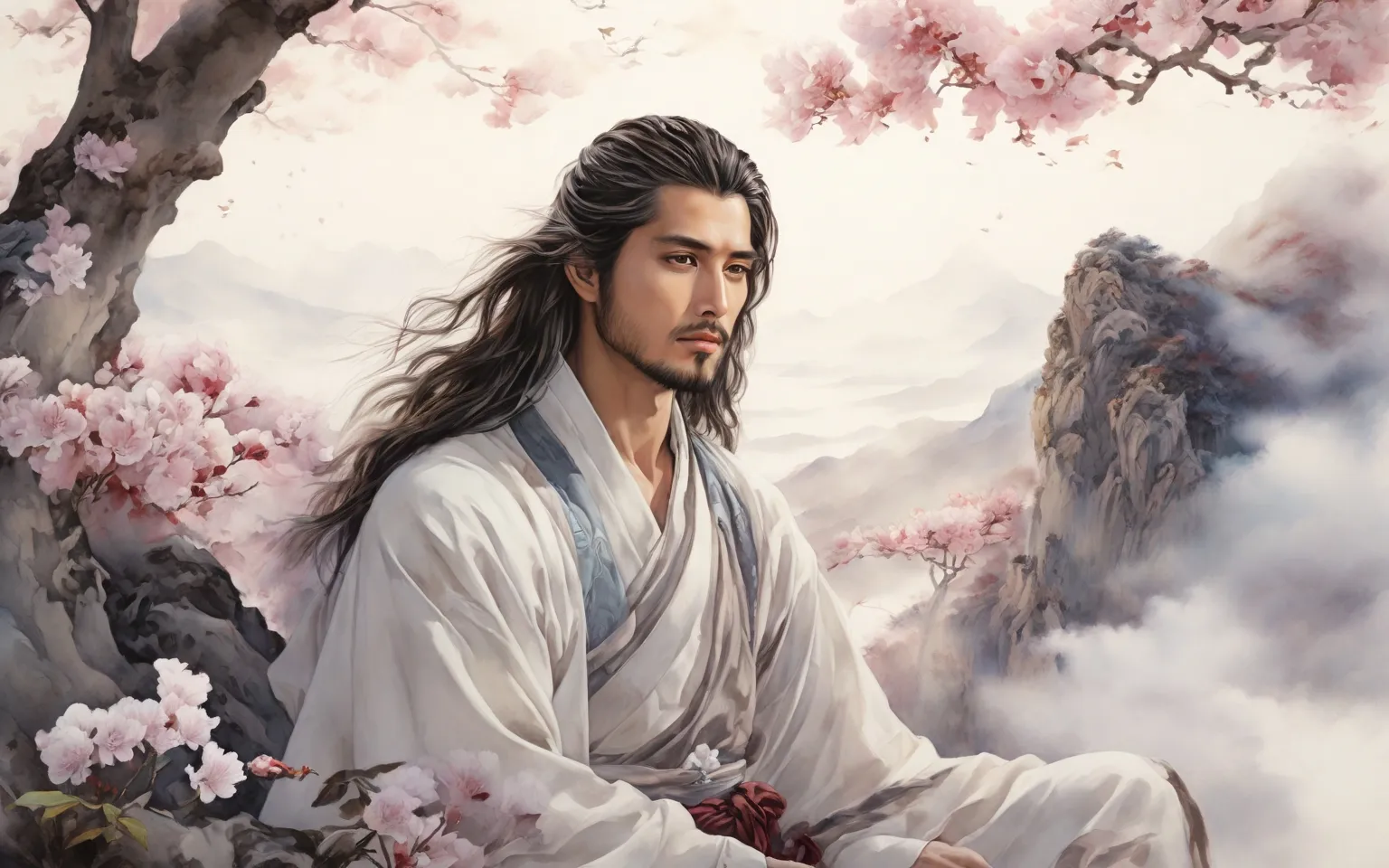
Li Bai (李白), 701 - 762 A.D., whose ancestral home was in Gansu, was preceded by Li Guang, a general of the Han Dynasty. Tang poetry is one of the brightest constellations in the history of Chinese literature, and one of the brightest stars is Li Bai.