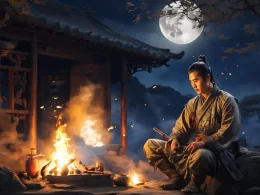

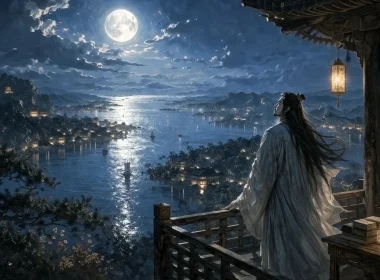
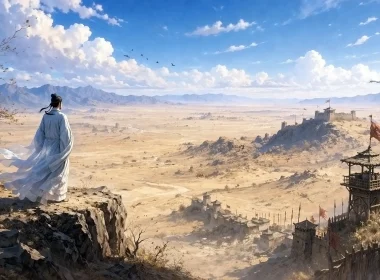
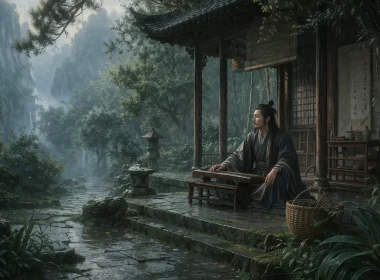
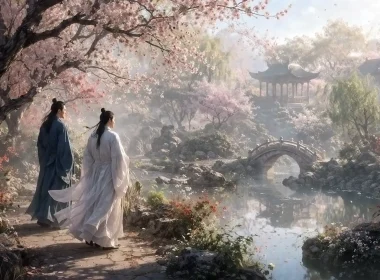
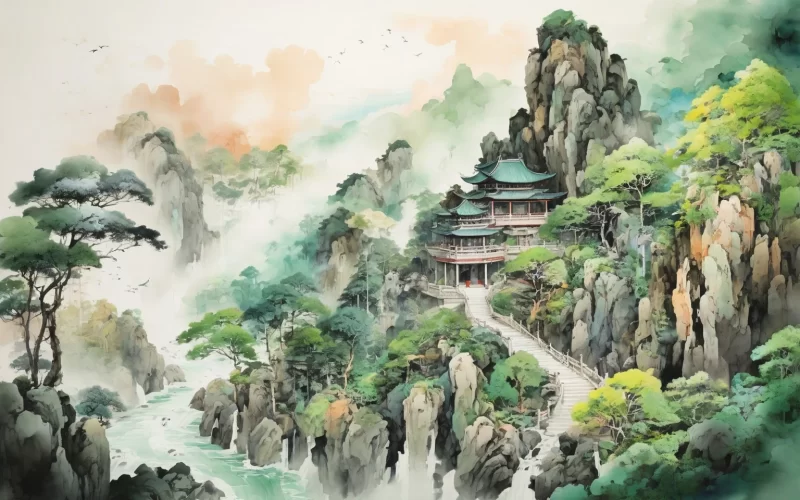
One cicada shrills after the rain;
Through pines and cassias blows autumn’s breath.
Green moss has sealed the steps with silent reign;
A white bird lingers, loath to meet its death.

Evening mist thickens in the woods’ deep heart;
The sun slants down the tower, loath to part.
Who knows, west of the path through bamboos, lies
Yangzhou, the town of music, songs, and cries?
Original Poem
「题扬州禅智寺」
杜牧
雨过一蝉噪,飘萧松桂秋。
青苔满阶砌,白鸟故迟留。
暮霭生深树,斜阳下小楼。
谁知竹西路,歌吹是扬州。
Interpretation
This poem was composed in the autumn of 837 AD, during the reign of Emperor Wenzong of Tang. It captures a genuine reflection of Du Mu's inner state at a time when personal concern and a weariness with official life were intertwined. At the time, Du Mu was serving as an Investigating Censor in Luoyang. Upon learning that his younger brother Du Yi, suffering from a severe eye illness that would eventually lead to blindness, was residing at the Chanzi (Zen Wisdom) Temple in Yangzhou, he resolutely requested leave and journeyed there with the renowned physician Shi Gongji to visit him. This trip was not only an act of familial devotion but also a temporary respite from the complexities of his official duties.
The Chanzi Temple, formerly known as the Zhuxi Temple, was once the extravagant traveling palace of Emperor Yang of the Sui dynasty, later converted into a Buddhist temple during the Tang. When Du Mu entered this place, its former splendor had long faded, leaving only a profound stillness. The temple's desolate quiet stood in stark physical and psychological contrast to the extreme bustle and prosperity of Yangzhou city, just separated by a river. The poem's creation lies precisely in the poet's acute capture and crystallization of a personal moment within this dissonance—a moment filled with anxiety over his brother's condition, sorrow for his family's circumstances, and perhaps tinged with a certain weariness and alienation from his own itinerant official career. Therefore, the "stillness" in the poem is far from mere scenic description; it is a psychologically charged state, steeped in a profound sense of personal destiny.
First Couplet: 雨过一蝉噪,飘萧松桂秋。
Yǔ guò yī chán zào, piāo xiāo sōng guì qiū.
After rain, a single cicada rasps its brittle tune; Through pines and cassia, soughing, sweeps the breath of autumn's gloom.
The poem opens with an auditory image, setting the tone of secluded stillness for the entire piece. "A single cicada rasps" uses the numeral "one" to emphasize the sound's loneliness and stridency; its call after the rain seems especially exhausted and plaintive. This faint yet stubborn noise, paradoxically, deepens the surrounding silence. "Soughing" appeals to both sight and sensation; pines and cassia are noble trees, yet here they appear desolate in the autumn wind. In just ten characters, this couplet moves from sound to scene, constructing a specific, cold, sparse, and seasonally charged moment in time and space, into which the poet's own solitude is quietly woven.
Second Couplet: 青苔满阶砌,白鸟故迟留。
Qīng tái mǎn jiē qì, bái niǎo gù chí liú.
Green moss has clothed the steps and stones in deep attire; A white bird lingers here, reluctant to retire.
The perspective shifts from the lofty trees to the low steps, juxtaposing the static and the animate. "Green moss has clothed the steps and stones" serves as visual proof of time standing still, indicating the lack of human footprints and speaking volumes about the temple's remoteness. "A white bird lingers here" is a dynamic detail rich in sentiment. The word "lingers" (implying deliberate action) personifies the bird, as if it, too, is drawn to the absolute tranquility of this place, thereby highlighting the captivating, almost magical quality of its silence. "Clothed" and "lingers," green and white—the colors are cool, the image serene, further transforming the auditory loneliness of the first couplet into a visual depth of seclusion.
Third Couplet: 暮霭生深树,斜阳下小楼。
Mù ǎi shēng shēn shù, xié yáng xià xiǎo lóu.
Evening haze is born where shadowy trees entwine; The slanting sun descends behind the small shrine's line.
Time flows into dusk, and the scene grows more profound. "Evening haze is born" uses "born" to give the twilight a dynamic, growing quality, as if it emanates from within the woods to engulf everything. "The slanting sun descends" uses "descends" to precisely capture the trajectory of the light's movement and the passage of time. This perfectly balanced couplet, through the two verbs "born" and "descends," condenses the grand process of nightfall and the retreat of light into the partial scenery of deep woods and a small building, creating a tranquil, shadowy, and slightly mysterious twilight atmosphere. The sense of the temple's isolation from the world reaches its peak.
Fourth Couplet: 谁知竹西路,歌吹是扬州。
Shéi zhī Zhúxī lù, gē chuī shì Yángzhōu.
Who would have thought, where Bamboo-West Road lies so still, That song and pipe from Yangzhou float o'er vale and hill?
The final couplet is the soul of the poem, sharply pivoting the focus from extreme quiet to imagined clamor. "Who would have thought" is both a rhetorical question to the reader and the poet's own murmur of astonishment and reflection. The Bamboo-West Road where the Chanzi Temple sits is as silent as antiquity, yet merely a few miles away lies Yangzhou city—a legendary metropolis of "spring breeze for ten li" and "night markets of a thousand lamps," filled with the clamor of "song and pipe" (singing, dancing, and music). These two lines create a powerful psychological impact through the juxtaposition of proximate spaces. The poet is not praising the city's prosperity but, by invoking this palpable, nearby bustle, reflects back upon his own solitude and alienation within the secluded scene. The "song and pipe" are evoked, not heard—a product of imagination—yet this very imagination makes the silence before his eyes feel more tangible and more oppressive.
Holistic Appreciation
This regulated verse (five-character, eight-line) is a masterclass in Du Mu's ability to craft atmosphere and convey stillness. The entire poem centers on the concept of "stillness" without once explicitly stating it, achieving its effect entirely through meticulous depiction of scenery and skillful use of contrast.
The poet employs a compositional method of "moving from the inside out, then from the outside to the distant." The first couplet uses sound to establish stillness, setting the overall autumnal atmosphere of the temple grounds. The second couplet uses traces (moss, bird) to confirm stillness, solidifying the sense of absence. The third couplet uses the time of day (dusk) to deepen stillness, enhancing the enclosed, shadowy space. Finally, the last couplet, like the dotting of the dragon's eye, directs the focus beyond the temple walls to that diametrically opposite world, using Yangzhou's universally acknowledged "motion" and "noise" to ultimately contrast and define the "stillness" and "solitude" of Chanzi Temple—and, by extension, the poet's own state of mind. This structure prevents the poem's atmosphere from being flat or monotone; instead, after building layer upon layer, it reaches an emotional climax through a vast juxtaposition, producing an artistic effect of lingering resonance and startling contrast.
Artistic Merits
- The Masterful Use of Contrast: The poem's core artistry lies in using sound to highlight silence, and clamor to depict solitude. Whether it is the opening "cicada rasps" or the concluding imagined "song and pipe," these auditory images do not shatter the quiet but, like stones dropped into a deep pool, make one more profoundly aware of the water's depth through their momentary ripples. Especially in the final couplet, introducing the general prosperity of Yangzhou as a backdrop noise creates a macroscopic opposition to the tranquility of Chanzi Temple—a technique of great subtlety.
- Precise and Potent Verbs: The use of verbs in the poem is exceptionally skillful. "Rasps," "soughing," "clothed," "lingers," "born," "descends," "would have thought"—each is irreplaceable. "Born" and "descends" imbue natural phenomena with life and dynamism; "lingers" endows the white bird with feeling and will; "would have thought" elevates a physical spatial contrast into a psychological realization and lament.
- A Harmonious Palette of Subdued Colors and Light: The poem's overall color scheme is somber: the grayness after rain, the somber green of pines and cassia, the dark green of moss, the plain white of the bird, the dusky gray of evening haze, the fading gold of the slanting sun. These hues combine to form a monochrome ink-painting with unified tones yet rich layers, evoking a poetic realm of detachment, cool solitude, and introspection.
- Clever Spatial Composition: The poem's sense of space moves from near to far, then from far back to near. It proceeds from within the temple (cicada, trees, steps, bird) to its immediate surroundings (deep woods, small building), finally leaping beyond the temple grounds to point toward the distant city of Yangzhou. This layout imbues the confined space of Chanzi Temple with immense psychological tension and symbolic significance through its confrontation with the vast, bustling world outside.
Insights
This poem reveals a constant condition of the human heart: absolute silence often requires the foil of clamor to be truly perceived and defined; profound loneliness is often most sharply felt at the edges of the crowd. Du Mu, situated in the desolate temple yet mentally hearing Yangzhou's "song and pipe," embodies a sense of alienation born from physical proximity and psychological distance—a feeling familiar even to the modern reader.
It reminds us that silence and clamor are not absolute opposites. Sometimes, it is precisely the tumult of the outside world that makes us crave and cherish inner peace more keenly. Conversely, extreme silence can also make us more acutely aware of our connection to, or separation from, the external world. The value of this poem lies in the fact that it does not merely describe an environment; it portrays a psychological state of establishing one's own position through contrast—maintaining a clear, quiet observation and independent introspection on the periphery of a bustling world. This, perhaps, is a form of spiritual strength to resist the sense of life's rootlessness.
About the poet
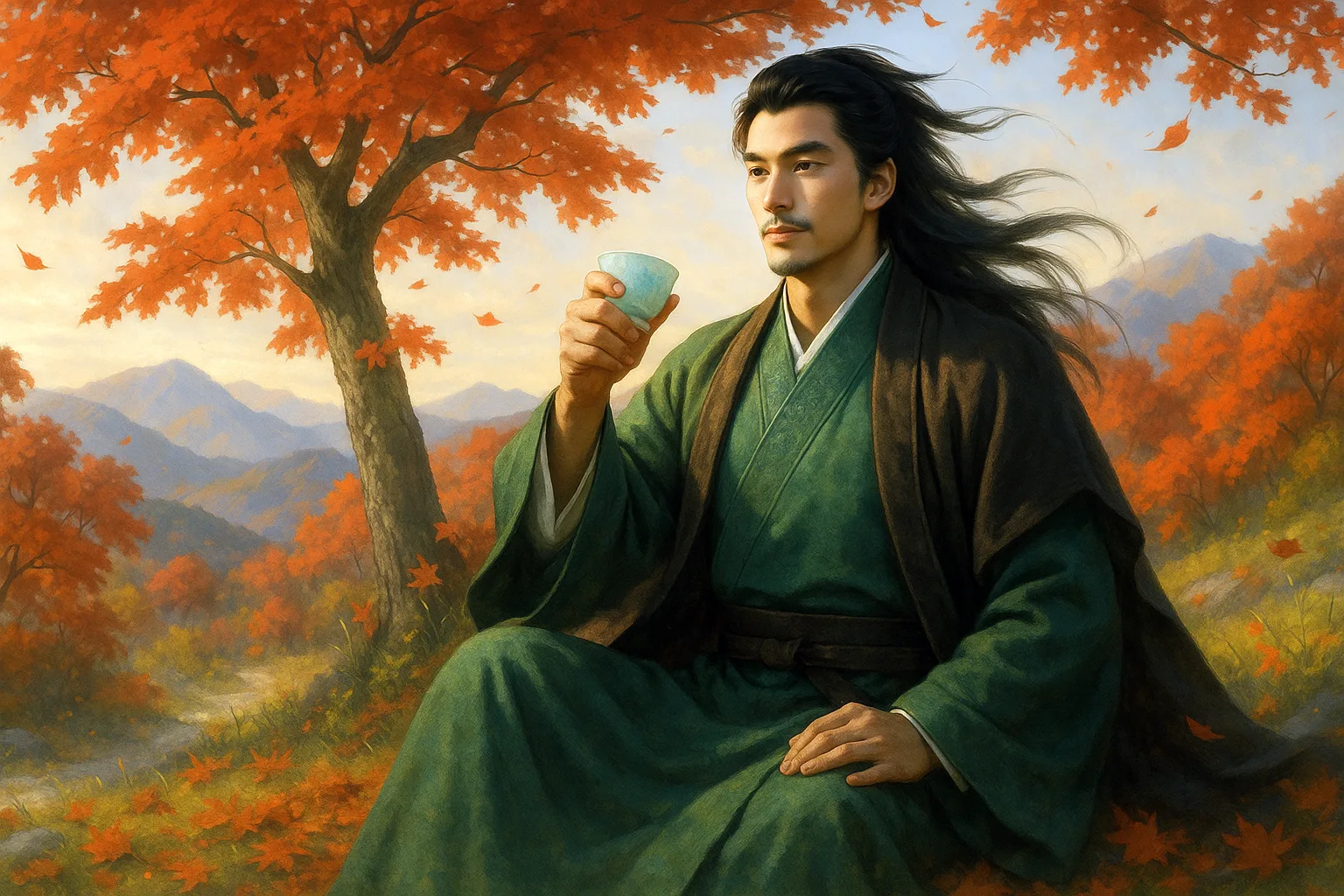
Du Mu (杜牧), 803 - 853 AD, was a native of Xi'an, Shaanxi Province. Among the poets of the Late Tang Dynasty, he was one of those who had his own characteristics, and later people called Li Shangyin and Du Mu as "Little Li and Du". His poems are bright and colorful.