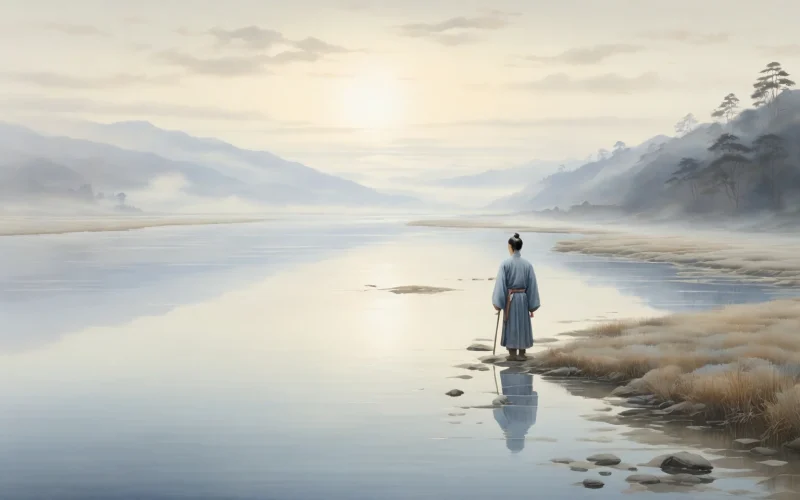

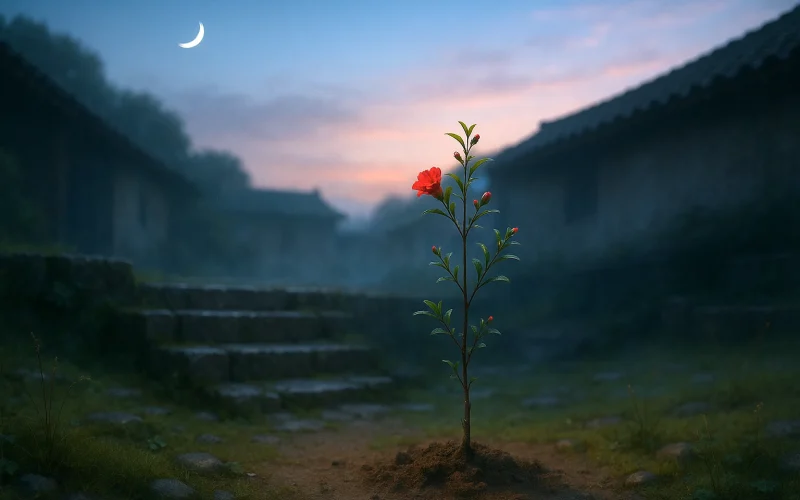
This frail sapling not a foot tall,
Yet dreams of Penglai's immortal hall.
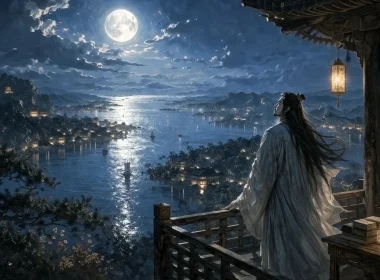
Cold moon pales the dawn's stairway,
While colored clouds haunt dreams at day.
From dung-soil springs this jeweled tree,
Moss-crowned with blossoms fair to see.
Fragrant roots hide their hue so bright—
For whom blooms this year's delight?
Original Poem
「新植海石榴」
柳宗元
弱植不盈尺,远意驻蓬赢。
月寒空阶曙,幽梦彩云生。
粪壤擢珠树,莓苔插琼英。
芳根閟颜色,徂岁为谁荣。
Interpretation
This poem was composed during Liu Zongyuan's exile in Yongzhou. After the failure of the Yongzhen Reforms, he was demoted from a ministry official to Marshal of Yongzhou, spending a long ten-year period of exile by the Xiao River. With his political ideals shattered and official prospects hopeless, the poet could only seek solace in the mountains and waters, entrusting his aspirations to flowers and trees. The "Sea Pomegranate" (海石榴) refers to the camellia, said to have been introduced from overseas, a rare ornamental plant at the time. Liu Zongyuan personally planted such a Sea Pomegranate by his dwelling and wrote this poem praising an object. The subject of the poem is a "newly planted" Sea Pomegranate that has not yet taken root—it is "fragile, not a foot high," delicate and stunted; it is rooted in "dung soil" and "mossy ground," at odds with the surrounding desolate environment. Yet it is this very fragile plant that "dreams of isles in the sea"—its heart yearns for the distant immortal mountains and jade pavilions.
This Sea Pomegranate is precisely Liu Zongyuan's self-comparison. Like this exotic flower from overseas, he was cast into remote Yongzhou, rooted in filthy soil, yet always cherished a noble and unsullied aspiration. The entire poem uses the flower to represent the man, blending object and self; beneath the surface of praising an object lies the poet's deep self-sorrow, self-pity, and self-encouragement.
First Couplet: "弱植不盈尺,远意驻蓬瀛。"
Ruò zhí bù yíng chǐ, yuǎn yì zhù péng yíng.
Fragile, not a foot high, this plant you see,
Yet dreams of isles in the sea.
The opening uses contrast to write the conflict between fate and ideal. "Fragile, not a foot high"—describes the Sea Pomegranate's appearance: delicate, stunted, not yet grown, with nothing eye-catching. The two words "fragile plant" are both about the flower and the poet's self-reference—in politics, he is a "fragile plant" uprooted, powerless to resist fate.
Yet "dreams of isles in the sea"—its heart and aspirations reside in the distant Penglai and Yingzhou, legendary immortal islands in the sea, symbolizing a noble, transcendent ideal realm. This "dream" is precisely the portrayal of the poet, though in a lowly position, his heart yearns for the lofty. Appearance and inner self, reality and ideal form a strong contrast in this couplet, establishing the poem's tone of "trapped in the mire yet harboring lofty aspirations."
Second Couplet: "月寒空阶曙,幽梦彩云生。"
Yuè hán kōng jiē shǔ, yōu mèng cǎi yún shēng.
Cold moonlight fills the steps at dawn;
From a hidden dream, rosy clouds are born.
This couplet shifts from the concrete to the abstract, describing the dreams of the Sea Pomegranate (and the poet). "Cold moonlight fills the steps at dawn"—describes the environment's desolate loneliness: the moonlight is cold, the steps are empty, day is breaking. These seven words sketch the poet's凄凉 situation living alone in exile. "From a hidden dream, rosy clouds are born"—on such a cold, clear night, the poet (or the Sea Pomegranate) had a dream, and in the dream appeared gorgeous rosy clouds.
"Rosy clouds" are a beautiful yet illusory image, symbolizing the lofty, unattainable ideals in the poet's heart. The more gorgeous the dream, the more凄凉 the awakening. This couplet uses dreams to express longing, uses illusion to contrast reality, letting the reader feel the poet's inner struggle and unwillingness in the contrast between beauty and凄凉.
Third Couplet: "粪壤擢珠树,莓苔插琼英。"
Fèn rǎng zhuó zhū shù, méi tái chā qióng yīng.
In dung soil, a tree of pearls would grow;
In mossy ground, gem flowers I'd sow.
This couplet uses extreme contrast to express the sharp conflict between ideal and reality. "Dung soil" is filthy earth; "mossy ground" is desolate, moss-covered land—this is the Sea Pomegranate's growing environment, and also the poet's reality: politically dark, situation base. "Tree of pearls" is a legendary immortal tree laden with pearls and jade; "gem flowers" are jade-like blossoms—this is the ideal realm pursued by the Sea Pomegranate (and the poet).
The word "would grow" and the word "I'd sow" express the poet's difficult effort to cultivate his ideal in this filthy environment. However, the contrast between "dung soil" and "tree of pearls," between "mossy ground" and "gem flowers" is simply too great; this effort is almost certainly destined to be futile. This couplet uses splendid imagery to write a sorrowful mood, a classic example of Liu Zongyuan's technique of "using beauty to write sorrow."
Fourth Couplet: "芳根閟颜色,徂岁为谁荣?"
Fāng gēn bì yán sè, cú suì wèi shuí róng?
Its scented root hides its hue unseen;
For whom will glory crown its years, once green?
The final couplet is the emotional climax of the poem and the sublimation of its philosophical thought. "Its scented root hides its hue unseen"—that beautiful root (both the flower's root and the poet's true nature) is still hidden deep underground, not yet displaying its brilliance. The word "hides" means concealed, hidden, expressing the poet's sorrow: though he has noble aspirations, he is buried, unable to display them.
"For whom will glory crown its years, once green?"—those passing years, for whom do they ultimately bring glory? "Passing years" are the elapsed time, the long years of a decade in exile; "for whom" is the poet's ultimate questioning of life's meaning: For whom is my effort, my perseverance, my pain? What is the point? This question is deafening, pushing the poem's emotion to its climax and drawing the reader into deep contemplation about the value of life.
Holistic Appreciation
This poem praising an object uses the flower to represent the man, blending object and self. Superficially praising a newly planted Sea Pomegranate, it is actually everywhere a self-comparison of the poet. The first couplet contrasts appearance and inner self, establishing the tone of "trapped in the mire yet harboring lofty aspirations." The second shifts from concrete to abstract, using dreams to express longing. The third uses extreme contrast to write the conflict between ideal and reality. The final couplet concludes with a question, elevating emotion to philosophical height.
The entire poem is rich in splendid imagery, profound in emotion. Images like "isles in the sea," "rosy clouds," "tree of pearls," and "gem flowers" are gorgeous and magnificent, representing lofty ideals; images like "cold moonlight," "empty steps," "dung soil," and "mossy ground" are desolate and bleak, representing harsh reality. The strong contrast between these two sets of images creates the poem's internal tension, letting the reader sense the poet's complex and profound mood in the intertwining of beauty and sorrow.
Compared to Liu Zongyuan's poems that directly express indignation, this one is more subtle and restrained. The poet does not cry out loudly; he simply lets the reader comprehend and perceive through the fate of a flower. This technique of using an object to convey emotion, using imagery to transmit meaning is precisely the excellence of Liu Zongyuan's object-praising poetry.
Artistic Merits
- Using an Object to Express Ambition, Blending Object and Self: The entire poem uses the Sea Pomegranate as a self-comparison; the flower's fate is the man's fate, the flower's ideal is the man's ideal; object and self are one, an integral whole.
- Strong Contrast of Imagery: "Isles in the sea" versus "fragile plant," "tree of pearls" versus "dung soil," "gem flowers" versus "mossy ground"—the鲜明 contrast between the two sets of images creates the poem's internal tension.
- Interweaving of Dream and Reality: Using the gorgeousness of "From a hidden dream, rosy clouds are born" to contrast the bleak desolation of reality, the abstract and concrete give birth to each other, redoubling the sorrow.
- Concluding Question, Lasting Resonance: The question "For whom will glory crown its years, once green?" elevates personal fate to a universal questioning of life, giving the poem a transcendent depth of philosophy.
Insights
This poem first enlightens us on how to maintain adherence to ideals in adversity. Liu Zongyuan, exiled for ten years, placed in "dung soil" and "mossy ground," still "dreams of isles in the sea," still sees "rosy clouds" in his dreams. This posture of being trapped in the mire yet harboring lofty aspirations is itself a spiritual victory. It tells us: the environment can trap our bodies, but cannot trap our minds; reality can strip us of our status, but cannot strip us of our ideals. As long as there are still "isles in the sea" in our hearts, as long as there are still "rosy clouds" in our dreams, we will never be truly defeated.
The imagery in the poem also makes us contemplate the conflict between ideal and reality. The poet tries to cultivate a noble ideal in a filthy environment, but that effort is almost certainly destined to be futile. This enlightens us: The realization of ideals requires a suitable environment; it cannot be achieved by individual effort alone. In reality, we must both adhere to our ideals and maintain clarity about environmental limitations; we must strive to "grow a tree of pearls," but also understand that not all "trees of pearls" can grow in "dung soil."
Looking deeper, the poem's question, "For whom will glory crown its years, once green?" also makes us contemplate the problem of life's meaning. Liu Zongyuan used ten years of exile in exchange for a Sea Pomegranate that did not bloom; he asks: For whom is all this? This question is also faced by everyone who perseveres with ideals in adversity: Is my perseverance meaningful? Does my pain have value? Liu Zongyuan does not provide an answer, but the very act of writing this poem is itself an answer—even without an answer, even if "for whom" cannot be known, we can still use poetry, words, art to preserve this questioning, letting it become the shared spiritual wealth of humanity.
Finally, that Sea Pomegranate in the poem is especially moving. It is fragile, stunted, not yet grown, struggling to grow in the night of "cold moonlight" on "empty steps," in the environment of "dung soil" and "mossy ground." But it still "dreams of isles in the sea," still sees "rosy clouds" in its dreams. This posture of maintaining loftiness in humility, of persisting in dreams amidst hardship is the most precious spiritual legacy Liu Zongyuan left us. It teaches us: the value of life lies not in how splendidly it blooms, but in that persistence of growing towards the light even in darkness.
About the Poet
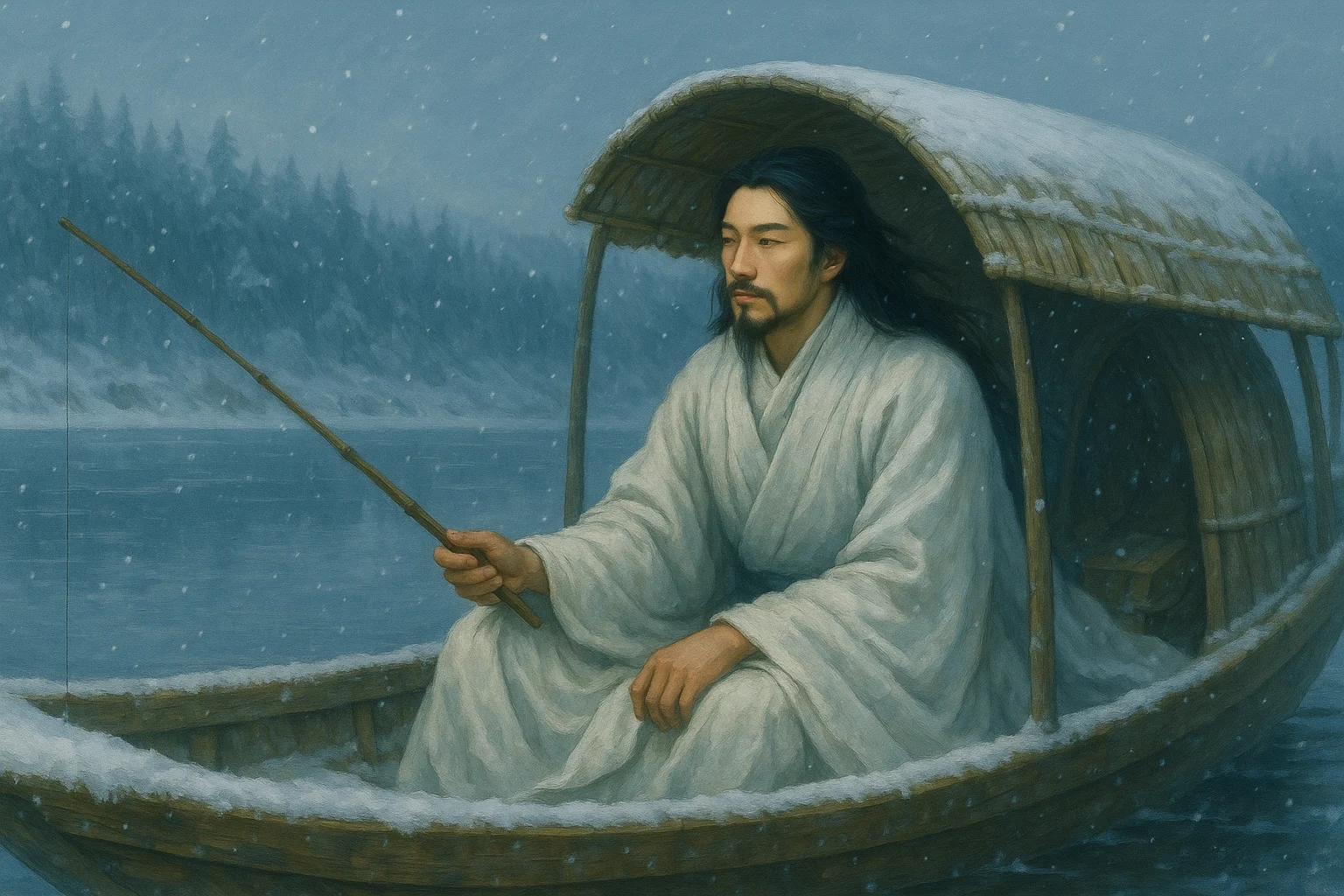
Liu Zongyuan (柳宗元, 773 - 819), a native of Yuncheng in Shanxi province, was a pioneering advocate of the Classical Prose Movement during China's Tang Dynasty. Awarded the prestigious jinshi degree in 793 during the Zhenyuan era, this distinguished scholar-official revolutionized Chinese literature with his groundbreaking essays. His prose works, remarkable for their incisive vigor and crystalline purity, established the canonical model for landscape travel writing that would influence generations. As a poet, Liu mastered a distinctive style of luminous clarity and solitary grandeur, securing his place among the legendary "Eight Great Masters of Tang-Song Prose" - an honor reflecting his enduring impact on Chinese literary history.