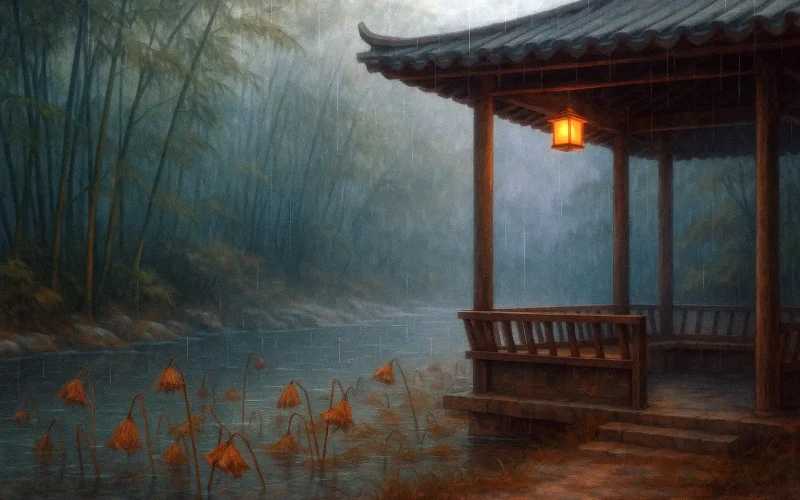

A drizzling rain falls like tears on the Mourning Day;
The mourner's heart is going to break on his way.
Where can a wine shop be found to drown his sad hours?
A cowherd points to a cot amid apricot flowers.
Original Poem
「江南春」
杜牧
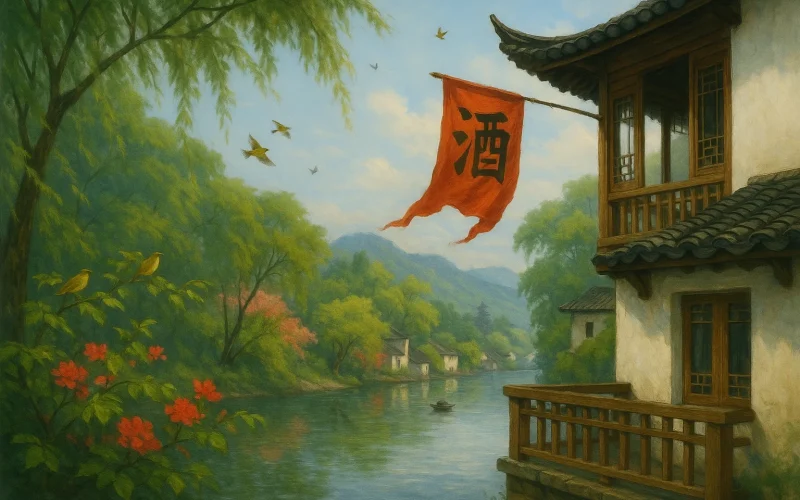
千里莺啼绿映红,水村山郭酒旗风。
南朝四百八十寺,多少楼台烟雨中。
Interpretation
This poem was composed during the Dazhong reign period of Emperor Xuanzong of Tang (around 850 AD), coinciding with Du Mu's multiple appointments and travels in the Jiangnan region. Although the Tang dynasty appeared temporarily stable at the time, underlying conflicts—eunuch dominance and military governors' fragmentation—persisted, casting the entire era under a collective presentiment of prosperity having peaked and now beginning to decline. Jiangnan, as the former heartland of the Six Dynasties, with its bright landscapes and historical ruins veiled in mist and rain, created a unique overlapping of time and space that deeply moved Du Mu, who possessed both a poet's sensitivity and a historian's perspective.
The poem's status as a timeless masterpiece stems precisely from its transcendence of mere scenery depiction. It was born at a historical juncture that required a re-examination of "prosperity" and "permanence." Du Mu placed the overwhelming, sensory richness of a Jiangnan spring (the orioles' song for miles, green leaves setting off red blossoms, tavern banners fluttering) alongside the historically accumulated, time-softened prosperity from the Southern Dynasties period (the "four hundred and eighty temples," the towers and terraces in mist and rain) within the same poetic canvas. This juxtaposition is not a simple contrast but creates an artistic conception filled with tension: the more vivid the present vitality, the more vast the historical backdrop; the brighter the immediate colors, the more profound the mist of time. It responds to a common late Tang perplexity: how to reconcile a clear awareness of historical change with a reality that still appears prosperous? The poem offers a poetic answer: to encompass vicissitude through aesthetic appreciation, to perceive eternal flux within a moment of supreme beauty.
First Couplet: 千里莺啼绿映红,水村山郭酒旗风。
Qiānlǐ yīng tí lǜ yìng hóng, shuǐ cūn shān guō jiǔ qí fēng.
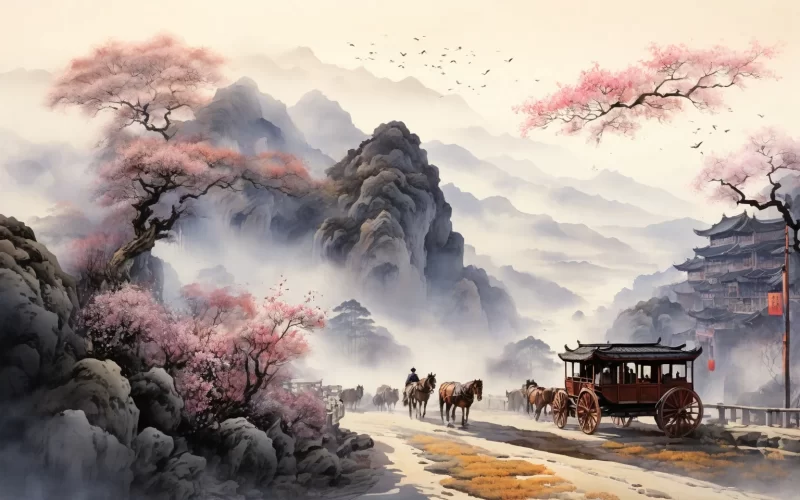
For miles and miles the orioles sing, green leaves set off the red, By riverside villages and mountain walls wine shop streamers sway, it's said.
The opening lines lavish the reader with a panoramic scroll of Jiangnan spring, brimming with vitality. "For miles and miles" is not a measurement but a poetic hyperbole, emphasizing the pervasive reach of spring, echoing the lingering resonance of High Tang grandeur within late Tang artistry. "The orioles sing" appeals to hearing, a vibrant symphony; "green leaves set off the red" appeals to sight, a strong yet harmonious chromatic contrast. These seven words sketch a sensory feast of spring in Jiangnan. The next seven words enrich its humanistic dimension: "riverside villages and mountain walls" highlight the geographical diversity of the region, while "wine shop streamers sway" animates the static scene with a lively detail, as if one can hear the banners flapping and catch a hint of wine aroma—the warm breath of human life wafts forth.
Second Couplet: 南朝四百八十寺,多少楼台烟雨中。
Náncháo sìbǎi bāshí sì, duōshǎo lóutái yānyǔ zhōng.
Of Southern Dynasties' four hundred and eighty temples, who can tell, How many towers and terraces now stand in the mist and rain's soft veil?
The poet's gaze and thoughts abruptly turn toward historical depth. "Southern Dynasties" instantly pulls the timeline back centuries, creating a spatiotemporal link with the vast space of the previous couplet. "Four hundred and eighty temples" is an approximate number, emphasizing multitude. It is both a historical epitome of the unprecedented flourishing of Buddhism during the Southern Dynasties and implies a veiled critique of the state's resources being drained by excessive religious patronage. "How many towers and terraces now stand in the mist and rain's soft veil?" is the timeless, celebrated line. It is both an actual scene—the characteristic haze of Jiangnan spring rain rendering the structures faintly visible—and a historical image: the mist and rain of time have long submerged past splendor, leaving only remnants of those grand complexes, now half-real, half-illusory in historical memory. The rhetorical question "How many…" is filled with lament for the impermanence of historical relics and a profound understanding of how prosperity ultimately dissolves into a misty void.
Holistic Appreciation
This heptasyllabic quatrain is hailed as a model of "capturing a thousand miles within a foot of silk." Within just twenty-eight characters, it accomplishes multiple leaps: from spatial exposition to temporal penetration, from sensory delight to philosophical contemplation.
The first two lines focus on the breadth and density of "spring." "For miles and miles" describes spatial breadth; "orioles sing," "green… red," "riverside villages and mountain walls" describe the density of imagery, together weaving a rich, joyous, dazzling tapestry of glorious springtime. This is both the spring of nature and, seemingly, the superficial "spring" of society. The latter two lines focus on the historical depth and existential texture of "Jiangnan." The poet skillfully transforms the natural "mist and rain" into the cognitive "mist and rain" of history. The towers and terraces of those Southern Dynasties temples, shrouded in this dual-layered mist and rain, present a complex beauty that is both real and illusory, both present and absent. Their existence reminds us of past glory; their indistinctness signifies the transience of that glory.
Du Mu's brilliance lies in completely dissolving deep historical melancholy into breathtaking scenic depiction. The poem's emotional tone is not sorrowful but rather a state of clarity and vastness attained after taking in the full panorama of prosperity. The towers in the mist and rain are both a vehicle for critique (pointing to the excesses of Southern Dynasties Buddhism) and an object of aesthetic appreciation, and furthermore, a visualized expression of historical philosophy: all zeniths of power and culture ultimately merge into this boundless, mist-and-rain-like passage of time.
Artistic Merits
- Interwoven Grandeur and Minute Detail in Spatial Narrative: The poem's structure exhibits a skillful integration of "panoramic scan" and "historical focus." The opening phrase "for miles and miles" is a bird's-eye panorama; "riverside villages and mountain walls" is a mid-range sketch; "wine shop streamers" is a detailed close-up; and the final couplet's "towers and terraces" is a deep focus on historical remnants. This shifting perspective from distant to near, then from concrete to abstract grants the short poem the capacity and depth of a grand scroll painting.
- Juxtaposition and Sublimation of Multiple Senses: The poem densely mobilizes hearing (orioles' song), sight (green and red, villages and walls, towers in mist and rain), imagined touch (wind), and even historical synesthesia. These sensations are not piled haphazardly but are orchestrated with the bright spring scene as the prelude, ultimately unified and sublimated into the culminating image of "mist and rain," which blends visual, tactile, and historical vastness, completing a journey from sensory pleasure to spiritual contemplation.
- Poetic Dialectics of Number and Substance: The tension between seemingly precise yet hyperbolic numbers like "miles and miles," "four hundred and eighty," and the indeterminate query "how many"; the contrast between the vivid reality of "green…red" and the misty illusion of "mist and rain." Through the symbolic use of numbers and the interplay of concrete and abstract imagery, the poet skillfully expresses the profound theme that "prosperity is countable, but time is infinite; physical objects perish, yet reflection endures."
- Aesthetic Presentation of Historical Consciousness: Du Mu does not directly discuss the rise and fall of the Southern Dynasties. Instead, he completely dissolves historical critique and reflection into the immensely beautiful image of "towers and terraces… in the mist and rain's soft veil." This allows history's weight to be presented in a poetic manner that is deceptively light yet profoundly suggestive, producing the artistic effect of "words end, but meaning lingers endlessly." It also elevates the sentiment of reflecting on the past beyond a specific dynasty, granting it universal aesthetic and philosophical value.
Insights
This enduring quatrain depicting a Jiangnan spring carries implications far beyond landscape. It reveals to us an eternal historical paradox: the most flourishing prosperity is often separated from the deepest emptiness by only the thinnest veil. The vibrant vitality of "for miles and miles the orioles sing, green leaves set off the red" in the poem is the tangible, palpable reality of the present; the hazy recollection of "how many towers and terraces now stand in the mist and rain" is the already illusory remnant filtered through history. By juxtaposing them, Du Mu shows us how time quietly dissolves all solid glory into a misty haze. This serves as a warning for any era: while we revel in the immediate "green…red," perhaps we should contemplate which seemingly eternal "towers and terraces" are already quietly steeped in their destined "mist and rain."
The imagery of "Southern Dynasties' four hundred and eighty temples" is especially worthy of deep thought. They are not merely Buddhist structures but represent a massive investment of an era's collective faith, wealth, and energy. When a nation channels its strength into erecting resplendent "towers and terraces," this itself may signal a certain deviation from its foundations, a drain on its vitality. Du Mu does not directly criticize, but the gentle question "how many… now stand in the mist and rain" speaks volumes about the inevitable fate in the long river of history for any grandiose narrative detached from people's livelihood—transitioning from solid to void, from clarity to misty obscurity. The lesson for any civilization is this: true prosperity should be rooted in the "wine shop streamers" that invigorate the "riverside villages and mountain walls," not in constructing too many castles in the air that can ultimately exist only in memory and misty rain.
Ultimately, this poem offers not just an aesthetic landscape but also a unique perspective for understanding the rise and fall of civilizations. Du Mu teaches us that to observe the vitality of an era, we should not merely look at how many dazzling "towers and terraces" it builds, but see if its springtime spirit truly reaches the breadth of "miles and miles" and the depth of "riverside villages and mountain walls." To judge the value of a kind of prosperity, we must look not only at its brilliance on sunny days but also at whether it can maintain a clear, discernible outline and significance within the historical "mist and rain." In this sense, this landscape poem is a key to historical philosophy—whenever and wherever we witness spectacular sights akin to "four hundred and eighty temples," we should allow a clear-eyed inquiry of "how many… in the mist and rain" to arise within our hearts, listening to the eternal bell about substance and emptiness that Du Mu rang for us a thousand years ago.
Poem translator
Xu Yuan-chong (许渊冲)
About the poet

Du Mu (杜牧), 803 - 853 AD, was a native of Xi'an, Shaanxi Province. Among the poets of the Late Tang Dynasty, he was one of those who had his own characteristics, and later people called Li Shangyin and Du Mu as "Little Li and Du". His poems are bright and colorful.