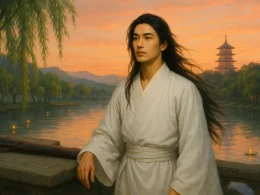



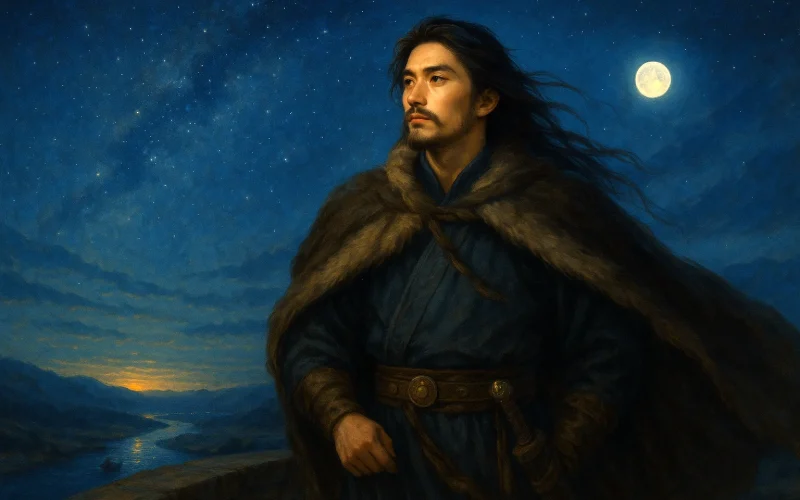
Li Yi (李益 748 - 829), a native of Wuwei, Gansu Province, was a representative poet of the Frontier Fortress School in the Mid-Tang period. He became a jinshi (presented scholar) in the fourth year of the Dali era (769 AD) and served through the reigns of Emperor Xianzong and Emperor Wenzong, eventually rising to the position of Minister of Rites. His poetry is particularly renowned for its seven-character quatrains, characterized by a style that is both solemn and poignant, blending the grandeur of High Tang frontier poetry with the plaintive elegance of the Mid-Tang. Inheriting the legacy of Wang Changling and inspiring later poets like Li He, his frontier poems carved out a unique and distinctive place in the Mid-Tang literary world.
Major Works


Life
Li Yi was a descendant of the Gucang branch of the Longxi Li clan, a distinguished family with a long history. His father, Li Qiu, served as a Yuanwailang in the Ministry of Works. The glory of his family and the geographical background of the Longxi frontier instilled in him from a young age a natural affinity for frontier landscapes. He lost his father early and was raised by his mother. Although the family was not wealthy, a strong family scholarly tradition enabled him to become well-versed in literature and history.
In the fourth year of the Dali era of Emperor Daizong (769 AD), at the tender age of twenty-two, Li Yi passed the Jinshi examination. Two years later, he also passed the special examination for "Admonishing Officials and Masters of Literature" and was appointed Registrar (Zhubu) of Zheng County (present-day Hua County, Shaanxi Province). During this period, he became acquainted with poets such as Lu Lun, Ji Zhongfu, Qian Qi, and Sikong Shu, becoming an important member of the "Ten Talents of the Dali Era." They often drank and composed poetry together, their works mostly depicting landscapes and rural scenes, as well as the sorrows of travel and homesickness, in a fresh and elegant style. However, Li Yi's inner self seemed unsatisfied with this leisurely literati life; his longing for the frontier and his desire for military achievement always lay hidden in his heart.
Around the ninth year of the Dali era (774 AD) and thereafter, Li Yi embarked on a nearly twenty-year-long career as a member of military headquarters (mufu). He successively joined the headquarters of Zang Xirang, Military Governor of Weibei; Li Huaiguang, Military Governor of Shuofang; Du Xiquan, Grand Protector of Lingzhou; and Zhang Xianfu, Military Governor of Binning. His travels took him to frontier towns such as Jingyuan, Shuofang, and Binning. This long period of frontier life allowed him to personally experience battlefields wreathed in beacon fire, the vast and desolate frontier landscapes, and the arduous life of the military. It also gave him profound insight into the joys and sorrows of partings and reunions between soldiers and their loved ones. This experience became the deepest wellspring for his frontier poetry.
In the thirteenth year of the Zhenyuan era (797 AD), Li Yi left the frontier and was summoned to court, where he held positions including Director of the Bureau of Capital Officials (Duguan Langzhong) and Secretariat Drafter (Zhongshu Sheren). During the Yuanhe era of Emperor Xianzong, he successively served as Junior Governor of Henan (Henan Shaoyin), Junior Director of the Palace Library (Mishu Shaojian), and Academy Scholar of the Jixian Academy (Jixian Dian Xueshi). Although his official rank was not extremely high, he was treated with considerable respect. However, in his later years, Li Yi's reputation suffered due to a personal matter. According to his biography in the Old Book of Tang, Li Yi "had a mild obsessive disorder from youth and was highly suspicious. In guarding his wife and concubines, he was excessively harsh and cruel, and stories of 'scattering ashes and bolting doors' circulated widely, so people at the time spoke of the 'Li Yi Disease.'" The so-called "scattering ashes and bolting doors" referred to his habit, before going out, of sprinkling ashes on the ground and locking doors and windows to prevent his wife and concubines from engaging in illicit affairs. This almost pathological suspicion left a negative impression in the minds of his contemporaries and became an indelible stain on his life.
In the first year of the Changqing era (821 AD), Li Yi retired from his post as Director of the Palace Library (Mishu Jian). In his later years, he lived a leisurely life, associating and exchanging poems with poets such as Bai Juyi and Liu Yuxi. He passed away in the third year of the Dahe era (829 AD) and was posthumously awarded the title of Minister of Rites (Libu Shangshu).
Looking at his life as a whole, Li Yi experienced the fading glory of the High Tang, the tranquility of the Dali era, and the revival of the Zhenyuan era. His life trajectory can be said to span the entirety of the Mid-Tang period. In his early years, he was renowned for his literary talent; in middle age, he achieved merit on the frontier; in his later years, he retired from a high official post. Such a wealth of experience is rare even among Tang dynasty poets.
Stylistic Characteristics
Li Yi's poetry achieved its highest distinction in the seven-character quatrain. His contemporaries called him "Literary Li Yi" (Wenzhang Li Yi), and he was known alongside Li He as one of the "Two Lis." His thematic range is broad, with his frontier poems being particularly renowned. Stylistically, he combines the fresh elegance and delicacy of the Dali poets with the vigorous power and mournful pathos of the frontier poets, forging a unique artistic identity.
Frontier Poetry
Li Yi's frontier poems are the most valuable part of his oeuvre. Unlike the High Tang frontier poets, the frontier in Li Yi's writing lacks the uplifting heroism and desire for achievement found in Gao Shi and Cen Shen. Instead, it possesses a deeper mournfulness and a reflection on the nature of war. This is closely related to his long-term service in military headquarters and his personal experience of battle.
He excelled at capturing the most affecting moments of frontier life, sketching vast and desolate artistic conceptions with concise brushstrokes. For example, in "Night on the Wall of the Surrendered City, Hearing a Flute" (Ye Shang Shouxiang Cheng Wen Di), the lines "回乐烽前沙似雪,受降城外月如霜" use sand compared to snow and moonlight compared to frost to vividly render the bitter cold and desolation of the frontier. He was also skilled at infusing deep emotion into landscape descriptions, merging scene and sentiment. For instance, in "Joining the Army on the Northern Expedition" (Congjun Beizheng), the lines "天山雪后海风寒,横笛偏吹行路难" use wind and snow and a horizontal flute to evoke the soldiers' suffering, blending scene and emotion in a deeply moving way.
Especially valuable is the profound reflection on life often embedded in Li Yi's frontier poems. He writes not only of the hardships of the frontier but also of the soldiers' homesickness, the helplessness of prolonged garrison duty, and the longing for peace. This deep humanistic concern elevates his frontier poetry beyond mere scene-painting and emotional expression, endowing it with richer ideological content.
Master of the Seven-Character Quatrain
Li Yi was a great master of the seven-character quatrain, ranking alongside Wang Changling and Li Bai. His seven-character quatrains feature concise language and profound artistic conception, often containing rich emotional content within an extremely short form. Hu Yinglin, in his Sousou (Poetic Depths), commented: "For seven-character quatrains, below the Kaiyuan era, Li Yi should be considered number one. Works like 'Night on the Wall of the Surrendered City, Hearing a Flute,' 'Joining the Army on the Northern Expedition,' and 'Hearing a Flute on a Spring Night' can all compete with Li Bai and Wang Changling."
His seven-character quatrains excel in the use of subtle suggestion, conveying much with little, where the words exhaust themselves but the meaning lingers on. For example, in "Song of the Southern River" (Jiangnan Qu), the lines "嫁得瞿塘贾,朝朝误妾期。早知潮有信,嫁与弄潮儿" use the voice of a merchant's wife to express resentment, yet do not directly voice the complaint. Instead, they suggest it through her keen anticipation of his return and the depth of her disappointment – subtle yet profound. Similarly, in "Expressing Feelings" (Xie Qing), the lines "水纹珍簟思悠悠,千里佳期一夕休。从此无心爱良夜,任他明月下西楼" use the abnormal psychology of being "无心爱良夜" (having no heart to love the beautiful night) to convey the despair and decisiveness after lost love – subtle yet powerful.
Diversity and Unity of Themes
Li Yi's poetic themes are quite broad. Besides frontier poems, he also produced numerous works of presentation and farewell, travel and homesickness, and landscape and rural life. Although varied in theme, these works are all permeated with deep emotion and refined language, presenting a unified artistic style.
His presentation and farewell poems often depict sincere friendship. For instance, in "Happy to See My Younger Cousin, Then Speaking of Parting Again" (Xi Jian Waidi You Yan Bie), the lines "十年离乱后,长大一相逢。问姓惊初见,称名忆旧容" vividly and movingly capture the surprise and emotion of reuniting with a younger cousin after years of war and separation. His travel poems often express the homesickness of wandering far from home. For example, in "Song of the Bian River" (Bianhe Qu), the lines "汴水东流无限春,隋家宫阙已成尘。行人莫上长堤望,风起杨花愁杀人" contrast the eternal flow of the Bian River with the vanished palaces of the Sui dynasty, evoking a deep sense of historical vicissitude.
Refinement of Language and Gradual Evolution of Style
Li Yi's poetic language is generally characterized by refinement, subtlety, and naturalness. He did not favor oddity or excessive ornamentation, but rather pursued a fresh and natural mode of expression. However, his style underwent a gradual evolution corresponding to different stages of his life.
In his early period (Dali era), his style was fresh and elegant, often depicting landscapes, rural life, travel, and homesickness, reflecting the common characteristics of the "Ten Talents of the Dali Era." In his middle period (the time spent in military headquarters), his style turned mournful and desolate, and his frontier poetry reached its peak; this is the period most characteristic of his personal style. In his late period (after retirement), his style tended towards tranquility and leisure. His exchange poems with Bai Juyi, Liu Yuxi, and others mostly depict his leisurely life in retirement, featuring a simple and peaceful style.
Literary Influence
Li Yi occupied an important position in the Mid-Tang poetic world, and his influence was profound and lasting.
The Final Great Master of the Tang Seven-Character Quatrain
Li Yi is an important link in the developmental history of the Tang seven-character quatrain. He carried on the tradition of Wang Changling and Li Bai, and paved the way for Du Mu and Li Shangyin, achieving great heights in the composition of seven-character quatrains. Hu Yinglin, in his Sousou, praised him highly, stating, "For seven-character quatrains, below the Kaiyuan era, Li Yi should be considered number one." His seven-character quatrains excel in using subtle suggestion to express deep emotion, featuring seamless artistic conception and refined language, making them models for later generations.
A Key Figure in the Transition from Dali Poetic Style to Yuanhe Poetic Style
Li Yi's creative output spanned the Dali, Zhenyuan, and Yuanhe periods. In his early years, he was an important member of the "Ten Talents of the Dali Era," and his works shared their common characteristic of fresh elegance. His middle-period frontier poetry, however, manifested a vigorous and mournful style. While differing from the Yuanhe style's emphasis on reality, commonality, and novelty, his profound reflections on life nevertheless hinted at certain aspects of the Yuanhe style. He served as an important bridge connecting the Dali poetic style with the Yuanhe poetic style.
A Central Figure of the Frontier Poetry School
Li Yi, along with Lu Lun, was a representative frontier poet of the Mid-Tang. Although his frontier poetry lacks the uplifting heroism of Gao Shi and Cen Shen, it expanded the expressive realm of frontier poetry through its deep mournfulness and reflection on the nature of war. His representative works, such as "Night on the Wall of the Surrendered City, Hearing a Flute" and "Joining the Army on the Northern Expedition," have been included in anthologies throughout the ages and have become classic works of frontier poetry.
Influence on Later Generations
Li Yi's poetry enjoyed a high reputation in later generations. The Song dynasty poet Lu You held him in the highest esteem, remarking, "Reciting several of your (Li Yi's) poems stirs one's spirit even more." The Ming dynasty archaists known as the "Former and Later Seven Masters," who advocated that "poetry must emulate the High Tang," regarded Li Yi's seven-character quatrains as models for study. Shen Deqian of the Qing dynasty, when compiling Tangshi Biecai (A Special Anthology of Tang Poetry), selected over ten of Li Yi's poems, demonstrating his status in the eyes of Qing dynasty critics.
The Controversy Surrounding the "Li Yi Disease"
The story of Li Yi "scattering ashes and bolting the door" is recorded in both the Old Book of Tang and the New Book of Tang, marking a stain on his character. Some scholars, however, believe this account may have been embellished by later generations or exaggerated due to political rivalries. The Tang dynasty tale of the marvelous "The Story of Huo Xiaoyu" by Jiang Fang features Li Yi as the protagonist, portraying him as heartless and faithless—a depiction that further darkened his image in later literature. Nevertheless, when it comes to his poetic achievements, critics across the ages have fully affirmed his greatness.
In summary, Li Yi was a great master of the Tang seven-character quatrain and a representative frontier poet of the Mid-Tang. In his early years, he entered the poetic scene as a member of the "Ten Talents of the Dali Era." In middle age, based on nearly twenty years of service in military headquarters, he produced a large body of mournful and desolate frontier poetry. In his later years, he retired from a high official post, and his style became more tranquil. His representative work, "Night on the Wall of the Surrendered City, Hearing a Flute," has been recited through the ages and is a famous piece included in all Tang poetry anthologies. His seven-character quatrains, subtle, evocative, and with lasting charm, carried on the tradition of Wang Changling and Li Bai and paved the way for Du Mu and Li Shangyin, occupying an important position in the developmental history of the Tang seven-character quatrain. Although the records of the "Li Yi Disease" complicate his image, his poetic achievements are sufficient to place him among the first-rank poets of the Tang dynasty.