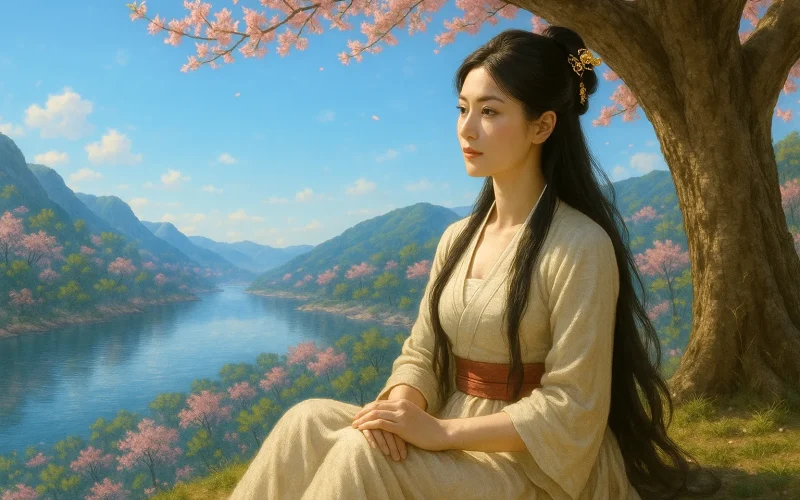



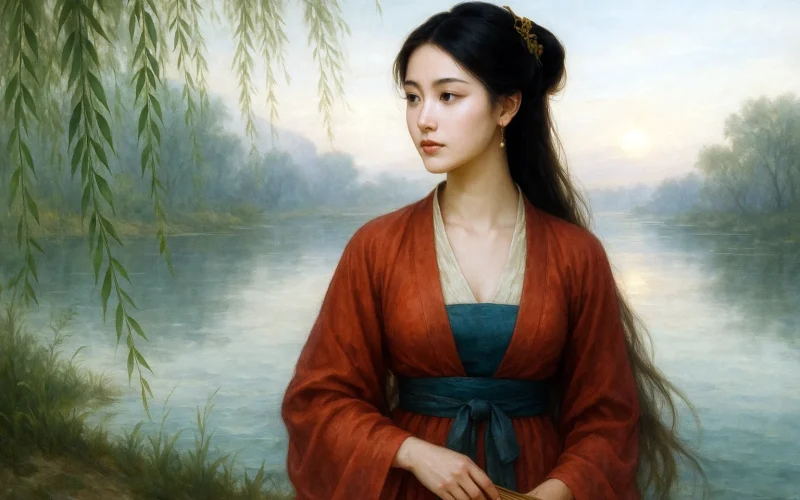
Green, green the willows, level the stream;
I hear my lad, on the stream, singing in a rhythmic theme.

In the east the sun shines, in the west rain falls free;
You may say it’s not clear (fine), yet it’s clear (fine), you see.
Original Poem
「竹枝词 · 杨柳青青江水平」
刘禹锡
杨柳青青江水平,闻郎江上踏歌声。
东边日出西边雨,道是无晴却有晴。
Interpretation
This poem was composed during the Changqing era of Emperor Muzong of Tang (821-824 AD), a time when Liu Yuxi, due to the failure of the "Yongzhen Reform," was exiled to the land of Ba and Shu, serving as Prefect of Kuizhou. This was the twentieth-odd year since his initial exile to Langzhou at age thirty-four, spent moving between remote prefectures. From Langzhou to Lianzhou, and then to Kuizhou, while his long years of exile distanced him from the political center, they also afforded him the opportunity to deeply engage with the folk life and culture of various regions. This poem is the most celebrated of the set. Adopting a young maiden's voice, it depicts the stirrings of her heart upon hearing a song by the riverside in springtime, possessing both the lively agility of folk songs and the subtle, profound sincerity of literati poetry, truly a model work combining literati poetry and folk song.
Kuizhou was located in eastern Sichuan, with perilous mountains and rivers and simple, rustic folkways. A local folk song genre called "Bamboo Branch Songs" was popular there. Originally rustic tunes sung impromptu by villagers during labor, boating, or festivals, they often sang of love between men and women or local landscapes, with straightforward, vivid language and a bright, melodious rhythm, frequently accompanied by dance and foot-tapping to mark the beat. Upon first arriving in Kuizhou, Liu Yuxi was captivated by this vibrant folk art—he discovered that within these seemingly rough and simple ballads lay a sincere emotion and vitality of life often lacking in literati poetry.
Thus, he began consciously imitating the melodies and style of the Bamboo Branch Songs in his own compositions, preserving the freshness and naturalness of the folk songs while infusing them with the subtlety and concision of literati poetry, ultimately creating a set of nine "Bamboo Branch Songs." It is important to note specifically that before Liu Yuxi, literati rarely ventured into composing such folk tunes. His attempt was groundbreaking, infusing Tang poetry with new folk vitality.
First Couplet: "杨柳青青江水平,闻郎江上踏歌声。"
Yáng liǔ qīng qīng jiāng shuǐ píng, wén láng jiāng shàng tà gē shēng.
Willows green, green; the river's waves are calm.
I hear my lad's voice singing stomping-songs upon the stream.
The poet begins with an evocative spring riverside scene: green willows, the river's calm surface, sketching a pure and gentle picture. This tranquil scenery perfectly externalizes the maiden's inner world—she stands alone by the river, her heart filled with both anticipation and unease. The line "I hear my lad's voice singing stomping-songs upon the stream" breaks the scene's stillness with the word "hear," also stirring the maiden's heart. The song drifts from the river; she hears the voice before seeing the person, preserving the forthright innocence of the folk song while adding a layer of subtle charm. Notably, "stomping-songs" (tage) was a form of folk ballad in the Ba-Chu region, sung while stamping feet to keep time. By incorporating this folk detail, the poet adds an authentic, tangible sense of life.
Second Couplet: "东边日出西边雨,道是无晴却有晴。"
Dōng biān rì chū xī biān yǔ, dào shì wú qíng què yǒu qíng.
The sun comes out in the east, rain falls in the west.
*You call this "no sun" (no feeling), yet there *is* sun (there is feeling)!*
This couplet can be called a stroke of genius. The poet first evokes the suddenly sunny, suddenly rainy weather, capturing the changeable nature of spring, then cleverly links "qing" (晴, sunny/clear) and "qing" (情, feeling/affection) through homophonic pun. On the surface, it describes the weather: the sun shines in the east, rain falls in the west—you can't definitively call it sunny or rainy. Actually, it describes the maiden's mood: the inner turmoil after hearing the song—her lad's voice warms her heart, yet she is unsure if the song is truly for her, doubts still lingering. This contradictory psychology of "seemingly sunny yet not, seemingly affectionate yet not" is captured profoundly in just seven characters. Even more wonderfully, the pun does not seem forced but emerges naturally from the immediate scene, as if the weather itself speaks of the maiden's heart.
Holistic Appreciation
Though only four lines, this poem is like a miniature psychological drama. The first line sets a static scene, establishing the backdrop for the maiden's presence. The second line introduces motion—the song intrudes, breaking the calm. The third line shifts to the weather, seeming to digress but secretly connecting to her mood. The fourth line concludes with the pun, merging weather and mood into one. The whole poem moves from external to internal, from scene to emotion, progressing layer by layer, subtly and seamlessly portraying a maiden's anticipation, hesitation, and delight at love's first stirrings. The poet does not directly describe the maiden's psychological activity; instead, through the arrival of the song and the change in weather, he lets readers infer the waves within her heart. This subtle, suggestive technique is precisely the brilliance of classical Chinese poetry.
Artistic Merits
- Homophonic Pun, Marvelously Integrated Without a Trace: The homophonic pun between "qing" (晴, sunny) and "qing" (情, feeling/affection) describes both the weather and the mood. This double entendre, achieved without apparent artifice, became an immortal, oft-quoted line.
- Using Scene to Convey Emotion, Subtle and Suggestive: Not a single word directly describes the maiden's feelings. Yet, through the tranquility of the riverscape and the shift in weather, readers sense the fluctuations within her heart.
- Folk Song Flavor, Literati Elegance: The language is simple and fluent, capturing the freshness and spontaneity of folk songs; the crafted use of puns and the depth of artistic conception exhibit the subtlety and enduring resonance characteristic of literati poetry. The two styles are harmoniously blended.
Insights
What this poem leaves us with is, first, an insight into the contradictory nature of emotion. The reason "You call this 'no sun' (no feeling), yet there is sun (there is feeling)!" is so moving is precisely because it expresses the most delicate moment in love—that anticipation amidst uncertainty, that hope amidst hesitation. In our current era that pursues "certainty," we habitually define relationships with "yes" or "no," "together" or "no contact," overlooking that the truest form of emotion is often ambiguous, seemingly present yet absent. Liu Yuxi reminds us with this line: The beauty of some emotions lies precisely in their uncertainty.
Secondly, this poem also prompts us to ponder where the poetry in life comes from. A maiden waiting by the river is a most ordinary scene; the sun shining in the east while it rains in the west is common weather. But in the poet's eyes, these ordinary things become perfect vehicles for emotion. This ability to discover poetry in the everyday, to capture the eternal in the mundane is perhaps what our era most needs to learn from the ancients. When we are accustomed to scrolling through short videos, chasing trends, can we still, like Liu Yuxi, read the richness and subtlety of life from a spring river, a strain of song, a sky interwoven with sun and rain?
Finally, the poet's own situation is also worth considering. When he wrote this poem, Liu Yuxi was in the midst of exile, politically frustrated and forlorn. Yet, the poem contains not a trace of dejection, only a sensitive observation and warm regard for human love. This very act of maintaining a love and sensitivity for life even in adversity is itself a remarkable spiritual strength. Life inevitably has its moments of interwoven sun and rain, but if, like the poet, we can read a different meaning in "The sun comes out in the east, rain falls in the west," then life will always have its parts worth savoring.
About the poet
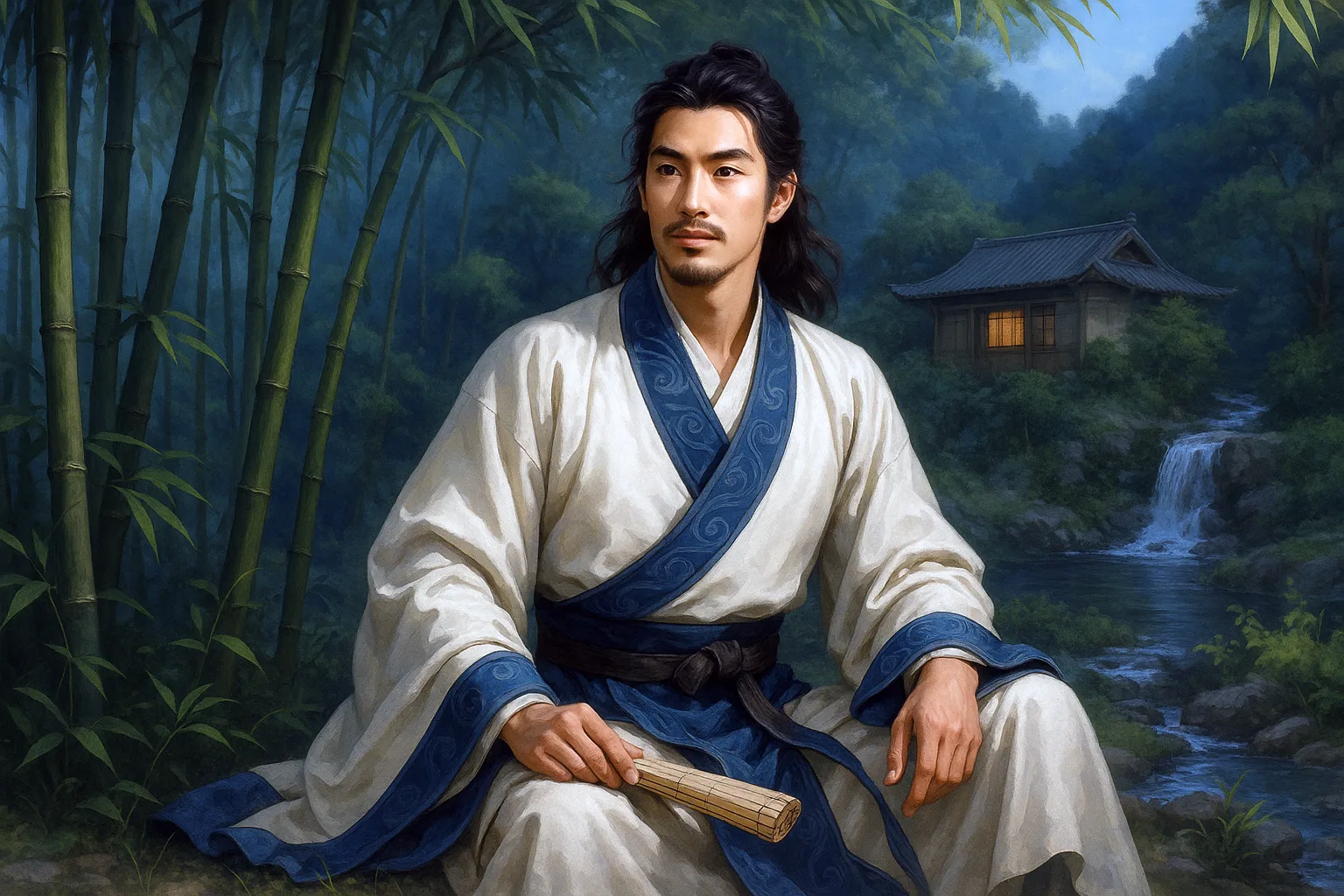
Liu Yuxi(刘禹锡), 772 - 842 AD, was a native of Hebei. He was a progressive statesman and thinker in the middle of the Tang Dynasty, and a poet with unique achievements in this period. In his compositions, there is no lack of poems reflecting current affairs and the plight of the people.