


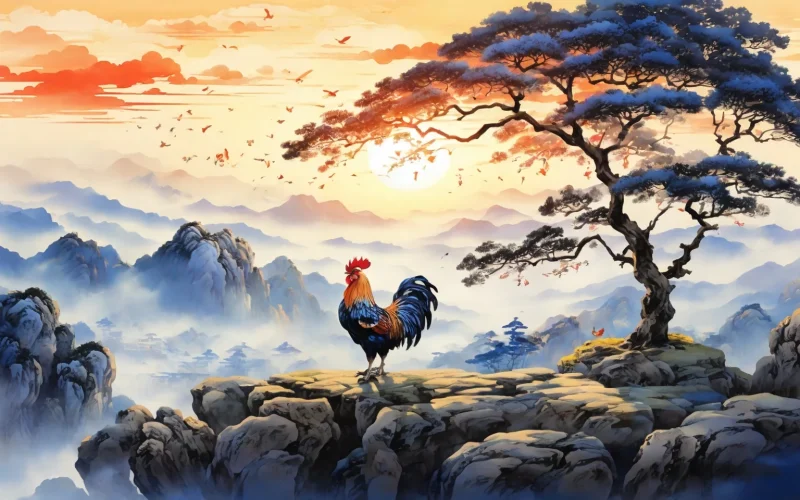
Unsuccessful I stay but with a cup of wine;
The kind host wishes me to live to ninety-nine.
An ancient could not but stay in the west for long;
In vain his household waited with their willow song.
"A young talent often met with contemptuous eye,
Unknown on the old earth under the dreary sky.

You may write letters of two lines now and again,
And you may not court imperial favor in vain."
I would not call back my soul lost in a sad plight,
But when the cock crows, all the world will see daylight.
"While young, you should aim high and soar into the cloud.
Who pities a lonely man sobbing in the crowd?"
Original Poem
「致酒行」
李贺
零落栖迟一杯酒,主人奉觞客长寿。
主父西游困不归,家人折断门前柳。
吾闻马周昔作新丰客,天荒地老无人识。
空将笺上两行书,直犯龙颜请恩泽。
我有迷魂招不得,雄鸡一声天下白。
少年心事当拏云,谁念幽寒坐呜呃。
Interpretation
In the winter of the second year of the Yuanhe era (807 AD), the eighteen-year-old Li He brought his poetry manuscripts from Changgu to the eastern capital, Luoyang. The young man's literary talent was already renowned throughout his hometown. The purpose of this journey was singular: to take the jinshi imperial examinations, enter officialdom through his family's status, and revive his family's declining fortunes. However, fate dealt him a fatal blow not long after he arrived in Chang'an. "The father's name is Jinsu; the son may not sit for the jinshi exams"—this single line, like a curse, nailed him fast outside the examination hall. Someone had accused him of violating "family name taboo": his father was named Li Jinsu, and "Jin" (晋) was homophonous with "Jin" (进) in jinshi (进士). According to ritual protocol, he was required to avoid this taboo and was thus barred from the examinations. Han Yu wrote a famous essay, "Disputation on Taboo," on his behalf, arguing pointedly: "If the father's name is Jinsu, the son may not sit for the jinshi exams; if the father's name is Ren ('benevolence'), does the son then cease to be human?" But public opinion was vehement, and in the end, there was no reversing the decision. This controversy destroyed Li He's only path to an official career. For the next few years, he remained stranded in Chang'an, relying on his distant imperial lineage to secure a minor, low-ranking post as a Ritual Ceremonialist (Fengli Lang), responsible for managing the placards of sovereign and ministers and directing sacrificial ceremonies, spending his days dealing with spirits and sacrifices. For a young poet whose ambitions soared to the heavens, this was nothing less than a spiritual exile.
This poem was composed during this period. Set in a scene of host and guest drinking together, it uses the host's words to introduce two famous historical figures: Zhufu Yan, who traveled west, found himself stranded, his family breaking willow branches at the gate awaiting his return; and Ma Zhou, who sojourned in Xinfeng, his talent unrecognized until old, yet who ultimately encountered a wise ruler because of a single memorial. These two allusions serve both as the host's consolation for his guest and the poet's own solace. And the timeless line, "Till a single cock-crow turns all under heaven white," is the unyielding cry bursting forth from the young Li He under the heavy pressure of fate—even if the road ahead is dark and cold, the young heart's ambition should soar to seize the clouds.
First Couplet: "零落栖迟一杯酒,主人奉觞客长寿。"
Líng luò qī chí yī bēi jiǔ, zhǔ rén fèng shāng kè cháng shòu.
Withered, adrift, stalled—a cup of wine;
The host presents the cup: "Long life, my guest!"
The opening states the predicament directly. "Withered, adrift, stalled" summarizes the poet's situation: withered like autumn leaves, stalled like a migrant bird. Yet the host raises his cup to urge a drink; the blessing, "Long life, my guest," offers a sliver of warmth in this cold reality. This couplet begins with "withered" and ends with "long life," establishing the poem's emotional shift from sorrow to resolve between hardship and well-wishing.
Second Couplet: "主父西游困不归,家人折断门前柳。"
Zhǔ fù xī yóu kùn bù guī, jiā rén zhé duàn mén qián liǔ.
Lord Father journeyed west, hard pressed, could not return;
His family broke and broke the willows by the gate.
This line uses the allusion of Zhufu Yan of the Western Han. In his early years, Zhufu Yan traveled to study, funds exhausted, often treated with contempt. Later, he submitted a memorial to Emperor Wu, was appointed a Gentleman of the Palace, and was promoted four ranks within a year. The poet selects his "stranded, could not return" phase. "His family broke and broke the willows by the gate" expresses the family's anxious longing—the broken willow branches symbolize both longing and the passage of time. This stroke both depicts his own drifting and foreshadows the reversal to come.
Third Couplet: "吾闻马周昔作新丰客,天荒地老无人识。"
Wú wén Mǎ Zhōu xī zuò Xīnfēng kè, tiān huāng dì lǎo wú rén shí.
I have heard that Ma Zhou once lodged in Xinfeng town,
Till heaven aged, earth crumbled, none knew his name.
This line uses the story of the early Tang minister Ma Zhou. In his impoverished youth, Ma Zhou lodged in Xinfeng, where the innkeeper slighted him. Later, becoming a client of General Chang He, he drafted a memorial on his behalf, winning Emperor Taizong's favor. He was appointed Investigating Censor and rose to be Secretariat Director. "Till heaven aged, earth crumbled, none knew his name" emphasizes the length of his hardship and depth of his obscurity. By having the host introduce this allusion, the poet likens himself to it: those who ultimately achieve great things also endured long years when "none knew [their] name."
Fourth Couplet: "空将笺上两行书,直犯龙颜请恩泽。"
Kōng jiāng jiān shàng liǎng háng shū, zhí fàn lóng yán qǐng ēn zé.
He merely took the two lines of writing on a sheet,
And, braving the dragon's countenance, sought the sovereign's grace.
Following directly, this line describes Ma Zhou's path to success. "Merely took" seems understated but implies depth: what changed his fate was not family status, wealth, or scheming, but merely "two lines of writing on a sheet." "Braving the dragon's countenance" captures the solitary courage and spirit of a scholar appealing directly to the Son of Heaven with his words. This couplet is both the host's guidance for his guest and the poet's hope for himself: even if stranded like Zhufu, obscure like Ma Zhou, as long as one holds grandeur within, a day will come to "brave the dragon's countenance."
Fifth Couplet: "我有迷魂招不得,雄鸡一声天下白。"
Wǒ yǒu mí hún zhāo bù dé, xióng jī yī shēng tiān xià bái.
I have a lost soul I cannot summon back,
Till a single cock-crow turns all under heaven white.
This couplet contains the timeless line and is the poem's emotional climax. "I have a lost soul I cannot summon back" continues the hardship of the preceding lines—the disappointment, hesitation, and confusion are like a scattered soul, difficult to recall. "Till a single cock-crow turns all under heaven white" uses a startling image to express sudden enlightenment and awakening: that single cock-crow tears through the long night, dispels confusion, and lets the whole world see the light again. This line is both literal (the long night ends) and metaphorical (the heart's knot is loosed); it is a natural scene, but more so, a sublimation of life's realm.
Sixth Couplet: "少年心事当拏云,谁念幽寒坐呜呃。"
Shào nián xīn shì dāng ná yún, shuí niàn yōu hán zuò wū è.
A young man's heart should aim to seize the clouds;
Who pities one who sits in cold and gloom and sobs?
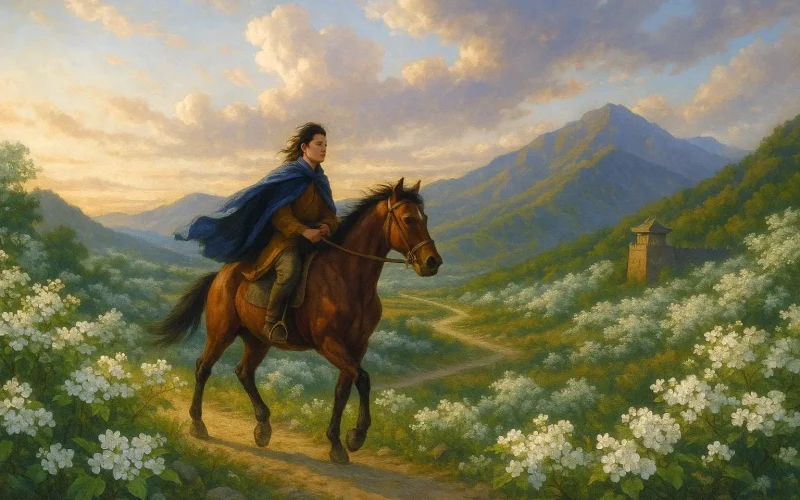
The final couplet concludes with a rhetorical question, expressing the sentiment directly. The seven words, "A young man's heart should aim to seize the clouds," are Li He's declaration to himself and to all unrecognized talented youths: ambition should be lofty, should aim to seize the clouds, soar straight to the Ninth Heaven. "Who pities one who sits in cold and gloom and sobs?" is a complete negation of the earlier hardship—sobbing alone wins no pity; rather than sitting and waiting, one should rouse oneself and soar. This couplet releases all the emotion accumulated previously, completing the total transformation from lament to self-exhortation.
Overall Appreciation
This poem is the most inspirational among Li He's works and a rare example where he concludes with an uplifting tone. Using the host-guest wine encouragement as a thread, and through allusions to two historical figures, it progresses layer by layer to complete the emotional transformation from hardship to self-encouragement.
Structurally, the poem divides into three layers. The first two lines are the first layer, opening with "withered, adrift, stalled" to describe present hardship. The middle six lines are the second layer, using the allusions of Zhufu Yan and Ma Zhou to use the past as a metaphor for the present, seeking spiritual solace and motivation. The final four lines are the third layer, using the enlightenment of "a single cock-crow turns all under heaven white" and the declaration of "a young man's heart should aim to seize the clouds" to complete the emotional reversal. Between the three layers, the movement is from sorrow to resolve, from hardship to attainment, clearly delineated and naturally transitioning.
Conceptually, the poem's core lies in the phrase "self-encouragement." Li He does not linger in denouncing an unjust fate. Instead, he seeks models from history and draws strength from within. Zhufu Yan's "stranded, could not return" and Ma Zhou's "none knew his name" ultimately awaited the chance to "brave the dragon's countenance." What of himself, then? That "single cock-crow" is both the host's guidance for the guest and the poet's own awakening.
Artistically, the poem's most moving aspect is the aptness of its allusions and the originality of its imagery. Zhufu Yan and Ma Zhou are both archetypes of lowly origins who endured hardship and ultimately found high office, highly resonant with Li He's own situation. The imagery of "a single cock-crow turns all under heaven white" is a quintessentially Li He-esque, startling creation—that cock-crow is not an ordinary dawn herald; it is a divine, soul-awakening sound that rends the darkness.
Artistic Features
- Layered Structure, Well-Paced Emotional Shifts: Begins with hardship, uses ancient examples for resolution, concludes with uplift. Emotion builds layer by layer; transitions are natural and powerful.
- Skillful Use of Allusion, Using the Past to Illuminate the Present: The allusions to Zhufu Yan and Ma Zhou both reflect his own situation and express hope for a reversal of fate. They are apt, not piled-on; deepen meaning without obscurity.
- Dialogue Format, Intimate and Natural: The setting of host and guest drinking allows the host to introduce allusions and consolation, giving the poem dramatic tension and avoiding the thinness of pure lyricism.
- Startling Imagery, Unique Ingenuity: "A single cock-crow turns all under heaven white" uses an ordinary image to express an extraordinary realm, possessing both visual impact and philosophical penetration. It is a signature creation of Li He's poetry.
- Concise Language, Full of Emotion: The entire poem has no superfluous words, yet it melds hardship, self-encouragement, and hope into one, resonating powerfully when read.
Insights
This poem is a potent tonic Li He left for later generations of youth. It tells us hardship is the norm of life, but not its end. When Zhufu Yan was "stranded, could not return," who could have imagined his four promotions within a year? When Ma Zhou was known by "none," who could have foreseen he would become a famed minister? The poet encourages himself and others with this: the present gloom is merely the unbroken night; as long as that inner cock-crow has not yet sounded, do not sit waiting for dawn, but go and seek that crow yourself.
It further tells us that "少年心事" should have the ambition "to seize the clouds." "Seizing the clouds" means reaching the Ninth Heaven to pluck the moon. This ambition is not calculation for rank and riches, nor scheming to curry favor; it is the solitary courage to "brave the dragon's countenance" with "two lines of writing on a sheet," the belief that words can change fate. Li He was stripped of the right to sit for exams, but he was never stripped of the right to write; he could not become a jinshi, but he became a poet for the ages.
For a hundred generations since, countless young people have read this poem in life's darkest moments. That single cock-crow, traversing a thousand years, still calls to everyone lost on the path: rise, go forth, daylight lies ahead.
Poem translator
Xu Yuanchong (许渊冲)
About the Poet
Li He (李贺 790 - 816), a native of Yiyang, Henan, was a Romantic poet of the Mid-Tang dynasty. A descendant of the Tang imperial clan, he was barred from taking the national jinshi civil service examination due to a naming taboo (his father's name contained a character homophonous with "Jin"), which led to a life of frustration and poverty. He died at the age of twenty-seven. His poetry, renowned for its bizarre grandeur, chilling elegance, and fantastical imagination, earned him the title "Ghost of Poetry." He pioneered the distinctive "Changji Style" within Tang poetry, exerting a profound influence on later poets like Li Shangyin and Wen Tingyun and on the expansion of poetic imagery in subsequent eras.