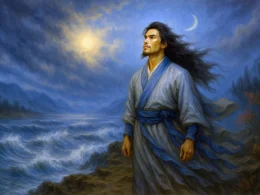
Master, I hail you from my heart,
And your fame arisen to the skies.
Renouncing in ruddy youth the importance of hat and chariot,
You chose pine-trees and cloud s; and now, white-haired,
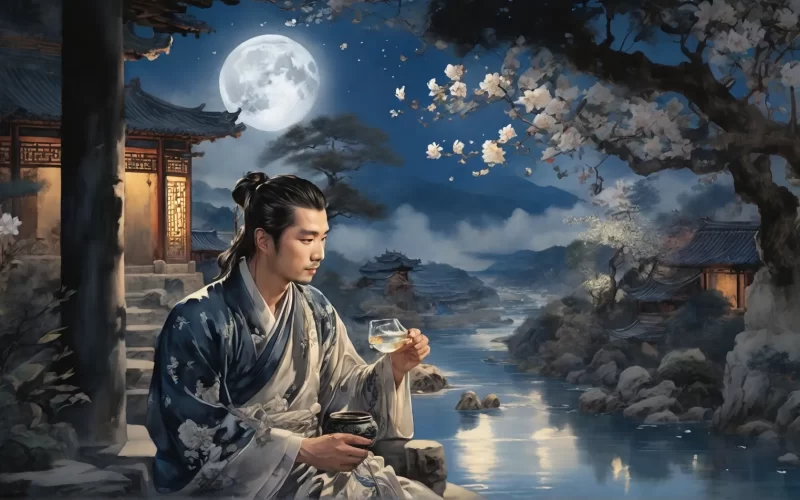
Drunk with the moon, a sage of dreams,
Flower-bewitched, you are deaf to the Emperor
High mountain, how I long to reach you,
Breathing your sweetness even here!
Original Poem
「赠孟浩然」
李白
吾爱孟夫子,风流天下闻。
红颜弃轩冕,白首卧松云。
醉月频中圣,迷花不事君。
高山安可仰,徒此揖清芬。
Interpretation
This poem was likely composed around 739 CE after Li Bai visited Meng Haoran in Xiangyang, or perhaps as a parting gift before Meng's passing the following year. By then, Meng Haoran was already widely celebrated. Though he never held official office, his lofty reclusive spirit and elegant poetic reputation were deeply admired by Li Bai. This work is exceptionally rare among Li Bai's poems—a complete five-character regulated verse expressing supreme respect for a living poet. It embodies Li Bai's understanding and admiration of Meng Haoran's personal character and ideals, while also reflecting his own spiritual pursuit of "neither bending oneself nor seeking favors from others."
First Couplet: “吾爱孟夫子,风流天下闻。”
Wú ài Mèng fūzǐ, fēngliú tiānxià wén.
My beloved Master Meng, I hold you dear; Your noble grace is known to all, far and near.
The opening directly expresses unreserved admiration. The word “love” governs the entire poem, establishing a tone of ardent yet solemn affection. “Noble grace” here does not imply romantic exploits but refers to Meng Haoran's exceptional character encompassing poetic fame, talent, demeanor, and moral integrity. This line elevates the social prestige and personal charisma of a poet outside officialdom to its highest form.
Second Couplet: “红颜弃轩冕,白首卧松云。”
Hóngyán qì xuānmiǎn, báishǒu wò sōng yún.
In youth you spurned carriage and crown's acclaim; In white-haired age you rest 'mid pines and clouds, the same.
This couplet succinctly summarizes Meng Haoran's lifelong aspirations. “Youth” contrasts with “white-haired age,” outlining a temporal span; “spurned carriage and crown” contrasts with “rest 'mid pines and clouds,” revealing his consistent life choices. “Spurned” is forceful, indicating a conscious, deliberate rejection; “rest” is vividly descriptive, portraying his harmonious ease with nature. Together, they depict a noble scholar who remained outside officialdom throughout his life, serene and transcendent.
Third Couplet: “醉月频中圣,迷花不事君。”
Zuì yuè pín zhòng shèng, mí huā bù shì jūn.
Drunk with moonlight, oft in holy wine you delight; Charmed by blossoms, you serve no sovereign's might.
This couplet vividly depicts details of Meng Haoran's reclusive life. “Drunk with moonlight” and “charmed by blossoms” merge a poetic, wine-loving existence with the appreciation of natural beauty, full of elegant artistic sentiment. “Oft” shows this as his常态; “serve no sovereign” resolutely declares his life stance. In Li Bai's portrayal, this choice is not passive withdrawal but an active pursuit of a nobler, freer mode of being.
Fourth Couplet: “高山安可仰,徒此揖清芬。”
Gāoshān ān kě yǎng, tú cǐ yī qīngfēn.
How can one hope to gaze up to a mountain so high? I can but bow here to your fragrance pure, with a sigh.
The concluding couplet uses metaphor and symbolism to culminate the emotion. The allusion to “gazing up to a high mountain” expresses utmost reverence for Meng Haoran's character. “How can one hope” reinforces this lofty ideal's perceived unattainability through rhetorical questioning. “Bow to your fragrance pure” crystallizes the poem's sentiment; “fragrance pure” refers both to his fresh poetic style and, more importantly, symbolizes his unsullied personal integrity. With a respectful “bow,” the poet offers the highest form of tribute to his spiritual idol.
Holistic Appreciation
This poem is a masterpiece among Li Bai's five-character regulated verses, notable for its tight structure and emotional richness. It follows a “general-specific-general” framework: the first couplet generally expresses affection and renown; the second and third couplets specifically describe his “reclusion” and “ease” through life summary and details; the final couplet generally praises his mountain-like character and offers supreme respect. The poem embodies a harmony of contrasts: on one hand, Li Bai's characteristic eruptive, direct passion (“My beloved”); on the other, Meng Haoran's image of serene tranquility (“rest 'mid pines and clouds”). It contrasts worldly standards of success (carriage, crown, serving the sovereign) with the poet's upheld values (spurning, not serving). Through these contrasts and choices, Li Bai establishes an ideal model of literati character in his mind.
Artistic Merits
- Exquisite and Precise Parallelism: The parallelism in the middle couplets is exceptionally balanced. For example, “youth” pairs with “white-haired age”; “spurned carriage and crown” with “rest 'mid pines and clouds”; “drunk with moonlight” with “charmed by blossoms”; “oft in holy wine” with “serve no sovereign.” This formal perfection creates a multi-dimensional portrayal from time to action, exterior to interior, rich in meaning.
- Subtle Use of Allusion and Imagery: “Holy wine” alludes elegantly to a story about Xu Miao from the Cao Wei period; “high mountain” adapts the Book of Songs phrase “gazing up to a high mountain” naturally; imagery like “pines and clouds” and “fragrance pure” collectively constructs a realm of lofty purity.
- Ardent yet Solemn Emotional Expression: The poem is emotionally full yet expressed with dignified propriety. The opening is passionate, the conclusion reverent, and the narrative in between filled with admiration, creating a sincere tone of respect without flattery, admiration without sycophancy, showcasing Li Bai's genuine reverence for true virtue.
Insights
This is not merely a poem to a friend but a “hymn to an ideal character.” It demonstrates a timeless standard for assessing life's value: a person's success and greatness need not be tied to fame and fortune. Meng Haoran, with his talent that made his “noble grace known to all” and his steadfast commitment to “rest 'mid pines and clouds” even in old age, earned Li Bai's and later generations' highest respect. The poem teaches us that within a pluralistic value system, maintaining spiritual independence, pursuing artistic truth, and guarding inner peace can also constitute a lofty and inspiring life. Furthermore, Li Bai's own magnanimity—his unreserved, sincere praise for another's virtue—itself shines as a precious moral light.
Poem translator
Kiang Kanghu
About the poet
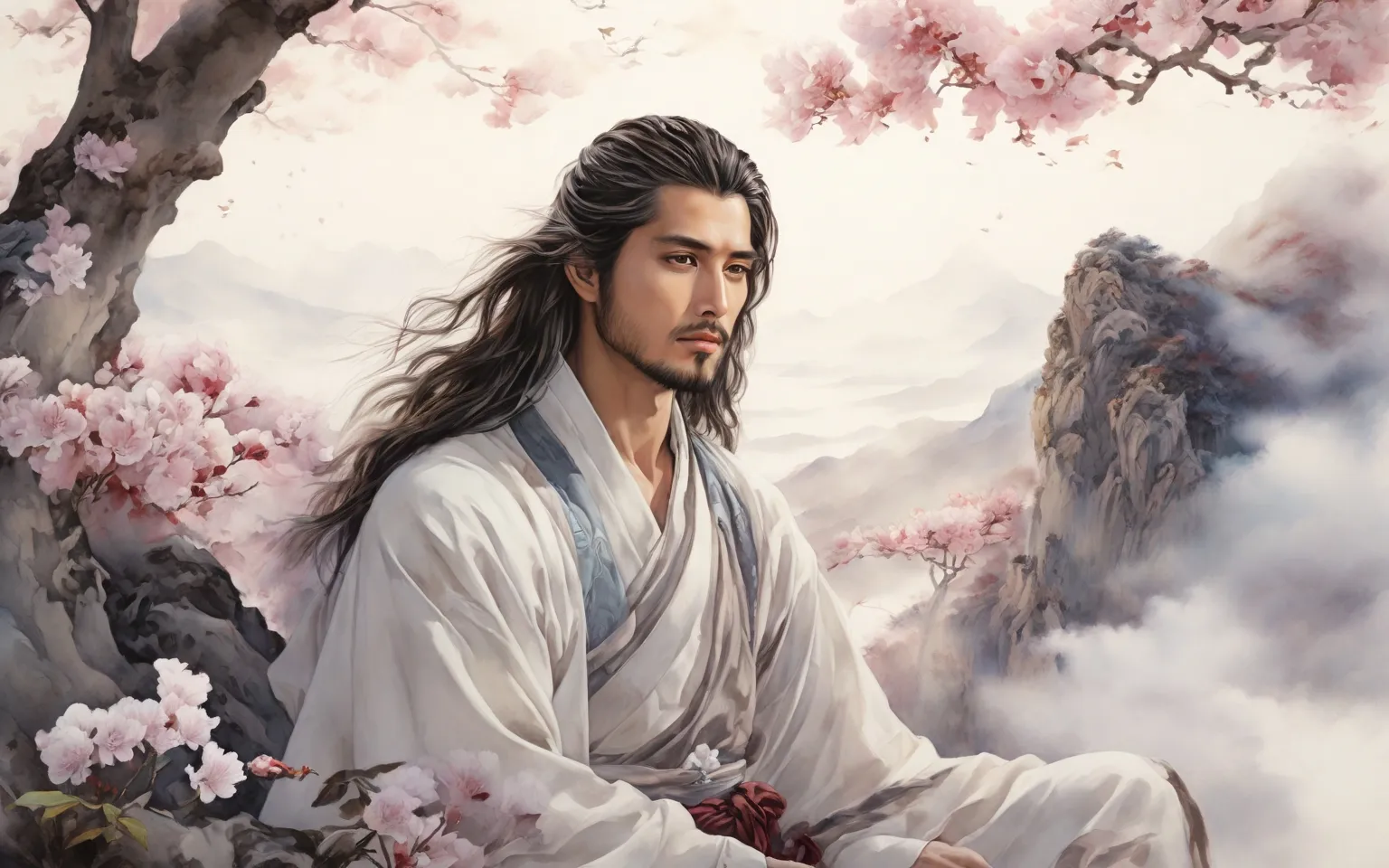
Li Bai (李白), 701 - 762 A.D., whose ancestral home was in Gansu, was preceded by Li Guang, a general of the Han Dynasty. Tang poetry is one of the brightest constellations in the history of Chinese literature, and one of the brightest stars is Li Bai.