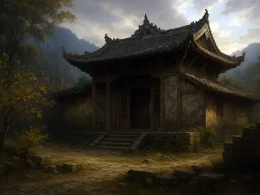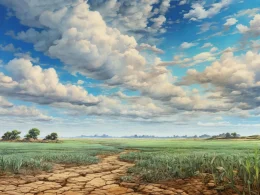



The foe shoot arrows on frontier in autumn day;
The startled grieved wild geese disperse and fly away.
The statue sees their shadows pass beneath the moon bright;
The lonely palace hears their cries in candlelight.

You know the foe would run their horses therefore long.
Could you go back one and all when spring sings its song?
Don't say few live on Southern rivers up and down!
With water plants the Southern shores are overgrown.
Original Poem
「早雁」
杜牧
金河秋半虏弦开,云外惊飞四散哀。
仙掌月明孤影过,长门灯暗数声来。
须知胡骑纷纷在,岂逐春风一一回。
莫厌潇湘少人处,水多菰米岸莓苔。
Interpretation
This poem was composed in the eighth lunar month of 842 AD, during Du Mu's tenure as Prefect of Huangzhou. That year, the Uighur Khan led his forces southward, invading and pillaging the regions of Yun and Shuo, triggering a large-scale southward exodus of border populations. The word "early" in the title refers not only to the wild geese migrating south prematurely in the eighth month (typically they fly in the ninth) but, more significantly, metaphorically points to the border refugees compelled to flee south ahead of time due to the ravages of war. Though stationed in the interior of the Jiang-Huai region at the time, Du Mu, with a poet's unique sensitivity to time and space, fused the northern conflict and the southern refugees' plight within the classical imagery of the southward-flying geese, crafting a frontier poem with strong allegorical force and deep social concern.
The poem's creation coincided with Li Deyu's administration, a period actively planning resistance against the Uighurs. As a local official, Du Mu would have been directly aware of the court's border policies and the realities of refugee resettlement. The depiction in the lines "Past the Immortals' palms in moonlight their lone shadows flee, / To the Dim-lit Long Gate Palace come a few cries, cold and clear" serves as a veiled critique of the Chang'an court while also reflecting the complex expectations local officials harbored toward the central government during national crises—hoping for decisive action while soberly cognizant of its limitations. This subtle tension elevates The Early Wild Geese beyond simple allegory, rendering it a profound expression of the late Tang scholar-official's political psyche.
First Couplet: 金河秋半虏弦开,云外惊飞四散哀。
Jīn hé qiū bàn lǔ xián kāi, yún wài jīng fēi sì sàn āi.
At Golden River, as mid-autumn reigns, the nomad's bowstring sings;
Beyond the clouds, in panicked flight, they scatter on bewildered wings,
Their mournful cries adrift on bitter air.
Explication: "At Golden River, as mid-autumn reigns" begins with precise spatiotemporal coordinates: Golden River (south of modern Hohhot) was the frontline of Uighur incursions at the time, while "mid-autumn" (the eighth lunar month) highlights the abnormality of the geese's premature migration. "The nomad's bowstring sings" strikes with the sharpness of a released arrow, depicting both the nomadic practice of hunting and, metaphorically, the brutal reality of war violently rupturing peace. "Beyond the clouds, in panicked flight" grants the geese a transcendent vantage point—even high above the clouds, they remain imperiled by the conflict below, implying the far-reaching, inescapable shadow of war. "Scatter on bewildered wings" captures their disordered formation, and "mournful cries" their plaintive sound, together forging a dual sensory impression—visual and auditory—of a refugee tide in disarray.
Second Couplet: 仙掌月明孤影过,长门灯暗数声来。
Xiān zhǎng yuè míng gū yǐng guò, Chángmén dēng àn shù shēng lái.
Past the Immortals' palms in moonlight, their lone shadows flee,
To the Dim-lit Long Gate Palace come a few cries, cold and clear.
This couplet accomplishes a spatial leap through imagery of the Chang'an palaces. "Immortals' palms" refer to the bronze dew-collecting plates shaped like immortal hands from Emperor Wu of Han's Jianzhang Palace, here representing the Tang imperial court; "Long Gate Palace" was originally a Han palace for disfavored consorts, here hinting at the neglected state of border affairs. The "lone shadows" passing by and the "few cries" arriving create an interweaving of sight and sound: the silent, visual passage of shadows past the Immortals' palms serves as a mute warning, while the faint, auditory cries reaching Long Gate constitute a direct, yet distant, plea. The contrast between the bright moonlight and the dim palace lamps subtly critiques the court's perception of the border crisis—which ought to be as lucid as the moonlight but remains as obscure and inattentive as the feeble lamplight. The scene of lone geese traversing the palace grounds becomes a potent metaphor for the plight of refugees reaching the seat of power yet meeting with indifference.
Third Couplet: 须知胡骑纷纷在,岂逐春风一一回?
Xū zhī hú jì fēnfēn zài, qǐ zhú chūnfēng yīyī huí?
Know well: the Tartar horsemen still run wild, a countless horde.
How could you, with the spring wind, return to order and accord?
Here, the poet's rational judgment shatters any romantic illusion. "Know well" carries the weight of a historian's pronouncement, insisting on harsh reality; "still run wild, a countless horde" uses emphatic language to stress the enemy's pervasive presence. The following rhetorical question, "How could you, with the spring wind, return to order and accord?" deconstructs the traditional poetic motif of geese returning with spring—a symbol of natural cycles and renewal. Du Mu asserts that when the homeland remains occupied, even the rhythms of nature must yield to political reality. The imagined orderly return ("to order and accord") poignantly underscores the shattered hope for the displaced to reunite in their homeland. This couplet marks a shift from depicting circumstance to pronouncing judgment on fate.
Fourth Couplet: 莫厌潇湘少人处,水多菰米岸莓苔。
Mò yàn Xiāo Xiāng shǎo rén chù, shuǐ duō gū mǐ àn méi tái.
Do not scorn the Xiao and Xiang, those sparsely peopled strands,
Where wild rice grains abound in water, moss clothes the shores and sands.
The final couplet, amidst despair, carves out a path of grim survival. "Do not scorn" adopts a tone of pragmatic consolation, acknowledging the desolation ("sparsely peopled strands") of the Xiao-Xiang river region (in modern Hunan), yet immediately countering with its material provisions: "wild rice grains abound in water, moss clothes the shores." Wild rice (the grain of Manchurian wild rice) and moss, natural sustenance for geese, are transformed here into symbolic resources for refugees struggling to subsist in unfamiliar lands. This advice embodies a desperate humanitarian concern—it is not an invitation to settle contentedly but a counsel to secure bare survival when larger circumstances are beyond one's control. Representing the southern hinterland, the Xiao-Xiang region stands in geographical opposition to the northern frontier of Golden River, thus completing a full narrative arc of exile: from northern warfare to a precarious southern refuge.
Holistic Appreciation
This is a poetic-historical work that reimagines the geography of displacement through the migration of wild geese. Du Mu's excellence lies in endowing the traditional "goose poem" with a sharp contemporary dimension, transforming the flock into living coordinates mapping a national crisis. The poem constructs three distinct spatial tiers: the northern borderlands (Golden River) as the origin of catastrophe; Chang'an (Immortals' Palms, Long Gate) as the detached and inattentive center of power; and the Xiao-Xiang region as the unwelcome yet necessary place of refuge. Linked by the geese's flight path, these spaces form a late Tang cartography of refugee movement.
The poem's emotional logic follows a stark progression: "panic and dispersal—lonely appeal—vanished hope—precarious sanctuary." The first couplet portrays the sudden shock of disaster; the second, the failed attempt to communicate suffering to authority; the third, the crushing realization that return is impossible; the fourth, the grim acceptance of a minimal existence. Through this structure, Du Mu profoundly transforms the traditional frontier poem theme: it moves beyond depicting "warriors half-dead upon the field" to articulate a postwar narrative of trauma focused on "the displaced and the dispossessed." The enduring damage of war is fully revealed only when the geese—symbolizing the people—are forced to abandon the dream of "returning with the spring wind" and must resign themselves to survival on "wild rice and moss."
Particularly noteworthy is the symbolic use of numerical and quantitative terms: "scatter" conveys the breaking of the multitude; "lone shadows" portrays individual isolation; "a few cries" suggests the weakness of their appeal; "return to order and accord" implies the impossibility of collective restoration; "sparsely peopled" describes the desolation of their refuge. This progression from plurality to singularity, from the collective to the solitary, traces the systematic disintegration of social fabric wrought by war. The solitary instance of "abound" in "wild rice grains abound" stands as the only note of increase amidst this narrative of diminishment, a minimal material promise that becomes the sole flicker of light in the encompassing darkness.
Artistic Merits
- The Wartime Reconfiguration of Geographic Imagery: Golden River (the battlefield), the Immortals' Palms and Long Gate (the court), and the Xiao-Xiang rivers (the refuge) form a complete geographic and narrative chain. By mapping the geese's trajectory onto these sites, Du Mu forges potent political connections between them, creating a form of poetic cartography charged with historical meaning.
- The Dual Signification of Palace Metaphors: "Immortals' palms" alludes to Emperor Wu of Han's quest for earthly immortality via dew-collecting—a subtle dig at Emperor Wuzong of Tang's later obsession with Daoist elixirs. "Long Gate," recalling the neglected Empress Chen, symbolizes the court's inattention to pressing border crises. This technique of embedding contemporary political critique within allusions to historical palaces is a hallmark of Du Mu's historical poetry.
- The Poetic Articulation of Survival Logic: The final couplet's admonition, "Do not scorn the Xiao and Xiang," superficially offers cold comfort but contains a starkly pragmatic survival wisdom—when one cannot alter the larger circumstance, one must first secure the means for bare survival. This elevation of grim necessity into a poetic theme is remarkably rare in classical verse.
Insights
This work exposes an often-overlooked dimension of wartime catastrophe: the greatest suffering often lies not in the immediate carnage but in the years of displacement and deracination that follow. Du Mu does not depict battlefield heroics but focuses on the protracted trauma of the displaced: their panicked flight, their unheard appeals to authority, their shattered hopes of return, and their grim adaptation to marginal lands. The lesson for any age is this: in assessing the cost of war, we must account not only for the battles lost but for the broken lives that "cannot return with the spring wind" and the long-term desolation of those who must learn "not to scorn" a barren refuge.
The imagery of "Past the Immortals' palms in moonlight their lone shadows flee, / To the Dim-lit Long Gate Palace come a few cries, cold and clear" poses a fundamental question of political ethics: when the suffering of the people passes like phantom shadows before the seat of power, does that power perceive it with the cold clarity of the moon, or does it remain shrouded in the willful obscurity of dimmed lamps? By juxtaposing the Immortals' Palms and Long Gate, Du Mu reveals the court's perilous paradox: it is capable of pursuing the fantastical (symbolized by the dew-collecting immortal) while remaining numb to the immediate (the cries from the frontiers). This reminds all holders of power that true governance begins with the capacity to hear the faintest, most distant "cries, cold and clear."
Ultimately, the poem provides not just historical empathy but a multifaceted lens for comprehending disaster. Du Mu teaches us that to understand a conflict, one must look both at where "the nomad's bowstring sings" and where "wild rice grains abound"; one must listen both to the "mournful cries" from beyond the clouds and heed the "dim-lit" silence within the palace walls. In this sense, The Early Wild Geese is more than a war poem; it is a diagnostic framework. It tells us that when the first flocks of "early" migrants take to the skies, a society's early warning system should already be sounding the alarm.
Poem translator
Xu Yuanchong (许渊冲)
About the poet
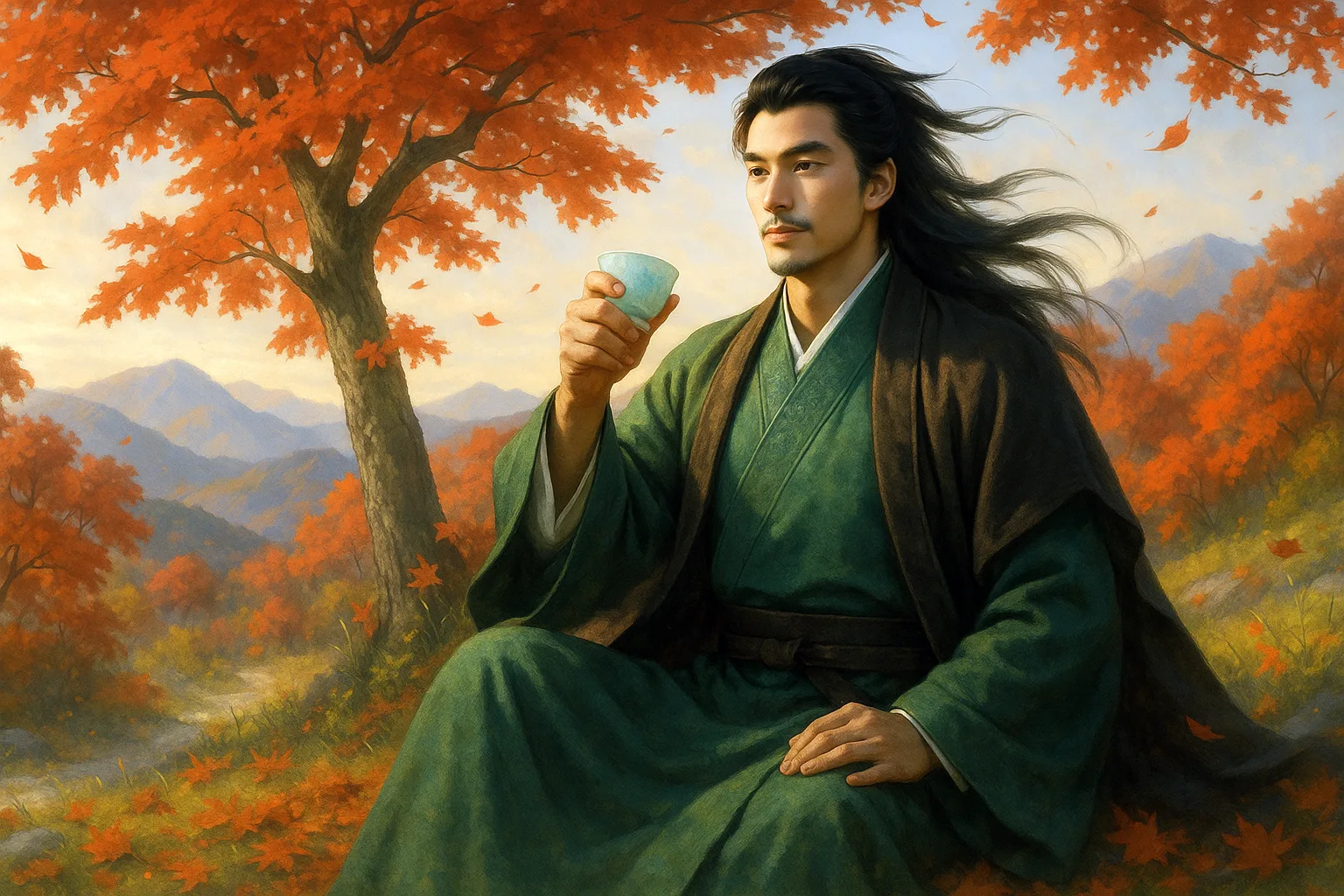
Du Mu (杜牧), 803 - 853 AD, was a native of Xi'an, Shaanxi Province. Among the poets of the Late Tang Dynasty, he was one of those who had his own characteristics, and later people called Li Shangyin and Du Mu as "Little Li and Du". His poems are bright and colorful.