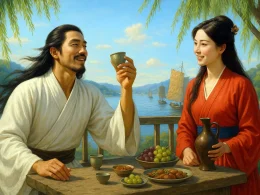




An old fisherman spent the night here, under the western cliff;
He dipped up water from the pure Hsiang and made a bamboo fire;
And then, at sunrise, he went his way through the cloven mist,
With only the creak of his paddle left, in the greenness of mountain and river.
...I turn and see the waves moving as from heaven,
And clouds above the cliffs coming idly, one by one.
Original Poem
「渔翁」
柳宗元
渔翁夜傍西岩宿,晓汲清湘燃楚烛。
烟销日出不见人,欸乃一声山水绿。
回看天际下中流,岩上无心云相逐。
Interpretation
This poem was composed during Liu Zongyuan's exile in Yongzhou, around 809 AD. By then, he had spent about four years in Yongzhou, his initial indignation and resentment gradually giving way to a deeper contemplation of the surrounding landscape. Yongzhou featured serene scenery, with fantastic peaks and the clear Xiang River meandering through. Liu Zongyuan often wandered these hills and streams, producing works like the Eight Records of Yongzhou. "The Fisherman" is from this period. The "Western Cliff" refers to West Mountain outside the city, a frequent haunt of his; the "Xiang" is the river flowing clear as silk through the region.
The poem depicts a fisherman: spending the night beneath West Mountain, drawing clear river water at dawn, cooking over a bamboo fire; after sunrise, the mist dissolves, the fisherman is gone, only the sound of an oar is heard, upon which the landscape appears vividly green; looking back, the boat is already midstream, and only the clouds atop the cliffs drift leisurely, chasing one another. This fisherman is both observed and envied by the poet; a real person, yet also a spiritual projection. Through this figure, Liu Zongyuan expresses his longing for freedom and detachment, while also hinting at the impossibility of achieving true reclusion.
First Couplet: "渔翁夜傍西岩宿,晓汲清湘燃楚烛。"
Yú wēng yè bàng xī yán sù, xiǎo jí qīng Xiāng rán chǔ zhú.
A fisherman anchors for the night beneath Western Cliff,
Draws clear Xiang River water, cooks with bamboo at dawn.
The opening outlines the fisherman's day and night. "Anchors for the night beneath Western Cliff"—at night, he moors his boat beneath the mountain and sleeps. The word "anchors" conveys intimacy with nature. "Draws clear Xiang River water, cooks with bamboo at dawn"—waking, he draws fresh water, lights a fire with bamboo, and cooks. The actions "draws" and "cooks" are simple yet concrete, full of life; the images of "clear Xiang River" and "bamboo" ground the scene and add poetic flavor.
These two lines depict an extremely simple life with utmost simplicity. There is no drama, only daily routines. This plainness renders the fisherman's life authentic and relatable.
Second Couplet: "烟销日出不见人,欸乃一声山水绿。"
Yān xiāo rì chū bú jiàn rén, ǎi nǎi yī shēng shān shuǐ lǜ.
When mist dissolves, sun rises, the fisherman's unseen;
A creak of the oar, and hills and streams turn fresh green.
This couplet is the stroke of genius in the poem. "When mist dissolves, sun rises"—as visibility clears, one expects to see the fisherman, yet he is "unseen"—he has quietly departed. This "absence" sparks more imagination than "presence."
Then, "A creak of the oar, and hills and streams turn fresh green"—that sound emerges from afar, as if saying: the fisherman is still there, just already far away. Wonderfully, that single "creak" seems magical, causing the landscape to "turn fresh green." This is not visual truth but an auditory illusion, a poetic creation—the sound awakens and tints the world.
These lines depict the person and scene through sound. The person is unseen, but his sound is heard; the sound enters the ear, and the scenery turns greener. The fisherman grows more mysterious in his absence; the verdancy more vivid because of the sound. This is a classic example of Liu Zongyuan's "mutual generation of the substantial and insubstantial."
Third Couplet: "回看天际下中流,岩上无心云相逐。"
Huí kàn tiān jì xià zhōng liú, yán shàng wú xīn yún xiāng zhú.
Turning, I watch him vanish down mid-current toward the sky;
On the cliff, clouds, free and purposeless, chase idly by.
The final couplet pulls the perspective distant and sublimates the conception. "Turning, I watch him vanish down mid-current toward the sky"—the gaze follows the departed fisherman downstream, as if he merges with the horizon. This "turning" is both a search and a framing of the scene.
The final line, "On the cliff, clouds, free and purposeless, chase idly by," is the finishing touch. The clouds drift and chase, carefree and unaware. The phrase "free and purposeless" recalls Tao Yuanming, describing both the clouds' natural state and a transcendent, free spiritual realm. The fisherman is gone, leaving only the clouds; his life is like these clouds—unfettered, spontaneous. These clouds are both the scene and a projection of the poet's soul—he longs to be like them, purposeless, drifting freely.
Holistic Appreciation
Using the fisherman's routine, this poem unfolds a serene landscape through time. The first couplet describes night and dawn, rich with life; the second couplet depicts the "unseen" fisherman and the transformative sound after sunrise; the final couplet offers a distant view, concluding with "free and purposeless clouds," elevating the conception.
The structure is complete. From near to far, concrete to abstract, person to clouds, it advances and sublimates. The language is simple, the conception deep; the imagery clear, yet philosophical. The fisherman is both real and symbolic; the green is both seen and perceived; the chasing clouds are both natural and ideal. Compared to Liu Zongyuan's more anguished works, this poem carries detachment and ease. Yet a subtle loneliness lingers—the wistfulness of the "unseen," the search in "turning," the longing in "free and purposeless" hint at a lack and desire in the poet's heart. This detachment is a longing for it; this ease is an imagination of it.
Artistic Merits
- Substantial and Insubstantial: The "absence" of the fisherman and the "presence" of the sound create a wondrous effect.
- Synesthesia: The "creak of the oar" gives rise to the landscape "turn[ing] fresh green," connecting sound and sight.
- Simple Language, Profound Meaning: Not a superfluous word. "Free and purposeless" describes scene, feeling, and aspiration.
- Clear Progression: From night to dawn, near to far, concrete to abstract, concluding with lingering resonance.
Insights
This poem first shows how to maintain a longing for freedom amidst hardship. Confined in exile, Liu Zongyuan could still write of detachment and ease. The carefreeness of the fisherman, the purposelessness of the clouds, are externalizations of his yearning. This tells us: Even if the body is bound, the mind can yearn for freedom; imagination can create another world.
The experience of "欸乃一声山水绿" prompts us to consider the creativity of perception. Can a sound make the landscape green? In poetry, it can—poetry creates reality. This reveals: Our perception is itself a form of creation. The same world can be perceived and expressed differently, creating different worlds.
The image of "岩上无心云相逐" leads us to consider true freedom. The clouds are "free and purposeless" because they are unbound, aimless, natural. This is the Daoist "non-action" Liu Zongyuan yearned for. It reveals: True freedom is not doing as one pleases, but being unencumbered; not deliberate pursuit, but natural emanation.
Finally, the "unseen" fisherman is especially thought-provoking. He never appears directly; we see only traces of his presence. This "absence" makes him more mysterious, more moving. It shows: Some beauties, because unattainable, are more yearned for; some presences, because half-visible, are more worth seeking. That fisherman is the ideal in Liu Zongyuan's heart; that ideal is always ahead, in the sound, among the clouds, yet the man is always "unseen."
Poem translator
Kiang Kanghu
About the poet
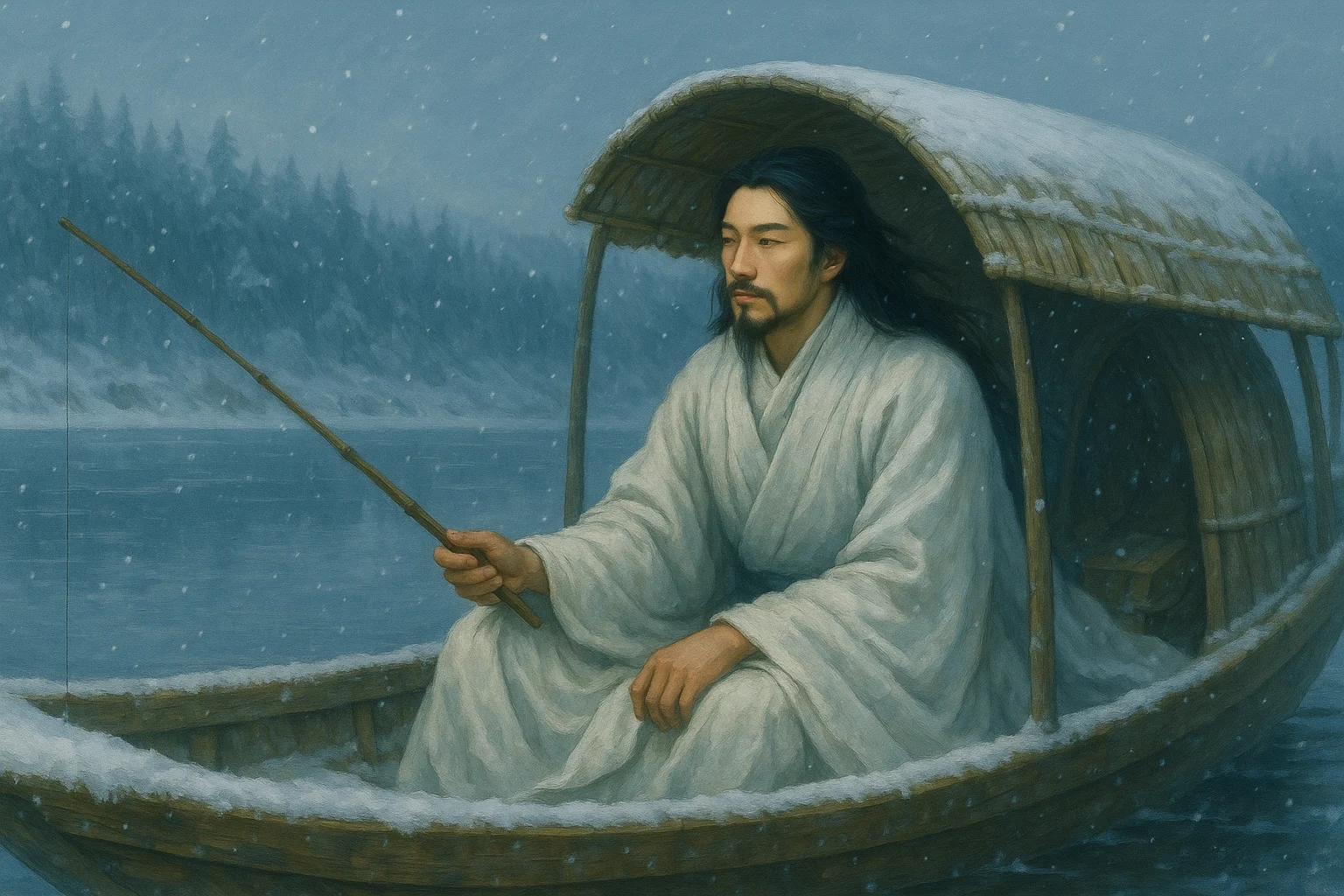
Liu Zongyuan (柳宗元), 773-819 A.D., a native of Yongji, Shanxi, was a progressive thinker, brilliant writer, and revolutionary statesman of the Tang Dynasty. Nineteen years before he was born, the An Shi Rebellion broke out, which dramatically changed the Tang Dynasty from prosperity to decline. The subsequent failure of the Yongzhen Reform was a historical tragedy that cut short Liu Zongyuan's political future, but made him one of the leading thinkers and literary figures of the Tang Dynasty.