


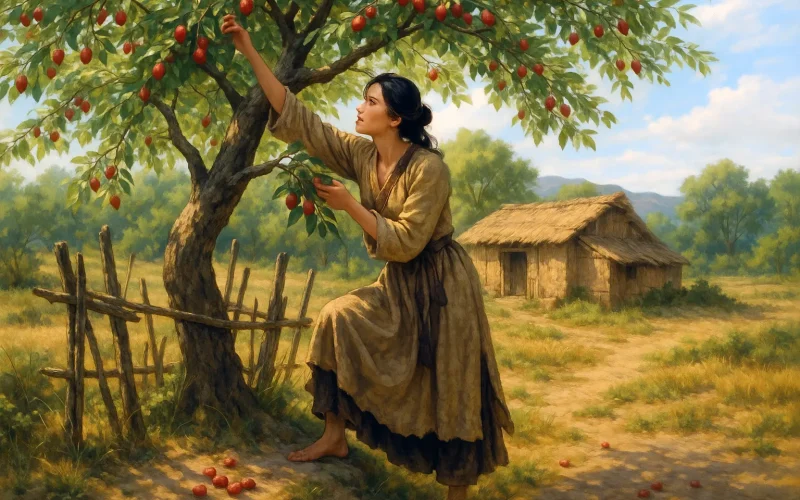
Before my hall I let the western neighbor pick dates as she pleases,
A childless widow who in hunger and misery freezes.
But for her bitter need, would she come here to steal?
Be kind to her fear and show her your zeal.

Though she may guard against a stranger living next door,
Why put up a fence around the date tree she picked before?
Taxation has made her poorer than e’er before;
On war and its grief my tears pour.
Original Poem
「又呈吴郎」
杜甫
堂前扑枣任西邻,无食无儿一妇人。
不为困穷宁有此?只缘恐惧转须亲。
即防远客虽多事,便插疏篱却甚真。
已诉征求贫到骨,正思戎马泪盈巾。
Interpretation
This work was composed in the autumn of 767 CE, the second year of the Dali era under Emperor Daizong, while Du Fu was residing in Dongtun, Kuizhou. Earlier, the poet had lent a thatched cottage he owned west of Rang Creek to a distant relative known as "Wu Lang" (a courtesy name; his given name is lost to history). In front of the cottage stood a date tree. A destitute widow, living alone to the west with no one to rely upon, had regularly come to gather its fruit to fend off hunger. While Du Fu occupied the cottage, he never intervened. After Wu Lang moved in, however, he erected a fence around the tree. Distressed, the widow appealed to Du Fu. The poet then wrote this piece as a letter, crafting a work of gentle admonition. Superficially concerned with a minor neighborhood matter, the poem unfolds as a profound dialogue on compassion, empathy, and the suffering of an age. It reveals the elevated plane upon which Du Fu enacted the Confucian spirit of benevolent love in the practical, daily circumstances of life.
First Couplet: “堂前扑枣任西邻,无食无儿一妇人。”
Táng qián pū zǎo rèn xī lín, wú shí wú ér yī fù rén.
Here, before my hall, I let the western neighbor beat the date tree; / A woman, foodless, childless, in her utter poverty.
The opening establishes a tone of recollection and direct statement, engaging immediately with the heart of the matter. The word "let" is the linchpin of the couplet; it denotes permission, yet more significantly, an "allowing" imbued with understanding and compassion, thereby setting the poem's foundational tone of humane tolerance. The following four words—"foodless, childless"—employ the simplest, most unadorned language to outline the twin absolutes of the neighbor's existence: complete material insecurity ("foodless") and the absence of any support or future in kinship or spirit ("childless"). This sketches the portrait of a figure quintessentially marginalized by society, clinging to survival's edge. The poet's permissiveness springs from a profound acknowledgment of her fundamental right to sustain life.
Second Couplet: “不为困穷宁有此?只缘恐惧转须亲。”
Bù wéi kùn qióng níng yǒu cǐ? Zhǐ yuán kǒngjù zhuǎn xū qīn.
But for her desperate, grinding need, would she ever do this deed? / Precisely because she is so full of fear, we should show greater kindness here.
This couplet constitutes the core exposition of Du Fu's philosophy of benevolent love, rich in deep empathy and psychological insight. The first line presents a rational analysis born of imagining oneself in another's place. It frames the widow's action (gathering dates) strictly within the prerequisite of "desperate, grinding need," thereby nullifying any ground for moral reproach. The second line ventures further, touching the sensitive, self-respecting inner world of the vulnerable. The two words "full of fear" articulate completely the timidity, anxiety, and sense of abasement in the heart of a helpless woman reduced to seeking food. The poet's prescribed response, "show greater kindness," radiates a humanistic light: the answer to fear is not distance or defense, but redoubled gentleness to dissolve barriers and confer dignity. This represents a form of goodwill more noble than mere almsgiving.
Third Couplet: “即防远客虽多事,便插疏篱却甚真。”
Jí fáng yuǎn kè suī duō shì, biàn chā shū lí què shèn zhēn.
Her wariness of you, a stranger, though excessive, it may be; / Your prompt raising of a sparse fence makes that fear a reality.
The focus turns to a diplomatic admonishment of Wu Lang, the phrasing a model of tactful and intelligent persuasion. The poet first makes allowances for the widow's "wariness," labeling it "excessive." This serves to placate Wu Lang's potential irritation while subtly implying the comprehensibility of the widow's behavior. The following line then addresses the crux of the matter, using "makes that fear a reality" to pinpoint the flaw in Wu Lang's action. The word "prompt" conveys the thoughtless ease of Wu Lang's deed; "makes that fear a reality" illuminates its consequence: the fence not only blocks access to the tree but materially confirms the widow's suspicion of being treated as a suspect, inflicting genuine psychological injury. This is a masterclass in persuasion that advances by yielding, perfectly harmonizing reason with a plea to fellow-feeling.
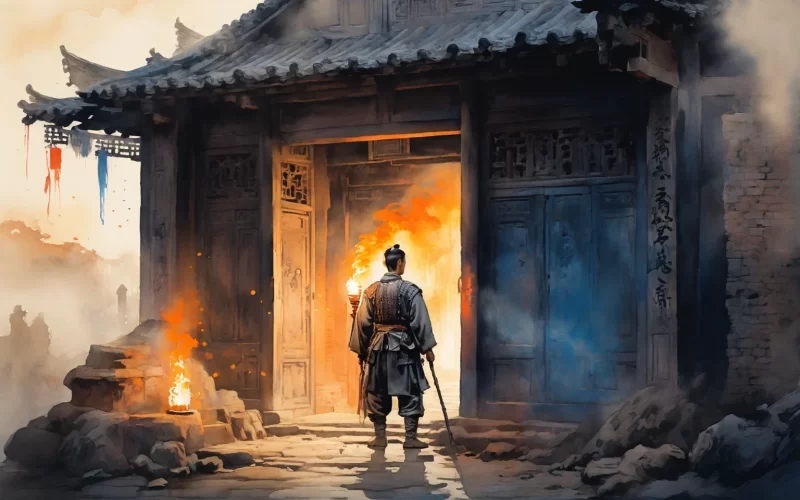
Fourth Couplet: “已诉征求贫到骨,正思戎马泪盈巾。”
Yǐ sù zhēng qiú pín dào gǔ, zhèng sī róngmǎ lèi yíng jīn.
She's told of harsh demands that stripped her to the very bone; / I think of ceaseless war—with tears my garment is outgrown.
Following the admonition, the poet abruptly elevates the particular instance of suffering to the plane of historical causation. "She's told of harsh demands that stripped her to the very bone" exposes the root of the widow's "desperate need" as systemic oppression—the "harsh demands" (exorbitant taxes and levies)—and not personal failing. The phrase "stripped her to the very bone" expresses with visceral force the cruelty and totality of this exploitation. "I think of ceaseless war—with tears my garment is outgrown" then expands from the sorrow of one individual to the universal anguish borne by the age due to relentless warfare ("ceaseless war"). The poet's own tears, soaking his garment, embody a dual compassion—for personal and collective tragedy. These two lines forge a powerful link between the minor incident of date-gathering and the great national afflictions of "harsh demands" and "war," immeasurably elevating the poem's conceptual scope and moral gravity.
Holistic Appreciation
This work is an "epistle exhorting to goodness," remarkable for its wisdom, humanity, and moral authority. It demonstrates how Du Fu translated the abstract Confucian ideal of "the benevolent person loves others" into concrete, practical conduct within daily life. The poem's structure is finely wrought, progressing in deliberate stages: from stating the factual premise (allowing her to gather), to analyzing the underlying psychology (desperate need, fear), to offering tactful critique (the fence's effect), finally ascending to reveal the social and historical roots (harsh demands, war). The emotional tone evolves from calm understanding, deepens into profound compassion, and ultimately resolves into a somber meditation on the age's pervasive injustice.
Its most compelling features are the "art of persuasion that seamlessly blends reason and empathy" and the "expansive vision that moves from the particular to the universal." Du Fu's admonition to Wu Lang consistently adopts the stance of seeking to understand the other. There is no condescending reprimand, only earnest, heart-to-heart analysis. He aims to awaken Wu Lang's innate compassion by guiding him to comprehend the "fear" of one who is "foodless, childless." More significantly, Du Fu does not halt at the level of individual ethics. He connects the widow's being "stripped to the bone" to the socio-political backdrop of "harsh demands" and "war," thereby proposing that true benevolent love requires not only personal kindness but also a clear-eyed recognition and profound critique of the structural forces that produce suffering.
Artistic Merits
- The Intimate Sincerity of the Epistolary Form: Using poetry as a personal letter, adopting the tone of speaking to kin, the language is plain and unaffected as everyday speech. Yet every word is weighted with earnest feeling, achieving a powerful affective resonance.
- Profound and Nuanced Psychological Delineation: The insight into the widow's state of "fear" and the analysis of the consequences of Wu Lang's action ("makes that fear a reality") reflect Du Fu's deep understanding of human nature and his precise grasp of motivation, rendering his argument profoundly persuasive.
- Natural Fluidity in Transitions and Progressive Development: The movement from "let" to "show greater kindness," from "wariness" to "raising a fence," from "told" to "think of"—the poetic thought undergoes several natural turns, delving ever deeper, moving logically from individual action to societal cause. The reasoning is rigorous and the progression clear.
- The Elevating Power of the Conclusion: The final two lines forge a connection between personal trifle and affairs of state, instantly granting a piece of advisory verse the weight and compassionate depth of historical reflection, vastly expanding the poem's intellectual and philosophical architecture.
Insights
This masterpiece offers insights that extend far beyond practical advice on neighborly relations; it touches upon the "practical wisdom of goodness" and the "cognitive depth of compassion." Du Fu shows us that true goodness resides not only in the act of "giving" but in the process of "understanding"—understanding the "desperate need" behind another's actions, perceiving the "fear" within their heart. Simultaneously, he reveals that sympathy for individual suffering, if it fails to penetrate to an awareness of its social roots ("harsh demands," "war"), may remain superficial and limited.
In contemporary society, this poem serves as a mirror, reflecting how we interact with the vulnerable around us and how we maintain a conscientious awareness in the face of systemic inequity. It reminds us: a seemingly reasonable "sparse fence" may sever the most precious warmth and trust between people; whereas a considerate, empathetic "kindness" constitutes the most fundamental and vital force for healing social indifference and building a harmonious community. Through this short poem addressed to a relative, Du Fu provided a profound lesson by example: a heart of benevolent love should originate in genuine feeling, be put into practice through action, and ultimately extend to a deep concern for the very destiny of the age.
About the poet

Du Fu (杜甫), 712 - 770 AD, was a great poet of the Tang Dynasty, known as the "Sage of Poetry". Born into a declining bureaucratic family, Du Fu had a rough life, and his turbulent and dislocated life made him keenly aware of the plight of the masses. Therefore, his poems were always closely related to the current affairs, reflecting the social life of that era in a more comprehensive way, with profound thoughts and a broad realm. In his poetic art, he was able to combine many styles, forming a unique style of "profound and thick", and becoming a great realist poet in the history of China.