Flowers crowd the sky, too dense to see;
Their scent fills the ground, from distance free.
The spring wind, thoughtful to a friend,
Breaks a full branch, and doth it send.
Original Poem
「游城南十六首 · 风折花枝」
韩愈
浮艳侵天难就看,清香扑地只遥闻。
春风也是多情思,故拣繁枝折赠君。
Interpretation
This poem is one of Han Yu's series Wandering South of the Wall, composed during the Yuanhe period when his political career was frustrated. Throughout his life, Han Yu considered himself a Confucian scholar—upright, outspoken, and often angering those in power with his remonstrances. In the 19th year of the Zhenyuan era (803 A.D.), while serving as a Investigating Censor, he submitted a memorial discussing the severe drought and famine, pleading for relief of the people's burdens, and was demoted to the post of Magistrate of Yangshan. In the 14th year of the Yuanhe era (819 A.D.), he again almost faced execution for his remonstrance against welcoming the Buddha's bone, and was finally demoted to Prefect of Chaozhou. Disappointed in politics, he often sought solace in excursions through mountains and rivers, channeling his life's reflections into every plant and tree.
The "southern city" refers to the area south of Chang'an, a popular scenic spot for scholars of the time, with its dense gardens around Wei Valley and Du Valley, resplendent with blossoms in spring. During intervals between his demotions, when Han Yu returned to the capital, he often visited the southern outskirts with friends and wrote this series of sixteen quatrains on natural scenery. These poems are sometimes delicate and lovely, sometimes somber, sometimes playful, sometimes sentimental, revealing the complex states of his mind from different angles.
The "wind breaking a flowering branch" described in this poem is an ordinary sight one might encounter by chance during a spring outing—a gust of spring wind passes, a lush branch snaps, and blossoms scatter. Yet, in the poet's eyes, this chance event becomes a metaphor for life: those dazzling blooms that seem to "touch the sky" resemble his own former ambitions and talents; the helplessness of "hard to view closely" and "only smell from afar" is precisely like the unbridgeable distance between ideal and reality; and the branch the spring wind "breaks and bestows" is both a gift of nature and a trick of fate. While lingering over the scenery, the poet infuses it with the feelings of his own life, so that beneath the delicate and lovely brushstrokes of this small poem lurks a deep sigh about life.
First Couplet: "浮艳侵天难就看,清香扑地只遥闻。"
Fú yàn qīn tiān nán jiù kàn, qīngxiāng pū dì zhǐ yáo wén.
Gaudy blooms assault the sky, hard to view closely;
Pure fragrance carpets the ground, only smell from afar.
The poem opens by separating the flower's form and its spirit with "浮艳" (gaudy blooms) and "清香" (pure fragrance). "浮艳侵天" (Gaudy blooms assault the sky) describes the extreme exuberance and rich color of the flowers in full bloom. The word "侵" (assault) gives static blossoms dynamic tension, as if that dazzling brilliance is about to fill heaven and earth. Yet the following three characters, "难就看" (hard to view closely), create a sudden turn—such profusion, yet one cannot get close, can only view it from a distance. The next line, "清香扑地" (pure fragrance carpets the ground), describes the fragrance permeating the air, as if it were about to cover the whole earth. Yet "只遥闻" (only smell from afar) once again creates distance. This "难就看" (hard to view closely) and "只遥闻" (only smell from afar) are precisely the poetic core of the entire poem: a thing of beauty is right before your eyes, yet seems far away; clearly within reach, yet you cannot truly possess it. Through this dual alienation of sight and smell, the poet expresses life's deepest helplessness—ideals, talent, opportunity are often like this, seemingly brilliant, yet ultimately separated by an insurmountable distance.
Second Couplet: "春风也是多情思,故拣繁枝折赠君。"
Chūnfēng yě shì duō qíng sī, gù jiǎn fán zhī zhé zèng jūn.
The spring breeze, too, is full of tender feeling;
So, choosing a lush branch, it breaks and bestows it on you.
This couplet personifies the spring wind, giving it the quality of being "多情思" (full of tender feeling). The spring wind cannot bear to let the poet only gaze from afar without getting close, so it actively "拣繁枝折赠君" (choosing a lush branch, it breaks and bestows it on you)—it selects the most luxuriant flowering branch, breaks it off, and gives it. This act of "breaking" (折) is both a fulfillment and a destruction; both a gift and a blight. On the surface, the spring wind does a beautiful thing, allowing the poet to possess this branch of blossoms. But the original meaning of "折" is to separate the branch from its root, ending its life. Through this image full of tension, the poet hints at a profound paradox in life: the things we long to possess, once truly possessed, may lose their original beauty; the wishes fulfilled for us by external forces often come with some unavoidable harm.
Overall Appreciation
This is a seven-character quatrain that uses an object to express the poet's feelings. In just four lines and twenty-eight characters, it contains the complex taste of life's vicissitudes. Taking the chance sight of a wind-broken flowering branch on a spring outing as a trigger, the poet moves from scene to emotion, from emotion to reason. Beneath the delicate and lovely brushstrokes lurks a deep sigh about life.
Structurally, the poem shows a clear progression of "scene—emotion—reason." The first couplet describes the scene. Using "浮艳侵天" (gaudy blooms assault the sky) and "清香扑地" (pure fragrance carpets the ground), it emphasizes the flower's profusion, then creates distance with "难就看" (hard to view closely) and "只遥闻" (only smell from afar), already subtly embedding human feeling within the scene. The second couplet moves from scene to emotion, personifying the spring wind and completing the projection of emotion through the action of "折赠君" (breaks and bestows it on you). And within this act of "breaking" naturally lies philosophical contemplation on life's gains and losses, fulfillment and harm. The four lines are closely linked, progressing layer by layer.
In terms of conception, the core of this poem lies in its dialectical contemplation of "distance" and "possession." The first couplet describes the "inaccessibility" of beautiful things, an inherent distance. The second couplet describes "attaining possession" through external intervention, yet achieved through the method of "breaking," suggesting that possession itself is a form of alteration or even harm. Through the tiny image of the spring wind breaking the flower, the poet voices a universal human emotional dilemma: We long to be close to beauty, but is the beauty after closeness still the original beauty? Do wishes fulfilled by external forces always come with some ineffable cost?
In terms of artistic technique, the most exquisite aspects of this poem are its use of "personification" and "double meaning." Writing of the spring wind as "多情思" (full of tender feeling) is already a stroke of genius. And the three characters "折赠君" (breaks and bestows it on you) can be read as both a gentle act of understanding and a violent intervention. This ambiguous meaning allows the simple act of giving a flower to be open to multiple interpretations. The poet provides no answer, only presents this tension-filled scene, letting readers savor and ponder for themselves.
Artistic Features
- Using the Small to See the Great, Using Objects to Express Feelings: Starting from the minor event of the wind breaking a flowering branch, it conveys deep reflections on life's vicissitudes. Within a small scene lies a grand vista; within a tiny object lies profound philosophy.
- Vivid Imagery, Strong Contrast: "浮艳侵天" (gaudy blooms assault the sky) and "难就看" (hard to view closely) form a strong contrast between sight and psychology. "清香扑地" (pure fragrance carpets the ground) and "只遥闻" (only smell from afar) constitute a deep alienation of smell and experience. This contrast and alienation are precisely the emotional undertone of the entire poem.
- Vivid Personification, Clever Double Meaning: Personifying the spring wind as "多情思" (full of tender feeling) gives nature human emotion. And the word "折赠" (breaks and bestows) contains both tenderness and violence, creating rich layers of meaning. Within a single word lies infinite depth.
- Concise Language, Rich Meaning: The poem contains not a single superfluous word, yet it fuses sight, smell, emotion, and philosophical reflection. Finding the extraordinary in the ordinary, discovering depth in simplicity, is a typical feature of Han Yu's poetic style.
- Subtle and Implied, Lingering Resonance: The poet does not express his feelings directly but hides all emotion and philosophical thought within the scenic description, leaving readers endless space for reflection. The words end, but the meaning is boundless, leaving much to ponder.
Insights
This poem uses the ordinary sight of the spring wind breaking a flower to express the eternal human dilemma of "visible yet unattainable," offering profound insights for later generations. It makes us contemplate the dialectical relationship between "distance" and "beauty." **The flower in the poem, when "viewed from afar," is a perfect existence—"浮艳侵天" (assaulting the sky), "清香扑地" (carpeting the ground). Once broken off and given to someone, it is separated from its root, losing its life. This reminds one of many beautiful things in life—dreams, love, ideals—which are often most moving when not yet truly possessed. Once truly touched, they may instead lose that hazy poetic quality. *It reminds us: Some beauties need to be appreciated from an appropriate distance; some longings, perhaps precisely because they cannot be fully realized, forever shine.*
Second, the image of "春风折赠" (the spring wind breaks and bestows) in the poem reveals the complex consequences of external intervention. The spring wind is a natural force, yet driven by "多情思" (tender feeling), it actively intervenes. The result both fulfills the poet's wish to "possess" and ends the branch's life. This brings to mind the help and fulfillment we receive from the external world in life—they often bring the results we hope for, yet frequently come with unforeseen changes. It enlightens us: While accepting fulfillment from external forces, we must also soberly recognize the potential cost such fulfillment may bring; while desiring possession, we must also respect the original mode of existence of things.
On a deeper level, this poem also lets us see Han Yu's unique temperament as a poet of thought. He was not content with merely chanting about objects and describing scenery. He was adept at discovering the extraordinary within the ordinary, discerning necessity within chance. This attitude of infusing poetry with philosophical thought, of contemplating life with reason, is precisely Han Yu's unique contribution to the development of Tang poetry. A thousand years later, we can still feel, from these mere twenty-eight characters, how that sensitive and profound mind, in a single branch of flowers broken by the spring wind, reflected all the complexity and subtlety of life.
About the Poet
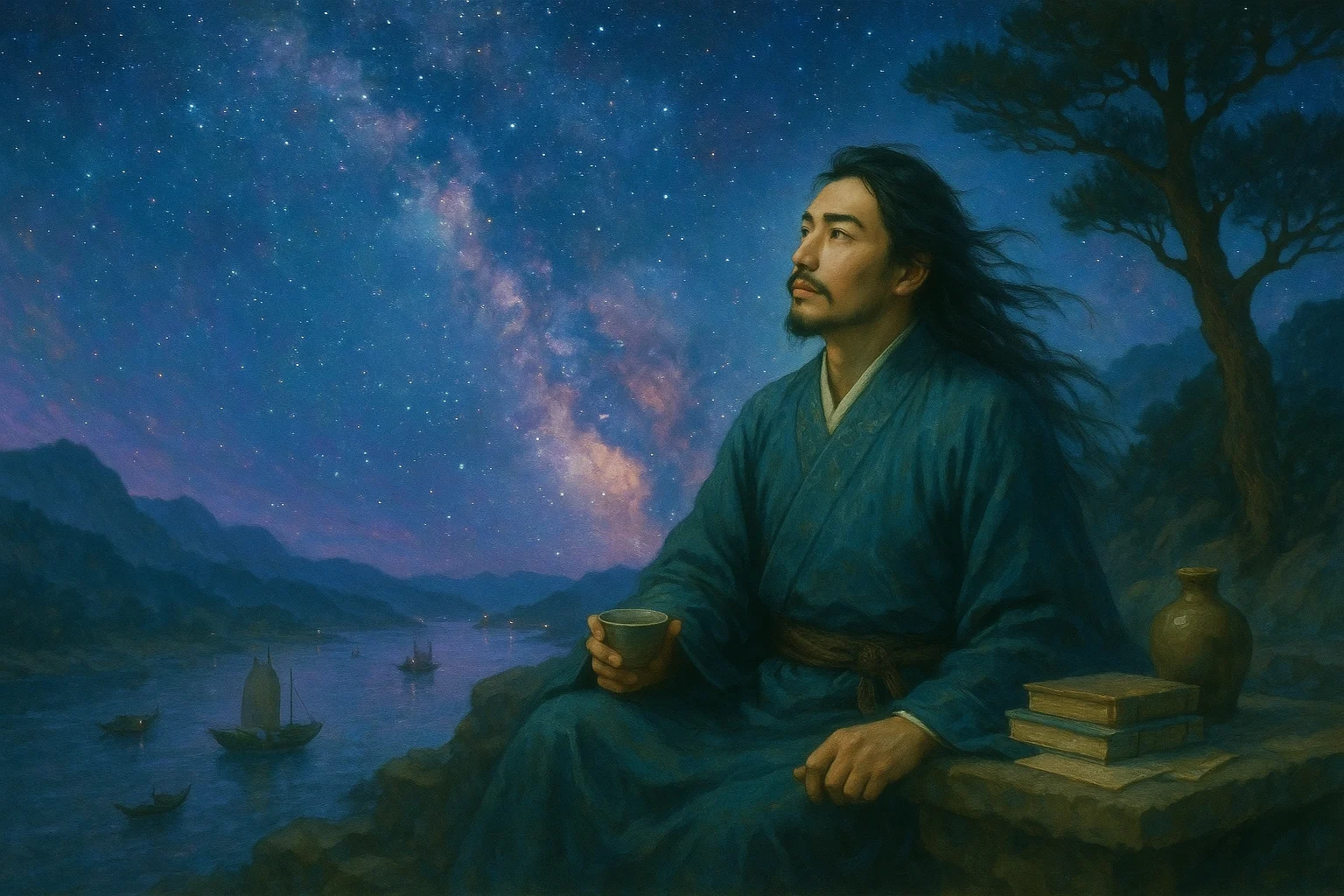
Han Yu (韩愈, 768 - 824), a native of Mengzhou, Henan Province, he was the leader of the Ancient Prose Movement in the Tang Dynasty. He became a jinshi (presented scholar) in the eighth year of the Zhenyuan era (792 AD). His prose was vigorous and powerful, and he patronized notable poets such as Meng Jiao and Jia Dao. Regarded as the foremost of the "Eight Great Masters of the Tang and Song Dynasties," Han Yu revolutionized both poetry and prose, exerting a profound and lasting influence. Later generations honored him as the "Literary Patriarch of a Hundred Generations."