



This night to the west of the river-brim
There is not one cloud in the whole blue sky,
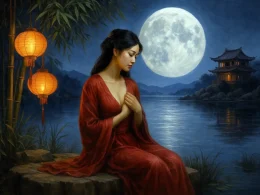
As I watch from my deck the autumn moon,
Vainly remembering old General Hsieh.
I have poems; I can read;
He heard others, but not mine .
...Tomorrow I shall hoist my sail,
With fallen maple-leaves behind me.
Original Poem
「夜泊牛渚怀古」
李白
牛渚西江夜,青天无片云。
登舟望秋月,空忆谢将军。
余亦能高咏,斯人不可闻。
明朝挂帆去,枫叶落纷纷。
Interpretation
Composed around the autumn of 727 CE, this poem was written when Li Bai, then twenty-seven years old, was journeying east along the Yangtze River and passed by Niuzhu (present-day Caishiji in Ma'anshan, Anhui). Though ambitious and newly embarked on his travels from Shu to seek official advancement, he had yet to encounter anyone who recognized his talent. The poem alludes to a celebrated historical anecdote in which the Eastern Jin general Xie Shang, on an autumn night on the river, recognized and promoted the humble scholar Yuan Hong. Li Bai uses this story to contrast his own situation: possessing Yuan Hong's talent but lacking Xie Shang's patronage, expressing profound loneliness in his search for a kindred spirit and uncertainty about his future.
First Couplet: “牛渚西江夜,青天无片云。”
Niúzhǔ xī jiāng yè, qīngtiān wú piàn yún.
Night on the Western River at Niuzhu shore; In the blue sky, not a single cloud to obscure.
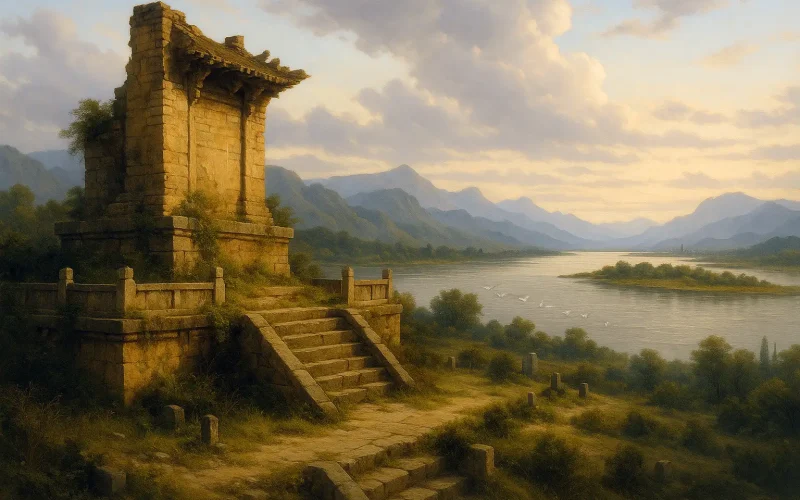
The opening sketches a vast, serene autumn river-night scene with minimalist clarity. “Not a single cloud in the blue sky” not only depicts the visual purity of the night but also creates an ethereal, lonely, even timeless atmosphere, establishing a clear and profound tone for historical reflection and lyrical expression. This cloudless sky and bright autumn moon form both the stage for the historical event and the medium that triggers the poet’s thoughts.
Second Couplet: “登舟望秋月,空忆谢将军。”
Dēng zhōu wàng qiū yuè, kōng yì Xiè jiāngjūn.
Boarding the boat, I gaze at the autumn moon; Vainly I recall General Xie, gone too soon.
The focus shifts from observation to recollection. The moon the poet “gazes at” is the same moon under which Xie Shang and Yuan Hong met; the boat he “boards” resembles Yuan Hong’s rental boat. Yet the word “vainly” conveys infinite regret over the changed times and lost opportunity. The moonlight remains, the anecdote persists, but the “General Xie” who could recognize talent is lost to history, leaving only futile admiration for later generations.
Third Couplet: “余亦能高咏,斯人不可闻。”
Yú yì néng gāo yǒng, sī rén bùkě wén.
I too can chant aloud with skilled refrain; But that man cannot hear my voice, my strain.
This couplet directly expresses emotion, drawing a sharp contrast between past and present circumstances. “I too can chant aloud” shows Li Bai’s absolute confidence and affirmation of his own talent, stated decisively; “but that man cannot hear” turns abruptly into a heavy sigh and cold reality. Confidence and disappointment collide instantly, highlighting the profound contradiction the poet feels—his intense loneliness and uncertain path despite living in a magnificent era.
Fourth Couplet: “明朝挂帆去,枫叶落纷纷。”
Míngzhāo guà fān qù, fēngyè luò fēnfēn.
At dawn I’ll raise my sail and journey on; Maple leaves will fall in showers, then be gone.
The concluding couplet uses scenery to convey emotion, transforming vast sorrow into concrete imagery. “Raise my sail and journey on” represents the unavoidable continuation of wandering, a microcosm of life’s journey; “maple leaves will fall in showers” renders the desolation ahead and the turmoil within through an autumnal visual scene. The falling leaves depict both the natural season and the silent fading of talent and time, leaving lasting resonance and unspoken depth.
Holistic Appreciation
This poem is celebrated among Li Bai’s five-character regulated verses for its “ancient simplicity, ethereal quality, and seamless artistry.” It closely intertwines the dual threads of “reflecting on the past” and “lamenting the self,” unfolding gradually within the clear, expansive nightscape of river and moon. The first two couplets describe the scene and introduce the event, creating a quiet, lonely atmosphere; the latter two express emotion and sentiment with intense feeling. Yet the entire poem shows no trace of artifice; its language seems naturally effortless, as if flowing directly from the heart. Its brilliance lies in how the poet perfectly merges a specific historical anecdote, a universal human lament, and an eternal riverside autumn moon scene, achieving a high degree of unity between emotion, scenery, event, and thought, creating infinite space for reflection within a limited length.
Artistic Merits
- Perfect Fusion of Scene and Emotion: Every line describes scenery, yet every line contains feeling. The clear river, bright moon, blue sky, and maple leaves all reflect the poet’s inner world, truly achieving “all scenes convey emotion.”
- Skillful Use of Temporal Juxtaposition: The poem realistically depicts present-day Niuzhu while alluding to the ancient story of kindred spirits, using the eternal image of the “autumn moon” to connect them, deepening the timeless theme of unrecognized talent through temporal interplay.
- Clear, Subtle Linguistic Style: Departing from Li Bai’s typical grandeur and exuberance, this poem uses simple, clear language without ornamentation, expressing emotion with subtle depth. Understated narration contains immense emotional tension, showcasing the poet’s stylistic versatility.
Insights
This work touches on a core theme transcending its era: the relationship between individual talent and historical opportunity. It reveals that even in a great age, the realization of personal value often requires chance encounters and fortunate patronage. Li Bai’s “sorrow” stems not only from personal circumstance but also from lamenting the loss of an ideal model of human connection (like Xie Shang and Yuan Hong). The poem teaches us that on the path of pursuing aspirations, we must possess the confidence and persistence of “I too can chant aloud,” while also maintaining the resilience and perspective to face the reality that “that man cannot hear.” True value may lie not in being heard in time, but in whether that “chanting” voice itself is clear and sincere, capable, like that autumn moon, of traversing time and space to illuminate the hearts of those who come after.
Poem translator
Kiang Kanghu
About the poet
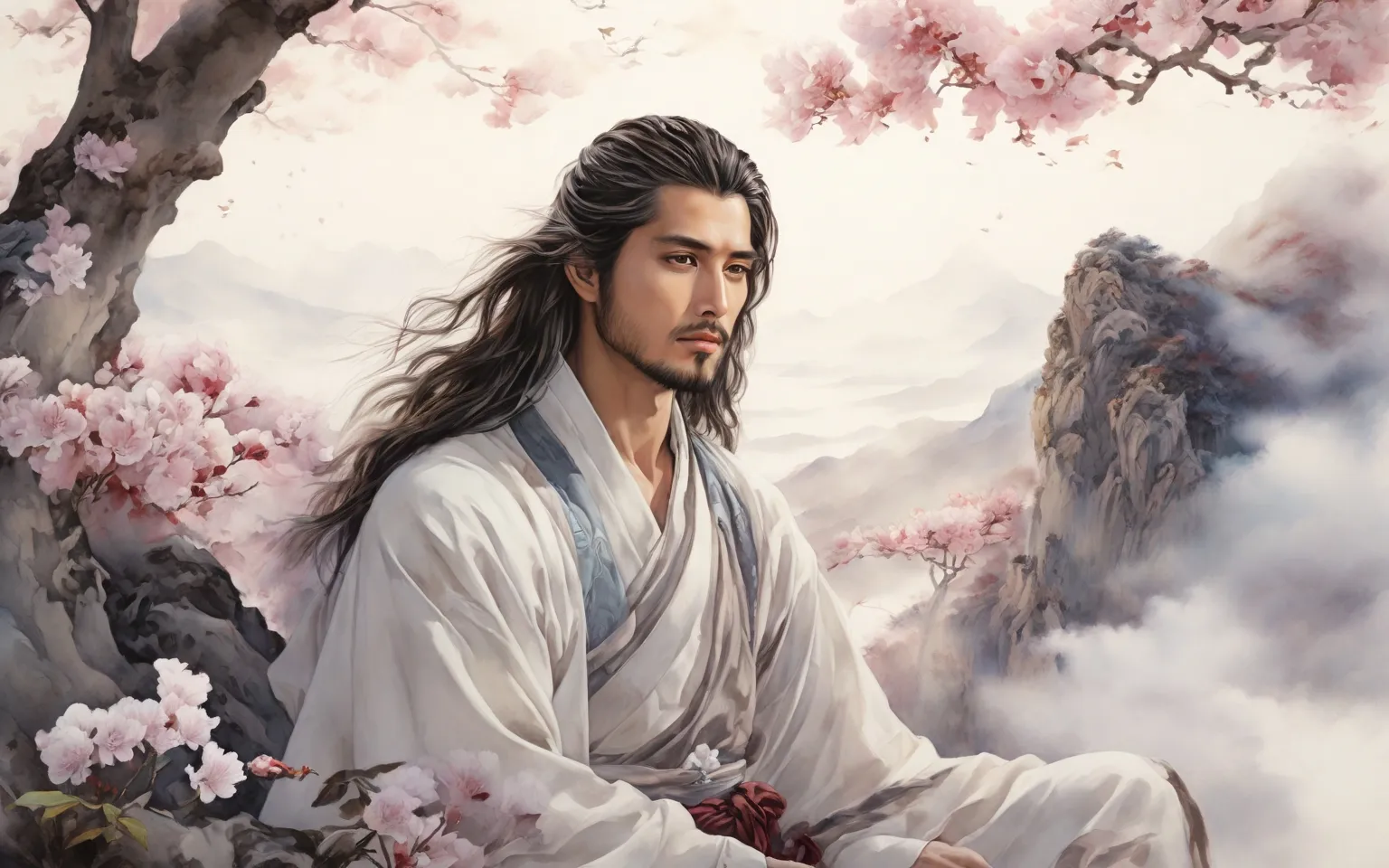
Li Bai (李白), 701 - 762 A.D., whose ancestral home was in Gansu, was preceded by Li Guang, a general of the Han Dynasty. Tang poetry is one of the brightest constellations in the history of Chinese literature, and one of the brightest stars is Li Bai.