

The mason of Duanzhou has marvel-doing hands,
Whetting his knife to carve blue clouds, aloft he stands.
He grinds the stone in order to make an inkwell;
Violet flowers look dim like cold blood shed pell-mell.

Black flowers seem like spring at noon behind the screen;
The pine-soot ink steeped in water smells like musk keen.
Smooth, water-proof, flat and heavy, it stands steadfast;
Like autumn bright its color, rain or shine, will last.

Your brush will make no noise when on paper you write.
Could the inkstone of Confucius give such delight?
Original Poem
「杨生青花紫石砚歌」
李贺
端州石工巧如神,踏天磨刀割紫云。
傭刓抱水含满唇,暗洒苌弘冷血痕。
纱帷昼暖墨花春,轻沤漂沫松麝薰。
干腻薄重立脚匀,数寸光秋无日昏。
圆毫促点声静新:孔砚宽硕何足云!
Interpretation
Duanzhou, present-day Zhaoqing in Guangdong, was part of the Lingnan Circuit during the Tang Dynasty. Inkstones produced in Duanzhou, known as Duan inkstones, had been famous throughout the land since the Wude era (618-626), and by the Mid-Tang period, they had become highly sought-after treasures in the study of scholars and literati. Duan stone is known for its warm, smooth texture, which grinds ink finely without damaging the brush tip. Those with "green flower" (qinghua) patterns are considered the finest quality—these are faint blue-green spots that appear within the stone, like clouds or mist, rare and impossible to seek out. Li He wrote this poem while serving as a Ritual Ceremonialist in Chang'an. His duties at the Court of Imperial Sacrifices were light, affording him ample time to socialize with other literati and engage with scholarly accouterments. The historical records about a certain Mr. Yang are unclear; he was likely a friend of Li He's who had obtained a Purple Stone Inkstone with green flower patterns and brought it for Li He to admire. The poet handled this inkstone, observing its warm, smooth stone, the faint green patterns, the exquisite craftsmanship, and what welled up in his heart was not only fondness for the object itself, but reverence for the people who created it.
"踏天磨刀割紫云"—he had never been to Duanzhou, yet with imagination he arrived at the quarry site. In his view, those Duanzhou stoneworkers were not ordinary artisans, but creators "skilled as gods." They scaled the cliffs, searching for that purple hue amidst swirling clouds and mist, as if slicing off rosy clouds from the sky. This poetic depiction of labor infuses a poem about an object with human warmth.
First Couplet: "端州石工巧如神,踏天磨刀割紫云。"
Duānzhōu shí gōng qiǎo rú shén, tà tiān mó dāo gē zǐyún.
Duanzhou stoneworkers, skilled as gods are they;
Tread the heavens, whet the knife, slice off purple cloud.
The opening line elevates the artisans' skill to the divine with direct praise. "Skilled as gods" is not mere flattery but genuine awe, transforming the workers into mythical figures. The following line visualizes this skill as a heroic, celestial act: "Tread the heavens" suggests the perilous height of the quarry, while "slice off purple cloud" metaphorically captures the extraction of the precious purple stone, painting labor as a majestic conquest of nature.
Second Couplet: "傭刓抱水含满唇,暗洒苌弘冷血痕。"
Yōng wán bào shuǐ hán mǎn chún, àn sǎ Chánghóng lěng xuè hén.
Polished, pared, it holds water, full-lipped, brimming clear;
A hidden spatter, Chang Hong’s cold blood-trace appears.
The focus shifts to the crafted inkstone's form and its most prized feature. The first line describes the砚池 (ink pool): "Polished, pared" denotes fine workmanship; "holds water, full-lipped" depicts its perfect, water-retaining shape. The second line introduces the "green flower" patterns through the典故 of Chang Hong, a loyal minister whose blood was said to have turned to jade. This comparison ("cold blood-trace") lends the stone's natural veins a profound, historical weight and a chilling beauty.
Third Couplet: "纱帷昼暖墨花春,轻沤漂沫松麝薰。"
Shā wéi zhòu nuǎn mò huā chūn, qīng ōu piāo mò sōng shè xūn.
Gauze curtains, day’s warmth, ink-flowers bloom in spring;
Light bubbles drift, froth floats, pine-soot, musk scenting.
The scene transitions to the inkstone in use within a scholar's tranquil study. "Gauze curtains, day’s warmth" sets a cozy, intimate scene. "Ink-flowers bloom in spring" is a beautiful metaphor for the ink spreading on the stone's surface. The second line engages multiple senses: sight ("Light bubbles drift"), touch (implied), and smell ("pine-soot, musk scenting"), fully immersing the reader in the serene, sensual ritual of grinding ink.
Fourth Couplet: "干腻薄重立脚匀,数寸光秋无日昏。"
Gān nì báo zhòng lì jiǎo yún, shù cùn guāng qiū wú rì hūn.
Dry, yet moist; thin, yet weighty; stands steady, well-balanced;
Few inches wide, autumn-bright, no daylight dims its sheen.
This couplet offers a connoisseur's precise appraisal of the inkstone's physical qualities. Four paradoxical qualities—"Dry, yet moist; thin, yet weighty"—are masterfully condensed, highlighting the stone's exceptional and balanced nature. "Stands steady" speaks to its solid craft. The second line praises its luster: "autumn-bright" evokes the clear, sharp light of fall, suggesting a flawless, luminous surface contained within a "few inches," merging qualities of vastness and miniature perfection.
Fifth Couplet: "圆毫促点声静新:孔砚宽硕何足云!"
Yuán háo cù diǎn shēng jìng xīn: Kǒng yàn kuān shuò hé zú yún!
Round-tipped brush, quick dip—sound: still, fresh, and clean!
The Kong Inkstone, broad and massive—what praise does that deserve?
The poem concludes with the ultimate test—practical use—and a bold, comparative judgment. The act of testing the inkstone with a brush ("quick dip") produces a subtly pleasing, "still, fresh" sound, confirming its superior texture. This sensory proof allows the poet to dismiss the legendary, oversized "Kong Inkstone" (associated with Confucius) as unworthy of praise. The exclamation asserts that true value lies in exquisite function and craft, not in mere size or historical association.
Holistic Appreciation
This poem is a representative work among Li He's poems on objects. The entire poem takes a Duan inkstone as its subject, unfolding layer by layer from quarrying and crafting to use and appreciation, perfectly blending the beauty of the object with human creation.
Structurally, the poem presents a clear chronological order and spatial progression. The first couplet describes quarrying, opening with a mythological scene; the second couplet describes crafting the inkstone, using an allusion to bestow cultural meaning; the third couplet describes grinding ink, using sensory experience to create the study's atmosphere; the fourth couplet evaluates the inkstone's quality, defining its character with precise judgment; the final couplet describes its use, concluding the poem with a comparative technique. Between the five couplets, the focus moves from distant to near, from object to person, progressing layer by layer, forming a cohesive whole.
Conceptually, the core of this poem lies in "paying tribute." Tribute to the Duanzhou stoneworkers—that "skilled as gods" artistry, that "tread the heavens, slice off purple cloud" courage; tribute to the inkstone itself—that "Chang Hong’s cold blood-trace" pattern, that "few inches wide, autumn-bright" quality; tribute, even more, to that small world of the study—where ink-flowers bloom like spring, pine and musk scent the air, the round-tipped brush touches paper, with a sound still and fresh.
Artistically, the poem's most moving aspect is the interweaving of imagination and reality. "Tread the heavens, slice off purple cloud" is imagination, yet it captures the truth of quarrying; "Chang Hong’s cold blood-trace" is an allusion, yet it captures the texture of the green patterns. Imagination serves realism; allusion serves description; the two complement each other.
Artistic Merits
- Bold Imagination, Magnificent Imagery: "Tread the heavens, whet the knife, slice off purple cloud" depicts the labor of quarrying with a mythological brush, making an ordinary scene glow with extraordinary brilliance.
- Apt Allusion, Profound Meaning: "Chang Hong’s cold blood-trace" uses an allusion to describe the green patterns, depicting their color and, more importantly, imbuing them with a tragic sense of history.
- Sensory Engagement, Rich Experience: Sight (ink-flowers, autumn-bright), smell (pine-soot, musk), hearing (sound: still, fresh), touch (dry, moist, thin, weighty) are all employed, making the reader feel present.
- Precise Appraisal, Professional Accuracy: The six words "Dry, yet moist; thin, yet weighty; stands steady" summarize the inkstone's qualitative characteristics with perfect accuracy, something only a connoisseur could express.
- Conclusive Comparison, Forceful Resonance: Comparing it to the Kong Inkstone elevates the Duan inkstone's status while subtly containing a critique of empty fame, ending the poem decisively.
Insights
Using an inkstone, this poem expresses the artisan's heart and cultural soul behind the object, offering profound insights. It shows us the value of the "artisan spirit." The Duanzhou stoneworkers' "skilled as gods" artistry is not innate, but the result of daily honing; that "踏天割紫云" courage does not come from nothing, but from familiarity with the material and confidence in the craft. It reminds us: Behind any exquisite object stands one or more creators worthy of respect.
The association of "苌弘冷血痕" in the poem gives the inkstone historical depth. The green flower patterns are originally a geological accident, but the poet bestows upon them the cultural imagination of a loyal minister's jade-green blood. It tells us: The beauty of an object lies not only in its material and craftsmanship, but also in the meaning people give it. A fine inkstone carries not only ink, but culture.
On a deeper level, this poem also shows us Li He's attitude towards "truth" and "fame." The last line, "孔砚宽硕何足云" uses Confucius's famous inkstone for comparison, yet says it is "not worthy of praise." This is not disrespect for Confucius, but a critique of being "famous in name only." That Kong Inkstone may be famous, but is not necessarily good to use; the Duan inkstone, though not endorsed by a famous artisan, is substantively "dry, yet moist; thin, yet weighty" and "few inches wide, autumn-bright." It teaches us: To judge something, one should not look only at its reputation, but at its essence.
Poem Translator
Xu Yuanchong (许渊冲)
About the Poet
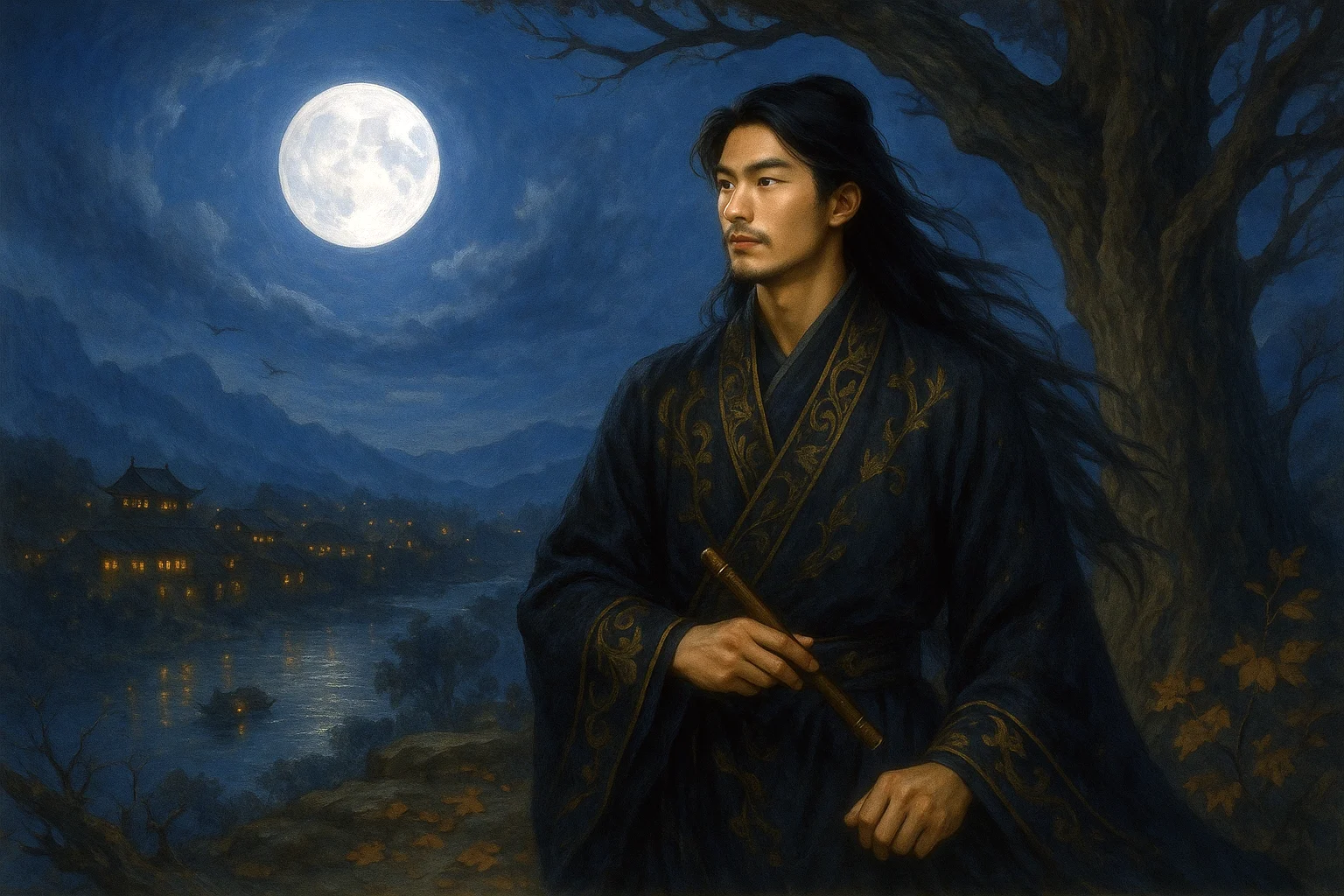
Li He (李贺 790 - 816), a native of Yiyang, Henan, was a Romantic poet of the Mid-Tang dynasty. A descendant of the Tang imperial clan, he was barred from taking the national jinshi civil service examination due to a naming taboo (his father's name contained a character homophonous with "Jin"), which led to a life of frustration and poverty. He died at the age of twenty-seven. His poetry, renowned for its bizarre grandeur, chilling elegance, and fantastical imagination, earned him the title "Ghost of Poetry." He pioneered the distinctive "Changji Style" within Tang poetry, exerting a profound influence on later poets like Li Shangyin and Wen Tingyun and on the expansion of poetic imagery in subsequent eras.