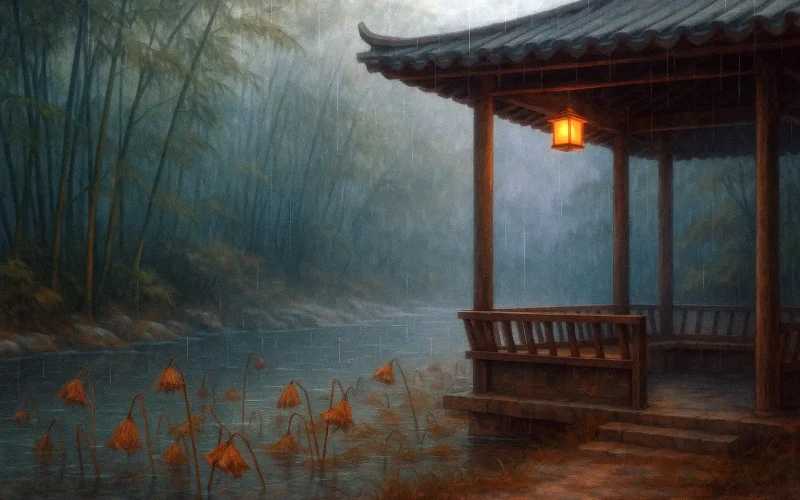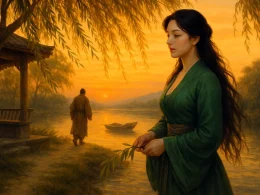



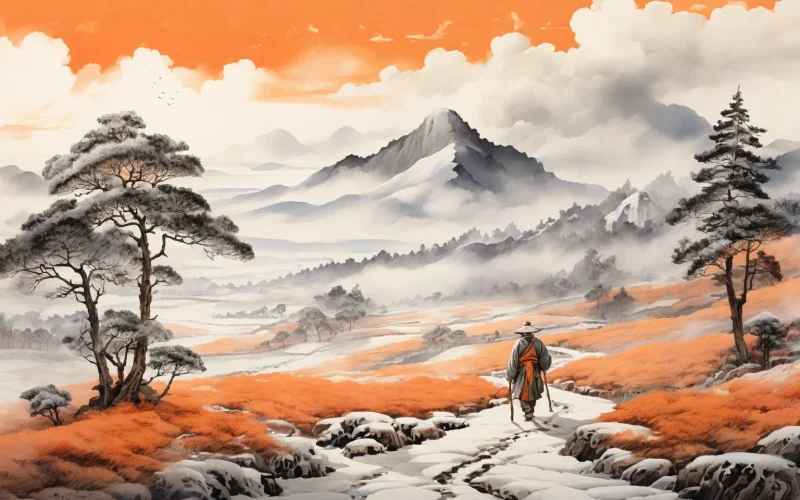
Cane in hand, I gaze on fine snow;
Cloud on cloud spreads over the creek.
To snow-covered cots woodmen go;
The sun sets on the frowning peak.
In the wildfire bums the grass dried;
Mid rocks and pines smoke and mist rise.
Back to the temple by the hillside,
I hear bells ring in evening skies.
Original Poem
「雪晴晚望」
贾岛
倚杖望晴雪,溪云几万重。
樵人归白屋,寒日下危峰。
野火烧冈草,断烟生石松。
却回山寺路,闻打暮天钟。
Interpretation
This poem was composed by the Tang Dynasty poet Jia Dao, most likely during his period of hardship while living in Chang'an after leaving the monastic life. Jia Dao became a monk in his youth, taking the Dharma name "Wuben" (Without Origin). Later, encouraged by Han Yu, he returned to secular life, but his official career was fraught with difficulty, marked by repeated failures in the imperial examinations and a life of poverty. He often dwelled in remote mountains and ancient temples, cultivating an extraordinary sensitivity and deep affection for the secluded tranquility of such landscapes.
On an evening after the snow had cleared, the poet was walking alone in the mountains, leaning on his staff and gazing into the distance. The sky was clear after the snowfall, and the world, blanketed in white, appeared exceptionally pure; layered clouds hung over the stream, the cold sun was setting, woodcutters were returning home, wild fires burned through the grass, and wisps of smoke drifted among the rocks and pines. The poet immersed himself in this clear, cold, and solitary mountain scene until the evening temple bell sounded, prompting him to finally begin his journey back. This poem captures that mountain experience, sketching a picture of the snowy wilderness at dusk with remarkably concise strokes. Within its clear, cold, and lonely atmosphere, it reveals the poet's inner, inescapable desolation and a lingering nostalgia for a contemplative, Zen-like existence.
First Couplet: "倚杖望晴雪,溪云几万重。"
Yǐ zhàng wàng qíng xuě, xī yún jǐ wàn chóng.
Leaning on my staff, I watch the snow-bright scene;
Over the stream, cloud on cloud extends, ten thousand folds between.
The opening phrase, "leaning on my staff," outlines the poet's possibly aged or weary form, also hinting at the duration of his mountain walk and his focused gaze. "Watch the snow-bright scene" establishes the season and weather—a clear sky after snow, the world utterly pure. The next line, "Over the stream, cloud on cloud extends, ten thousand folds between," shifts the view from near to far, towards the sky above the stream. Vapor rising after the snow forms layered, swirling clouds, suggesting immense depth. This "ten thousand folds" describes both the scene and the mind—those piled clouds resemble the layered, distant, and uncertain thoughts within the poet's heart.
Second Couplet: "樵人归白屋,寒日下危峰。"
Qiáo rén guī bái wū, hán rì xià wēi fēng.
The woodcutter turns to his hut, thatched and white;
The cold sun sinks down the dangerous peak's height.
This couplet shifts the focus from a distant view to a middle ground, from stillness to slight movement. "The woodcutter turns to his hut"—the word "turns" (归) captures the woodcutter's motion towards home, also implicitly contrasting with the poet's own lack of a definite destination or home. "Thatched and white" refers literally to the snow-covered hut but also suggests a simple, impoverished life. The next line, "The cold sun sinks down the dangerous peak's height": "cold" describes the physical chill of the winter sunset and, more poignantly, the poet's inner feeling; "dangerous peak" conveys the cliff's steepness, and paired with "sinks," it captures the sun's dynamic, majestic descent. This couplet, with the woodcutter's "return" and the sun's "descent," creates a dual sense of movement—human and natural—imbuing the scene with a flow of time.
Third Couplet: "野火烧冈草,断烟生石松。"
Yěhuǒ shāo gāng cǎo, duàn yān shēng shí sōng.
Wild fire burns the grasses on the ridge, aflame;
Scattered smoke wreathes the pines rooted in rock, the same.
The gaze now turns to the distant ridge. Dry grass, exposed after snow, is easily set alight; a wild fire sweeps across, its red flames creating a stark contrast with the white snow. The word "burns" injects heat and dynamism, breaking the preceding cold silence. The next line, "Scattered smoke wreathes the pines rooted in rock," describes the lingering tendrils of smoke rising from beside ancient pines among the rocks after the fire passes. "Scattered smoke" suggests both the smoke's intermittent nature and the flickering, unsettled quality of the poet's mood; "pines rooted in rock," with the solidity of stone and the endurance of pine, symbolizes a strength that remains upright through hardship. Wild fire and scattered smoke, red and white, movement and stillness, intertwine here to form a strangely beautiful picture.
Fourth Couplet: "却回山寺路,闻打暮天钟。"
Què huí shān sì lù, wén dǎ mù tiān zhōng.
And now I turn back to the mountain temple's way,
Hearing the evening bell sound through the gloom of day.
The final couplet returns focus to the poet himself, shifting from the visual to the auditory. "And now I turn back" suggests the poet finally rousing from his reverie to begin his return. "The mountain temple's way" specifies his dwelling—a mountain temple—hinting at his enduring connection to the Buddhist world. The closing line, "Hearing the evening bell sound through the gloom of day," concludes the poem with sound. That distant bell tone, passing through the twilight and the cold woods, reaches the poet's ears—and the reader's heart. This single bell note breaks the mountain silence and concludes the poet's contemplation; it is both a real sound and a symbol of Zen awareness, allowing the entire poem to fade on a note of serene resonance.
Holistic Appreciation
This work is a representative piece of Jia Dao's landscape poetry. The eight lines and forty characters use time as a thread and space as a framework, perfectly fusing the scene of the mountain wilderness after snow at dusk with the poet's inner loneliness, showcasing the uniquely clear, cold, and secluded beauty characteristic of Jia Dao's verse.
Structurally, the poem presents a clear spatial progression of "shifting steps, changing scenes." The first couplet shows the poet leaning on his staff, gazing afar at the bright snow and layered stream clouds, offering an open vista. The second withdraws the gaze slightly, observing the woodcutter's return and the sun's descent, moving from far to near. The third turns to the ridge's wild fire and the rock pines' smoke, shifting from stillness to motion. The final couplet transitions from visual to auditory, concluding with the evening bell. Across the four couplets, the perspective flows naturally, the imagery is multi-layered, like a landscape scroll slowly unrolling.
Conceptually, the poem's core lies in the echo between the idea of "return" (归) and the "bell" (钟). The woodcutter returns to his hut—a human return; the cold sun sinks behind the peak—nature's return; the poet turns back to the mountain temple path—his own return. These three layers of "return" accumulate, ultimately resolved by "hearing the evening bell." That bell sound is both a summons and a farewell; an end and a beginning. The poet's life was marked by career setbacks and rootlessness; perhaps in the mountain temple's bell, he found a hint of spiritual homecoming.
Artistically, the poem's most striking features are the subtlety of "using scene to convey mind" and the skillful "conclusion with sound." Not a single word directly expresses emotion, yet through a series of verbs—"lean," "watch," "return," "sink," "burn," "wreathe," "turn back," "hear"—the poet's movement and mood are隐含 (implicitly woven) into the flow of scenery. The conclusion with the bell is a masterstroke—that distant sound transforms the visual picture into auditory resonance, allowing the poem's mood to extend infinitely in the reader's mind.
Artistic Merits
- Integration of Movement and Stillness, Rich Layering: The poem contains both the stillness of "leaning" and "watching" and the movement of the woodcutter's "return," the sun's "descent," and the fire's "burning"; both the tranquility of "cloud on cloud extends" and the drift of "scattered smoke." Movement and stillness give birth to each other, creating a vivid tableau.
- Clear, Cold Imagery, Secluded and Silent Atmosphere: Imagery like "snow-bright scene," "cold sun," "dangerous peak," "wild fire," "scattered smoke," and "evening bell" collectively forge a clear, cold, secluded, and silent atmosphere, consistent with Jia Dao's distinctive poetic style of purity, strangeness, reclusion, and austerity. State of mind is revealed through imagery; deep feeling resides within the seclusion and silence.
- Vivid Contrast, Full of Tension: The contrast between the snowy cold and the fire's warmth, the snow's purity and the smoke's haze, the wilderness silence and the bell's distant resonance creates multiple layers of tension. Poetic force emerges from the tension inherent in these contrasts.
- Conclusion with Sound, Lingering Resonance: Ending with "hearing the evening bell" transforms the visual scene into auditory afterimage, allowing the poetic mood to extend endlessly in sound. Using sound to conclude the scene leaves the notes lingering.
- Concise Language, Rich Connotation: The poem contains no superfluous words, yet encompasses the myriad scenes of the snowy wilderness and the poet's complex inner feelings. Brevity yields comprehensiveness; each word is a polished gem.
Insights
Using the mountain wilderness after snow at dusk as its backdrop, this poem speaks of human immersion in and return to nature, offering profound insights. It allows us to see the value and beauty of solitude. The poet, "倚杖望晴雪" watches the scene alone, lingering in the silent mountains. Without companion or clamor, only heaven, earth, cloud, snow, woodcutter, cold sun, and self remain. This solitude is not loneliness, but immersion in communion with the spirit of the universe. It reminds us: Beyond the clamor of the mundane world, preserving time for solitude, immersing oneself in nature, and listening to one's inner voice is indispensable nourishment for life.
The conclusion, "却回山寺路,闻打暮天钟" invites reflection on the meaning of "a place of return." After wandering all day, the poet finally begins his return, and that evening bell is both summons and reminder—it is time. This "return" is both a geographical turning towards the temple and a spiritual turning towards a haven. It tells us: In life, however far we roam, we need a place to return to; however much we wander, we need a bell's sound to remind us it is time to go home.
On a deeper level, the poem reveals Jia Dao's unique temperament as a "poet-monk." Though he returned to secular life, the clear, cold, secluded atmosphere of his poetry, his attachment to mountain life, his sensitivity to the Zen-like quality of the evening bell—all reveal an inextricable connection to the Buddhist world that he could not sever. It shows us: Life's choices are seldom absolute; the paths once walked, the identities once held, all become part of us, revealing themselves in unexpected moments. Like Jia Dao, who, though he returned to the world, always carried within him that quality of transcendent clarity and Zen awareness.
Poem translator
Xu Yuanchong (许渊冲)
About the Poet
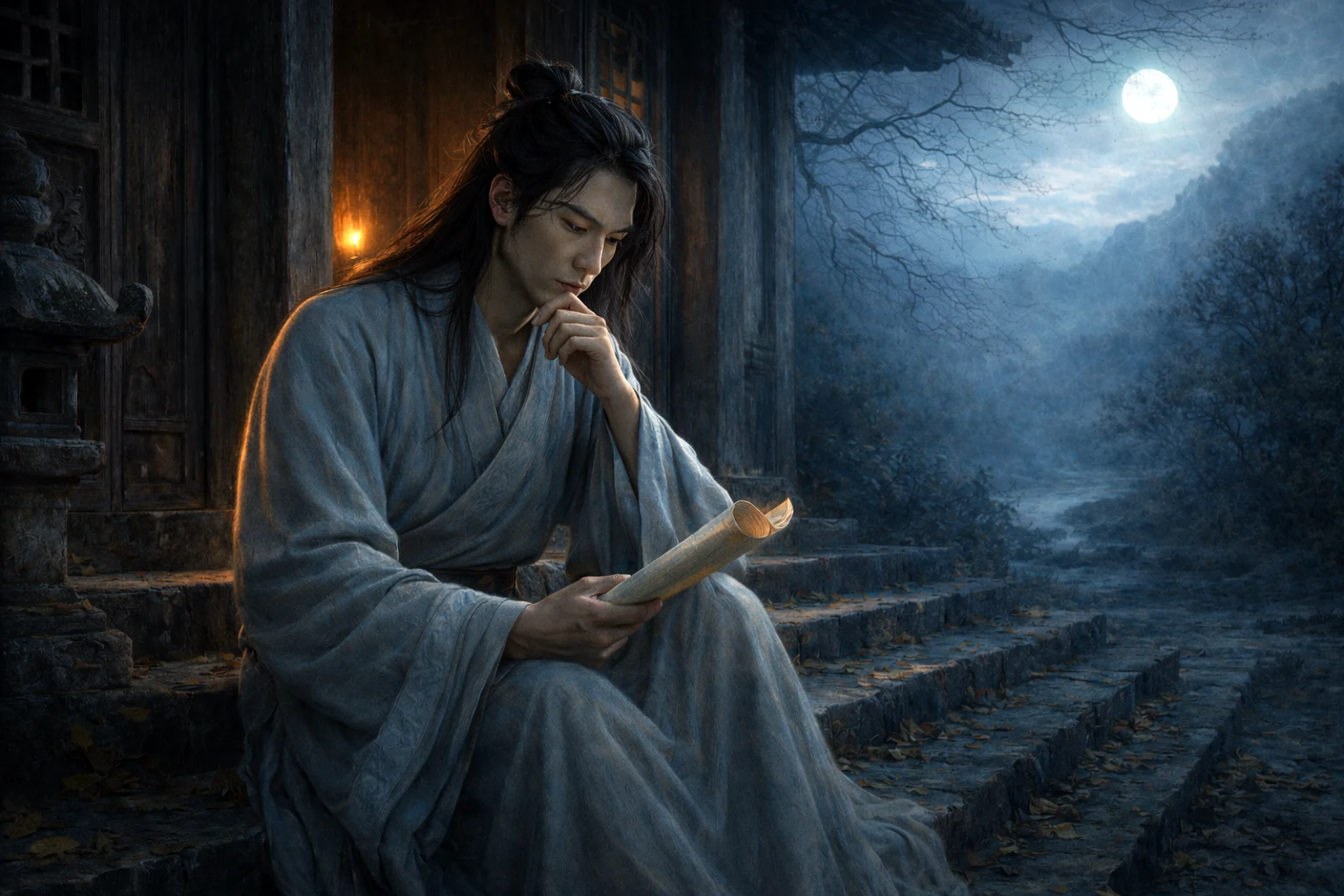
Jia Dao (贾岛 779 - 843), a native of the vicinity of present-day Beijing, was a renowned poet of the Mid-Tang dynasty. In his early years, he became a Buddhist monk under the dharma name Wuben. Later, he returned to lay life to sit for the imperial examinations, but never passed them throughout his life. In his later years, he served as Registrar of Changjiang County, earning him the sobriquet "Jia Changjiang." He was famous for his "painstaking composition" (ku yin), and together with Meng Jiao, they were known as "Meng's cold, Jia's thinness." His poetry pursued meticulous refinement of every word and line. His poems often depict desolate, barren, and lonely landscapes, excelling in the five-character regulated verse form. He exerted a profound influence on later "painstaking" poets such as Li Dong of the Late Tang and the "Four Lings" of the Southern Song.