


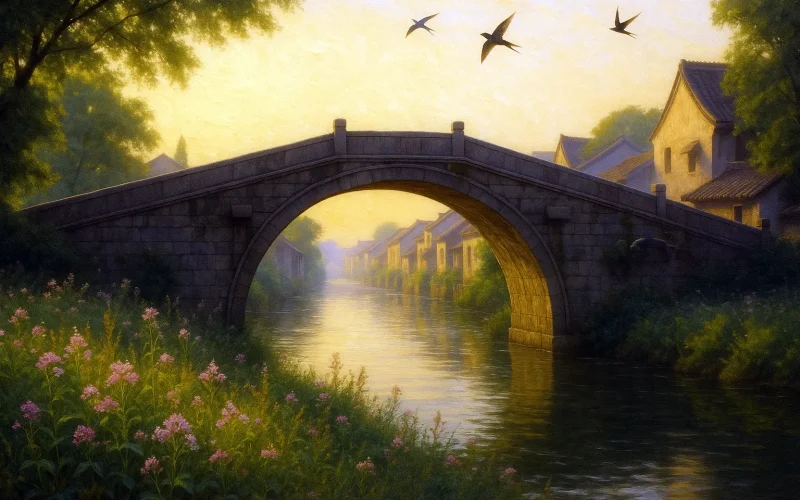
By Rosefinch Bridge wild grasses overgrow;
O’er Black-Robe Lane the setting sun hangs low.

Swallows that skimmed by painted eaves of yore,
Now dip in common people’s humble door.
Original Poem
「乌衣巷」
刘禹锡
朱雀桥边野草花,乌衣巷口夕阳斜。
旧时王谢堂前燕,飞入寻常百姓家。
Interpretation
This poem was composed in 826 AD, the second year of the Baoli era of Emperor Jingzong of Tang. It is the second poem in Liu Yuxi's "Five Poems on Jinling" and one of his most renowned poems reflecting on the past. At the time, Liu Yuxi had left his post as Prefect of Hezhou and was returning to Luoyang. Passing through Jinling (present-day Nanjing), facing the remnant hills and waters of this ancient capital of six dynasties, reflecting on the past and present, he composed a set of five poems. Jinling was once the capital of six dynasties: Eastern Wu, Eastern Jin, Song, Qi, Liang, and Chen. Its "imperial aura" had been extolled by countless poets. The Street of Mansions (Wuyi Lane) was a concentrated area for the powerful and aristocratic in its day—during the Three Kingdoms period, it housed the barracks for Wu troops guarding the Stone City, named for the black uniforms worn by the soldiers; during the Eastern Jin, it became the location of the mansions of the two great families, Wang Dao and Xie An, a symbol of overwhelming influence and gathering of the high and mighty. However, the Street of Mansions before Liu Yuxi's eyes was now overgrown with wild grasses by the Zhuque Bridge, bathed in the setting sun at the lane's entrance, its former splendor utterly gone.
It is worth noting that Liu Yuxi himself was a descendant of northern aristocracy (he claimed descent from Liu Sheng, Prince Jing of Zhongshan) and had a natural sensitivity to the rise and fall of prominent families. His own experience, from a reform-minded scholar to a disgraced and exiled official, gave him a personal understanding of the impermanence of worldly affairs. Standing at the entrance of the Street of Mansions, gazing at the setting sun, the wild grasses, and idle flowers, what welled up in his heart was not only a sigh for the rise and fall of history but also reflections on the vicissitudes of life. This poem is truly a masterpiece that blends personal fate with the vast changes of history.
First Couplet: "朱雀桥边野草花,乌衣巷口夕阳斜。"
Zhūquè qiáo biān yěcǎohuā, Wūyī xiàng kǒu xīyáng xiá.
Beside the Zhuque Bridge, wild grasses and flowers grow;
At the entrance of Wuyi Lane, the setting sun hangs low.
The poet opens by juxtaposing two place names—"Zhuque Bridge" was a large bridge spanning the Qinhuai River in southern Jinling, a major thoroughfare; "Wuyi Lane" was the famous lane beside it. These two names themselves carry the weight of history: once, this place bustled with traffic and thronged with the elite; now, beside the bridge, there are only "wild grasses and flowers"—the word "wild" (野) points to desolation, while "flowers" (花) suggests life, a natural tenacity amidst the bleakness. At the lane's entrance, it is the "setting sun" (夕阳斜)—the same sun that once shone on the scions of the Wang and Xie families now slants its rays as before, but the people and affairs are no more. This couplet does not write of people in a single word, yet people are seen everywhere: wild grasses blooming is the result of no one tending them; the setting sun slanting is the loneliness of no one paying heed. With minimal imagery, the poet sketches a desolate picture of past glory faded away.
Second Couplet: "旧时王谢堂前燕,飞入寻常百姓家。"
Jiùshí Wáng Xiè táng qián yàn, fēi rù xúncháng bǎixìng jiā.
Swallows that skimmed by painted eaves in bygone days
Are dipping now among the humble homes' doorways.
This couplet is a timeless, exquisite line, supremely clever through the ages. The poet captures an extremely evocative detail: swallows are migratory birds, returning year after year, yet they do not lightly change their nesting sites. The swallows of old perhaps once carried mud to build nests before the halls of the Wangs and Xies, witnessing the sumptuous feasts and elegant gatherings of the powerful. Now they still return, but can only fly into the homes of ordinary people. The swallows do not change; it is the human world that has changed—those illustrious families are now a thing of the past, that glorious lineage has vanished like mist, only the swallows still come and go each year, measuring the great changes of worldly affairs with their unchanging flight paths.
The contrast between "bygone days" (旧时) and "humble homes" (寻常) pushes the sense of historical vicissitudes to its limit. The poet does not directly comment on prosperity and decline, nor does he even express emotion; he simply lets the swallows serve as witnesses to history, allowing readers to taste endless change from this small detail. This is Liu Yuxi's brilliance—not spelling it out makes it deeper; not discussing it makes it more moving.
Holistic Appreciation
This short poem of only twenty-eight characters holds within it centuries of historical rise and fall. The first two lines describe the scene, using the images of "wild grasses and flowers" and "the setting sun" to sketch the desolate loneliness of the present-day Street of Mansions. The last two lines express emotion, using the shift in perspective of the "swallows before the halls" to cleverly connect the past splendor with the present plainness. The entire poem contains not a single word of direct discussion, yet every line discusses; not a word of direct expression of emotion, yet every word is emotional.
The poet deeply understood the artistic truth of revealing the great through the small, writing history through objects. He does not write on a grand scale; he does not write of the former pomp and circumstance of the Wang and Xie families, nor of the armies and battles of the Six Dynasties. He writes only of a bridge, a lane, a slant of sunlight, a swallow. And these minute things bear the entire weight of history. As an ancient critic remarked: "Just mentioning the swallows reveals the vicissitudes of time."
Artistic Merits
- Revealing the Great through the Small, Making Light of Heavy Themes: Without directly writing of rise and fall, writing only of wild grasses, the setting sun, and swallows, yet completely conveying the principles of prosperity and decline—a masterful technique.
- Subtle Contrast, Deep and Lasting Meaning: The contrast between the halls of Wang and Xie in the past and the homes of common people today, formed through the medium of swallows, is unobtrusive yet profoundly meaningful.
- Plain Language, Profound Conception: The entire poem contains not a single obscure or difficult phrase; it is conversational, yet holds boundless emotion, embodying Liu Yuxi's artistic characteristic of "simple words, deep meaning."
- Unique Perspective, Ingenious Conception: Using swallows as witnesses and connectors of history, merging past and present in an instant, the conception is novel and thought-provoking.
Insights
This poem first prompts us to contemplate the impermanence of glory and the justice of history. The Wang and Xie families—how illustrious they once were! Wang Dao assisted Sima Rui in establishing the Eastern Jin; Xie An commanded the Battle of Feishui, crushing the Former Qin. Their mansions were once centers of power, wellsprings of culture. Yet, in just a few centuries, those carved beams and painted rafters have turned to dust; where their descendants scattered, no one knows. Liu Yuxi uses a swallow to tell us: There are no eternal noble houses in the world, no perpetual aristocracy. All glory is ultimately washed away by time, returning to the ordinary, returning to dust.
Secondly, this poem also leads us to re-examine the value of ordinary life. The splendor before the halls of Wang and Xie in the past was indeed enviable, but behind that splendor, how much blood, tears, and intrigue? The humble homes of ordinary people, though simple, possess the warmth and resilience of life. While the mansions of Wang and Xie have become historical relics, those ordinary households continue to thrive, welcoming the returning swallows year after year. This teaches us: There is no need to envy the prominence of others, no need to chase illusory glory; within the ordinary lies its own eternity.
Looking deeper, this poem also teaches us how to face a changing world. That swallow flying into the ordinary home is a witness to history and also a symbol—some things change, some things do not. The halls of Wang and Xie becoming common homes—this is change. The swallows returning year after year—this is constancy. In a world of constant change, we must learn to distinguish: what will fade, what can endure. Superficial splendor, empty fame and fortune—these will ultimately vanish with the wind. But those truly beautiful things—nature, familial love, conscience, poetry—can traverse time, enduring and renewing.
Finally, the beauty of "not spelling it out" in the poem is also worth savoring carefully. Facing the vast changes of history, Liu Yuxi is not impassioned, does not lament to heaven and earth; he simply, quietly, writes of a swallow, letting readers feel and ponder for themselves. This restrained expression, this measured lyricism, is precisely the most moving quality of classical Chinese poetry. In today's noisy, restless world, this wisdom of "not spelling it out" is perhaps what we most need to learn—some feelings need not be spoken; some truths need not be spelled out; in the spaces left blank, there lies infinite possibility.
About the poet
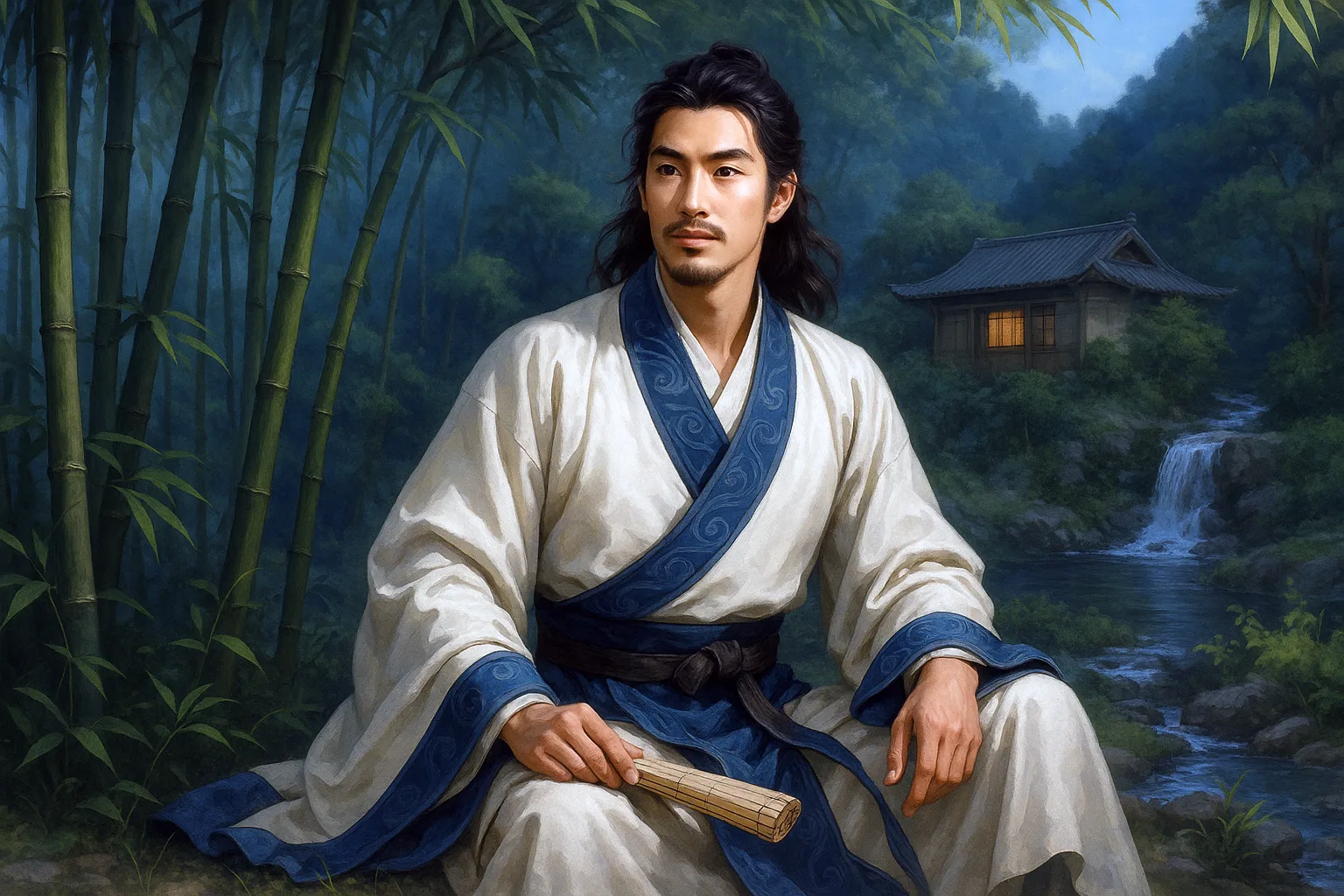
Liu Yuxi(刘禹锡), 772 - 842 AD, was a native of Hebei. He was a progressive statesman and thinker in the middle of the Tang Dynasty, and a poet with unique achievements in this period. In his compositions, there is no lack of poems reflecting current affairs and the plight of the people.