


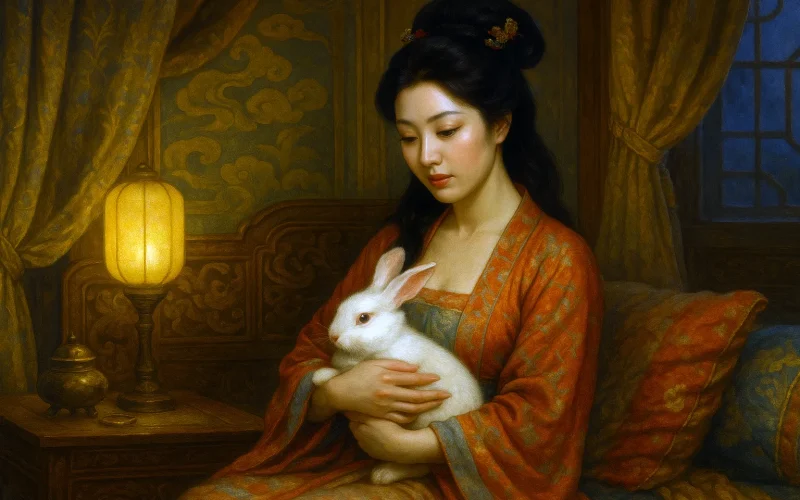
Behind a cloud-like screen, so fair and peerless, she
Now dreads spring nights in town when winter’s cold may flee.
Why did she wed a man with golden badge of pride?
To leave her sweet warm bed for court at morning tide!
Original Poem
「为有」
李商隐
为有云屏无限娇, 凤城寒尽怕春宵。
无端嫁得金龟婿, 辜负香衾事早朝
Interpretation
This poem is believed to have been composed around 839 AD, during Li Shangyin's tenure as a Collator in the Palace Library. This period marked the poet's initial entry into the bureaucracy, where he experienced firsthand the rigors of the Tang "dawn audience" system and its intrusion into private life. While the poem ostensibly expresses a boudoir lament, it fundamentally addresses the enduring conflict for the scholar-official class between public duty and domestic life. The figure of the "husband of high rank" refers not only to powerful ministers but also reflects a subtle self-irony regarding the poet's own predicament—though Li Shangyin had attained the prestigious jinshi degree, his future was clouded by his involvement in the Niu-Li factional strife. Thus, the regret over "spurning the warm, perfumed bed" can be read as a broader reflection on how the relentless pursuit of official success often leads to the loss of life's essential authenticity.
The Tang dawn audience system is noteworthy: officials were required to present themselves at the palace gates before the fifth watch (around 3-5 a.m.), awaiting the imperial summons in the chill of the predawn spring. The conflict between this institutional mandate and basic human instinct (to linger in a warm, fragrant bed) constituted a hidden psychological wound in a scholar-official's daily existence. By capturing this precise moment and presenting the alienation inherent in institutional demands through the intimate lens of the boudoir, Li Shangyin demonstrates his poetic genius in using micro-narratives to reflect broader social structures.
First Couplet: 为有云屏无限娇,凤城寒尽怕春宵。
Wèi yǒu yún píng wúxiàn jiāo, fèng chéng hán jǐn pà chūn xiāo.
For this—a mother-of-pearl screen, a beauty beyond compare— Though the Phoenix City's cold has passed, I dread the spring night's air.
Explication: The opening line presents a dual abundance, material (the screen) and human (the wife's beauty), which is instantly undercut by the emotional reversal of "dread the spring night's air." The mother-of-pearl screen, a hallmark of aristocratic Tang interiors, symbolizes a meticulously curated, worldly happiness that proves fragile before the demands of institutional time. "Though the Phoenix City's cold has passed" should signal seasonal joy, but the verb "dread" transforms this climatic shift into psychological pressure—the more delightful the spring night, the more painful the impending separation. The poet thus reveals a profound paradox: the human moments we cherish most are often shadowed by our very awareness of their fleeting nature.
Final Couplet: 无端嫁得金龟婿,辜负香衾事早朝。
Wúduān jià dé jīn guī xù, gūfù xiāng qīn shì zǎocháo.
All for wedding, without cause, a husband of such high degree, Who must spurn the perfumed bed to serve the dawn court's stern decree.
Explication: The phrase "without cause" is the emotional linchpin of the poem. It conveys neither fortune nor misfortune but rather a profound sense of bewilderment and detachment from one's fate. The "husband of high rank"—a reference to officials of the third rank and above who wore the golden tortoise insignia—epitomizes the pinnacle of social achievement. Here, however, that status becomes the direct cause of "spurning the perfumed bed." Most telling is the phrasing "to serve the dawn court's stern decree." It is not merely to "attend" court but to "serve its decree," transforming a routine obligation into an alienating form of servitude, which suggests how the pursuit of an official career systematically fragments and compromises private life. The stark sensory contrast between the intimate warmth of the bed and the impersonal chill of the dawn audience renders the ruthless logic of the system viscerally tangible.
Holistic Appreciation
This is a microscopic study of power, observed from within the confines of a boudoir. Li Shangyin's brilliance lies in his indirect method. He does not directly critique the system but, through the tremor of private feeling in a spring-night moment, allows the reader to feel how institutional demands permeate the most intimate spaces. The poem constructs a precise duality of contrasts: the screen's opulence versus the night's brevity; the husband's eminence versus the bed's emptiness. Together, they point to the foundational schism in the Tang scholar-official's existence: success in the public sphere is purchased with a deficit in the private realm.
The poem's narrative perspective is particularly ingenious. While the surface voice is that of a neglected wife, the poem implicitly contains the husband's own anxiety of divided self—he is both the man who "spurns the perfumed bed" and the official compelled to "serve the dawn court's decree." This internal drama of a split identity lifts the poem beyond a simple tale of marital neglect into a profound portrait of the scholar-official's existential state. The wife's lament, "All for wedding, without cause, a husband of such high degree," contains an unspoken counterpart: that husband, with his insignia of rank, is himself, equally and "without cause," conscripted by the machinery of the state.
The emotional logic linking "dread" and "without cause" is crucial. Because one possesses (screen, beauty), one fears loss (the passing night). Because one attains (high rank), one feels adrift ("without cause"). This experience of possession as burden, achievement as alienation is Li Shangyin's penetrating insight into the fate of his class. By mapping this conflict onto the spatial divide marked by the screen (warmth within, cold duty without), he gives tangible form to the perpetual tug-of-war the Tang official endured between his familial and bureaucratic roles.
Artistic Merits
- The Emotional Alchemy of Objects: Li Shangyin transforms material objects into vessels of feeling. The mother-of-pearl screen shifts from a luxury item to a symbol of fragile domesticity; the golden tortoise insignia morphs from a badge of honor into a source of isolation. He demonstrates a masterful ability to load material symbols with emotional and philosophical weight far beyond their literal function, turning household items into ciphers for the spirit of the age.
- Psychological Imprint on Seasonal Time: The phrase "the Phoenix City's cold has passed" is an objective seasonal marker, but "dread the spring night's air" subjectivizes and emotionalizes it. This technique of converting natural chronology into a timeline of feeling embodies Li Shangyin's distinctive poetic mode of perceiving the external world primarily through the lens of internal psychological response.
- Defamiliarizing Institutional Language: The choice of "serve the dawn court's stern decree" is a masterstroke of defamiliarization. The verb "serve" is typically reserved for solemn duties (to sovereign or family). Its application to the daily grind of the dawn audience carries a quiet irony, simultaneously revealing how routinized institutional behavior becomes internalized as a core, unquestioned aspect of the self. This precise diction demonstrates the poet's acute sensitivity to the politics and psychology embedded in language.
Insights
This work lays bare a timeless condition of institutionalized life: the fulfillment of public, social value routinely demands the sacrifice of private, emotional fulfillment. The high status of the "husband of rank" is paid for with the daily forfeiture of "the perfumed bed." The enduring lesson is that whenever personal worth becomes overly contingent on validation by an external system—be it bureaucratic rank, wealth, or social status—the operational logic of that system will inevitably begin to colonize and compromise the integrity of personal existence.
The bewildered sense of "without cause" warrants particular reflection in any era. This feeling does not stem from obvious tragedy but from a sudden, unsettling awareness of a void in meaning, encountered on a path that seemingly fulfills all societal expectations of success. Both the woman's marriage to a high official and the man's attainment of that rank are social "successes." Yet this very success yields only the "dread" of the night and the "spurning" of the bed. This reminds us that socially sanctioned goals and markers of achievement are not reliable proxies for authentic, lived happiness.
Ultimately, the poem offers not a simplistic choice between career and home but a catalyst for reimagining the very concept of "success." In an age that revered official rank, Li Shangyin, through the subtle complaint voiced from behind a mother-of-pearl screen, allows us to glimpse the intimate warmth shattered daily by the bell calling men to predawn duty. This poetic reminder remains perpetually relevant in any culture that prizes efficiency and achievement: **A society's true measure of civilization may be its capacity to design institutions that find a humane balance with fundamental human needs, so that the warmth of the private chamber need not live in perpetual dread of the breaking dawn.
About the poet
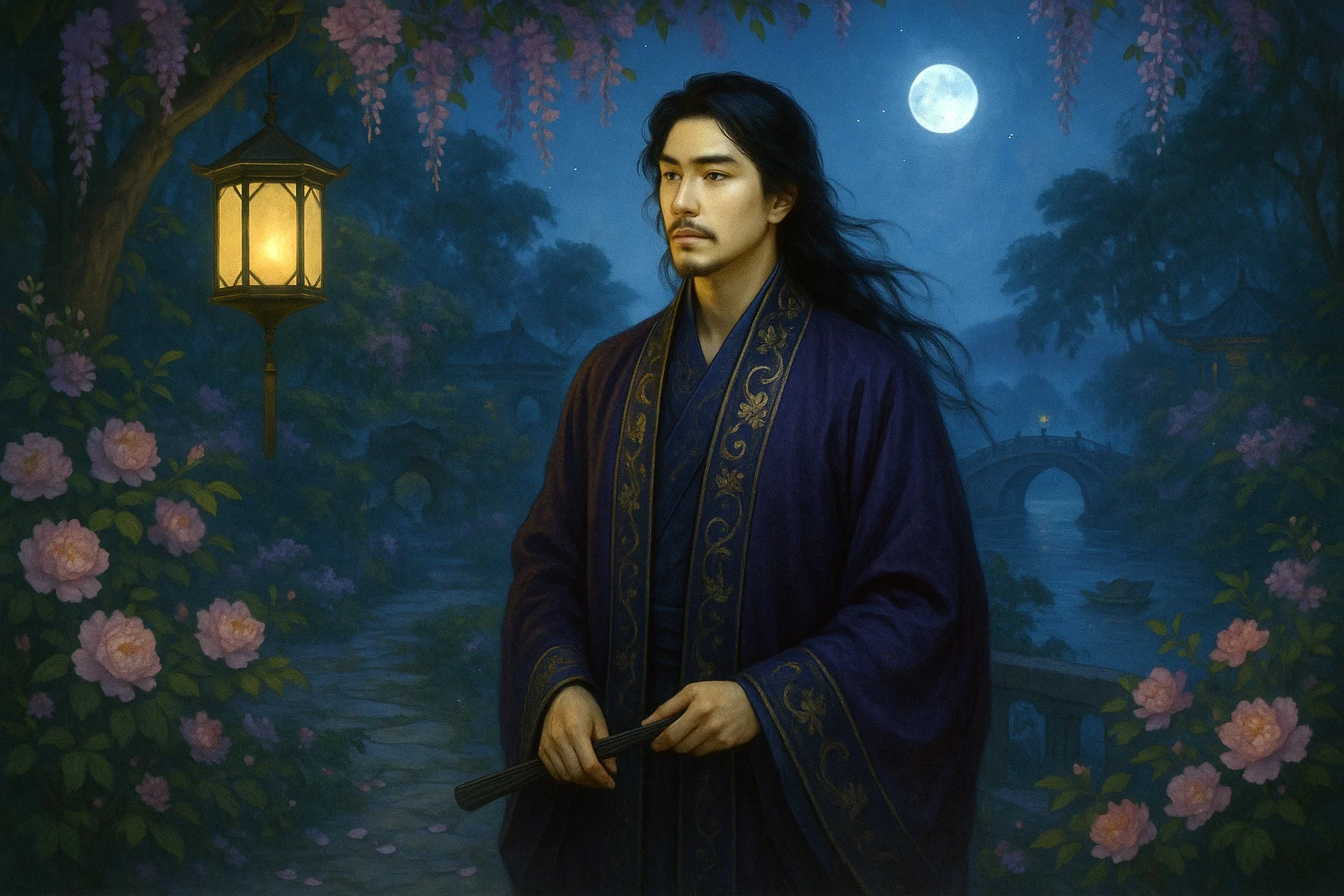
Li Shangyin (李商隐), 813 - 858 AD, was a great poet of the late Tang Dynasty. His poems were on a par with those of Du Mu, and he was known as "Little Li Du". Li Shangyin was a native of Qinyang, Jiaozuo City, Henan Province. When he was a teenager, he lost his father at the age of nine, and was called "Zheshui East and West, half a century of wandering".