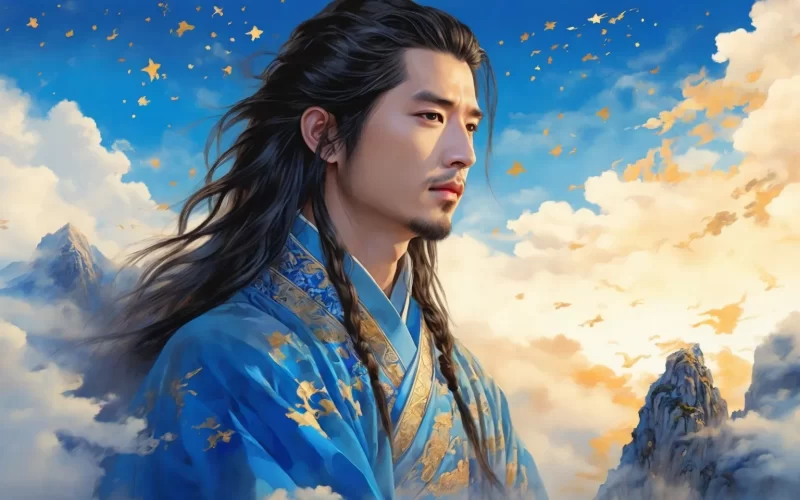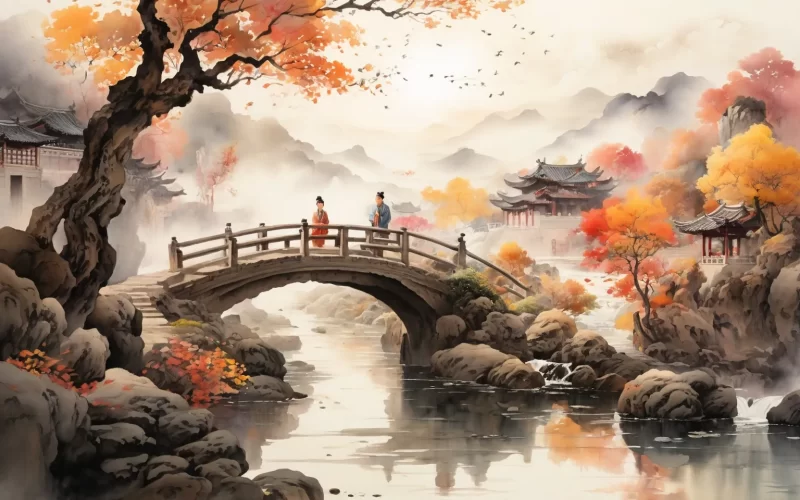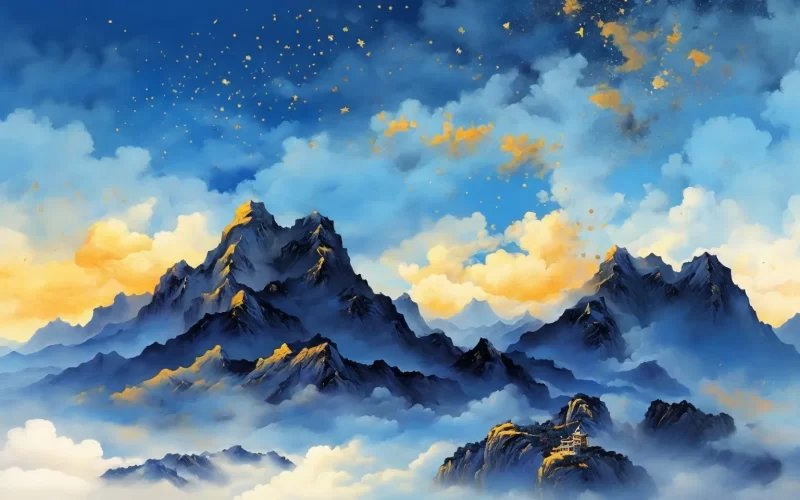
What shall I say of the Great Peak? --
The ancient dukedoms are everywhere green,
Inspired and stirred by the breath of creation,
With the Twin Forces balancing day and night.

...I bare my breast toward opening clouds,
I strain my sight after birds flying home.
When shall I reach the top and hold
All mountains in a single glance?
Original Poem
「望岳」
杜甫
岱宗夫如何?齐鲁青未了。
造化钟神秀,阴阳割昏晓。
荡胸生层云,决眦入归鸟。
会当凌绝顶,一览众山小。
Interpretation
This widely celebrated poem was composed in 736 CE, the twenty-fourth year of the Kaiyuan era under Emperor Xuanzong of the Tang dynasty, and stands as one of Du Fu's earliest extant works. At twenty-four, having just failed the imperial examinations, the poet embarked on a journey east, beginning a period of untrammeled wanderings in the regions of Qi and Zhao (modern-day Shandong and Hebei), a life he later recalled as one of "youthful abandon in fine furs and on spirited steeds." When he reached the foot of Mount Tai—revered as the foremost of the Five Sacred Mountains—and gazed upon its heights, its majestic grandeur instantly resonated with the ambitions stirring within the young poet's breast and with the unyielding passion of a spirit recently met with setback yet undimmed. Thus, this poem became a magnificent symphony of youth and landscape, marking the brilliant dawn of a great poet's creative journey.
First Couplet: “岱宗夫如何?齐鲁青未了。”
Dài zōng fū rú hé? Qí Lǔ qīng wèi liǎo.
O Peak of Peaks, how is it you tower? / Your green melts into the vast lands of Qi and Lu, far and near.
The poem opens with an exclamation of awe and longing. The words "how is it you tower" vividly capture the poet's stunned wonder upon first confronting the lofty peak—a feeling urgent to describe yet beyond words. The reply, "Your green melts into the vast lands of Qi and Lu," is a stroke of genius. Rather than depicting the mountain's form directly, it evokes Mount Tai's overwhelming presence through an immense geographical expanse and a single, pervasive hue of green. "Melts into" suggests both visual boundlessness and the surging, restless emotions within the poet's heart.
Second Couplet: “造化钟神秀,阴阳割昏晓。”
Zào huà zhōng shén xiù, yīn yáng gē hūn xiǎo.
Here Nature gathered all grace and wonder rare; / Its north and south split darkness from the light of air.
This couplet focuses on Mount Tai's divine beauty and mighty grandeur. "Gathered" personifies Nature as having willfully concentrated all heavenly and earthly excellence upon this single mountain. "Split" imbues the mountain ridge with the force of a blade, vividly depicting how its immense height cleaves the sunlit and shadowed slopes, demarcating dawn from dusk. "Gathered" and "split," one concentrating, one dividing, convey how the mountain embodies all beauty while commanding time and space itself. The interplay of tangible and intangible creates powerful tension.
Third Couplet: “荡胸生层云,决眦入归鸟。”
Dàng xiōng shēng céng yún, jué zì rù guī niǎo.
Layer upon layer of clouds surge, stirring my soul's core; / My straining eyes trace homing birds till they are seen no more.
The gaze shifts from the mountain's imposing form to its dynamic scenes, and the emotional focus turns from outward observation to inward experience. "Stirring my soul's core" describes the spiritual awe and catharsis induced by the layered, rolling clouds—a profound communion between the self and nature. "My straining eyes" depicts a gaze of such intense concentration that it verges on physical strain, revealing the poet's rapt absorption and his desire to take in every facet of the mountain's grandeur. The imagery of homing birds hints at the approach of dusk and subtly echoes the poet's own search for spiritual anchorage. This couplet introduces a layer of subtle contemplation into the majestic scene, infusing it with deep emotional resonance.
Fourth Couplet: “会当凌绝顶,一览众山小。”
Huì dāng líng jué dǐng, yī lǎn zhòng shān xiǎo.
One day I shall ascend the summit, supreme and high, / And at a glance see all other mountains dwarfed beneath the sky.
The poem concludes with a heroic declaration, elevating its sentiment to a climax. "One day I shall" expresses unwavering resolve, a youthful vow brimming with absolute confidence and strength. "See all other mountains dwarfed" adapts the sentiment from Mencius—"Having ascended Mount Tai, one finds the world small"—but with greater imagistic force and personal agency. This is not merely the conquest of a geographical height but a升华 of spirit. Through it, the poet voices his lofty ambition to surmount all obstacles and scale the peaks of life and endeavor.
Holistic Appreciation
This poem is a cornerstone of Du Fu's early work, perfectly embodying the fusion of High Tang youthful vitality with sublime natural grandeur. Governed throughout by the act of "gazing," it presents not a static view but a dynamic, immersive journey: from the soul-stirring distant gaze and questioning wonder upon first sight, to the aesthetic contemplation of its divine artistry, to the merging of self and nature as clouds stir his breast and his eyes follow homing birds, culminating in the life-affirming declaration to ascend the summit and command the world below.
The poem is charged with a powerful, upward-striving energy. The young Du Fu projects his personal ambition—temporarily checked by setback yet all the more vigorous—onto Mount Tai, a majestic cultural symbol. Thus, the mountain under his brush becomes not merely a natural entity but a monument to the human spirit. Its emotional intensity, grandiose imagery, and vigorous language already reveal the "majestic and expansive" dimension within Du Fu's signature "somber and powerful" style, heralding the future greatness of the poet.
Artistic Merits
- Grand Conception, Led by a Question
The awestruck opening question—"O Peak of Peaks, how is it you tower?"—immediately draws the reader in and establishes the poem's emotional arc of wonder, exploration, and conquest. The beginning is masterful and compelling. - Precise and Potent Diction
Verbs like "gathered," "split," "stirring," "straining," "ascend," and "see" are employed with remarkable expressiveness and imaginative force. Particularly "split," transforming stillness into dynamic power, grants Mount Tai dominion over nature—it is the poem's pivotal word. - Blending Tangible and Intangible, Scene Born from Emotion
The first two couplets realistically depict the mountain's form and presence; the latter two focus on the feelings evoked and the aspirations awakened. The transition from the tangible vista of "green melts into" to the envisioned prospect of "mountains dwarfed" achieves a natural shift and artistic elevation from objective description to subjective expression. - Majestic Momentum, Elevated Tone
The poem flows with unbroken energy, its emotions building layer upon layer: from awe to reverence, from absorption to resolve, culminating in a resounding declaration. It is imbued with the confidence, ambition, and romantic vigor characteristic of the High Tang era.
Insights
A view of Taishan is more than a landscape poem; it is a hymn to youth and a manifesto of aspiration. It teaches us that true grandeur begins with a courageous upward gaze, and every great journey originates from a firm "One day I shall." Before Mount Tai's majesty, the young Du Fu felt not intimidation but a stirring ambition to conquer and transcend. This spirit of "the human peak surpassing the mountain's height" epitomizes the High Tang ethos and should form the foundation of every aspiring soul.
It reminds us that at life's outset, or when facing seemingly insurmountable challenges, what we need is precisely this "heart stirred by layered clouds"—an openness of spirit—and the "far-seeing eye that dwarfs lesser peaks"—a lofty perspective. Life's meaning lies in continually setting our sights on higher summits and striving toward them. The youthful passion Du Fu inscribed a millennium ago still speaks to us: vision defines our horizon, and aspiration guides our path. With the summit in our hearts, every step forward becomes part of the ascent.
Poem translator
Kiang Kanghu
About the poet
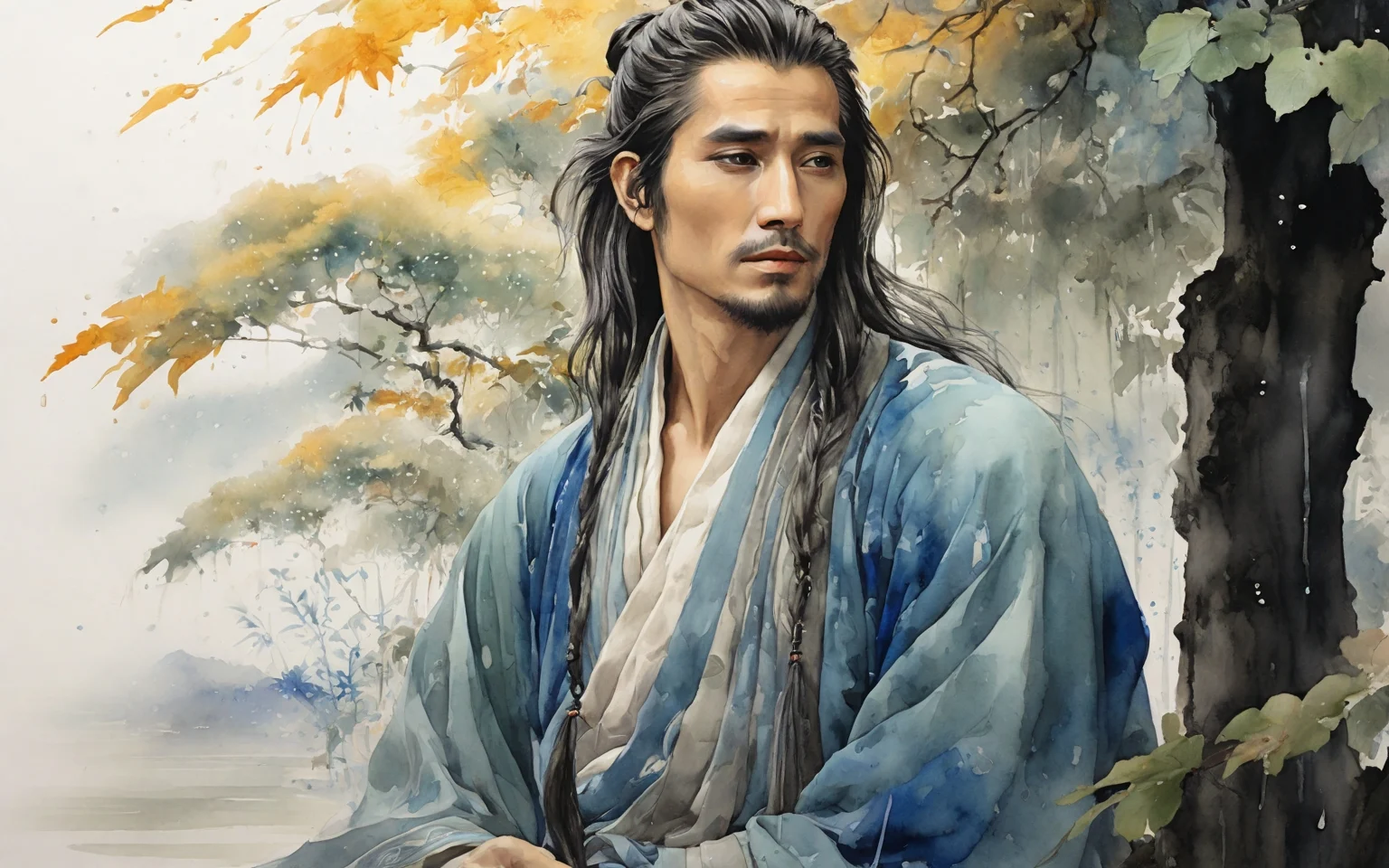
Du Fu (杜甫), 712 - 770 AD, was a great poet of the Tang Dynasty, known as the "Sage of Poetry". Born into a declining bureaucratic family, Du Fu had a rough life, and his turbulent and dislocated life made him keenly aware of the plight of the masses. Therefore, his poems were always closely related to the current affairs, reflecting the social life of that era in a more comprehensive way, with profound thoughts and a broad realm. In his poetic art, he was able to combine many styles, forming a unique style of "profound and thick", and becoming a great realist poet in the history of China.