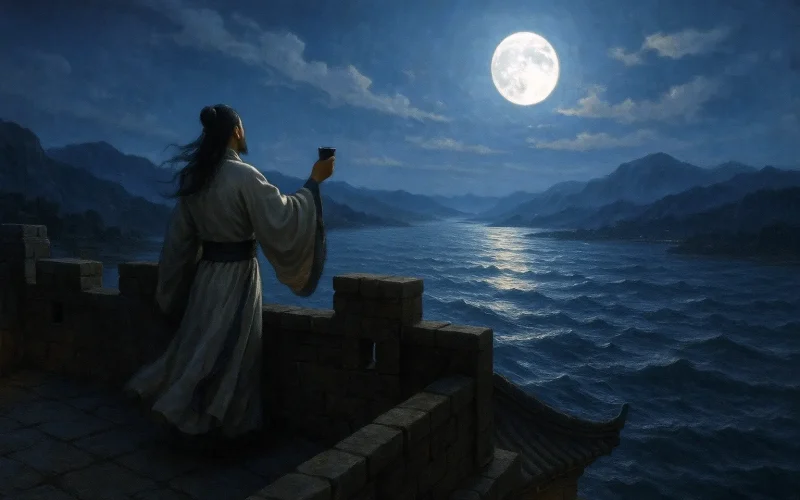



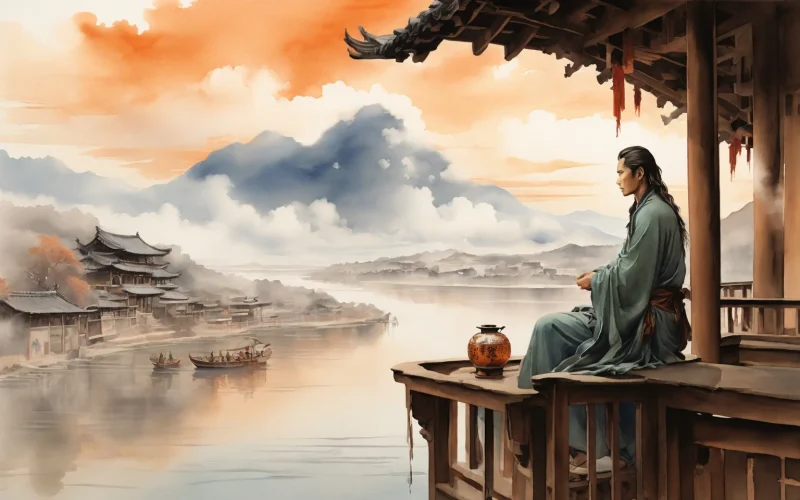
For miles and miles I sail and float;
High famed mountains are hard to seek.
By riverside I moor my boat,
Then I perceive the Censer Peak.

Knowing the hermit's life and way,
I love his solitary dell.
His hermitage not far away,
I hear at sunset but the bell.
Original Poem
「晚泊浔阳望庐山」
孟浩然
挂席几千里,名山都未逢。
泊舟浔阳郭,始见香炉峰。
尝读远公传,永怀尘外踪。
东林精舍近,日暮空闻钟。
Interpretation
This poem was composed in the 21st year of the Kaiyuan era (733 CE). Meng Haoran was already past forty and had concluded his wanderings through the Wu and Yue regions. He was traveling upstream along the Yangtze River, returning home. Jiujiang, situated in the middle reaches of the Yangtze with Mount Lu towering beside it, had since ancient times been a place where culture flourished and Buddhism and Daoism intermingled. This "night mooring" was not merely a pause from the fatigue of river travel; it became a significant moment for the poet's spirit to pause and gaze afar.
Prior to this journey, Meng Haoran had traveled to Chang'an with high hopes of securing an official post, yet he encountered disappointment and frustration. His journey home thus carried undertones of disillusionment and melancholy. As he moored his boat outside Jiujiang city, the majestic Incense Burner Peak of Mount Lu suddenly filled his view. This was not merely the appearance of a famous geographical landmark; it was the manifestation of a symbol laden with profound traditions of reclusion and religious culture. It resonated deeply with the poet's current state of mind—his yearning for transcendence and his search for solace.
The poem mentions Master Huiyuan, a revered monk of the Eastern Jin Dynasty who founded the Donglin Monastery on Mount Lu and initiated the Pure Land school of Buddhism. His "footsteps beyond the dust" represented, to traditional scholars, a lofty ideal of worldly transcendence. Here, Meng Haoran connects the mountain scenery before him with this transcendent figure. This is both a cultural echo evoked by the sublime landscape and, more importantly, a projection of his own inner struggle to find a spiritual path between official service and reclusion. Consequently, the poem transcends a typical traveler's snapshot of a scene; it becomes a condensed, profound work embodying reflection upon a life stage and the pursuit of spiritual meaning.
First Couplet: "挂席几千里,名山都未逢。"
Guà xí jǐ qiān lǐ, míng shān dōu wèi féng.
For thousands of miles my sail has hung; / I’ve met no famous mountain on the way.
The opening line, with the "thousand-mile sail" as its backdrop, sketches a faint weariness and unfulfilled expectation from a long search. The phrase "met none" (dōu wèi féng), within a plain statement, implies a spiritual thirst felt over the long journey, building emotional momentum for the surprise of "first see" in the following lines.
Second Couplet: "泊舟浔阳郭,始见香炉峰。"
Bó zhōu Xúnyáng guō, shǐ jiàn Xiānglú fēng.
Mooring my boat by riverside town, I see / The sunlit Censer Peak in its full splendor.
The shift from "met none" to "first see" turns the poem's tone, the mood opening up with sudden clarity. The two words "first see" are highly charged, capturing both the visual impact of the peak suddenly appearing and, more significantly, the emotional stir of a long-sought encounter, serving as the key pivot in the poem's scene and mood.
Third Couplet: "尝读远公传,永怀尘外踪。"
Cháng dú Yuǎngōng zhuàn, yǒng huái chén wài zōng.
I’ve read the life of the great monk of yore / And long for the pure life that he led then.
The focus shifts from the actual scene to reverie, moving naturally from "gazing at the mountain" to "remembering the man." By invoking Master Huiyuan and his spiritual connection to Mount Lu, the poet elevates the scene before his eyes into a cultural image and a symbol of an ideal personality, expressing a deep-seated admiration for a life of noble seclusion.
Fourth Couplet: "东林精舍近,日暮空闻钟。"
Dōnglín jīngshè jìn, rì mù kōng wén zhōng.
The Eastern Temple is as near as it is far, / I only hear the evening bell in the setting sun.
The poem concludes with an aural image, its mood far-reaching. The three words "empty hear the bell" are especially exquisite: the bell can be heard, yet the great monk is long gone; the temple is near, yet the world beyond the dust is hard to reach. "Empty" (kōng) conveys both a sense of physical distance and a feeling of melancholy in the heart, the lingering sound inviting deep reflection.
Holistic Appreciation
The entire poem begins with a thousand-mile boat journey and ends with the empty sound of a dusk bell, outlining a complete spiritual movement from restlessness to stillness, from seeking to reverie. The poet does not focus on depicting the specific, magnificent forms of Mount Lu. Instead, using the Incense Burner Peak as a guide, he fuses natural landscape, cultural memory, and personal feeling, containing multiple layers of meaning within a deceptively simple language.
The most moving aspect of the poem is that "aesthetic and spiritual tension of what is visible yet unattainable." Although the Incense Burner Peak is "first seen," it remains a distant view; although the Eastern Temple is "near," one only "hears the bell" without reaching it. This sense of distance precisely constitutes the space where poetry is generated—it is both a geographical gap and a spiritual longing, a symbol of the eternal tension between the realm of the ideal and the reality of the self.
Artistic Merits
- Natural Structure, Flowing Meaning: The transitions—from traveling the river seeking mountains, to mooring the boat and seeing the peak, to remembering the monk and hearing the bell—are smooth and natural, forming a complete emotional and logical sequence.
- Interplay of Tangible and Intangible, Interweaving of Time and Space: The tangible is the journey seen from the boat; the intangible is the memory stirred by reading. Spatially, it moves from the vast river surface to a single peak; temporally, it reaches from the present moment back to a Jin Dynasty monk. The tangible and intangible reflect each other; time and space interweave.
- Economical Language, Expansive Mood: The poem's diction is extremely simple and unadorned. Yet, through the use of key words like "first see," "long for," and "empty hear," it creates an artistic realm of subtle depth, where meaning extends beyond the words.
- Concluding with Sound, Lingering Resonance: The ending concludes with the "sound of the bell," causing the visual act of "gazing" to finally resolve into the aural experience of "hearing." In the dusk, all the gazing and longing merge into that one, lingering, resonant echo.
Insights
Through a seemingly casual travel fragment, this poem reveals an eternal human search and encounter within the human spirit. We are all, on life's journey, "hanging our sails," seeking our own "famous mountain." And the true encounter often occurs in a moment of pause after a long trek, in that instant when the heart opens to the world.
The "Incense Burner Peak" in the poem has transcended a specific landscape to become a symbol of an ideal, a belief, or a spiritual home. It tells us that what matters may not be the final arrival, but the longing maintained during the search, and the stirring and cleansing the heart receives at the moment of encounter. That sound of the bell, "empty" yet heard, is both a regret and a solace—it reminds us that some forms of beauty can be listened to, yearned for, and forever carried in the heart, without necessarily being fully possessed.
Poem translator
Xu Yuanchong (许渊冲)
About the poet
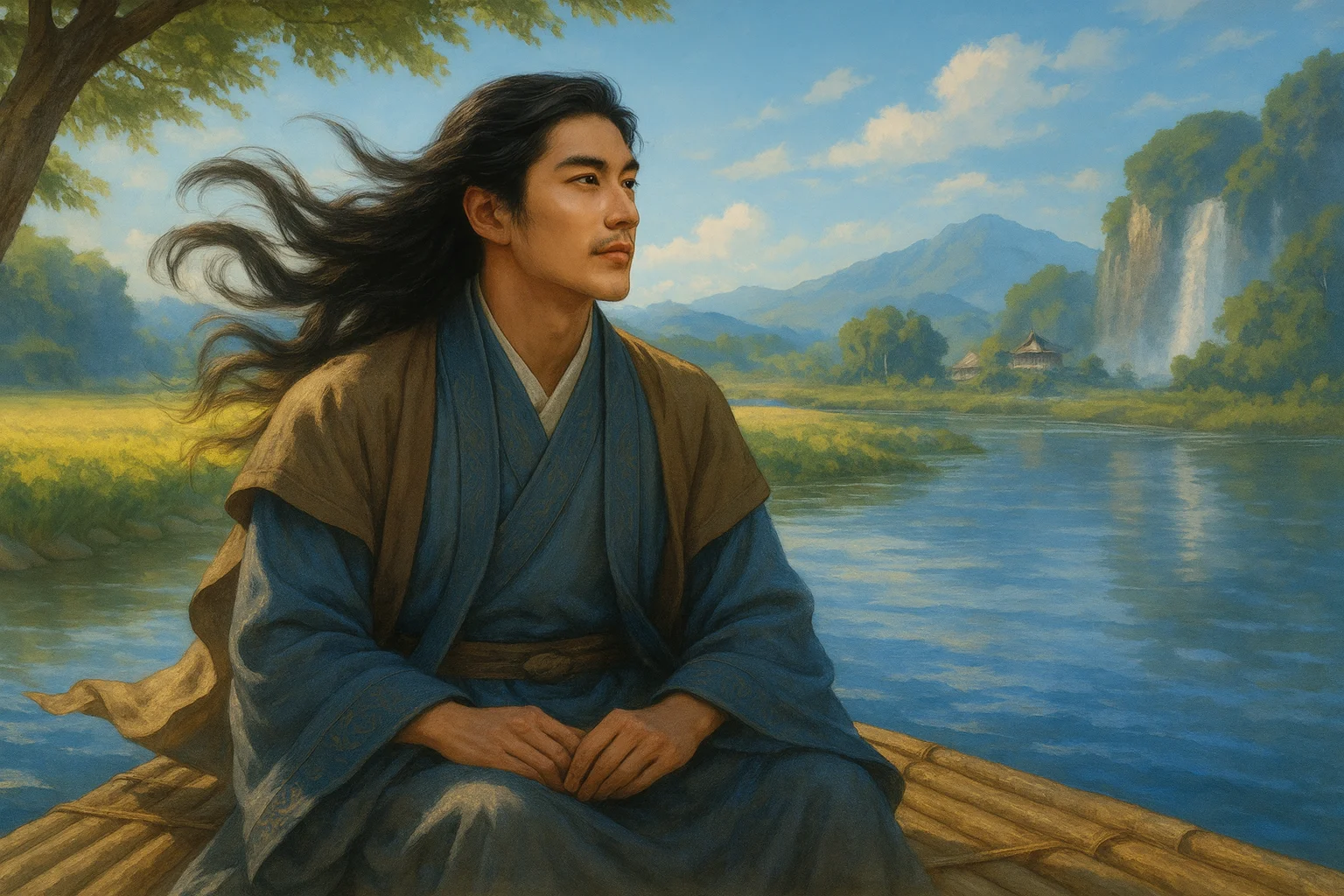
Meng Haoran (孟浩然), 689 - 740 AD, a native of Xiangyang, Hubei, was a famous poet of the Sheng Tang Dynasty. With the exception of one trip to the north when he was in his forties, when he was seeking fame in Chang'an and Luoyang, he spent most of his life in seclusion in his hometown of Lumenshan or roaming around.