


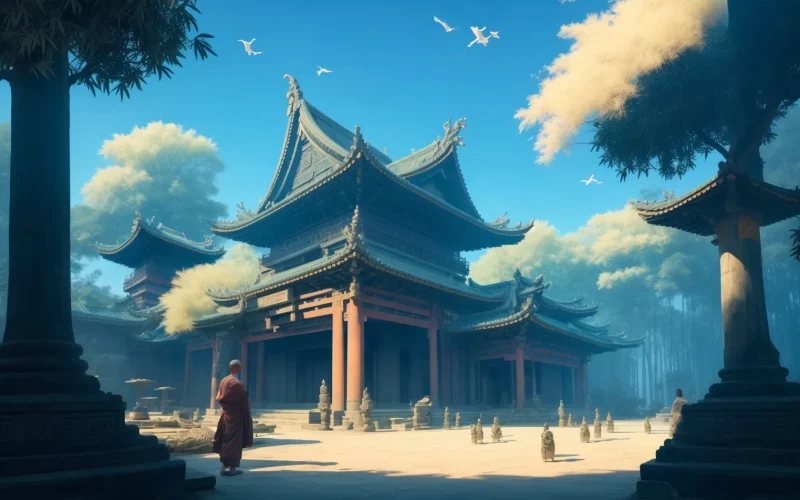
At dawn I come to the old temple’s gate;
The morning sun lights up the forest straight.
A winding path leads to a calm retreat;
The cell’s deep hid where flowers and branches meet.

The hills delight the birds with sunny rays;
The pool’s clear shade the human heart allays.
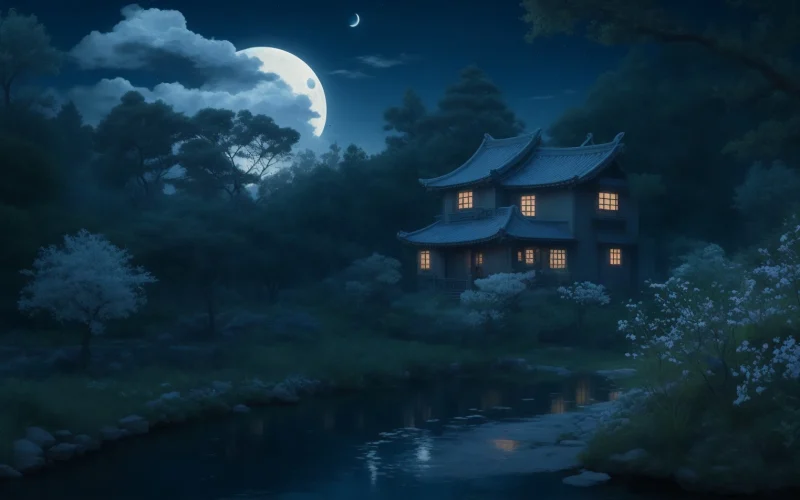
All worldly sounds are hushed in this lone spot
But the tingling of the temple bell still heard a lot.
Original Poem
「题破山寺后禅院」
常建
清晨入古寺,初日照高林。
曲径通幽处,禅房花木深。
山光悦鸟性,潭影空人心。
万籁此俱寂,但余钟磬音。
Interpretation
This poem is a quintessential work of landscape poetry imbued with Chan (Zen) Buddhist contemplation by the Tang Dynasty poet Chang Jian, composed during his travels to the Xingfu Temple on Mount Yu. The "Broken Hill Monastery" refers to the present-day Xingfu Temple located on the northern slopes of Mount Yu in Changshu, Jiangsu, a place of deep forests and valleys with a profound, enduring Chan atmosphere. Originally the residence of Ni Deguang of the Southern Qi Dynasty, it was later donated to become a temple, evolving into a renowned Jiangnan monastery. Immersed in this setting, the poet was not only moved by the serene scenery of the temple but also deeply felt a fusion of body, mind, nature, and the Chan state. Thus, he took up his brush to compose this poem, recording both the beauty of the landscape and expressing a longing to transcend the mundane world and return to tranquility.
First Couplet: "清晨入古寺,初日照高林。"
Qīngchén rù gǔ sì, chū rì zhào gāo lín.
At dawn I come to the convent old / While rising sun tips its tall trees with gold.
This couplet outlines the time, place, and overall atmosphere with concise strokes. "At dawn" not only indicates the hour of entry but also subtly suggests a mental state of freshness and awakening. The "rising sun" symbolizes light and enlightenment, contrasting with the ancient, solemn weight of the "convent old." The "tall trees" depict the actual scenery while also metaphorically suggesting the lofty, profound realm of Buddhist teachings. Through the interplay of light, shadow, and space, the poet constructs a solemn yet vibrant scene of a mountain forest at dawn, establishing a tone of serene stillness and illumination for the entire poem.
Second Couplet: "曲径通幽处,禅房花木深。"
Qūjìng tōng yōu chù, chánfáng huāmù shēn.
On a winding pathway green with gloom, / To deep secluded garden leads my room.
This couplet uses the "winding pathway" to guide both vision and spirit gradually inward, embodying a journey of seeking seclusion and discovering beauty. The word "secluded" refers both to spatial remoteness and implies the profound, elusive depth of Chan philosophy. "Leads my room" not only describes the natural luxuriance of the plants but, with the word "deep," highlights the hermitic quality of the meditation retreat, its distance from worldly bustle and its integration with nature. These lines deeply capture the aesthetic principles of "concealment over revelation" and "natural charm" found in Chinese garden design and Chan Buddhism, also revealing the poet's yearning for a reclusive life and his pursuit of a Chan-like state of stillness.
Third Couplet: "山光悦鸟性,潭影空人心。"
Shān guāng yuè niǎo xìng, tán yǐng kōng rén xīn.
Here mountain's aura freshens birds' delight; / Shadows of pools empty the human heart.
This couplet is the focal point of the poem. The word "freshens" endows the mountain's aura with emotion, describing both the birds and, by implication, the human observer, suggesting that the delight of nature is sufficient to nourish one's spirit. The word "empty" uses the tranquil clarity of the pool's reflection to symbolize the cleansing and transcendence of the human heart. One line depicts movement, the other stillness; one external, the other internal, creating a tension and升华 (shēnghuá: sublimation) in artistic conception. Here, all descriptions of scenery are expressions of feeling. Through a contemplative fusion of self and object, the poet conveys the experience of comprehending Chan principles within nature and attaining spiritual clarity through meditation, aligning closely with the Chan Buddhist path of "awakening the mind through the scene."
Final Couplet: "万籁此俱寂,但余钟磬音。"
Wànlài cǐ jù jì, dàn yú zhōngqìng yīn.
All mundane noises are hushed here and gone, / But chiming bells and tinkling stones are heard.
The poet concludes the poem with the sense of hearing, highlighting the lingering sound of bells and chimes amidst extreme silence. Sound within stillness paradoxically deepens the sense of emptiness and solitude. Bells and chimes are instruments used in Buddhist temples for chanting and worship; their clear, distant tones symbolize the Dharma guiding the mind beyond the worldly. This couplet uses sound to emphasize silence, using finite sound to echo the infinite realm, allowing the poem's Chan essence to move from scene to mind, from mind to spirit, finally settling in a mood of contemplative forgetfulness and harmonious unity between heaven and humanity.
Holistic Appreciation
This work uses the journey through the temple as a thread, gradually moving from the outer to the inner, from scenery to Chan, completing a spiritual pilgrimage and purification. The poem begins with "At dawn I come," passes through the "winding pathway" and "my room," reaches the "mountain's aura" and "shadows of pools," and concludes with the "chiming bells and tinkling stones." The structure is rigorous and clearly layered. In this process, the poet not only depicts the secluded scenery of the Broken Hill Monastery but also reveals the transformation of his own mental state: moving from the mundane world into a pure land, rising from the visible scene to the realm of mental enlightenment, finally uniting with the Chan state in the sound of the bells and chimes, achieving complete peace of mind.
The poem's language is elegant, economical, and pure, without a single superfluous word, yet within its simplicity and subtlety lies a profound artistic conception. It is not only an excellent example of the Tang Dynasty landscape and pastoral poetry tradition but also a representative work of poetry imbued with Chan spirit, reflecting the High Tang literati's integration of natural contemplation, aesthetic experience, and philosophical thought.
Artistic Merits
- Synchronized Deepening of Space and State of Mind
The poem progresses in physical space from outside to inside the temple, from the visible to the secluded, simultaneously mapping the poet's inner spiritual journey from worldly engagement to transcendence, from distracted thought to empty clarity. This structure of "steps shifting, mood transforming" gives the entire poem a strong sense of guidance and immersion. - Depicting Stillness through Movement, Emphasizing Silence through Sound
In the poem, "freshens birds' delight" is a scene of movement, and "chiming bells and tinkling stones" are sounds, yet both serve the themes of "seclusion," "silence," and "emptiness." This technique not only avoids a static picture but also deepens the layers of contemplative stillness, giving the quiet realm breath and vitality. - Natural Fusion of Chan Spirit and Poetic Artistry
The poet does not reason directly but allows Chan principles to emerge naturally from the scenery through the arrangement of images like light, shadow, sound, and color. For example, in "shadows of pools empty the human heart," the clarity of the water's reflection and the emptiness of the mental state form an overlapping of imagery, making the philosophy self-evident. - A Unique Position within High Tang Poetic Style
Chang Jian's poem belongs to the same clear and tranquil school as the landscape poetry of Wang Wei and Meng Haoran, but its monastic theme and empty, silent atmosphere are more concentrated and pronounced. It reflects a subtle transition from landscape aesthetics to religious experience of the mind and can be seen as a precursor to the Chan-infused landscape poetry of Wang Wei.
Insights
The reason this poem has been recited for a millennium lies not only in its artistic achievement but also in its touch upon a universal human spiritual need—the longing for tranquility, purification, and transcendence. The deep, secluded monastery in the poem has become a cultural symbol, representing the peaceful home within our hearts that we yearn to return to.
In today's noisy, busy life, this poem reminds us: true peace may not stem from environmental isolation but from inner contemplation and grounding. Through a morning visit to a temple, the poet completed a brief spiritual practice. This also enlightens us that even in daily life, we can, through moments of quiet observation and closeness to nature, cleanse the dust from our hearts and regain mental clarity and freedom.
About the Poet:
Chang Jian (常建), A.D. 708 - c. A.D. 765, received his Bachelor's Degree in A.D. 727 and served as a county lieutenant before resigning from his post and returning to his hermitage in the Western Hills of Wuchang. His poems are mostly about mountains and monasteries, with twisted emotions, tranquil moods, and light and beautiful language.