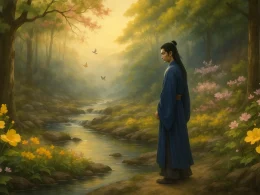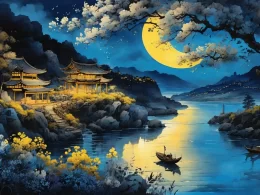



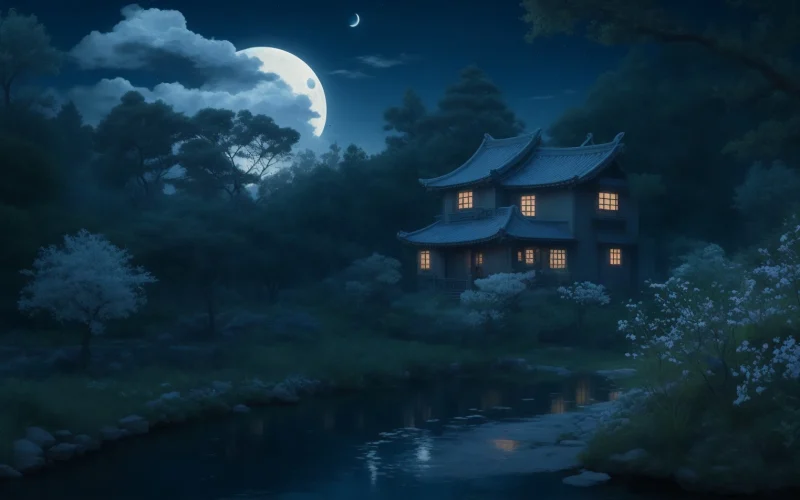
A clear stream deep beyond compare;
A lonely cloud dwells in the air.
Through pines peeps out the slender moon;
Its light for you shines late and soon.

Thatched eaves keep shadows of flowers in dream;
Moss veils the herb-plot like a silvery seam.
I’ll also leave the world of men,
For western hills and cranes’ own den.
Original Poem:
「宿王昌龄隐居」
清溪深不测,隐处唯孤云。
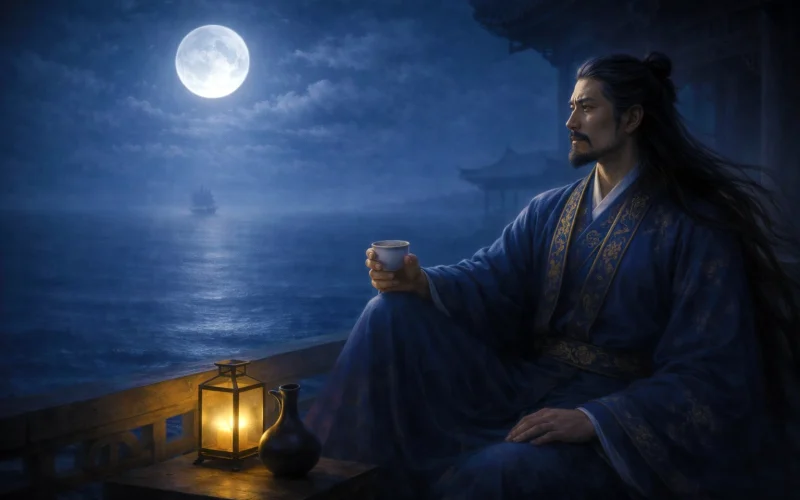
松际露微月,清光犹为君。
茅亭宿花影,药院滋苔纹。
余亦谢时去,西山鸾鹤群。
Interpretation
This poem was likely composed during the later Kaiyuan era of Emperor Xuanzong of the Tang Dynasty, at the height of the High Tang period. Chang Jian and Wang Changling were close associates who passed the imperial examination in the same year (727 AD), sharing similar aspirations and interests. In his early years, Wang Changling had lived in seclusion at Stone Gate Mountain (within present-day Hanshan, Anhui), a place of deep mountains and quiet waters, far from the dusty world, which served as the physical embodiment of his noble ideals and reclusive sentiments. Chang Jian's visit and stay were not merely a call upon a friend but a spiritual pilgrimage into the heart of reclusive culture.
Unlike poets like Wang Wei and Meng Haoran, who alternated between official service and reclusion, Chang Jian's official career was more obscure, and his poetic style leaned more towards desolate tranquility and depth. His understanding of the theme of reclusion often carried a more resolute tone of yearning. This poem is not a typical landscape travelogue or a work of social reciprocity; rather, it is a dialogue the poet conducts with his own ideal self through the space of his friend's seclusion, an immersive experience and ultimate affirmation of an "alternative possible life." What the poem depicts is both a real physical environment and a highly poeticized, purified spiritual utopia. Through it, Chang Jian expresses not only his admiration for Wang Changling's lofty, reclusive life but also reveals his own deep-seated desire to break free from the fetters of fame and fortune and return to the simplicity of nature. It is a first-rate masterpiece within High Tang reclusive poetry, particularly renowned for its ethereal and limpid artistic conception.
First Couplet: "清溪深不测,隐处唯孤云。"
Qīng xī shēn bù cè, yǐn chù wéi gū yún.
A hidden hermitage here by a clear deep stream, / Only a lonely cloud is found in this ravine.
The opening outlines the overall aura of the hermitage with extremely concise brushstrokes. "A clear deep stream" is both a realistic description of the stream's secluded, meandering course and a metaphor for the unfathomable, infinitely meaningful life of seclusion, inviting inquiry. "Only a lonely cloud is found in this ravine" focuses the space and enhances the atmosphere. The word "only" emphasizes the pure, world-abandoned quality of the place; "lonely cloud" is both a scene before the eyes and, more importantly, a symbol of the hermit's aloof, pure, and unfettered spirit. Between heaven and earth, a stream, a cloud, and a person construct a realm of absolute tranquility and self-sufficient solitude.
Second Couplet: "松际露微月,清光犹为君。"
Sōng jì lù wēi yuè, qīng guāng yóu wèi jūn.
'Mid pines appears a moon that's viewing you alone; / The thatched pavilion's steeped in flowers' shadowy scene.
Time shifts from day to night, and the perspective moves from a distant view to a mid-range one. "'Mid pines appears a moon" captures the subtle dynamism of moonlight filtering through dense pine needles; the word "appears" is remarkably vivid, conveying both the shyness of the moonlight and the depth of the mountain forest. "The thatched pavilion's steeped" is a stroke of genius. The poet personifies a natural phenomenon, endowing the moonlight with emotion and will: this pure, clear light seems to be the silent approval and deep affection of heaven and earth for a virtuous recluse. The word "viewing" is full of a poetic imagination of mutual affinity between object and self, and resonance between heaven and man; it is the most chaste and implicit praise of the host's character.
Third Couplet: "茅亭宿花影,药院滋苔纹。"
Máo tíng sù huā yǐng, yào yuàn zī tái wén.
'Mid pines appears a moon that's viewing you alone; / The thatched pavilion's steeped in flowers' shadowy scene. / The courtyard for medical herbs is o'ergrown with moss green.
The poet's gaze settles on the details of the dwelling, using two exquisitely parallel lines to depict the daily poetry of the reclusive life. "The thatched pavilion's steeped" personifies the "steeped," giving the flower shadows a posture of restful sleep, enhancing the night's peace and harmony. "is o'ergrown with moss green" describes the state of the moss's natural growth, suggesting the host's long removal from worldly affairs, the courtyard undisturbed by frequent human activity, and is full of a Daoist delight in quietly observing the self-generating growth of all things. The thatched pavilion, flower shadows, herb garden, and moss patterns—these images together weave a picture of a hermit's life that is both simple and humble, yet brimming with vitality and elegant interest.
Final Couplet: "余亦谢时去,西山鸾鹤群。"
Yú yì xiè shí qù, xī shān luán hè qún.
I'll also take my leave of the world of the mean, / To live with cranes on Western Hill as man serene.
After the first three couplets have fully established the scene and extolled the beauty and purity of the reclusive realm, the poet finally articulates his innermost thoughts directly. The words "I'll also" pivot the reader's focus from Wang Changling back to the poet himself, signifying that this is not merely praise but a personal declaration of intent. "Take my leave of the world" conveys a resolve to depart from worldly affairs. The concluding line, "To live with cranes on Western Hill as man serene," employs the "Luan and cranes"—mythical and real birds symbolizing longevity, purity, and the transcendent realm in Daoist culture—as emblems of his envisioned spiritual destination. The word "live" expresses a profound longing to integrate into this state of transcendence, freedom, and harmony. This couplet shifts from observing another's seclusion to voicing one's own aspiration, completing the emotional elevation and the final thematic affirmation of the poem.
Holistic Appreciation
This five-character ancient poem is a divine work among High Tang landscape and reclusion poetry. It describes scenes throughout, yet every scene relates to human feeling; each line is simple description, yet not a line fails to permeate lofty ideals. The poem's structure is rigorous, moving with the changing scenery, emotion growing with the scenes.
The entire poem follows a clear progression of scene and sentiment: it moves from the exterior to the interior, from expansive vistas to minute details, and from quiet observation to profound resonance. The first couplet establishes the seclusion of the hermitage setting (with its deep stream and lone cloud), sketching an overall atmosphere far removed from the mortal world. The second couplet depicts the purity of the night (with the faint moon and clear light), using the moonlight as a medium to express admiration for the hermit's character. The third couplet captures the tranquility of the courtyard (with its resting flower shadows and growing moss patterns), revealing the quiet poetry of life and the gentle passage of time in fine detail. Finally, the closing couplet directly voices the poet's own admiration and aspiration, declaring a profound desire to leave worldly affairs behind. Across these four couplets, the imagery unfolds layer by layer while the emotion deepens step by step, guiding the reader from an appreciation of the friend's secluded life to a final, personal reaffirmation of the poet's own spiritual path, thus completing a process of inner purification.
The poem's artistic conception is ethereal and lucid, its language simple and fresh. Chang Jian avoids any ornate embellishment or impassioned rhetoric, employing only delicate, clear words such as "clear," "deep," "lonely," "faint," and "o'ergrown," along with serene images like the stream, cloud, pine, moon, flower, and moss. These elements combine to construct a pure, beautiful world untouched by worldly dust and turmoil. Within this world, nature and the human spirit exist in profound harmony, reaching a state of selfless unity with all things. This embodies the highest aesthetic ideal in classical Chinese poetry: one of transcendent clarity and serene, timeless simplicity.
Artistic Merits
- Selection of a Tranquil, Personified Imagery Group: The poem's images are all carefully chosen, pointing to the aesthetic categories of "clarity," "seclusion," "stillness," and "tranquility." More importantly, through expressions like "only a lonely cloud," "viewing you alone," "steeped in flowers' shadowy scene," and "o'ergrown with moss green," the poet endows natural scenery with personified emotion and will, making them not just a background but witnesses and resonators of the hermit's noble character, seamlessly integrating scene and feeling, object and self.
- Depth and Focus in Spatial Narration: The spatial arrangement of the poem is highly ingenious. It moves from the immeasurable "clear deep stream" (distant view, external scene) to the "faint moon" 'mid pines (mid-range view), then to the "thatched pavilion" and "courtyard for medical herbs" (close view, internal scene), finally pointing to the imagined "Western Hill" (imagined view). This camera-like movement from far to near, from real to imagined not only clearly shows the layers of the hermitage but also symbolizes the poet's psychological process of gradually deepening his spirit and ultimately transcending the material world.
- Implicit Expression of "Using Scenes to Prove the Way": The entire poem aims to express a longing for the reclusive life, yet except for the final couplet, it almost entirely speaks through scenery. The solitary loftiness of the stream and cloud, the pure affection of the moonlight, the peaceful quiet of the flower shadows, and the naturalness of the moss patterns collectively "prove" the rationality and superiority of the reclusive life. This "teaching without words," letting the scenes themselves become vessels for philosophical thought and emotion, is more persuasive and moving than direct reasoning, deeply capturing the essence of implicit meaning in classical Chinese aesthetics.
- The Art of Transition and Culmination in the Final Couplet: The first three couplets meticulously depict the secluded beauty of Wang Changling's retreat. The pivotal phrase "I'll also" in the final couplet abruptly redirects the focus inward, marking the poem's most significant emotional and intellectual turn—a moment of profound sublimation. This shift reveals that the preceding imagery is far from mere objective description of scenery; it is, in essence, a deep act of self-projection and spiritual contemplation. The concluding vision, "To live with cranes on Western Hill as man serene," employs transcendent, immortal imagery to elevate the ideal of reclusion to its utmost expression, thereby opening a spiritual realm that transcends the physical landscape, leaving the reader with a lasting and resonant aftertaste.
Insights
This work is like a clear spring from the deep mountains of the High Tang, its insights pure and profound. It shows us that beyond the widely recognized mainstream path of official career and fame, life holds another precious possibility—a form of existence that communes alone with the spirit of heaven and earth, settling the soul in simplicity and tranquility. Chang Jian's delicate appreciation of the "thatched pavilion's steeped in flowers' shadowy scene" and the "courtyard for medical herbs is o'ergrown with moss green" reminds us that the poetry and satisfaction of life may not come from grand mansions, fine clothes, and bustling excitement but may be hidden in the plainest objects and the most peaceful moments.
On a deeper level, the poem touches upon an eternal human dilemma: the tension between social belonging and individual freedom, between external achievement and inner peace. Through the declaration, "I'll also take my leave of the world," Chang Jian expresses a profound inclination toward the latter in this poetic moment. The verse enlightens us that true spiritual independence may reside in the capacity to clearly recognize these dual aspects of life and, at different stages, to find the courage to heed one's most authentic inner voice and make conscious choices accordingly.
Ultimately, the value of this poem lies not only in its depiction of an alluring world of seclusion but also in its demonstration of how to use art (poetry) to construct and inhabit a spiritual home that transcends reality. When the "world" of reality becomes wearying, we can, like Chang Jian, find momentary residence and eternal solace in the poetic images of "clear deep stream," "lonely cloud," "faint moon 'mid pines," and "thatched pavilion." This, perhaps, is the fundamental power of literature and art to nourish the human heart across millennia.
Chang Jian (常建, 708 - 765 AD), probably a native of Chang'an (now Xi'an, Shaanxi), was a poet of the Tang Dynasty. In the 15th year of the Kaiyuan era (727 AD), he was admitted to the same list as Wang Changling, but he was unhappy with his career and lived a long life of wandering in the mountains and scenic spots. Later, he moved home and lived in seclusion in Ezhu. In the middle of Tianbao, he served as a lieutenant of Xuyi. Chang Jian's surviving literary works are few, but his poem "A Buddhist Retreat behind Broken-Mountain Temple" is more famous.