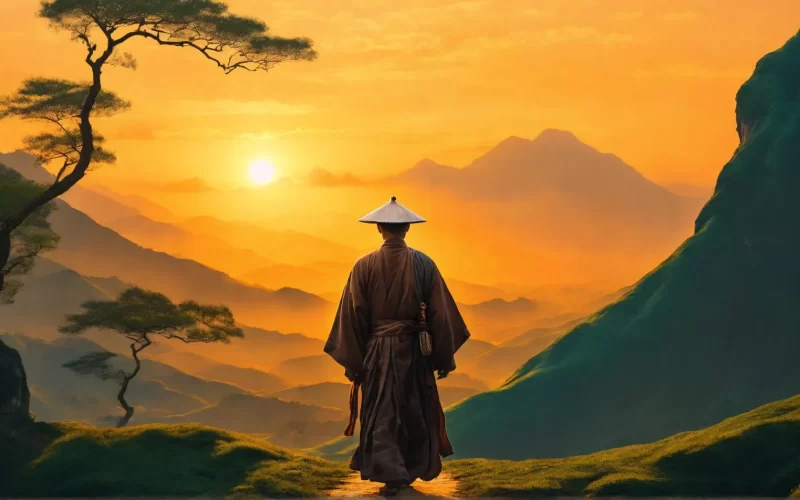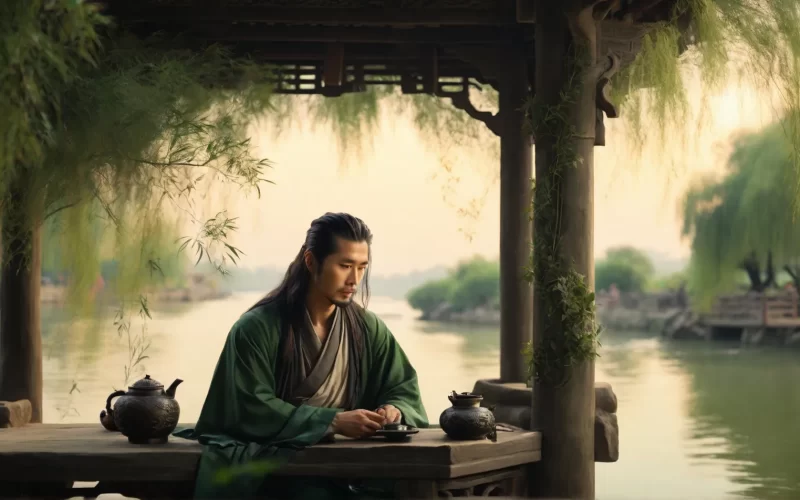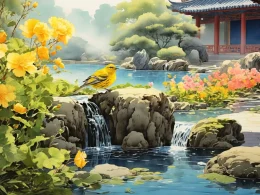



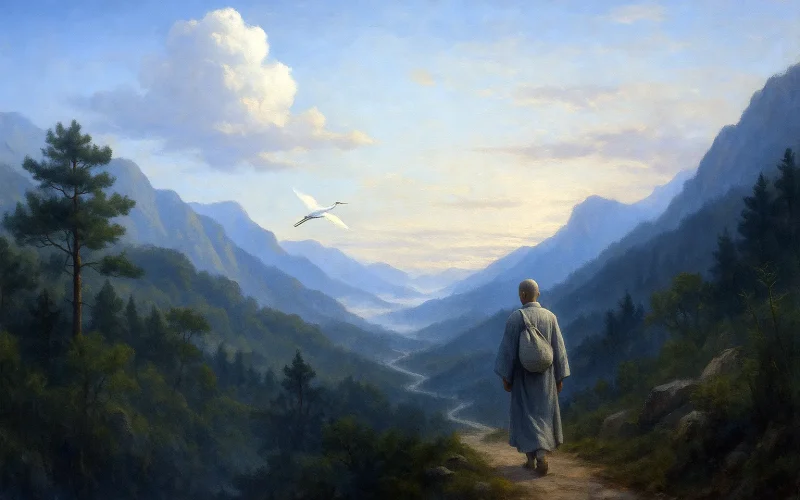
Can drifting clouds and white storks
Be tenants in this world of ours? --
Or you still live on Wuzhou Mountain,
Now that people are coming here?
Original Poem
「送上人」
刘长卿
孤云将野鹤,岂向人间住。
莫买沃洲山,时人已知处。
Interpretation
This poem is Liu Zhangqing's farewell to a Buddhist monk. In just twenty characters, it provides profound insight into the "true reclusion" and "false reclusion" of those who leave the world. During the mid-to-late Tang Dynasty, Buddhism and Taoism were prevalent, and interaction between scholars and monks became fashionable. Many monks, though clad in robes, frequented the doors of the powerful, dwelling in famous mountains and blessed lands to seek fame and reputation. So-called "reclusion" often became another form of "entering the world"—body in the mountains and forests, heart in the court and marketplace; named as leaving the world, but in reality angling for fame.
Liu Zhangqing, upright and unyielding throughout his life, was demoted twice. The phrase "刚而犯上" (unyielding and offending superiors) sums up the fate of his official career. It was precisely this deep understanding of the fickleness of the world that made him unusually sensitive to the trend of "false reclusion." The "superior man" (上人, a reverent term for a monk) in the poem is unknown, but judging from the admonition "莫买沃洲山" (Do not buy the Wo Zhou Mountain), it was likely a monk intending to dwell in a famous mountain. Wo Zhou Mountain, in modern Xinchang, Zhejiang, was a famous Taoist mountain and Buddhist sacred site in the Tang Dynasty, also a gathering place for recluses and literati. Such a place, "already known to the world," if one still flocks to it, how is it different from the mundane world? The poet uses a bantering tone to perform the work of admonition, serving as both a farewell and a warning.
First Couplet: "孤云将野鹤,岂向人间住?"
Gū yún jiāng yě hè, qǐ xiàng rénjiān zhù?
Like a lonely cloud and a wild crane you go; Would you deign to linger in the world below?
The poem opens with lofty imagery, sketching the ideal image of a recluse. "孤云" (gū yún, lonely cloud), rolling and unfurling freely, relying on nothing; "野鹤" (yě hè, wild crane), aloof and proud, unsociable and forming no factions. The two together perfectly symbolize the transcendent otherworldliness of one who has left the world. The poet connects them with the word "将" (jiāng, with, accompanying), emphasizing their compatibility and inseparability. The next line, "岂向人间住" (qǐ xiàng rénjiān zhù, would you deign to linger in the world below?), is posed as a rhetorical question, its tone resolute and forceful—a true recluse is inherently incompatible with the mundane human world; how could he be willing to dwell amidst worldly clamor? This question is both praise and advice; it affirms how a monk should be and reminds him not to forget his original intent.
Second Couplet: "莫买沃洲山,时人已知处。"
Mò mǎi Wò zhōu shān, shí rén yǐ zhī chù.
Do not buy the Wo Zhou Mountain, I pray!
The world knows the way.
The first two lines describe the ideal; these two lines land in reality. The brush turns sharply, full of meaning. The two words "莫买" (mò mǎi, do not buy) seem like dissuasion, but are actually satire—the mountain has no owner, why "buy"? And "buying a mountain to reclude" was precisely the practice of famous scholars and monks since the Wei-Jin period, intending to choose a secluded place for retreat. However, the poet says: Do not buy Wo Zhou Mountain, because it is "already known to the world"—that place is already known to the world, no longer a place of purity. Since it is known to the world, visitors are numerous, carriages and horses constant; since it is a famous, blessed mountain, many cling to it, noise and disturbance unceasing. How can such a place be called "reclusion"? This couplet, with ironic words, points to the poem's main theme: true reclusion lies not in famous mountains, but in one's state of mind; if the heart has not left the dust, even dwelling in deep mountains is like a bustling marketplace.
Holistic Appreciation
This is a unique piece among Liu Zhangqing's farewell poems. The entire poem consists of four lines and twenty characters. Using the farewell to a monk as its entry point, it blends praise and admonition, ideal and reality, aloofness and satire, revealing the deep insight into "true" and "false" reclusion of a poet who has experienced the vicissitudes of official life.
Structurally, the poem presents a progressive layering from the abstract to the concrete, from praise to satire. The first couplet begins with the images of "lonely cloud" and "wild crane," sketching the transcendent posture a recluse should have, using the rhetorical question "would you deign to linger in the world below?" to strengthen the ideal realm. The final couplet sharply turns to reality, directly admonishing with the words "do not buy," and exposing the falseness of famous mountains and the ills of contemporary trends with "already known to the world." Between the two couplets, the poem falls from ideal to reality, shifts from praise to admonition, forming a strong contrast that is truly thought-provoking.
Thematically, the core of this poem lies in the two words "真隐" (true reclusion). The "lonely cloud and wild crane" of the first couplet symbolize true reclusion—unreliant, free and at ease. The "Wo Zhou Mountain" of the final couplet is a metaphor for false reclusion—named a famous mountain, but in reality a mundane place. The poet does not oppose the monk's retreat; he opposes the hypocritical trend of choosing famous mountains to dwell in, using reclusion to fish for fame. Within the dissuasion of "do not buy" lies genuine concern for the monk and, even more, a sober critique of the trends of the times.
Artistically, the poem's most moving aspect lies in the dual tone of "using praise as satire, speaking straightforwardly as if inversely." The first couplet is clearly praise, yet contains implicit admonition; the final couplet is clearly dissuasion, yet is filled with expectation. The poet does not say, "You should not go to a mundane place," but says, "Like a lonely cloud and a wild crane you go; Would you deign to linger in the world below?" He does not say, "That place is too noisy," but says, "Do not buy the Wo Zhou Mountain, I pray! The world knows the way." This technique of speaking straightforwardly as if inversely, inversely as if straightforwardly, makes the admonition not seem harsh, the satire not lose gentleness, precisely embodying the "gentleness and sincerity" of classical Chinese poetry.
Artistic Merits
- Using Imagery to Convey Meaning, Subtle and Profound: Using "lonely cloud" and "wild crane" to symbolize true reclusion, using "Wo Zhou Mountain" to imply false reclusion, imagery precise, meaning clear.
- Speaking Straightforwardly as if Inversely, Satirizing without Exposure: The entire poem contains not a single line of direct criticism, yet every line implies admonition and satire, showing sharpness within gentleness and sincerity.
- Language Concise, Resonance Lingering: Within twenty characters, there is praise, admonition, satire, and expectation, words ending but meaning endless.
- Vivid Contrast, Lofty Conception: The ideal realm of the first couplet and the realistic critique of the final couplet form a contrast, making the value of "true reclusion" and the flaws of "false reclusion" clear at a glance.
Insights
Using the farewell to a monk as its subject, this poem speaks to an eternal theme—true transcendence lies not in form, but in the heart.
It first makes us contemplate the "authenticity of reclusion." Wo Zhou Mountain is a famous mountain, yet because it is "already known to the world," it loses its tranquility. The poet's words reveal: if the heart has not left the dust, even dwelling in deep mountains is like a bustling marketplace; if the heart is already transcendent, even amidst a marketplace is like mountains and forests. The true essence of reclusion has never lain in the distance of landscape, but in the purity or turbidity of one's state of mind. This still holds profound启示 (qǐshì, enlightenment) today: we often pursue formal "escape"—escaping the city, the workplace, the crowd—yet forget that true peace can only be sought within.
On a deeper level, this poem allows us to see the "trap of fame." The reason Wo Zhou Mountain became "already known to the world" is precisely because it became a "famous mountain." Once linked with fame, a place of purity becomes a place of disturbance; once pursued by the world, the act of reclusion becomes capital for fishing for fame. Is the poet's admonition to the monk not also a warning to all people? Many things we pursue—status, reputation, wealth—once they become objects of contention for the masses, have already lost their authentic value.
And what is most evocative is the poem's attitude of "gentle yet firm" admonition. The poet does not preach with a stern face, does not criticize with harsh words, but simply says lightly, "Do not buy the Wo Zhou Mountain," containing all admonition within. This gentle yet firm posture is itself a kind of wisdom in life: true admonition does not need to be frantic; true awakening of the world is often most powerful in a soft voice.
This poem writes of a Tang dynasty farewell, yet allows everyone seeking tranquility in the clamorous mundane world to find resonance within it. The figure of the "lonely cloud and wild crane" is the ideal of everyone yearning for freedom; the admonition "Do not buy the Wo Zhou Mountain" is the insight into worldly trends of every clear-sighted person; the sigh of "already known to the world" is the cold eye on fame and gain of everyone who does not follow the trends. This is the vitality of poetry: it writes of one person's experience, but reads as the heart's concern of all.
Poem Translator
Kiang Kanghu
About the Poet
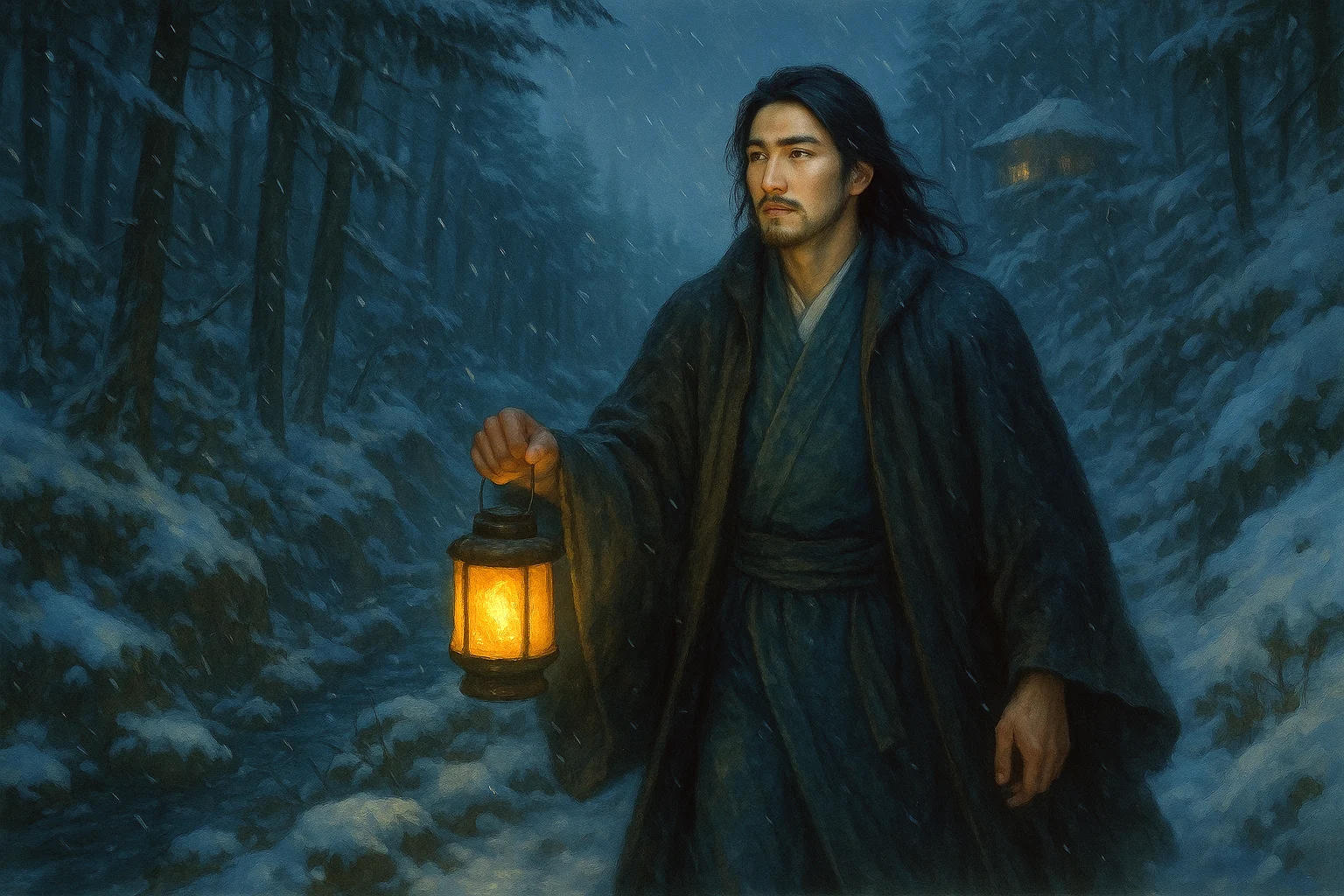
Liu Zhangqing (刘长卿 c. 726 – c. 786), a native of Xuancheng, Anhui Province, was a poet of the Mid-Tang Dynasty. He obtained the jinshi degree (presented scholar) in the late Tianbao era and successively held official posts such as Sheriff of Changzhou and Investigating Censor. Due to his upright and unyielding character, he was exiled twice. His poetry, particularly his five-character verses, achieved the highest distinction, often depicting the melancholy of exile and the joys of reclusion in landscapes. His poetic style is refined, elegant, and ethereal, blending a desolate undertone with the meticulousness characteristic of the Ten Talented Poets of the Dali era. He excelled in using plain sketching to create an atmosphere of tranquil emptiness and profound remoteness. As a pivotal poet bridging the High Tang and Mid-Tang periods, his work inherits the idyllic charm of Wang Wei and Meng Haoran while foreshadowing the bleak and cool elegance of Dali poetry. He exerted a certain influence on late Tang poets such as Yao He and Jia Dao, who belonged to the "painstaking school."