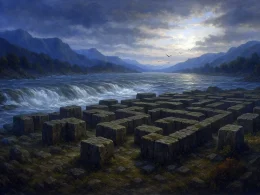

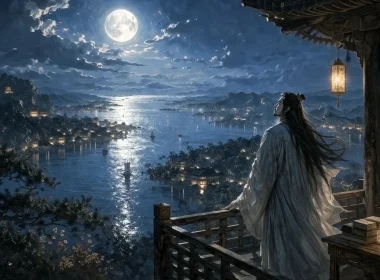
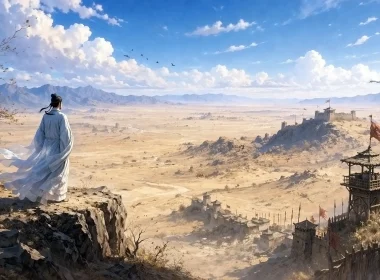
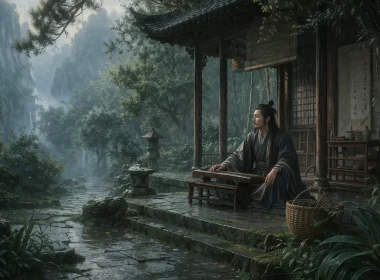
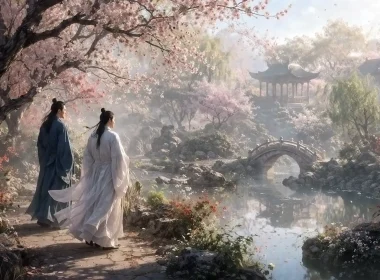
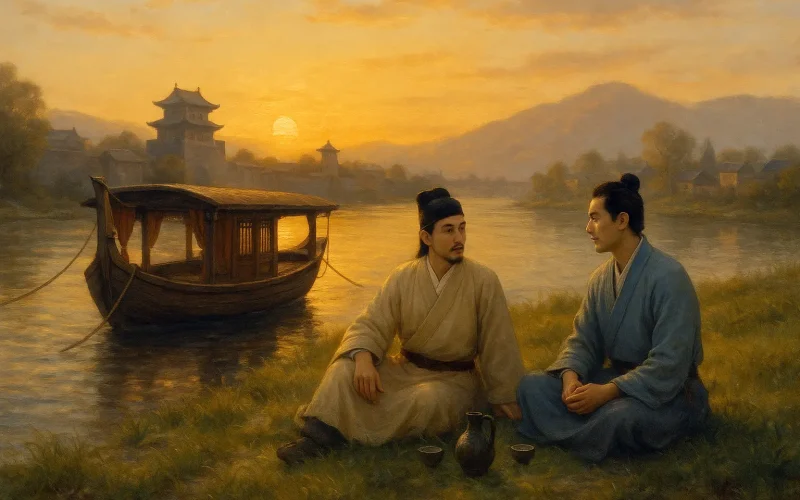
In a flourishing age, no true sage should live apart;
The wise and worthy crowd the court and do their part.
Thus you, a recluse from the Eastern Hills, resigned
Your life of herb-picking, with a determined mind,
And made your way to the Golden Gate, the capital’s heart,
Only to find your loyal zeal played a fruitless part.

Now, to spend the Cold Food Day by southern streams so clear,
You mend your spring robes in northern towns, while staying here.
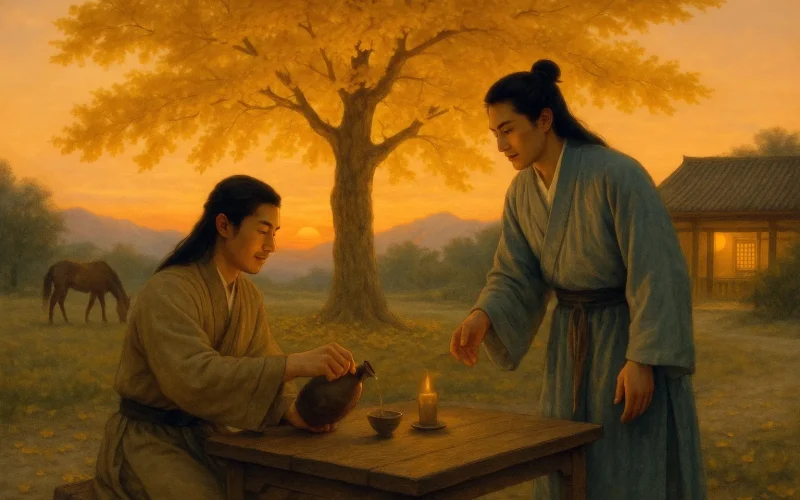
I pour this farewell cup as you leave the royal city;
Soon I'll be left behind, missing my friend in pity.

Your boat of fragrant cassia-wood will drift with ease,
Steering again toward your humble cottage 'midst the trees,
Guided by distant woods along the winding way,
Toward a sunset glowing on a town far away.

Though, for now, your worthy purpose has missed its aim,
Never doubt there are those who still can hear your noble fame.
Original Poem
「送綦毋潜落第还乡」
王维
圣代无隐者,英灵尽来归。
遂令东山客,不得顾采薇。
既至金门远,孰云吾道非。
江淮度寒食,京洛缝春衣。
置酒长安道,同心与我违。
行当浮桂棹,未几拂荆扉。
远树带行客,孤城当落晖。
吾谋适不用,勿谓知音稀。
Interpretation
This poem was written by Tang Dynasty poet Wang Wei to console his friend Qiwu Qian.This poem is an exemplary farewell piece from Wang Wei's early period, deeply imbued with the spirit of its era and profound camaraderie. Composed during the flourishing Kaiyuan era, as the imperial examination system was gaining prominence and the fate of scholars became closely tied to it, Wang Wei uses a friend's examination setback as an opportunity. He not only offers deep consolation to the unsuccessful candidate but also unfolds a microcosm of the intellectual world of the High Tang—containing both a response to the era's call, faith in personal worth, as well as an acceptance of fortune's unpredictability, and the steadfast protection of friendship. The entire poem blends reason and feeling, with a grand, open atmosphere, representing a concentrated expression of the young Wang Wei's Confucian zeal to contribute to the world and his warm, humane character as a poet.
First Couplet: 圣代无隐者,英灵尽来归。
Shèng dài wú yǐn zhě, yīng líng jìn lái guī.
In this sage age, there are no recluses; / All men of talent return to offer their service.
The opening establishes a commanding, grand narrative of the era, setting the tone for the entire poem. This is not empty praise but a true reflection of the vibrant society and the widespread ideal among scholars to achieve merit and glory in the early Kaiyuan period. The juxtaposition of "sage age" (圣代) and "men of talent" (英灵) constructs an ideal field for the exchange of value: the era provides the stage, talent contributes wisdom. This both extols the times and imbues the friend's examination attempt with lofty significance—his failure is not a negation of his personal ability, but a momentary setback within this grand narrative.
Second Couplet: 遂令东山客,不得顾采薇。
Suì lìng Dōngshān kè, bù dé gù cǎi wēi.
Thus, even a recluse like the one of Dongshan, / Can no longer heed the gathering of ferns.
The allusions are exquisite, further placing the friend's personal choice within a sublime historical and ethical context. "Dongshan recluse" (东山客) alludes to the Eastern Jin statesman Xie An, who lived in reclusion on Dongshan (East Mountain) before taking office, praising the friend's high talent and refined aspirations. "Can no longer heed the gathering of ferns" (不得顾采薇) alludes to the righteous recluses Bo Yi and Shu Qi, who lived on ferns after the fall of the Shang dynasty, indicating they could not focus on such solitary pursuits. This shows the powerful summons of the flourishing age and the scholar's own sense of responsibility, making it impossible to remain content with personal integrity alone. Together, these two couplets complete a logical preparation: the friend's journey was a heroic act responding to the times and fulfilling duty; its spiritual value far exceeds the outcome of a single examination.
Third Couplet: 既至金门远,孰云吾道非。
Jì zhì jīn mén yuǎn, shú yún wú dào fēi.
Although the golden gates seem distant now, / Who can say the path I hold is wrong?
This couplet is the first emotional and logical turning point of the poem and the core of its consolation. "The golden gates seem distant" (金门远) directly confronts the failure, without evasion or gloss. "Who can say the path I hold is wrong?" (孰云吾道非) suddenly raises the tone with a forceful rhetorical question, strictly separating a specific examination failure from the fundamental belief and life path ("my path") that one upholds. This is the highest form of consolation: what is negated is circumstance, not your essence or your choice.
Fourth Couplet: 江淮度寒食,京洛缝春衣。
Jiāng Huái dù hán shí, Jīng Luò féng chūn yī.
By rivers Huai and Yangtze, you passed Cold Food Day; / In Eastern Capital Luoyang, you sewed spring attire.
The brushstroke suddenly becomes extremely concrete and plain, like recounting daily matters. These two lines, with simple and pure diction, sketch the friend's arduous journey of travel and lodging for the examination, marked by the changing seasons. There is no embellishment of hardship, but the details themselves—"passed Cold Food Day" (度寒食, a festival), "sewed spring attire" (缝春衣)—are already filled with understanding and deep empathy for the friend's toils. The grand era narrative is now grounded in the real experience of an individual life.
Fifth Couplet: 置酒长安道,同心与我违。
Zhì jiǔ Cháng'ān dào, tóng xīn yǔ wǒ wéi.
I set out wine by the road of Chang'an; / Though our hearts are one, from me you part.
The focus shifts from recollection to the present farewell scene. "Set out wine" (置酒) is a ritual of friendship; "the road of Chang'an" (长安道) is the path of fame and fortune, and also the place of parting. The two words "hearts are one" (同心) carry great weight, indicating they are not merely personal friends but kindred spirits. "From me you part" (与我违) expresses the inevitability of physical separation and the constancy of spiritual affinity. The emotion is deep yet restrained.
Sixth Couplet: 行当浮桂棹,未几拂荆扉。
Xíng dāng fú guì zhào, wèi jǐ fú jīng fēi.
I shall soon set my cassia boat afloat, / And before long, knock upon your bramble door.
The focus turns from present parting to future reunion—a warm and concrete promise. "Set my cassia boat afloat" (浮桂棹) is poetic and full of a sense of action; "knock upon your bramble door" (拂荆扉) is filled with intimate imagination. This is not only a pledge of friendship but also implies a beautiful vision of the friend's life after returning to a rustic existence, injecting a ray of hopeful light into his moment of disappointment.
Seventh Couplet: 远树带行客,孤城当落晖。
Yuǎn shù dài xíng kè, gū chéng dāng luò huī.
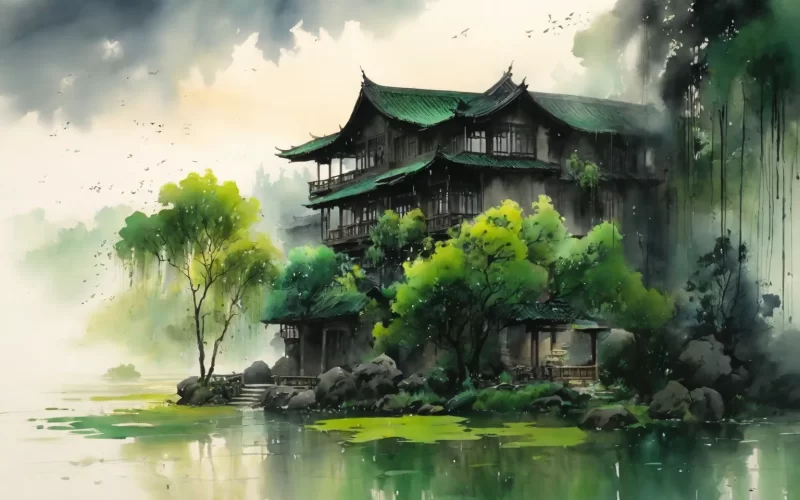
Distant trees escort the parting traveler; / A lone town faces the sinking sun's glow.
This couplet concludes the scene with imagery, a picture vast, desolate, and rich in symbolism. "Distant trees escort the parting traveler" (远树带行客) is dynamic, depicting the gradual distancing of farewell; "A lone town faces the sinking sun's glow" (孤城当落晖) is static, a vast, lonely standing. The sunset's afterglow bathes the entire farewell scene in a hue that is both warm and solemn, both personal and universal. The scene is entirely infused with feeling, embodying the abstract sorrow of parting into an eternal visual image.
Final Couplet: 吾谋适不用,勿谓知音稀。
Wú móu shì bù yòng, wù wèi zhīyīn xī.
*Our plans just now find no employ— / Never say that those who know you are few.*
The poem concludes by returning to its core message of consolation for the friend, forming a circle with the grand narrative of the opening. "Our plans" (吾谋) echoes "my path" (吾道), referring to specific strategies and talents. "Just now find no employ" (适不用) acknowledges the objective reality of an untimely opportunity, the tone calm and accepting. "Never say that those who know you are few" (勿谓知音稀) is the poem's strongest note: it is both firm encouragement for the friend—I am your kindred spirit—and a fundamental confidence in the era—this "sage age" will ultimately recognize talent. The light of faith pierces the gloom of disappointment.
Holistic Appreciation
This is a model poem of "gentlemen's friendship" that is structurally rigorous, emotionally rich, and intellectually profound. Its emotional progression is clear: from affirmation of the era's call (couplets 1-2), to rational transcendence of setback (couplet 3), to understanding of hardship (couplet 4), reluctance of parting (couplet 5), hope for the future (couplet 6), evocation of the scene (couplet 7), and finally reaffirmation of faith (final couplet). The links are tightly connected, the layers deepen progressively.
Wang Wei's brilliance lies in consistently examining his friend's personal experience within the dual framework of "sage age" and "my path." Therefore, the consolation is not cheap sympathy but a profound understanding and spiritual support built upon shared values and beliefs. The poem contains both the realistic starkness of "the golden gates seem distant" and the emotional warmth of "never say that those who know you are few"; both the vast and poignant artistic conception of "a lone town faces the sinking sun's glow" and the lively anticipation of "I shall soon set my cassia boat afloat." This masterful balance of reason and feeling, the grand and the minute, setback and hope displays the young Wang Wei's precocious poetic mind and robust personal strength.
Artistic Merits
- Exquisite Integration of Grand Narrative and Personal Feeling: The poem begins with the grand discourse of "sage age" and "men of talent," settles into the personal details of "sewed spring attire" and "knock upon your bramble door," and is ultimately unified by the spiritual community of "my path" and "kindred spirit." The scale shifts effortlessly, public and private merge into one.
- Apt Allusions and Reflection of Character: The allusions to "Dongshan recluse" and "gathering ferns" not only praise the friend's nobility but also define his examination failure as a righteous act of "responding to the call." This greatly elevates the spiritual stature of the setback, representing a peak in the art of consolation.
- Interweaving of Parallelism and Simple Description: The poem contains both meticulously parallel narrative lines like "By rivers Huai and Yangtze, you passed Cold Food Day; / In Eastern Capital Luoyang, you sewed spring attire" and picturesque, simply depicted scenery like "Distant trees escort the parting traveler; / A lone town faces the sinking sun's glow." The linguistic form serves the natural flow of emotional content.
- Precise Advancement of Emotional Logic: The logical chain of consolation in the poem is clear and powerful: Your choice was right (the era needed it) → Your path is right (my path is not wrong) → I understand your effort (passing Cold Food Day) → Our bond remains (hearts are one) → The future holds promise (set boat afloat) → Belief endures (kindred spirits are not few). Rational persuasion and emotional solace go hand in hand.
Insights
This work transcends simple farewell consolation; it shows us an ideal model of interpersonal relationships and spiritual support in classical society. It reveals that when a friend suffers a failure in worldly terms, the highest form of consolation is not to deny the failure, but to help him affirm the value of his choice, uphold his inner convictions, and offer unwavering emotional commitment.
In the fiercely competitive modern society, where standards of success and failure are increasingly narrow, this poem holds particular mirroring significance. It reminds us: when evaluating others or ourselves, can we, like Wang Wei, distinguish between "the golden gates seem distant" (the non-attainment of a specific goal) and "who can say the path I hold is wrong?" (an error in fundamental values and path)? In times of setback, can we still see the vastness of the "sage age" and the existence of "kindred spirits"? More importantly, can we be that warm, steadfast friend who can say, "Never say that those who know you are few," when others are disappointed?
With this poem, Wang Wei not only bid farewell to a friend who failed the examinations but also established an eternal benchmark concerning friendship, conviction, and the spirit of the times—a deep-seated faith in "men of talent" and "my path" that never extinguishes, even in any hour of "the sinking sun's glow."vides both the anchor in life's storms and the compass pointing toward brighter horizons.
Poem translator
Kiang Kanghu
About the poet
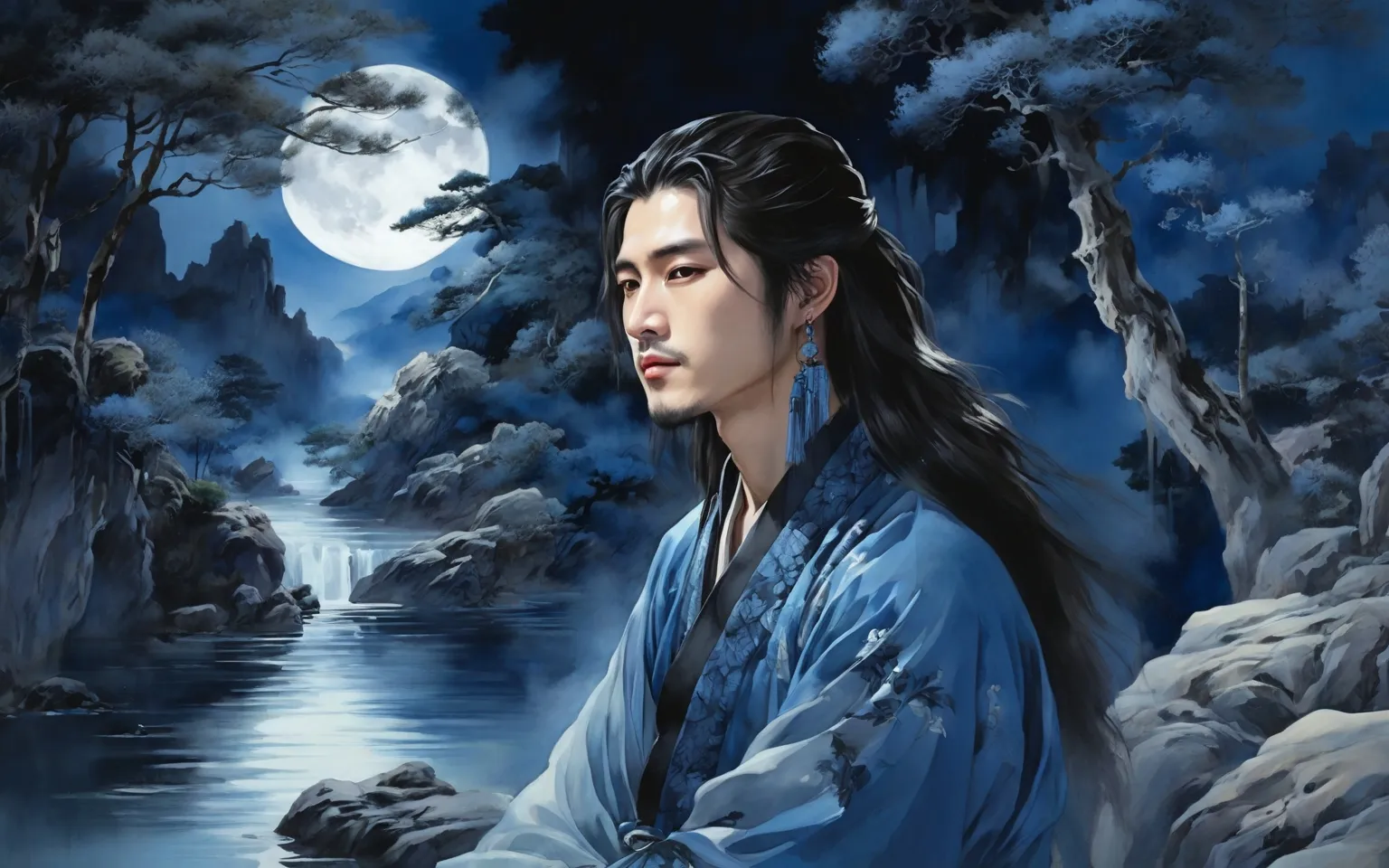
Wang Wei (王维), 701 - 761 A.D., was a native of Yuncheng, Shanxi Province. Wang Wei was a poet of landscape and idylls. His poems of landscape and idylls, with far-reaching images and mysterious meanings, were widely loved by readers in later generations, but Wang Wei never really became a man of landscape and idylls.