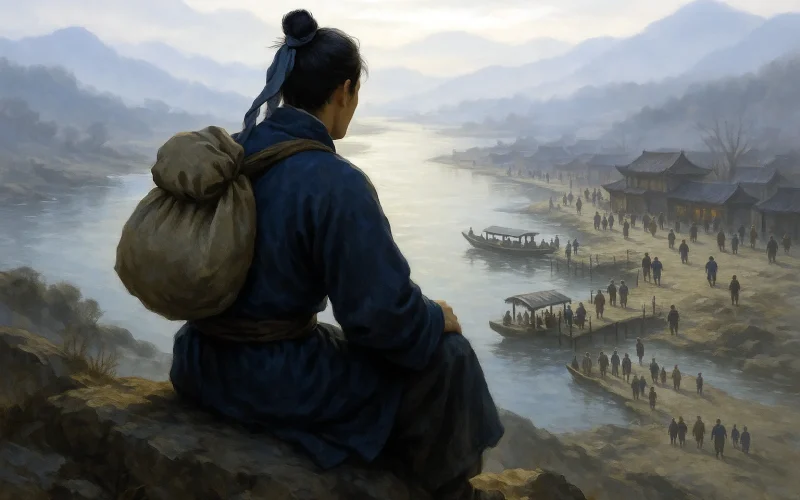




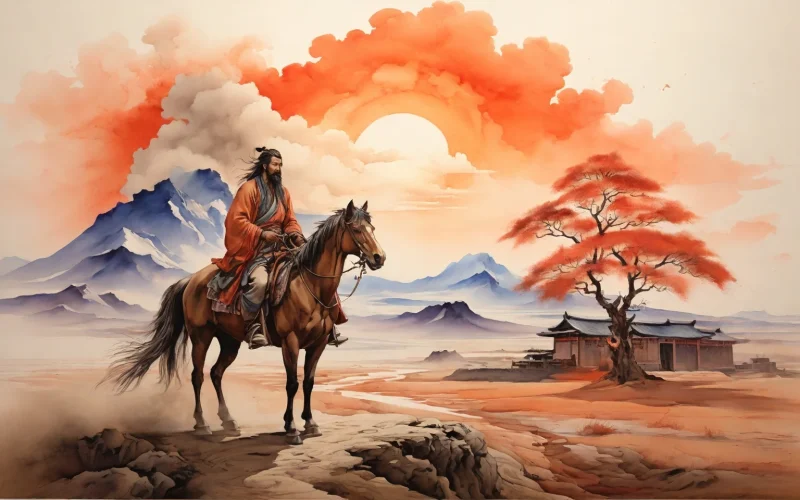
Fiery Mountain in sixth moon hotter than before,
No people pass by Red Pavilion any more.
I know you're used to hardship on the west frontier;
Oh, could the moon over Wheel Tower make you drear?

Unsaddle your horse, drink and drown in wine your woe;
I'll see you go for miles and miles to beat the foe.
You will win rank and fame only on battle steed;
A real hero must have done heroic deed.
Original Poem
「送李副使赴碛西官军」
岑参
火山六月应更热,赤亭道口行人绝。
知君惯度祁连城,岂能愁见轮台月。
脱鞍暂入酒家垆,送君万里西击胡。
功名祗向马上取,真是英雄一丈夫。
Interpretation
This poem was composed during Cen Shen's service on the staff of the Anxi or Beiting Protectorate, though the exact year cannot be determined. Vice-Envoy Li (name unknown) was likely a colleague or friend of Cen Shen's, and was being dispatched west of the desert (the region beyond the Tarim Basin) on official business or military campaign. Unlike conventional farewells within the heartland, this parting takes place at the very frontier, with a destination even more remote and harsh than their current posting. This specific context determines that the poem diverges entirely from the sentimental, melancholy tradition of farewell verse; it must confront and transcend the dangers of the borderlands themselves, transforming the act of parting into a celebration of heroic spirit and a mutual affirmation of the belief in building achievement. It stands as the quintessential example of the "heroic farewell" within High Tang frontier poetry.
Cen Shen's own experience—twice going beyond the frontier and immersing himself in border life—enabled him to move beyond mere description or fear of frontier hardships, replacing it with a sense of familiarity, pride, and even an aestheticized desire for conquest. Thus, in this poem, images like the Volcano, Chiting, Qilian, and Luntai are no longer daunting symbols of bitter cold, but become the grand stages where heroes are forged and achievements are witnessed. This is not merely a farewell to a friend; it is a concentrated expression of Cen Shen's own frontier values and heroic spirit.
First Couplet: "火山六月应更热,赤亭道口行人绝。"
Huǒ shān liù yuè yīng gèng rè, chì tíng dào kǒu xíng rén jué.
The Volcano in the sixth month must be even hotter;
At the Chiting Pass, travelers are nowhere to be seen.
The opening does not dwell on parting sentiment but directly confronts the harshness of the environment the friend is about to enter. The "Volcano" (present-day Flaming Mountains near Turpan, Xinjiang) and "Chiting" (a strategic pass in the Western Regions) pinpoint the location, using geographical extremity to suggest the perils ahead. "应更热" (must be even hotter) is a surmise, full of concern for the friend's journey; "行人绝" (travelers are nowhere to be seen) is reality, evoking the utter isolation of the road. These two lines, with their unflinching objectivity, construct a forbidding backdrop that would make any ordinary person shrink back—precisely to set off the extraordinary nature of the protagonist to come.
Second Couplet: "知君惯度祁连城,岂能愁见轮台月。"
Zhī jūn guàn dù Qílián chéng, qǐ néng chóu jiàn Lúntái yuè.
I know you are long accustomed to crossing the passes of the Qilian Mountains—
How could you ever fret at the sight of the moon over Luntai?
The poet's brush turns from the trial of the environment to a tribute to the friend's spirit. "惯度祁连城" (accustomed to crossing the Qilian passes) reveals that Vice-Envoy Li is a seasoned veteran who has long traversed the frontier passes; hardship has become routine. "岂能愁见轮台月" (how could you ever fret at the moon over Luntai?) employs a forceful rhetorical question, expressing boundless trust in the friend and paying high tribute to his iron will and professional dedication. The Luntai moon is a classic image of homesickness in frontier poetry—here, its melancholy associations are completely negated, marking the establishment of a pure frontier persona that transcends personal emotion.
Third Couplet: "脱鞍暂入酒家垆,送君万里西击胡。"
Tuō ān zàn rù jiǔ jiā lú, sòng jūn wàn lǐ xī jī hú.
Dismount from your saddle and step briefly into this tavern;
I see you off on your ten-thousand-li journey west to strike the Hu.
This couplet brings the scene back to the present moment of farewell, yet without any trace of sentimentality. The action "脱鞍暂入" (dismount and briefly enter) is crisp and efficient, embodying a soldier's characteristic directness. "酒家垆" (the tavern counter) is an ordinary place for drink and parting, but the seven characters "送君万里西击胡" (seeing you off on your ten-thousand-li journey west to strike the Hu) instantly connect this small tavern to a vast expedition and a national mission, opening the horizon wide. A single cup of wine carries the heroic resolve and heavy responsibility of defending the border; within the plain narration resounds a metallic clang of conviction.
Final Couplet: "功名祗向马上取,真是英雄一丈夫。"
Gōng míng zhī xiàng mǎ shàng qǔ, zhēn shì yīng xióng yī zhàng fū.
Fame and merit are to be won only from horseback;
Truly you are a hero, a man among men!
The final couplet is the poem's apex and the poet's direct declaration of values. "功名祗向马上取" (fame and merit are to be won only from horseback) is resolute and definitive, clarifying the legitimate source of achievement—on the frontier, on the battlefield. This is both an expectation of the friend and a shared creed of countless High Tang frontier aspirants. The poem concludes with the exclamation "真是英雄一丈夫" (truly you are a hero, a man among men), no longer relying on any metaphorical detour but speaking directly from the heart, filled with genuine admiration and appreciation—like a resounding final verdict and a bugle call for the journey ahead.
Overall Appreciation
This is a masterpiece among Cen Shen's frontier farewell poems. In fifty-six characters across eight lines, with the departure of Vice-Envoy Li to the West of the Desert as its entry point, it fuses the harshness of the borderlands, the friend's fortitude, the heroism of parting, and the conviction in achievement into a single whole, displaying the most exalted and vigorous spirit of High Tang frontier poetry.
Structurally, the poem presents a progression from suppression to elevation, from the external to the internal. The first couplet, with its extreme environment of "the Volcano in the sixth month must be even hotter" and "travelers are nowhere to be seen," constructs a daunting backdrop that would make any ordinary person shrink back—using the "bitterness" of the environment to gather momentum for the entire poem. The second couplet, with the resolute rhetorical questions of "accustomed to crossing the Qilian passes" and "how could you ever fret at the moon over Luntai?" transforms the "bitterness" of the previous couplet into a tribute to the friend's iron will, completing the first emotional ascent. The third couplet, with the battlefield-style toast of "dismount and step briefly into this tavern," elevates parting from sentimental attachment to a ceremony of heroic dispatch. The final couplet, with the declarative conviction of "fame and merit are to be won only from horseback," brings the poem to a close by elevating the personal farewell into an ultimate affirmation of heroism. The four couplets move from environment to person, from external trials to inner conviction, from concrete action to value declaration—layer upon layer, like an arrow released from the bow, unstoppable in its momentum.
In terms of theme, the poem pivots on the spiritual loop formed by the rhetorical "how could" and the affirming "truly." The "岂能" (how could) of "岂能愁见轮台月" is a thorough negation of traditional frontier melancholy—the Luntai moon is no longer a trigger for homesickness but a witness to the hero's journey. The "真是" (truly) of "真是英雄一丈夫" is the final confirmation of the friend's—and the poet's own—values. The poet abandons all elaboration of parting sorrow and instead, in a tone filled with understanding and trust, jointly affirms with his friend the value and glory of this expedition. This treatment transforms farewell from a one-sided expression of grief or blessing into a summit dialogue between two kindred spirits about conviction and mission, brimming with positive, action-oriented power.
Artistically, the most striking quality of this poem is the use of environmental harshness to highlight human excellence. The poet does not write of parting sorrow but only of the geographical coordinates—Volcano, Chiting, Qilian, Luntai—allowing the extreme environment itself to serve as the most powerful foil to the heroic spirit. He does not write of sentimentality but only of the crisp action of "dismount and step briefly into this tavern," letting the soldier's characteristic directness replace the murmurs of parting. He does not write of longing but only of the value declaration "fame and merit are to be won only from horseback," letting conviction itself become the most heartfelt send-off. This technique of concealing emotion within environment, conviction, and action gives the poem an irrepressible heroic spirit in its plain and vigorous language, making it the quintessential example of the "heroic farewell" within High Tang frontier poetry.
Artistic Features
- The Core Use of Contrast (Foiling): The poem's artistic power lies in its strong contrasts. The extreme environment of "the Volcano's heat" and "travelers nowhere to be seen" contrasts with the composure of being "accustomed to crossing the Qilian passes"; the traditional melancholy of the "Luntai moon" contrasts with the heroic "how could you ever fret?"; the ordinary setting of the "tavern" contrasts with the grandeur of "striking the Hu ten thousand li away." The more the poem emphasizes hardship and ordinariness, the more it highlights the friend's extraordinary character and lofty aspirations.
- Direct Portrayal of Character: Unlike traditional farewell poems that focus on the poet's own emotions, this poem keeps its gaze steadily on Vice-Envoy Li. Through the indirect praise of "I know you are accustomed," the rhetorical "how could you fret," the action sketch of "dismount and enter," and the value definition of "fame won from horseback," it progressively builds the image of a heroic warrior—fearless, ambitious, and dashing—as sharp as a carving.
- Active Control of Emotional Tone: The poet firmly steers the emotional direction, deliberately avoiding any image that might evoke sadness or anxiety. Even when mentioning the "Luntai moon," he immediately negates its melancholy with a rhetorical question. This "filtering" and "purification" of parting sentiment keeps the poem in a consistently uplifting and stirring register, opening a new realm for farewell poetry.
- Direct and Powerful Value Declaration: "功名祗向马上取,真是英雄一丈夫"—this is both the poem's eye and one of the most representative value declarations in High Tang frontier poetry. It does not rely on subtlety but speaks directly, producing an aphoristic impact through the purity of its conviction and the force of its expression, serving as the ultimate destination of the poem's emotion and thought.
Insights
This poem is like a quenched bronze mirror, reflecting the High Tang spirit that honored achievement, praised courage, and sought the fullest expression of life across vast horizons. It tells us that true farewell need not be tears and sighs, but understanding, affirmation, and rousing encouragement. When a friend sets out on a noble mission and an ideal journey, the deepest affection transforms into the firmest trust and the warmest inspiration.
Its deeper insight lies in its reflection on the relationship between "value" and "environment." In the eyes of ordinary people, volcanoes and desolate lands mean suffering and exclusion; but in the hearts of aspirants like Cen Shen and Vice-Envoy Li, they are the necessary stages and proving grounds for becoming a "hero among men." This poem challenges our habitual notions of comfort and success, safety and value, reminding us that the greatest achievements and the most solid reputations are often forged in the most arduous trials.
Ultimately, this poem, with its cloudless heroism, offers us a spiritual tempering: when facing life's "ten-thousand-li journey" and "volcanic" challenges, can we possess the composure of one "accustomed to crossing the Qilian passes," uphold the conviction of "winning fame from horseback," and ultimately become that "hero among men" in our own lives? Cen Shen's poem is an eternal march for all souls who press forward through hardship and seek meaning in challenge.
Poem translator
Xu Yuanchong (许渊冲)
About the poet:
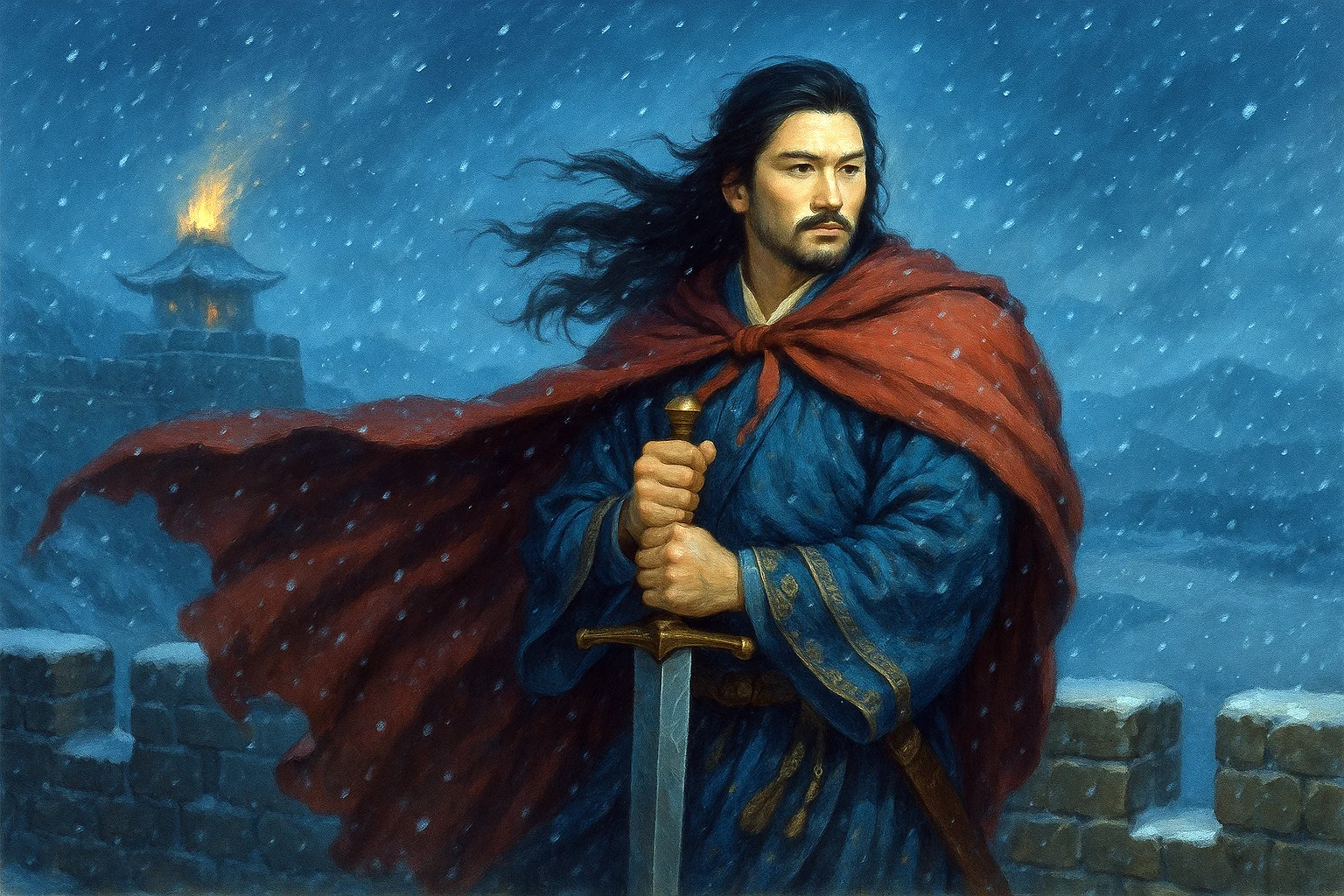
Cén Cān(岑参), 715 - 770 AD, was a native of Jingzhou, Hubei Province. He studied at Mt. Songshan when he was young, and later traveled to Beijing, Luoyang and Shuohe. Cén Cān was famous for his border poems, in which he wrote about the border scenery and the life of generals in a majestic and unrestrained manner, and together with Gao Shi, he was an outstanding representative of the border poetry school of the Sheng Tang Dynasty.