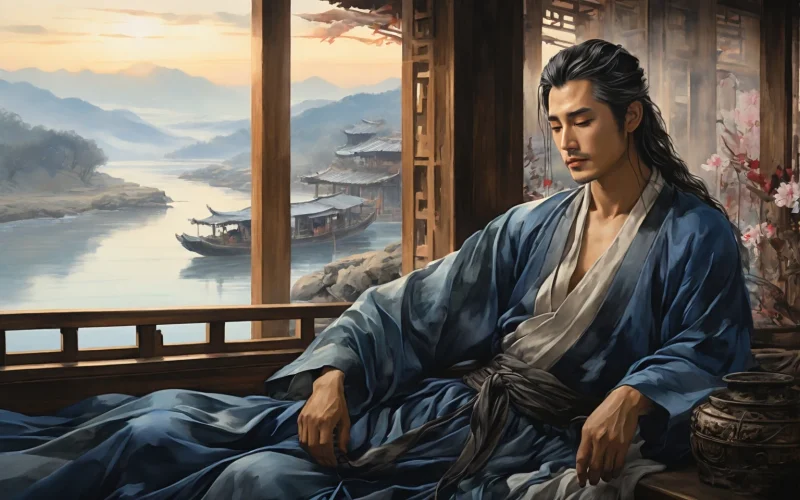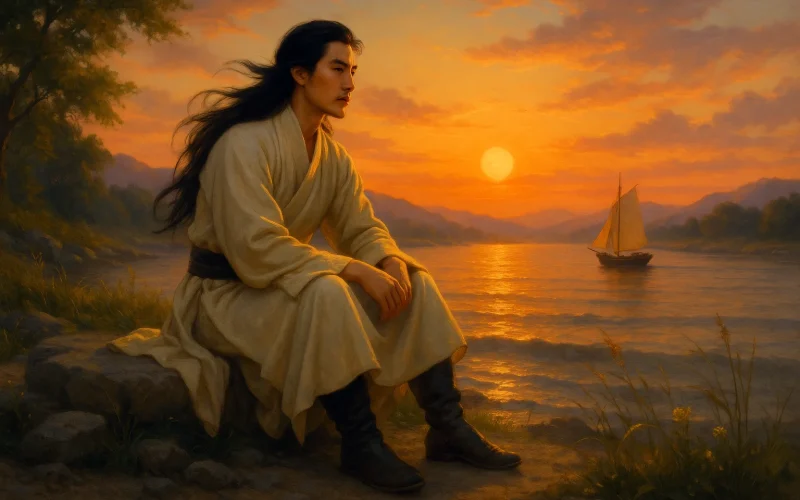
The east and west are joined by boundless water clear;
On the endless spring river goes the boat you steer.
Where will you moor it at sunset far, far apart?
Can I not gaze far, far away with broken heart!
Original Poem
「送杜十四之江南」
孟浩然
荆吴相接水为乡,君去春江正渺茫。
日暮征帆何处泊?天涯一望断人肠。
Interpretation
This poem was written by the Tang Dynasty poet Meng Haoran as a farewell to his friend Du Huang, who This poem was written during Meng Haoran’s travels in the Jing-Chu region. During the Tang Dynasty, transportation relied heavily on waterways. The frequent boat traffic between Jing (in modern Hubei) and Wu (in modern Jiangsu and Zhejiang) along the Yangtze River nurtured a unique "river-town" culture and a "boat-bound" way of life. The journey of Du Huan, the poem's dedicatee, encapsulates this very social milieu. The address "Du the Fourteenth" uses his family seniority ranking, reflecting both intimacy and the casual conventions of literati interaction of the time. Having faced disappointment in the imperial examinations, Meng Haoran was then in a state of wandering among landscapes and befriending companions from all quarters. This life experience granted him a sensitivity to farewells more acute than most—he understood life’s wandering as the norm, yet treasured each specific parting all the more deeply. As he bid farewell to his friend on the banks of a springtime river, the "vast and misty" scene before him was not just the shimmering, boundless waters; it was also the uncertainty of his friend’s path ahead and the unknown date of their reunion. This sentiment transcends ordinary sorrow at parting; it is imbued with a sensitive poet’s profound recognition of life’s separations and fate-led wandering.
Farewell was a major theme in High Tang poetry. Meng Haoran’s unique gift lay in his ability to use the simplest, purest language to elevate a specific scene of parting into a portrait of a universal human condition. This heptasyllabic quatrain is the artistic crystallization of that moment by the spring river, where the scene before his eyes, the feelings in his heart, and his concern for his friend were distilled into verse.
First Couplet: "荆吴相接水为乡,君去春江正渺茫。"
Jīng Wú xiāng jiē shuǐ wéi xiāng, jūn qù chūn jiāng zhèng miǎománg.
Jing and Wu share a home upon the water’s thread; / Your boat now parts, the spring river vast and misty ahead.
The opening lines sketch the geographical space, noting that the two distant regions are connected by water, subtly containing the consolation of "parted, yet still connected". However, the turn to "vast and misty" spring river shifts the tone. The immense, mist-shrouded waters are both a realistic depiction of the long journey and a projection of the empty, ineffable sorrow of parting in the poet’s heart.
Second Couplet: "日暮征帆何处泊?天涯一望断人肠。"
Rìmù zhēng fān hé chù pō? Tiānyá yī wàng duàn rén cháng.
At dusk, your lonely sail—where will it find its rest? / One gaze toward the world’s edge rends the heart within my breast.
The latter two lines naturally shift from scene to feeling. Moved by dusk, the poet voices concern for a "place to moor"—an ordinary inquiry that is, more deeply, an outpouring of affection. "One gaze toward the world’s edge" pushes both his sight and his thoughts into the distance, while the three words "rends the heart" abruptly gather the emotion to its peak, ending the poem yet leaving behind endless concern and echoing sorrow.
Holistic Appreciation
With extremely condensed language, this poem traces a complete farewell, moving from geography to emotion, from watching someone leave to having one’s heart follow. The first two lines write of "water," literally the river but also a metaphor for parting feelings as endless as its flow. The last two lines write of "gazing," which is both watching the lone sail depart and the spiritual extension of the heart following the friend on his journey.
Meng Haoran does not directly express intense grief. Instead, he blends emotion into plain descriptions of nature and simple expressions of concern. "Where will it find its rest" is the most genuine worry of the one who stays behind; "one gaze toward the world’s edge" is the limit reachable by sight and thought; and "rends the heart" is the emotional peak finally irrepressible after all restraint. The poem’s language is plain yet its feeling deep, its vista broad yet its heart attentive. Between the boundless spring river and the solitary traveling sail, it constructs a vast and profound poetic space, rightly considered a masterpiece among High Tang farewell poems for mastering complexity with simplicity and lodging profound feeling within understated words.
Artistic Features
- Scene-Setting that Evokes Emotion, Broad Conception: The poem opens with the geographical link of "Jing and Wu… connected" and the natural imagery of the "vast and misty" spring river. This provides a boundless spatial backdrop for the sentiments of parting, allowing the personal emotion to be framed within the vast breath of heaven and earth.
- Interplay of the Tangible and the Imagined, Question Infused with Feeling: The line "At dusk, your lonely sail—where will it find its rest?" functions both as a practical concern and as a tangible expression of deep care. Images like the lonely sail, dusk, and the world's edge interweave, jointly conjuring an atmosphere of uncertain wandering and an unknown future.
- Simple, Pure Language, Profound, Sincere Emotion: The entire poem employs no difficult words or overly crafted phrases; its diction is as fresh and natural as speech. Yet, the layers of concern, reluctance, and quiet melancholy within it build progressively, reaching their peak with "rends the heart." This showcases the artistic power of achieving "rich flavor from plain words."
Insights
This farewell poem transcends ordinary sorrow at parting, touching upon the universal human experiences of concern and solitude. A friend's distant journey leaves behind not just simple longing, but endless worry for the safety of their travels and the unpredictable turns of their life's path. The poet's question—"where will it find its rest?"—is an eternal one. It asks not merely where the boat will moor, but how the heart finds anchorage on life's wandering journey.
On life's journey, we are all, at different times, both the "one who sees another off" and the "traveler on the lonely sail." This poem reminds us to cherish the deep affection of those who, at day's end, worry "where will it find its rest." It also teaches us, when journeying far in loneliness, to remember to look back towards that steady, caring gaze from the "world's edge." True friendship is a spiritual connection that physical separation cannot sever; it is a warm regard that, even across the mistiest river, can traverse time and space.
Poem translator
Xu Yuanchong (许渊冲)
About the poet
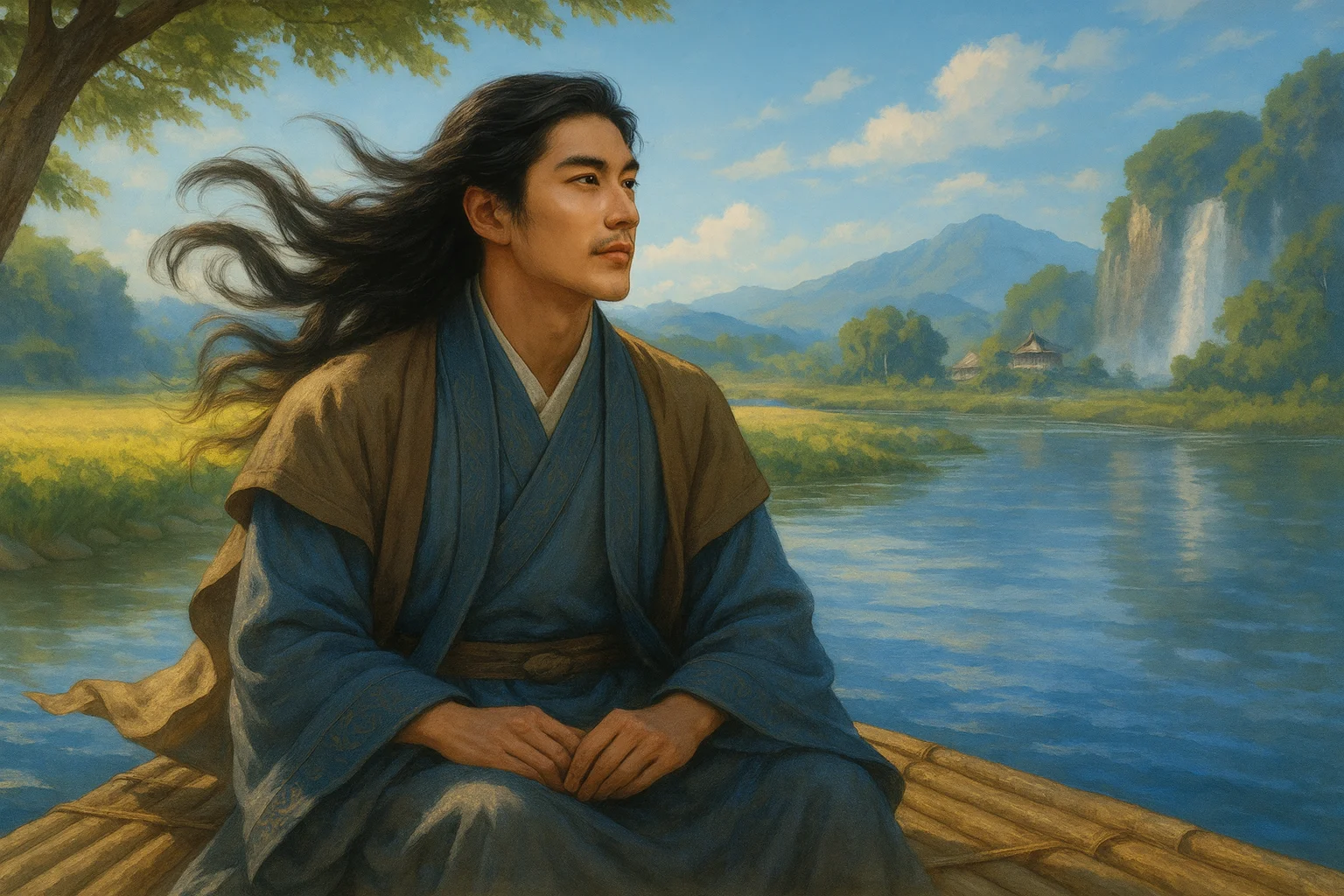
Meng Haoran (孟浩然), 689 - 740 AD, a native of Xiangyang, Hubei, was a famous poet of the Sheng Tang Dynasty. With the exception of one trip to the north when he was in his forties, when he was seeking fame in Chang'an and Luoyang, he spent most of his life in seclusion in his hometown of Lumenshan or roaming around.