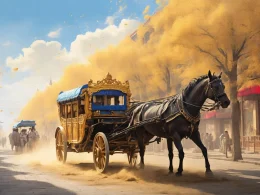
The empty mountain, bathed by newfound rain,
Stands in the freshness of an autumn night.
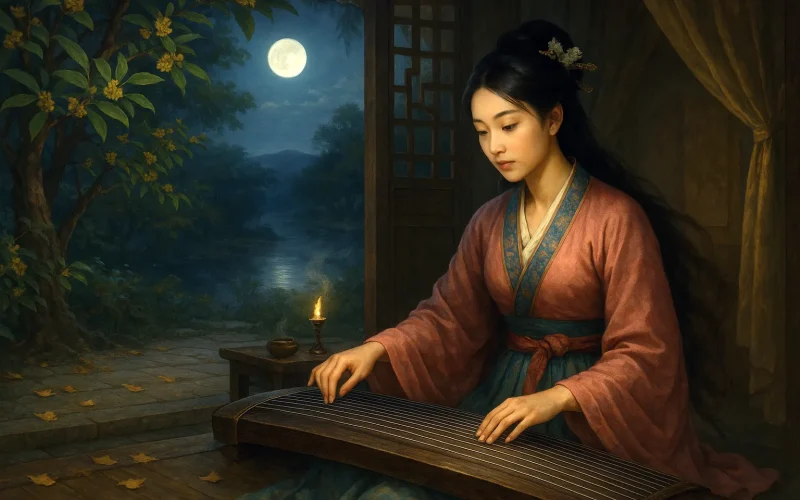
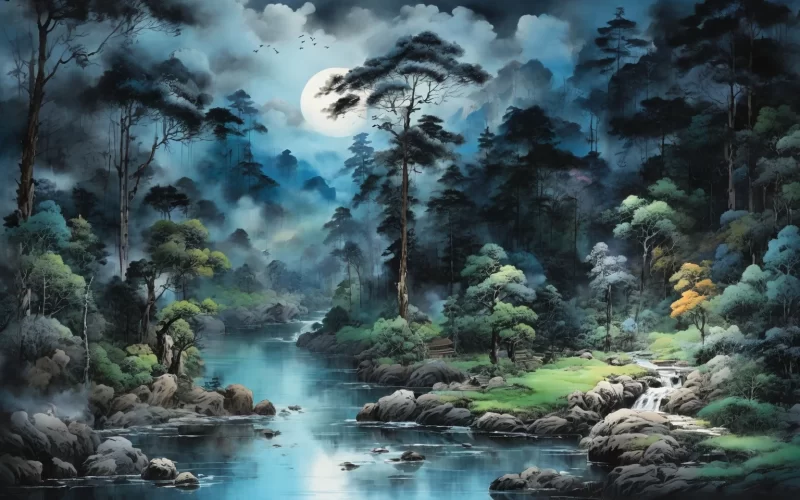
Through pine woods streams the clear moon’s glow;
Over stone beds crystal brooklets flow.

From bamboo groves comes noise of laundry maids;
Among the lotus leaves a fishing boat wades.
Though fragrant spring may long have passed away,
Here with you, my friend, I’m glad to stay.
Original Poem
「山居秋暝」
王维
空山新雨后, 天气晚来秋。
明月松间照, 清泉石上流。
竹喧归浣女, 莲动下渔舟。
随意春芳歇, 王孙自可留。
Interpretation
"Mountain-Dwelling on an Autumn Evening" is the most radiant pearl on the crown of Wang Wei's landscape and pastoral poetry, and the ultimate exemplar of the aesthetic realm of "the trinity of poetry, painting, and Chan (Zen)" in Chinese classical poetry. Composed during his later years of reclusion at Wangchuan, a period of profound communion where his body and mind had merged with nature, the poet, with a spiritually attuned and exquisite brush, not only paints a fresh and ethereal picture of a mountain evening after rain in autumn but also, through the layered unfolding of scenery, quietly constructs a poetic universe where movement and stillness engender each other, humanity and heaven blend as one, eternally self-sufficient. It fully embodies the artistic philosophy and life state of Wang Wei's late period: "the scene itself is truth, the event itself is Chan."
First Couplet: 空山新雨后,天气晚来秋。
Kōng shān xīn yǔ hòu, tiānqì wǎn lái qiū.
Through empty hills after the recent rain, / The air is fresh as evening hints of fall.
The opening ten characters unfurl like a light-ink landscape painting, setting the poem's tone of clarity and spacious stillness. The "emptiness" of the "empty hills" does not denote nothingness, but a primal state cleansed of worldly clamor and filtered of impurities, the mind's direct perception of a world unveiled. "After the recent rain" brings visual clarity, olfactory freshness, and tactile moisture; "evening hints of fall" lends time a texture of slight coolness and seasonal depth. This is not merely description of the external environment; it is the direct projection of the poet's inner state of mind—a lucid, tranquil, and rich spiritual world reached in the autumn of life ("evening… fall") after being cleansed by the storms of existence ("recent rain").
Second Couplet: 明月松间照,清泉石上流。
Míng yuè sōng jiān zhào, qīng quán shí shàng liú.
A bright moon shines between pines; / Clear springs flow over stones.
This couplet, celebrated through the ages for its scenic description, fuses visual, auditory, and tactile senses to construct a microcosm brimming with spirit. "A bright moon shines between pines" is a vertical illumination from above, tranquil, sacred, and richly layered; the pines' uprightness and the moon's pure glow enhance each other, symbolizing nobility and clarity. "Clear springs flow over stones" is a horizontal flow from afar, light, lively, and full of rhythm; the stones' solidity and the spring's soft movement complement each other, metaphorically suggesting resilience and agility. One "shines," one "flows"; one is stillness, one movement; one is light, one sound—together they weave the inherent picture of the autumn mountain night, both utterly serene and vibrantly alive within.
Third Couplet: 竹喧归浣女,莲动下渔舟。
Zhú xuān guī huàn nǚ, lián dòng xià yú zhōu.
From bamboo grove comes noise of washerwomen; / Lotus stirs as a fisher boat goes down.
The brush turns from pure nature to human activity within nature, yet without abruptness, instead adding vitality. "Noise from bamboo grove" – sound is heard first, then its cause is understood ("washerwomen returning") – uses sound to break the visual silence, and this "noise" is the joy after labor, a warm, measured infusion of human warmth. "Lotus stirs" – movement is seen first, then its reason is grasped ("fisher boat goes down") – uses motion to enrich the picture's layers; this "stir" is the leisure of returning from fishing, the poetic manifestation of harmonious interaction between humans and nature. The washerwomen and the fisher boat are not intruders upon nature; they are organic, beautiful components of this mountain-water ecology. Their presence makes the "empty hills" not empty, but filled with the warmth of life and the joy of work.
Final Couplet: 随意春芳歇,王孙自可留。
Suíyì chūn fāng xiē, wángsūn zì kě liú.
Though spring's fragrance ends, let it end at will; / Here, a recluse can well remain.
This couplet reveals the poem's intent in its conclusion, the sublimation and ultimate destination of its spirit. "Though spring's fragrance ends, let it end at will" expresses a profound understanding and serene acceptance of nature's way: not clinging to past splendor ("spring's fragrance"), but cherishing the clear beauty of the present ("autumn evening"). This embodies the Daoist wisdom of "following nature" and the Chan insight of "living in the present moment." "Here, a recluse can well remain" alludes to but reverses a典故 from the Songs of Chu: the original, "O prince, return! Do not linger in the mountains!" urges leaving the hills to return to society; Wang Wei instead asserts "can well remain," a final affirmation of the reclusive life and a poetic declaration of his own choice. Here, "recluse" (王孙, literally "prince's descendant") refers both to the poet himself and extends an eternal invitation to all kindred spirits who can appreciate the beauty of these hills, this scene.
Holistic Appreciation
This is a perfectly structured, progressively layered symphonic poem of cosmic life. The poem's four couplets恰好 form the classic paradigm of "introduction, elaboration, transition, conclusion": the first couplet introduces, creating the grand atmosphere of empty hills at autumn dusk (起); the second elaborates, focusing on the micro-beauty of moon and spring (承); the third transitions, introducing human activity, infusing the breath of life (转); the fourth concludes, expressing insight, clarifying the theme (合). More profoundly, these four couplets correspond respectively to heavenly light (recent rain, evening), earthly phenomena (bright moon, clear springs), human traces (washerwomen, fisher boat), and heart's realization (let it be, can well remain), together constructing a complete, harmonious, self-sufficient poetic world.
In this poem, Wang Wei achieves a revolutionary transcendence of traditional landscape poetry. The mountains and waters under his brush are not merely objects for viewing; they are a dwelling place for existence and a realm for the soul. Everything in the poem—the rain-washed empty hills, the moon between pines, the springs over stones, the returning washerwomen, the homeward fisher boat—are not isolated scenes, but organic parts of a living community, echoing and resonating with each other. The poet himself is not merely a quiet observer of this scenery, but an immersed dweller within it. His "remaining" is not passive lingering, but active homecoming and complete being.
Artistic Merits
- Holistic Presentation of Senses and Synesthetic Mastery: The poem engages sight (empty hills, bright moon, stirring lotus), hearing (flowing springs, bamboo noise), touch (recent rain, evening autumn), and even smell (air after rain), allowing these senses to intermingle (e.g., "shines" has both visual and quiet qualities, "flows" has both auditory and kinetic qualities), creating an immersive aesthetic experience.
- Artful Parallelism and Flowing Imagery: The middle two couplets are perfectly parallel yet never rigid. "Bright moon" pairs with "clear springs," "between pines" with "over stones," "shines" with "flows"; "bamboo noise" with "lotus stirs," "return" with "goes down," "washerwomen" with "fisher boat." Within the formal parallelism lies contrast of imagery (vertical/horizontal, stillness/movement) and harmonious unity.
- Precise Verbs and Generation of Meaning: "Shines," "flows," "noise," "return," "stirs," "goes down"—each verb is exquisitely precise, serving as objective description while endowing the scenery with life and spirit. Especially, the eternal quality of "shines" and "flows," and the momentary quality of "noise" and "stirs," together form the ultimate rhythm of a universe where movement and stillness are perfectly balanced.
- Transformation of Allusion and Sublimation of Theme: The repurposing of the Songs of Chu典故 in the final couplet is the finishing touch. It is not only the poet's personal declaration but a solemn affirmation of a new choice of values (reclusion, nature, inner transcendence), elevating the poem from the aesthetic level to the philosophical and the level of life's meaning.
Insights
This work is like an inexhaustible spring of wisdom, nurturing countless souls longing for peace in later ages. It reveals to us: true happiness and peace lie not in possessing external things, but in possessing a capacity of heart that can resonate with all things and harmonize with nature's rhythm. Wang Wei tells us that even without a Wangchuan estate, if on an evening "after the recent rain," we can feel the clarity of "evening hints of fall," hold in our hearts the imagery of "a bright moon shines between pines; / clear springs flow over stones," and appreciate the beauty of ordinary life around us—the "noise of washerwomen" and the "fisher boat" stirring the lotus—then, in spirit, we have already "remained" in our own "mountain dwelling."
In our contemporary age of material abundance and spiritual anxiety, this poem is a precious antidote. It invites us to undertake a "mountain dwelling of the heart": to relinquish attachment to "spring's fragrance" (external glamour) and learn to find fulfillment in the "autumn evening" (the clear scene of the present). Wherever we are, by cultivating a sensitive and tranquil heart, we can create, within our own lives, that "empty hill" which can be contemplated, listened to, and dwelt within. This, perhaps, is the most precious legacy of "mountain dwelling" that Wang Wei, across a thousand years, bequeaths to each of us.
Poem translator:
Kiang Kanghu
About the poet
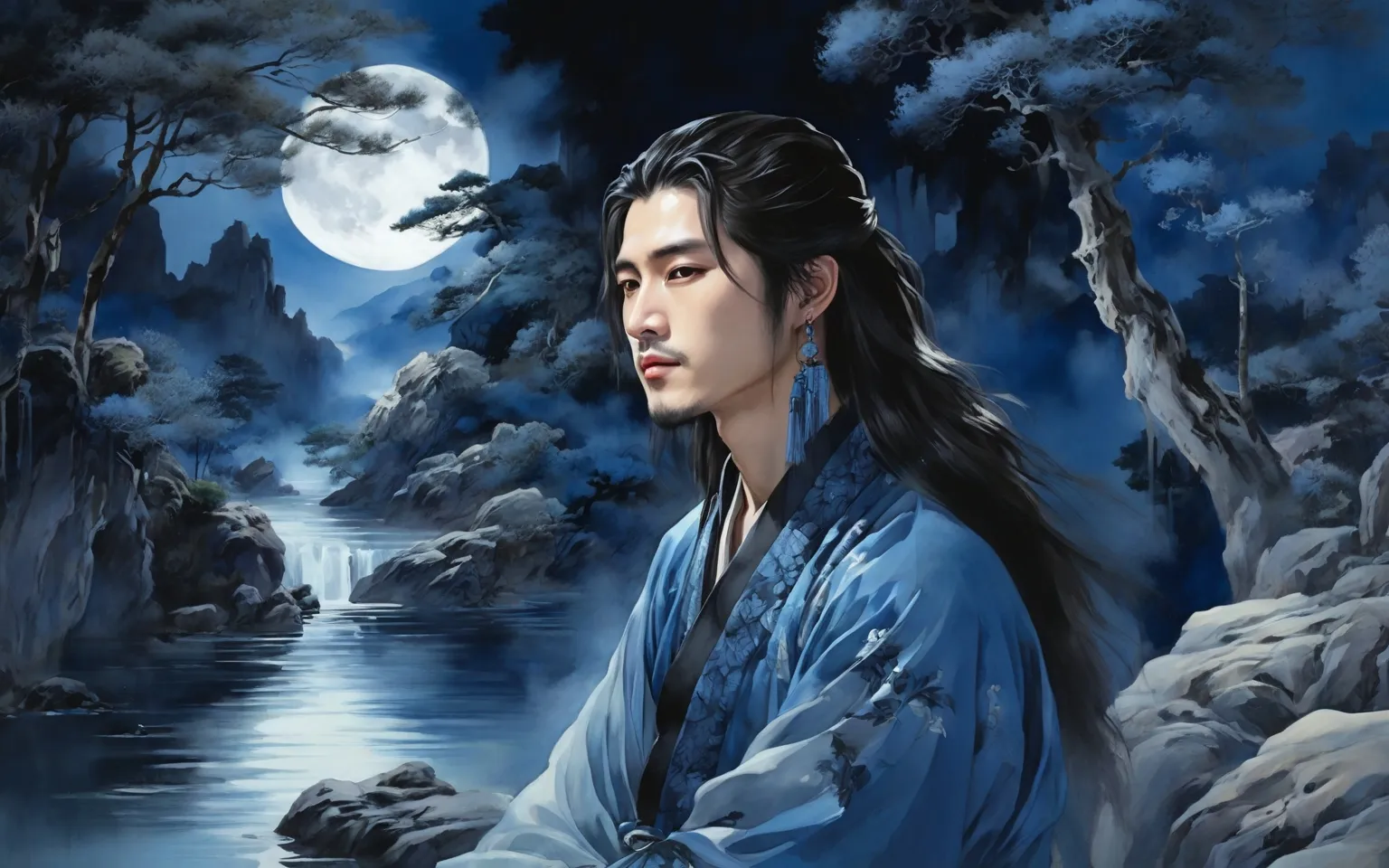
Wang Wei (王维), 701 - 761 A.D., was a native of Yuncheng, Shanxi Province. Wang Wei was a poet of landscape and idylls. His poems of landscape and idylls, with far-reaching images and mysterious meanings, were widely loved by readers in later generations, but Wang Wei never really became a man of landscape and idylls.