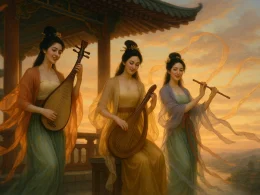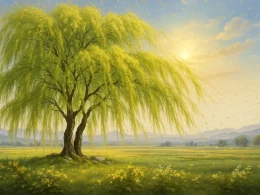



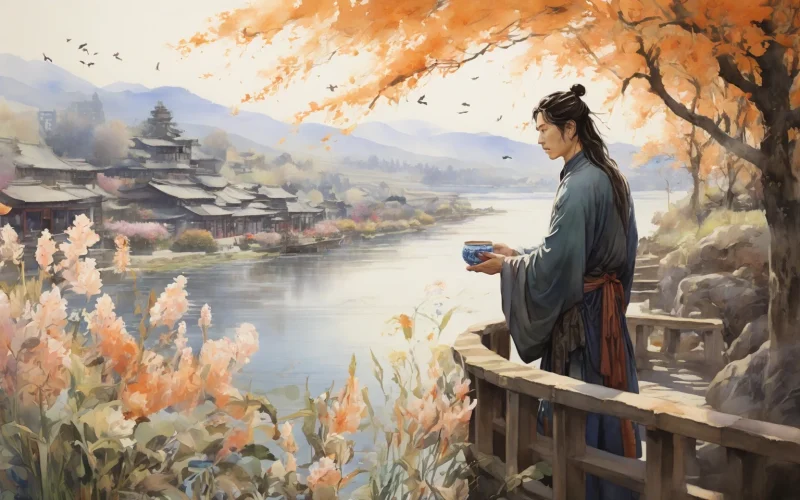
Back from the court from day to day, I pawn spring gown
To get drunk by the riverside where I go down.
In every wine shop I have a debt to pay;
It's rare to live to seventy since olden day.

Deeper and deeper amid flowers go butterflies;
Slowly and slowly on water skim dragonflies.
I will enjoy the present with those on the wing.
Do not let pass away any delightful thing!
Original Poem
「曲江二首 · 其二」
杜甫
朝回日日典春衣,每日江头尽醉归。
酒债寻常行处有,人生七十古来稀。
穿花蛱蝶深深见,点水蜻蜓款款飞。
传语风光共流转,暂时相赏莫相违。
Interpretation
This poem was composed in the spring of 758 CE, during the first year of Emperor Suzong's Qianyuan reign, while Du Fu served as a Reminder. Although Chang'an had been recovered, the An Lushan Rebellion was not yet quelled, court politics were complex, and Du Fu had angered the emperor by submitting a memorial defending Fang Guan. Though not dismissed, he was marginalized, and his political ideals teetered on the brink of collapse. The poem expresses not ordinary seasonal melancholy or personal dejection, but the complex state of mind of a statesman deeply concerned for the empire. After his ideals were thwarted, he sought consolation and release in personal indulgence and the beauty of nature. It stands as another profound embodiment of his poetic style, known for its deep poignancy and a tightly controlled, halting rhythm.
First Couplet: “朝回日日典春衣,每日江头尽醉归。”
Cháo huí rìrì diǎn chūnyī, měi rì jiāng tóu jǐn zuì guī.
Returning from court each day, I pawn my spring attire; / Day after day, to the riverbank, I stagger back, drunk with desire.
The opening, with its repetition of "each day," emphasizes a cyclical, near self-destructive pattern of life. The juxtaposition of "returning from court" and "pawn my spring attire" is deeply ironic: a court official's first act after court is to pawn his seasonal clothes, revealing his meager salary and dire financial state. "Stagger back, drunk with desire" is the conscious choice made under these circumstances—not casual drinking, but deliberate, thorough inebriation, an attempt to drown his disillusionment with the court and his own sense of impotence. This seemingly dissolute behavior is, in truth, the venting of profound anguish.
Second Couplet: “酒债寻常行处有,人生七十古来稀。”
Jiǔ zhài xúncháng xíng chù yǒu, rénshēng qīshí gǔ lái xī.
Wine debts lie common wherever I may roam; / But to live to seventy is rare, from any ancient tome.
This couplet bursts forth with a bitter, impassioned insight into life, couched in self-mockery. "Wine debts lie common" is the inevitable consequence of the previous line's drunkenness. The poet's offhand dismissal of them as "common" only deepens the underlying sorrow. The seemingly proverbial sigh, "to live to seventy is rare," is, in this context, startling. It implies that in such turbulent times, longevity is itself a rare luxury, so why fret about tomorrow? This serves both as an excuse for his indulgence and as a fierce, disillusioned acknowledgment of life's brevity and the futility of worldly achievement. The couplet thus leaps from material want to existential limitation, achieving an emotional intensification.
Third Couplet: “穿花蛱蝶深深见,点水蜻蜓款款飞。”
Chuān huā jiádié shēnshēn jiàn, diǎn shuǐ qīngtíng kuǎnkuǎn fēi.
Butterflies weave through deepest blooms, glimpsed, then lost to sight; / Dragonflies touch the water's face, adrift in tranquil flight.
The third couplet shifts abruptly, casting aside worldly cares to depict the vibrant beauty of late spring by the Qu River with finely detailed brushstrokes. "Weave through deepest blooms" and "touch the water's face" capture the insects' ethereal lightness, while "glimpsed, then lost" and "adrift in tranquil flight" lend the scene depth and a leisurely rhythm. This creates an extreme contrast with the poet's earlier drunken staggering and financial窘迫. The more serene and beautiful the scene, the more it underscores his inner turmoil; the more he immerses himself in its appreciation, the more it reveals his painful estrangement from reality.
Fourth Couplet: “传语风光共流转,暂时相赏莫相违。”
Chuányǔ fēngguāng gòng liúzhuǎn, zànshí xiāng shǎng mò xiāng wéi.
A whispered plea to this fair scene: let's drift as one, we two; / This brief, shared joy—do not withdraw, I beg this much of you.
The concluding couplet employs personification to bring the emotion to its peak. "A whispered plea" is the poet's direct, almost desperate address to nature. "Let's drift as one" expresses a hope for the lingering of spring and, more profoundly, a longing for some change, some flow, in his own stagnant, troubled life. The phrase "this brief, shared joy" speaks volumes of inner sorrow: all the poet asks is the humble right to share a fleeting moment with beauty. Yet, behind the恳求 of "do not withdraw" lies the clear-eyed despair of knowing spring must fade and fate is immutable. This is both a lament for the passing season and an endless, futile clinging to his own vanished political springtime.
Holistic Appreciation
The poem begins with "drunkenness" and ends with "pleading appreciation," presenting a complete portrait of Du Fu's spiritual state at a specific life stage: resisting mental anguish through material indulgence, and ultimately seeking temporary solace and transcendence in natural beauty. The structure is artful: the first half depicts the "impoverishment" of human life, the latter half the "beauty" of nature, with the monumental sigh about life's brevity serving as the pivotal hinge that elevates personal hardship to the level of philosophical contemplation.
Du Fu's profundity lies in not stopping at self-pity. The multiple tensions—between the impoverished official and the leisurely natural charm, between numbed weariness and heartfelt yearning—reveal the complex portrait of an ambitious man of principle after his ideals are shattered. It shows vulnerability, indulgence, sensitivity, and steadfastness coexisting within him. Beneath the surface dejection beats a heart not yet completely cooled in its desire to engage with the world.
Artistic Merits
- Masterful Use of Contrast: The stark juxtaposition of personal destitution and natural vibrancy, and the co-existence of dissolute behavior and a delicate aesthetic sensibility within one person, create a three-dimensional and authentic poetic persona.
- Integration of Vernacular and Refined Language: The proverbial, plainspoken line "life is short" stands in effective contrast with the exquisitely parallel and vivid imagery of butterflies and dragonflies. This embodies Du Fu's linguistic mastery in blending philosophical depth with immediate, vivid expression.
- Layered Emotional Progression: The poem's emotion moves from depicting action, to reflecting on circumstance, to observing nature, and finally to voicing a direct entreaty. This structure allows the feeling to advance layer by layer from a state of superficial restlessness to one of profound, internal sorrow, achieving a resonance that lingers beyond the final line.
- Personalized Portrayal of Historical Context: Without offering any direct political commentary, the simple phrase "returning from court" and the overarching mood of dejection and world-weariness fully reveal the background of his political frustration. This exemplifies Du Fu's signature technique of reflecting the broader era through the prism of personal fate.
Insights
This work shows that even a figure like Du Fu had moments of seeking solace in wine and near indulgence during life's trials. This is not simple moral failing, but the painful and genuine spiritual state of a lucid mind confronting an unchangeable reality. The shift from drowning sorrows to pleading with beauty is especially poignant: it teaches us that amidst profound suffering, one can still retain the capacity to perceive and cherish natural beauty. This act of cherishing is itself a vital force that resists despair and nihilism.
Simultaneously, the poem prompts reflection on the individual's relationship with their era. Du Fu's "wine debts" and "plea to the scene" are, in essence, the spiritual anguish of a capable man living in an age unfit for his talents. It reminds us to seek understanding behind seemingly negative choices, within their historical and personal context. And that faint, whispered plea from within despair still flickers with humanity's inextinguishable, instinctive yearning for beauty, connection, and hope.
Poem translator
Xu Yuanchong (许渊冲)
About the poet
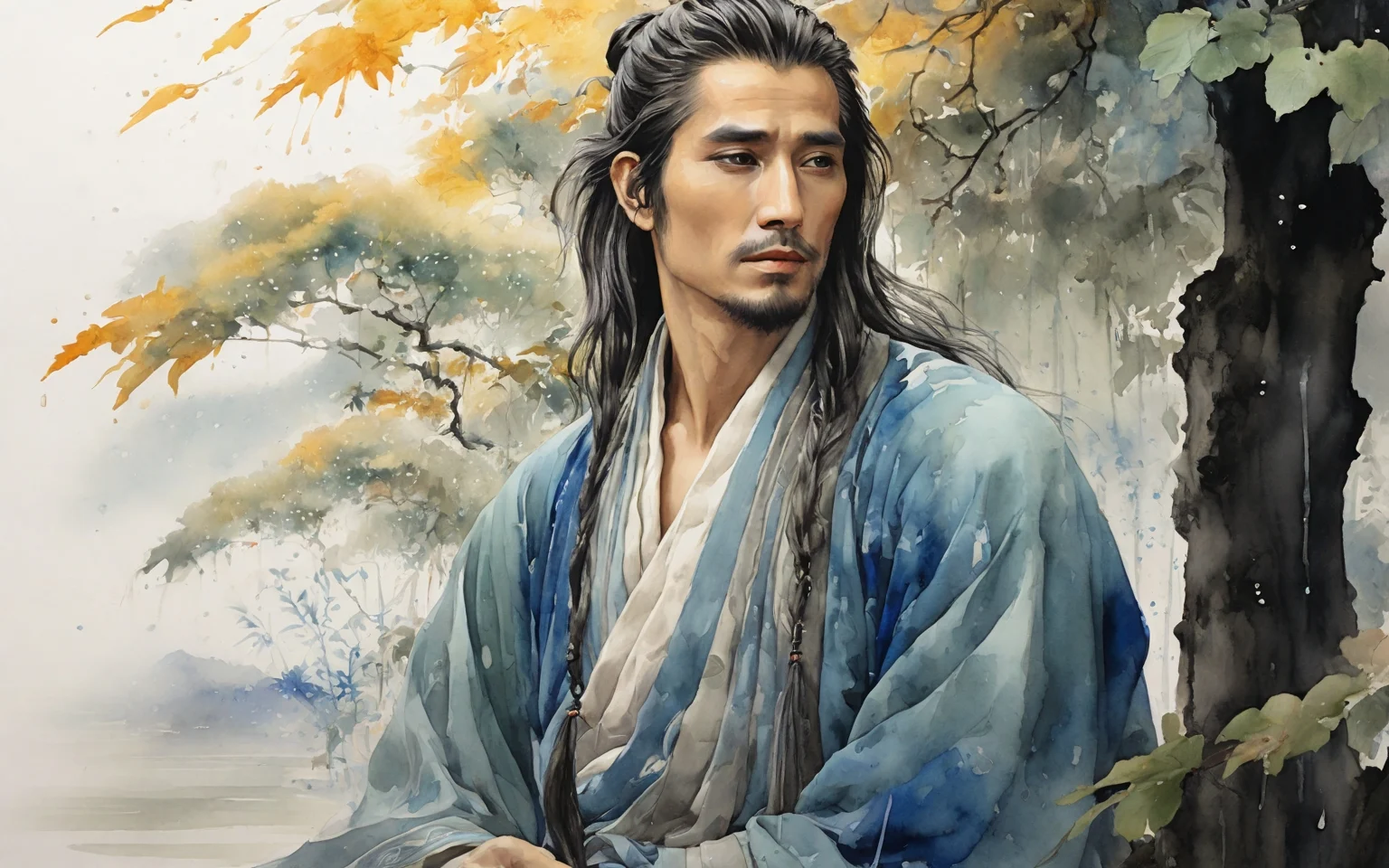
Du Fu (杜甫), 712 - 770 AD, was a great poet of the Tang Dynasty, known as the "Sage of Poetry". Born into a declining bureaucratic family, Du Fu had a rough life, and his turbulent and dislocated life made him keenly aware of the plight of the masses. Therefore, his poems were always closely related to the current affairs, reflecting the social life of that era in a more comprehensive way, with profound thoughts and a broad realm. In his poetic art, he was able to combine many styles, forming a unique style of "profound and thick", and becoming a great realist poet in the history of China.