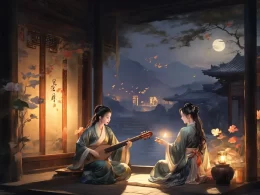
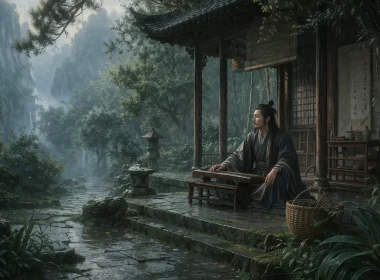
The crickets' chirp breaks twilight late;
In the West Wood I meditate.
I hear a shower cold which grieves,
But outdoors I see fallen leaves.
The capital's weal and woe wake
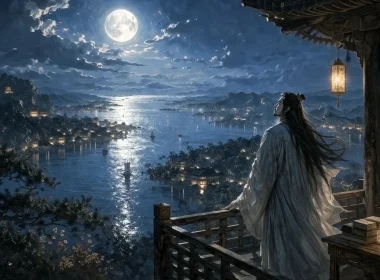
Our dream to float on Dongting Lake.
Sink or swim, you will go your way;
You won't come back but go astray,
Original Poem
「秋寄从兄贾岛」
无可
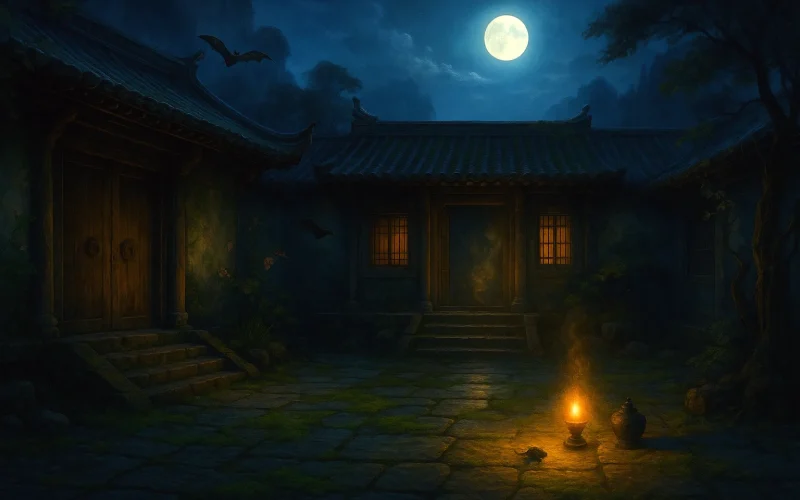
螟虫喧暮色,默思坐西林。
听雨寒更彻,开门落叶深。
昔因京邑病,并起洞庭心。
亦是吾兄事,迟回共至今。
Interpretation
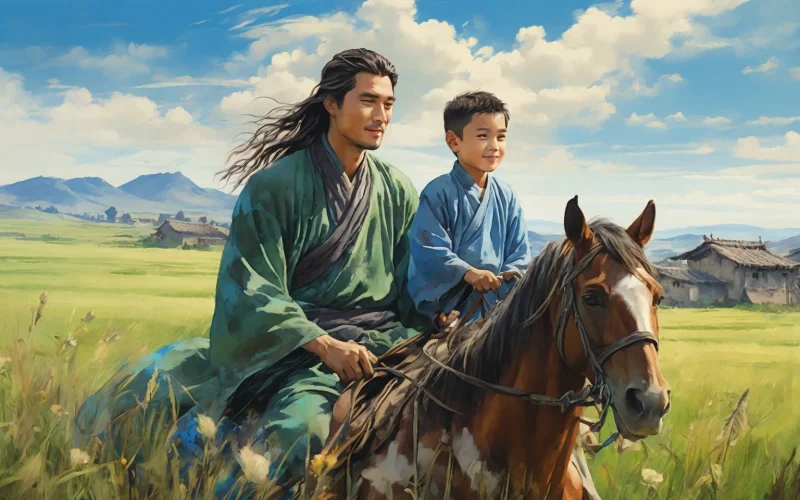
Wu Ke, a monk-poet of the Tang Dynasty, was the cousin of the renowned poet Jia Dao. The two grew up together and were as close as brothers. In their youth, they were both monks in a mountain monastery, sharing a life of asceticism under the dim lamp and ancient Buddha, accompanied by the tolling of morning bells and evening drums. Later, Jia Dao returned to secular life and went to Chang'an to take imperial examinations, seeking an official career, while Wu Ke remained true to his original intent, retreating to the Xilin Temple on Mount Lu for the rest of his life. Jia Dao's official path was fraught with setbacks; he repeatedly failed the examinations and only held a minor post late in life, dying in disappointment. Though Wu Ke lived outside the worldly sphere, he always kept his cousin in his heart, and the exchange of poems and letters between them never ceased.
This poem was composed in deep autumn. Wu Ke sat alone in the Xilin Temple. Dusk gathered, and the sounds of insects rose on all sides. Through the long, sleepless night, he listened to the rain until dawn. Pushing open the door, he saw fallen leaves filling the courtyard—autumn's mood was profound. He recalled the days with Jia Dao in the capital—Jia Dao had just returned to secular life then, and both of them, exhausted in body and mind from setbacks in their official aspirations, had once agreed to retire together to Dongting Lake, far from the dusty world. However, Jia Dao ultimately could not relinquish his pursuit of fame and fortune, vacillating for years between an official career and a hermit's life, and to this day had not returned. The poet does not blame; there is only understanding and waiting. The five characters, "迟回共至今" (lingering, we've delayed until today), express a monk's deep concern for his brother in the mundane world: I do not urge you; I wait for you; you know I am here. The entire poem uses an autumn night as its backdrop and fallen leaves as its metaphor, blending fraternal affection, the desire for reclusion, and reflections on life into a realm of serene solitude. It is a model work among Tang Dynasty monk-poets' poems expressing remembrance and feeling.
First Couplet: "螟虫喧暮色,默思坐西林。"
Míng chóng xuān mù sè, mò sī zuò xī lín.
Moths and insects clamor in twilight's hue; silent in thought, I sit in West Wood Temple.
The poem opens with sound used to depict stillness. "螟虫喧暮色" (Moths and insects clamor in twilight's hue)—the more clamorous the insects, the more it reveals the depth of the twilight and the stillness of the temple. "默思坐西林" (silent in thought, I sit in West Wood Temple)—the word "默" (silent) contrasts with "喧" (clamor), highlighting the poet's solitude and inner stillness in a single stroke. The opening line immediately establishes the word "思" (thought), setting a profound and far-reaching tone for the entire poem.
Second Couplet: "听雨寒更彻,开门落叶深。"
Tīng yǔ hán gèng chè, kāi mén luò yè shēn.
I listened to rain chill the watches through; opening the door, I find fallen leaves piled deep.
This couplet is a stroke of genius in the poem. "听雨寒更彻" (I listened to rain chill the watches through) describes a sleepless long night, mistakenly taking the sound of falling leaves for rain. "开门落叶深" (opening the door, I find fallen leaves piled deep) describes what is seen upon rising at dawn—only then realizing that what was heard last night was not rain but falling leaves. The poet introduces an auditory illusion, interweaving sound and sight, conveying both the desolate chill and solitude of the autumn night, and subtly metaphorizing life's impermanence and drifting uncertainty. Between this "寒更彻" (chill the watches through) and "落叶深" (fallen leaves piled deep) lies the poet's deep understanding of worldly flux and the parting of brothers.
Third Couplet: "昔因京邑病,并起洞庭心。"
Xī yīn jīng yì bìng, bìng qǐ Dòng tíng xīn.
Once, sick in the capital city, we both conceived a longing for Dongting Lake.
This couplet shifts from scene to memory, tracing their shared experience of disappointment. "京邑病" (sick in the capital city) carries a double meaning: it refers to both physical illness and mental distress—the burden of official life, the troubles of the mundane world, leaving one exhausted in body and mind. "并起洞庭心" (we both conceived a longing for Dongting Lake) writes that they once agreed to retire together; that "Dongting" (Dongting Lake) is the pure, quiet place they yearned for in their hearts. This couplet merges fraternal affection with the desire for reclusion, foreshadowing the consolation in the final couplet.
Final Couplet: "亦是吾兄事,迟回共至今。"
Yì shì wú xiōng shì, chí huí gòng zhì jīn.
This too is a matter for my elder brother; lingering, we've delayed until today.
The final couplet directly expresses heartfelt emotion; the language is plain yet profound in feeling. "亦是吾兄事" (This too is a matter for my elder brother) writes that Jia Dao shared this same desire, experienced this same hardship. "迟回共至今" (lingering, we've delayed until today)—the word "迟回" (lingering) expresses the cousin's hesitation and vacillation between official life and reclusion; the word "共" (we) signifies both their shared understanding and subtly implies the poet's continued waiting. He does not blame, but understands; he does not urge, but accompanies. This couplet expresses fraternal affection with含蓄 (implicit) yet真挚 (sincere) feeling, leaving a long-lasting aftertaste.
Holistic Appreciation
This is an excellent work among Wu Ke's poems of remembrance. The entire poem consists of eight lines and forty characters. Using the autumn night in the temple as its backdrop, it unfolds layers of imagery—insect sounds, rain sounds, fallen leaves—moving from scene to emotion, from memory to consolation. The profound longing and gentle admonition for his cousin Jia Dao are written with implicit depth, serene and detached.
Structurally, the poem presents a progressive sequence from scene to emotion, from emotion to memory, from memory to consolation. The first couplet begins with "Moths and insects clamor in twilight's hue", creating an atmosphere of solitude. The second couplet uses "listening to rain" and "fallen leaves" to describe the sleepless night, merging the cold of the autumn night with the solitude of the heart. The third couplet recalls past events in the capital, pointing to their shared desire for reclusion. The final couplet concludes with "lingering, we've delayed until today", concealing the intent of consolation within plain words. Between the four couplets, the poem moves from outer to inner, from scene to heart, progressing layer by layer, forming a seamless whole.
Artistically, the poem's most moving aspect lies in its skillful conception of "using illusion to express deep feeling." The poet hears rain but it is actually falling leaves; this illusion depicts both the tranquility and sensitivity of the autumn night, and subtly metaphorizes life as a dream, the affairs of the world as difficult to discern. Those "fallen leaves" are not merely an autumn scene; they are also a symbol of the thought of returning to roots, the desire to return to seclusion. This technique of blending natural scenery with the principles of life is precisely the embodiment of the classical Chinese poetic ideal of "not a word explicitly stated, yet capturing the essence perfectly."
Artistic Merits
- Using Sound to Write Stillness, Blending Scene and Feeling: Using "clamor of moths and insects" to contrast the stillness of "silent in thought", and the illusion of "listening to rain" to write of the solitude of the long night. The more clamorous the sound, the stiller the heart; the colder the scene, the deeper the feeling.
- Illusion Enters Poetry, Meaning Rich and Profound: Hearing rain that is actually falling leaves, using illusion to write of the desolate chill of the autumn night, and also using illusion to write of life's uncertainty, implicit and profound.
- Plain Language, Deep and Sincere Emotion: The entire poem uses no ornate rhetoric, yet in the five characters "迟回共至今", it fully expresses the understanding, waiting, and deep affection between brothers.
- Precise Structure, Layered Progression: Moving from scene to emotion, from emotion to memory, from memory to consolation. The four couplets are interlinked like a clear spring flowing, gradually entering the heart.
Insights
This poem, through a solitary sitting on an autumn night, speaks to an eternal theme—True concern is not urging another onto the path one deems right, but waiting in understanding, accompanying in silence.
First, it lets us see "deep affection within solitude." The poet sits alone in West Wood Temple, listening to insects, listening to (what he thinks is) rain, gazing at fallen leaves—a scene of desolation all around, yet his heart and mind are preoccupied with his brother far away. This longing is not a clamor amidst bustle, but a sediment within stillness. It reminds us: The deepest feelings often do not express themselves in crowds, but emerge in solitude.
On a deeper level, this poem makes us contemplate the choice between "reclusion and an official career." The poet himself chose the mountains and forests, while Jia Dao still vacillates in the dusty world. The poet does not accuse, does not lecture, but softly says, "lingering, we've delayed until today"—I understand your hesitation, I wait for you. It makes us understand: True understanding is not making decisions for another, but respecting the other's choice, and quietly waiting in place.
And what is most memorable is the poem's symbolism of "fallen leaves returning to their roots." Falling leaves drift, ultimately returning to the earth; a life adrift must ultimately return to the heart. The poet uses fallen leaves as a metaphor for returning to roots, and night rain to write of the solitary heart. Within the clear chill of the autumn night, he places his deepest hope for his brother—that you may soon lay down worldly burdens and find peace within.
This poem is about an autumn night in the Tang Dynasty, yet it allows everyone who misses loved ones amidst noise or vacillates amidst choices to find resonance within it. The solitude of "Moths and insects clamor in twilight's hue" is the dusk in the eyes of every solitary person. The desolation of "opening the door, I find fallen leaves piled deep" is the autumn in the heart of every wanderer. The waiting in "lingering, we've delayed until today" is the gentlest watch kept by every understanding person. This is the vitality of poetry: it writes of Wu Ke's longing for Jia Dao, but one reads of people of all eras—those who remember in silence on quiet nights, and wait quietly in understanding.
Poem translator
Xu Yuanchong (许渊冲)
About the poet
Wuke (无可 dates of birth and death unknown), a Buddhist monk and poet of the Tang Dynasty, was a native of Zhuozhou, Hebei Province. He was a younger cousin of Jia Dao. In his youth, he became a monk and later traveled extensively. During the Taihe era of Emperor Wenzong of Tang, he became a monk at Baige Temple in Chang'an. Wuke excelled in five-character regulated verse. He was equally renowned with Jia Dao and Zhou He, sharing Jia Dao’s poetic style and also being known for his "painstaking chanting." He was also skilled in calligraphy. Among the many poet-monks of the Tang Dynasty, his achievements are considered second only to those of Jiaoran.