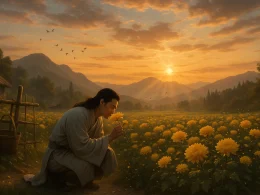




Where comes the autumn wind, pray?
It brings geese on their way.
At dawn it grieves in trees alone;
The stranger hears it first, as his own.
Original Poem
「秋风引」
刘禹锡
何处秋风至?萧萧送雁群。
朝来入庭树,孤客最先闻。
Interpretation
This poem was composed during Liu Yuxi's exile in the southern regions, a lyrical piece born of a scene encountered in his life as a wanderer. After the failure of the Yongzhen Reforms in 805 AD, Liu Yuxi was first demoted to Marshal of Langzhou, then transferred successively to Lianzhou, Kuizhou, Hezhou, and other posts, drifting for over twenty years amidst the rivers and mountains of Ba and Chu. Far from his homeland, dwelling in desolate places, his political ambitions dashed, his life's ideals thwarted—such circumstances were enough to sink anyone into profound sorrow.
One early morning as the autumn wind first began to rise, the poet, alone in a foreign land, suddenly heard the mournful sound of the wind and watched as flocks of wild geese flew south. That wind, arriving from an unknown source, and those geese, beating their wings into the distance, instantly touched the most vulnerable part of the poet's heart. He took up his brush and wrote these twenty characters, blending his personal fate, his longing for home, and the melancholy of the wanderer, all into the formless autumn wind. Compared to Liu Yuxi's more uplifting and forward-looking poems (such as "Autumn Lines"), this "Autumn Wind" possesses a deeper, more introspective quality, revealing another facet of his emotional world—even the poet who remained stubborn in adversity could have moments stirred by the autumn wind.
First Couplet: "何处秋风至?萧萧送雁群。"
Héchù qiū fēng zhì? Xiāoxiāo sòng yàn qún.
Whence comes the breath of autumn, sighing as it goes,
And drives the honking wild geese in straggling rows?
The opening line begins with a rhetorical question, abrupt and ethereal. The words "whence comes" are both an inquiry into the wind's origin and a subtle expression of the poet's own bewilderment regarding his fate—just as this wind arrives from an unknown source, his exile, his wanderings, came just as suddenly and inexplicably. The second line, "And drives the honking wild geese in straggling rows," fuses auditory and visual elements: "sighing" is the sound of the autumn wind brushing past the ear, carrying the desolation and chill of the season; "the honking wild geese" are the forms passing across the sky, beating their wings southward. The geese can fly south, returning to warmth; but the poet can only linger in a foreign land, watching them depart. The word "drives" describes the wind urging on the geese, but it also implies the poet's gaze seeing them off, blending scene and self, emotion contained within.
Second Couplet: "朝来入庭树,孤客最先闻。"
Zhāo lái rù tíng shù, gū kè zuì xiān wén.
At dawn it enters the courtyard trees, bereft of leaves,
The lonely stranger is the first to hear it grieve.
The second couplet shifts the focus from distance to near, from the geese in the sky to the trees in the courtyard, finally settling on the "lonely stranger" himself, the space contracting layer by layer, the emotion growing more introspective with each step. The line "At dawn it enters the courtyard trees, bereft of leaves" gives form to the formless wind—it stirs the branches and leaves of the courtyard trees, producing sound, announcing its presence. But the most poignant line is the last: "The lonely stranger is the first to hear it grieve." The three words "the first to hear" speak volumes of sensitivity and solitude—it is not that his hearing is exceptional, but because his heart bears too many cares, thus he is exceptionally sensitive to the change of seasons, to the sound of the rising wind. In the utter silence of the dawn, the stranger waking alone is the first to hear the autumn wind, and the first to be struck by autumn's sentiment.
Holistic Appreciation
This short poem comprises only twenty characters, yet within this extremely brief span, it accomplishes a layered progression from far to near, from scene to emotion. The first line poses a question, beginning abstractly; the second depicts a scene, landing concretely; the third contracts the space, focusing on the courtyard trees; the final line reveals the person, unveiling the emotion. The entire poem is like a slowly zooming lens: from the distant, vast sky with its geese, to the trees in the courtyard, finally settling on the figure of the "lonely stranger"—and the formless autumn wind is the thread that runs through it all.
Not a single word in the poem directly mentions "sorrow," "homesickness," or "exile," but every line builds power for these emotions. The question "whence comes" expresses bewilderment at fate; the scene of the wind "driv[ing] the honking wild geese" reveals a longing for home; the wind that "enters the courtyard trees" is an omnipresent intrusion; the person who is "the first to hear" is the poet who bears it all alone. Liu Yuxi buries intense emotion deeply, allowing the reader to see only the autumn wind, the geese, the courtyard trees, and the figure who is "the first to hear." This mode of subtle, suggestive expression makes the poetic meaning more profound, the aftertaste more enduring.
Artistic Merits
- Begins with a Question, Creating an Ethereal Mood: Opening with "Whence comes the breath of autumn" not only enhances the rhythmic quality of the lines but also evokes the wind's sudden, untraceable arrival, establishing an ethereal tone for the whole poem.
- Layered Spatial Progression, Skillful Focus: The gaze moves from the geese in the sky to the trees in the courtyard, and finally to the poet himself. The perspective narrows step by step, the emotion deepens layer by layer. The structure is rigorous, the conception refined.
- Expressing Emotion through Scene, Subtle and Evocative: The entire poem does not directly express feelings in a single word, yet everywhere it reveals the sorrow of the wanderer and longing for home. Emotion resides within the scene; meaning lingers beyond the words.
- Precise Diction, Deep and Lasting Flavor: The word "drives" captures the relationship between the wind and the geese; "enters" describes the wind's contact with the trees; "the first to hear" expresses the poet's encounter with the wind. Each word is precise and thought-provoking.
Insights
The most important insight this poem offers concerns the universality of loneliness and the restraint of expression. That "lonely stranger" who is "the first to hear" is Liu Yuxi; he is every traveler far from home; he is every person who faces their inner self alone in a clamorous world. The poet tells us in twenty characters: Truly profound emotion does not require loud proclamation. A gust of autumn wind, the cry of a wild goose, a trembling of leaves—these are enough to carry the deepest longing and sorrow.
In our current era of information overload and emotional exhibitionism, we are accustomed to expressing ourselves with intense language, often neglecting the power of subtlety. Liu Yuxi's work reminds us: Sometimes, saying less expresses more. The three words "the first to hear" are more powerful than a thousand words of outpouring; the homesickness left unspoken is, in the end, more moving.
Looking deeper, this poem also makes us contemplate the value of sensitivity. "The lonely stranger is the first to hear" because his heart holds attachments, expectations, and unwillingness. This sensitivity allows him to feel the autumn chill earlier than others, and to taste the flavor of life more deeply. In reality, we are often taught to be "resilient" and "strong," but Liu Yuxi shows us through this poem: Sensitivity is not a weakness, but our way of connecting deeply with the world. It is precisely because of his sensitivity that the poet, even in hardship, maintained his perception of nature and his observation of life, enabling him to create, within twenty characters, an emotional resonance that transcends millennia.
Finally, the poem's composure in hearing the thunderclap within the silence is also worthy of our contemplation. When Liu Yuxi wrote this, he was in the midst of exile, his future uncertain, his return date unknown. But he did not cry out or lament; he simply listened quietly to the autumn wind, watched the geese, and then, with twenty characters, allowed readers centuries later to still feel the chill of that morning and the state of mind of that "lonely stranger." This ability to distill immense pain into concise verse is, in itself, a form of spiritual transcendence.
About the poet

Liu Yuxi(刘禹锡), 772 - 842 AD, was a native of Hebei. He was a progressive statesman and thinker in the middle of the Tang Dynasty, and a poet with unique achievements in this period. In his compositions, there is no lack of poems reflecting current affairs and the plight of the people.