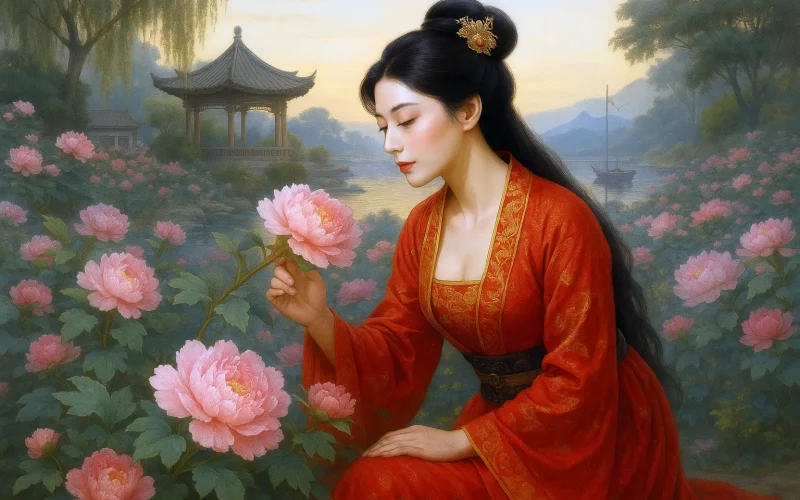



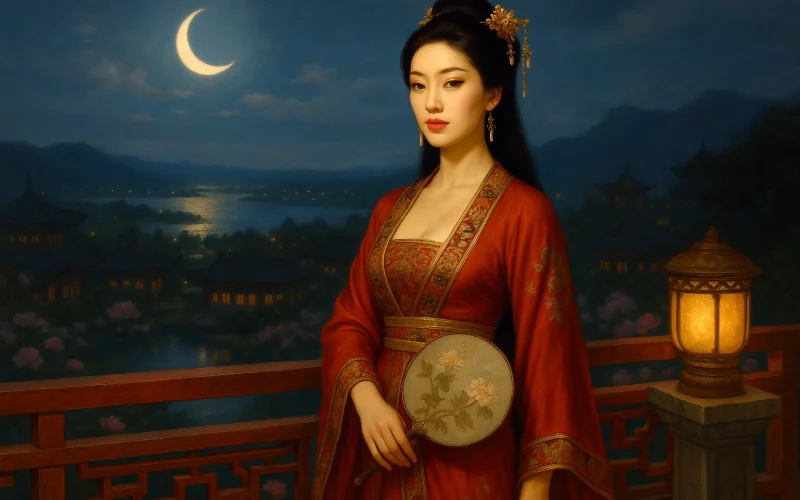
There's a perfume stealing moist from a shaft of red blossom,
And a mist, through the heart, from the magical Hill of Wu -
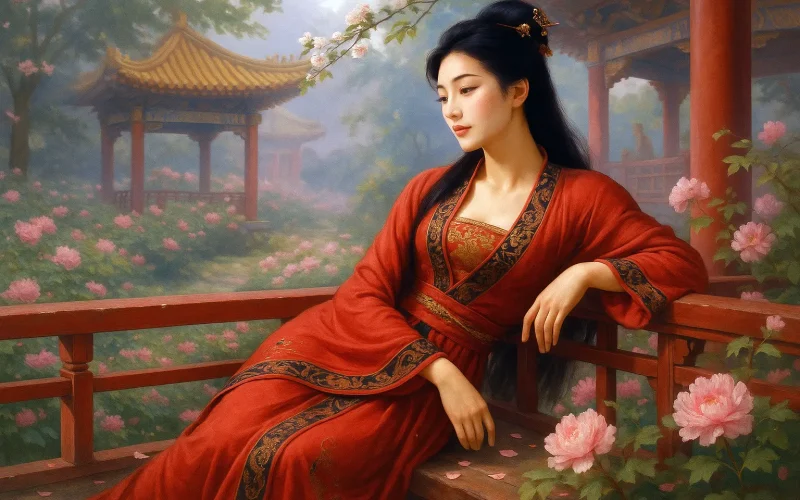
The palaces of China have never known such beauty -
Not even Flying Swallow with all her glittering garments.
Original Poem
「清平调 · 其二」
李白
一枝红艳露凝香,云雨巫山枉断肠。
借问汉宫谁得似?可怜飞燕倚新妆。
Interpretation
This poem is the second in Li Bai’s “A song of pure happiness” series, composed during the same occasion in 743 CE as Emperor Xuanzong and Consort Yang admired peonies by the Aloeswood Pavilion. Following the first poem’s portrayal of Consort Yang as a celestial figure, this work further elevates her beauty and imperial favor through layered historical and legendary comparisons. It demonstrates Li Bai’s artful flattery within the court-commissioned setting while subtly revealing, through exquisite allusions and contrasts, his nuanced insight into the illusory nature of extreme favor and the cyclical patterns of history.
First Couplet: “一枝红艳露凝香,云雨巫山枉断肠。”
Yī zhī hóngyàn lù níng xiāng, yúnyǔ Wū Shān wǎng duàncháng.
One stem, crimson-gorgeous, holds dew that clings with scent; The Wushan clouds-and-rain but stir vain heart’s lament.
The first line continues the “flower” imagery from the previous poem but with greater specificity. “Crimson-gorgeous” describes its color, “dew that clings with scent” captures its form and essence—a single dewdrop concentrates the flower’s full beauty and fragrance, an apt symbol of Consort Yang receiving undivided imperial affection. The second line shifts dramatically, introducing the famous典故 of “Wushan clouds-and-rain.” The poet re-evaluates its worth with the phrase “vain heart’s lament”: even the divine maiden’s encounter with King Xiang of Chu in his dream was ultimately illusory and fleeting, leaving only endless regret. Compared to the Consort—tangible and constantly by the emperor’s side—this seems “in vain.” This couplet uses a mortal-immortal contrast to highlight the Consort’s “real favor” surpassing a mythic “empty dream.”
Second Couplet: “借问汉宫谁得似?可怜飞燕倚新妆。”
Jièwèn Hàn gōng shuí dé sì? Kělián Fēiyàn yǐ xīn zhuāng.
Who in Han’s palace could be said to compare? Pitiable Feiyan leaned on fresh-adorned hair.
This couplet moves from myth to history for a deeper comparison. The words “could be said to compare” introduce a paragon of beauty and favor in history: Empress Zhao Feiyan of Emperor Cheng of Han. Yet, with the terms “pitiable” and “leaned on fresh-adorned hair,” the poet renders a clear verdict. Zhao Feiyan’s beauty relied on external adornment, while Consort Yang possesses the natural beauty of “born lovely, unable to conceal herself.” This is the ultimate praise of the Consort’s beauty while subtly upholding the charm of her unadorned authenticity. Using history as a mirror, the poet implies that present favor surpasses historical limits.
Holistic Appreciation
Within the series, this poem serves to “develop and deepen” the themes. If the first poem deifies the Consort’s beauty, this one historicizes and concretizes it. The poem employs a “layered contrast” structure: first, comparing the present “crimson-gorgeous dew-clinging scent” (real beauty, current favor) with the illusory “Wushan clouds-and-rain” (mythic romance), establishing its advantage of tangible preciousness; then comparing this real advantage with the acknowledged historical benchmark “Zhao Feiyan,” thereby affirming its unprecedented status.
Li Bai’s ingenuity lies in making all comparisons not straightforward but naturally revealing praise and critique through emotionally charged words like “vain,” “pitiable,” and “leaned on,” letting the conclusion speak for itself. The allusions are profound yet natural, meeting the court poetry’s need for splendor and historical gravity while embedding subtle insight within the flattery, hinting that even beauty like Feiyan’s and favor like Han’s will pass, foreshadowing the emotional turn in the final poem of the series.
Artistic Merits
- Layering and Reinterpretation of Allusions: The poem employs two profound allusions in succession—the myth of “the clouds and rain of Mount Wu” and the historical figure of Zhao Feiyan. Li Bai revitalizes the former by framing it as “but a vain heart’s lament,” while offering a subtle critique of the latter by depicting her as one who “leaned on fresh adornment.” This demonstrates his masterful ability to creatively adapt and transform classical allusions.
- Carefully Designed Contrastive Structure: The poem forms a dual framework of “reality vs. myth” and “present dynasty vs. past dynasty,” each serving the same core—highlighting the uniqueness and supremacy of Consort Yang’s beauty.
- Layered and Measured Praise: The praise unfolds progressively, beginning with concrete sensory attributes like "color" and "scent" ("crimson-gorgeous dew-clinging scent"), then advancing to comparisons of aura and destiny, and finally culminating in historical judgment. This stepwise intensification maintains passionate conviction while preserving a tone of subtle dignity.
- Concentrated and Suggestive Language: Words like “vain,” “pitiable,” and “leaned on” complete the comparisons while lightly judging the subjects, enriching the verse with meaning that invites contemplation.
Insights
“A song of pure happiness II” demonstrates the subtlety and depth achievable in the art of language. Beneath the surface praise, it touches on eternal topics of beauty, favor, and historical judgment. Li Bai seems to inadvertently remind us: any “present” exalted to the extreme is inevitably measured against “legend” and “history.” The distinction between “leaned on fresh-adorned hair” and “dew that clings with scent” perhaps also enlightens us that beauty and value that are natural, integral, and unadorned are far more enduring and moving than that which depends on external embellishment and transient favor. Like a prism, the poem reflects, behind dazzling courtly brilliance, a latent awareness of the historical pattern of prosperity inevitably followed by decline.
Poem translator
Kiang Kanghu
About the poet
Li Bai (李白), 701 - 762 A.D., whose ancestral home was in Gansu, was preceded by Li Guang, a general of the Han Dynasty. Tang poetry is one of the brightest constellations in the history of Chinese literature, and one of the brightest stars is Li Bai.