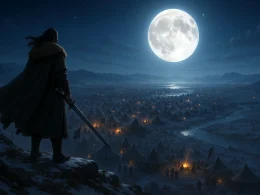


The King of Qin rode the tiger to eight Poles high:
His sword shone in the air and brightened the blue sky.
His driver struck the sun with a glass-breaking sound;
All were reduced to ashes on the battleground.

Stars were invited to drink wine poured from dragon's head;
The golden pipa played at night would grieve the dead.
The rain treading on Dongting Lake would blow the lute;
The King ordered the moon to go back to its root.

Silver cloud on cloud made the crystal palace bright;
The gate-keeper announced it was still early night.
The phoenix in the tower sang her bewitching song;
Clear fragrance of ladies' silken dress wafted long.

The dancers drank to his health of a thousand years.
From the candles on the fairy trees rose smoke light.
From the lutist's drunken eyes streamed down copious tears.
Original Poem
「秦王饮酒」
李贺
秦王骑虎游八极,剑光照空天自碧。
羲和敲日玻璃声,劫灰飞尽古今平。
龙头泻酒邀酒星,金槽琵琶夜枨枨。
洞庭雨脚来吹笙,酒酣喝月使倒行。
银云栉栉瑶殿明,宫门掌事报一更。
花楼玉凤声娇狞,海绡红文香浅清,
黄鹅跌舞千年觥。
仙人烛树蜡烟轻,清琴醉眼泪泓泓。
Interpretation
Who is the "Qin Emperor" in this poem? Is it the First Emperor of Qin who unified the six states, or a Tang dynasty imperial clansman posthumously honored as "Prince of Qin"? Commentators through the ages have been divided. But one thing is certain: the "Qin Emperor" in Li He's pen is never a specific historical figure, but an immensely magnified symbol of power—he roams the eight limits riding a tiger, his sword's gleam lights the sky; he can make Xihe strike the sun, reduce kalpa ashes to nothing; and in his drunken exhilaration, he can command the moon to reverse its course, making the entire cosmos submit to his drunken will. Li He lived a life of hardship, serving only three years as a minor ninth-rank Ritual Ceremonialist, dealing daily with spirits and sacrifices. His imagination of power carries both the dazzled bewilderment of a lowly scholar gazing upward and the lucid clarity of a bystander's cold scrutiny. This contradiction gives his imperial poems a peculiar tension: on one hand, he spares no effort in lavish description, shaping the emperor into a nearly mythical being; on the other, following the utmost extravagance, he suddenly reveals emptiness and desolation.
This poem is a classic embodiment of this tension. The entire poem divides into two parts: the first four lines describe the Qin Emperor's "Might"—riding a tiger to roam the sky, sword-light piercing the void, even controlling the sun and moon, pacifying all ages; the middle ten lines describe the Qin Emperor's "Pleasure"—wine pouring from dragon-heads, night-strummed pipas, revelrous songs and dances, commanding the moon to reverse—reaching the zenith of extravagance and wild abandon; the final two lines, however, take a sharp turn, concluding with "clear zither, drunken eyes, a welling of tears," transforming all the preceding grandeur and wildness into a sigh of sorrow. Whose tears are these? The Qin Emperor's, or the poet's? Perhaps what Li He wishes to say is this: when a person possesses the power to make "the moon reverse its course," he also loses the ability to interact truthfully with the world. All revelry ultimately exacts its price in tears.
First Couplet: "秦王骑虎游八极,剑光照空天自碧。"
The Qin Emperor, tiger-riding, roams the eight limits;
His sword’s gleam lights the sky; the sky itself turns blue.
The opening establishes the poem’s tone with two intensely impactful images. "Tiger-riding" rather than horse-riding already hints that this ruler is no ordinary lord—the tiger is a fierce beast; one who can ride a tiger must be a conqueror of all under heaven. "Roams the eight limits" further expands his sphere of action to the eight directions of the cosmos, beyond the reach of any mortal emperor. The next line, "His sword’s gleam lights the sky; the sky itself turns blue," describes his might as so immense that it fills heaven and earth, changing the very color of the sky. The phrase "itself turns blue" is especially marvelous—it is not that the sword-light dyes it blue, but that heaven and earth, awed by his majesty, naturally assume a blue hue, as if even the sky is complicit in this hegemon’s entrance.
Second Couplet: "羲和敲日玻璃声,劫灰飞尽古今平。"
Xihe strikes the sun—a sound of shattering glass;
Kalpa-ashes scattered, gone, all ages now are stilled.
This couplet introduces mythological elements, extending the Qin Emperor’s power to the workings of the cosmos. "Xihe" is the solar charioteer, who should drive the sun, but is now compelled to "strike the sun"—and the sound of that strike is as clear and sharp as shattering glass. This image both describes the Qin Emperor’s power to shake the sun and moon and subtly satirizes the arrogance of power: the sun, originally an untouchable, sacred entity, is now treated like glass to be struck at will. The next line, "Kalpa-ashes scattered, gone, all ages now are stilled," uses the Buddhist image of "kalpa-ashes" to describe universal peace—all ashes of catastrophe are dispersed, and history is now forever stilled. The word "stilled" here means both "pacified" and "silenced"; it signifies both achievement and termination.
Third Couplet: "龙头泻酒邀酒星,金槽琵琶夜枨枨。"
From dragon-heads wine pours, inviting the Wine Star;
Pipas with frets of gold at night go zheng-zheng.
Transitioning from the cosmic-scale might of the first four lines to a specific banquet scene. "Wine pours from dragon-heads" describes the extravagance of the feast—wine cascades like a waterfall from dragon-head spouts, as if inexhaustible. "Inviting the Wine Star" elevates the drinking to a mythological level, feasting alongside the stars themselves. The next line, "Pipas with frets of gold at night go zheng-zheng," uses sound to set the atmosphere—the sound of pipas echoing in the night air heightens the revelry and foreshadows the wild abandon to come.
Fourth Couplet: "洞庭雨脚来吹笙,酒酣喝月使倒行。"
From Dongting, raindrop-sound of mouth-organs blown;
Drunk to the full, he shouts for the moon to turn back.
This couplet pushes the revelry to its extreme. "Raindrop-sound" metaphorically describes the dense, pervasive sound of the mouth-organs, also evoking a moist, dreamlike atmosphere. "Drunk to the full, he shouts for the moon to turn back" is the poem’s most wildly extravagant line—in his drunkenness, the Qin Emperor dares to shout an order for the moon to reverse its course. This line takes the arrogance of the earlier "Xihe strikes the sun" a step further: striking the sun is already presumptuous; shouting at the moon to reverse is overturning the cosmos. The phrase "turn back" is both a drunken fantasy and a metaphor for power gone awry—when a person can make the moon reverse its course, he inevitably inverts all worldly order.
Fifth Couplet: "银云栉栉瑶殿明,宫门掌事报一更。"
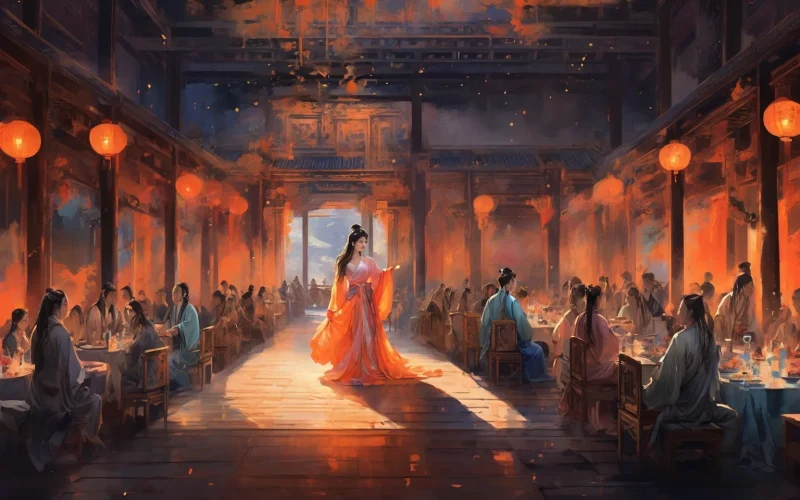
Clouds like a comb’s fine teeth, the jasper hall is bright;
A gatekeeper reports the first watch of the night.
This couplet returns from fantasy to a realistic scene, but the "reality" is also distorted. "Clouds like a comb’s fine teeth" describes the densely packed clouds in the night sky, contrasting with the bright lamps of the "jasper hall" below—the sky is dark, but the palace is not asleep. "A gatekeeper reports the first watch" is the poem’s most intriguing detail: the gatekeeper comes to report the time, clearly intending to remind them of the late hour, but the Qin Emperor ignores it, and the feast continues. The three words "reports the first watch," in their plain statement, imply the passage of time and its disregard, wielding more force than any direct criticism.
Sixth Couplet: "花楼玉凤声娇狞,海绡红文香浅清,黄鹅跌舞千年觥。"
In the flower-tower, a jade phoenix, voice both shrill and sweet;
Sea-gauze, red patterns, scent both light and clear;
Yellow-gowned dancers, stumbling, offer cups of a thousand years.
Three consecutive lines describe the scene, employing the full power of lavish description. "Voice both shrill and sweet" is most striking—shrill and sweet are opposites, yet placed together to describe the same singing voice, it conveys a performance both seductively charming and faintly violent. "Sea-gauze, red patterns, scent both light and clear" uses delicate brushstrokes to depict the gorgeous attire and elegant fragrance, contrasting with the "shrill and sweet" voice. "Yellow-gowned dancers, stumbling, offer cups of a thousand years" uses "stumbling" to describe the dancers’ drunkenness and "cups of a thousand years" for the toasts, pushing the revelry to its peak. Yet the word "stumbling" already reveals signs of collapse—the staggering dance steps foreshadow the impending loss of control in this orgy.
Seventh Couplet: "仙人烛树蜡烟轻,清琴醉眼泪泓泓。"
Candle-trees of the immortals, the wax-smoke light and thin;
Clear zither, drunken eyes, a welling of tears.
The final couplet makes a sudden turn, shifting from extreme clamor to extreme stillness. "Candle-trees of the immortals" uses a mythological image to describe the abundance of candlelight, but the three words "wax-smoke light and thin" suggest dissipation—the feast is ending, the wax-smoke thinning. The next line, "Clear zither, drunken eyes, a welling of tears," is the emotional summation of the entire poem: the one playing the clear, cold zither—perhaps the Qin Emperor himself, perhaps an attending palace maiden—with drunken eyes, now brimming with tears. Tears for what? For the feast about to end? For the revelry that cannot be sustained? Or for the arrogance that could make the moon reverse its course, which will ultimately be crushed by time? The poet does not say explicitly, concluding only with "a welling of tears," leaving boundless desolation in the reader’s heart.
Holistic Appreciation
This poem is one of Li He’s most tensely dramatic and richly theatrical works. Centered on the Qin Emperor, with the feast as its thread, it forges together cosmic-scale might and extravagant pleasure-seeking, finally concluding with a single teardrop, completing a full narrative from arrogance to emptiness.
Structurally, the poem displays a clear "three-part" layout. The first four lines describe the Qin Emperor’s "Might," using images like tiger-riding, sword-light, Xihe striking the sun, and kalpa-ashes flying to shape him into a nearly mythical being. The middle ten lines describe the Qin Emperor’s "Pleasure," employing scenes like wine pouring from dragon-heads, night pipas, mouth-organs from Dongting, commanding the moon, jasper halls, and tower revelry to exhaust the possibilities of lavish description. The final two lines conclude with "clear zither, drunken eyes, a welling of tears," transforming all the preceding grandeur and wildness into a sigh of sorrow. The three parts progress from Might to Pleasure, from Pleasure to Sorrow, layer upon layer, forming a seamless whole.
Conceptually, the poem’s core lies in the juxtaposition of "revelry" and "emptiness." The Qin Emperor who makes Xihe strike the sun and commands the moon to reverse, the Qin Emperor who lives in a drunken stupor with wine pouring from dragon-heads and shrill-sweet phoenix songs, ends up as nothing more than a pitiful figure with "drunken eyes, a welling of tears." The poet offers no direct critique, nor even any moral judgment; he merely places this revelry and these tears side by side, allowing the reader to comprehend the profound meaning within.
Artistically, the poem’s most moving aspect is its startling imagination and intense sensory impact. Lines like "Xihe strikes the sun—a sound of shattering glass," "Drunk to the full, he shouts for the moon to turn back," and "Yellow-gowned dancers, stumbling, offer cups of a thousand years" are astonishing for the extremity of their imagery and the boldness of their imagination. Yet the conclusion, "clear zither, drunken eyes, a welling of tears," pulls all this startling imagination back to the human world, leaving the reader, after the initial shock, with a deep sense of compassion.
Artistic Features
- Extensive Use of Mythological Imagery: The introduction of mythological elements like Xihe, the Wine Star, and the immortals' candle-trees gives the poem a splendid color and grand scale, while also containing veiled satire on the transgression of power.
- Techniques of Extreme Exaggeration: Lines like "His sword’s gleam lights the sky; the sky itself turns blue," "Xihe strikes the sun—a sound of shattering glass," and "Drunk to the full, he shouts for the moon to turn back" use extreme exaggeration to depict the Qin Emperor’s might and madness, serving both as artistic expression and as critique of power.
- Comprehensive Sensory Description: Sight (sword-light, silver clouds, candle-trees), sound (pipa, mouth-organ, shrill-sweet voice), smell (light, clear scent), touch (light, thin wax-smoke)—almost all senses are engaged, creating a powerful sense of immediacy.
- Careful Structural Arrangement: The three-part structure progressing from Might to Pleasure to Sorrow gives the poem dramatic tension and emotional depth.
- The Reversal and Sublimation of the Conclusion: The conclusion with "clear zither, drunken eyes, a welling of tears" transforms the preceding revelry into desolation, allowing the poem to transcend mere critique and attain a depth of humanity.
Insights
This poem, through an extravagantly luxurious feast, speaks of the emptiness behind power and revelry, offering a profound warning to later generations. It makes us contemplate the limits of power. The Qin Emperor, who can make Xihe strike the sun and command the moon to reverse, seems to possess the power to manipulate the cosmos, yet in the end can only conclude with tears. This tells us: no amount of power can withstand the passage of time; the wildest delusions will ultimately be consumed by emptiness. The greater the power, the greater the need for clarity and self-reflection, or one risks losing oneself in revelry.
The poem’s conclusion, "清琴醉眼泪泓泓" allows us to see the desolate underside of post-revelry. Those tears may be the indiscretion of drunkenness, the melancholy before the party ends, or fear of the revelry that cannot be sustained. It reminds us: any happiness built on illusion is doomed to be fleeting; any intoxication that escapes reality will exact a deeper emptiness as its price.
On a deeper level, this poem also makes us consider the gap between ideal and reality. Li He lived a life of hardship, never possessing power himself, yet he wrote such soul-stirring poetry about emperors. Are those imaginings of tiger-riding and moon-reversing not also his longing for another kind of life? And are those final tears not also his lament for his actual circumstances? Perhaps this is precisely the charm of Li He’s poetry—he constructs a surreal world with splendid imagination, yet infuses it with the most genuine of human emotions.
Poem translator
Xu Yuanchong (许渊冲)
About the Poet
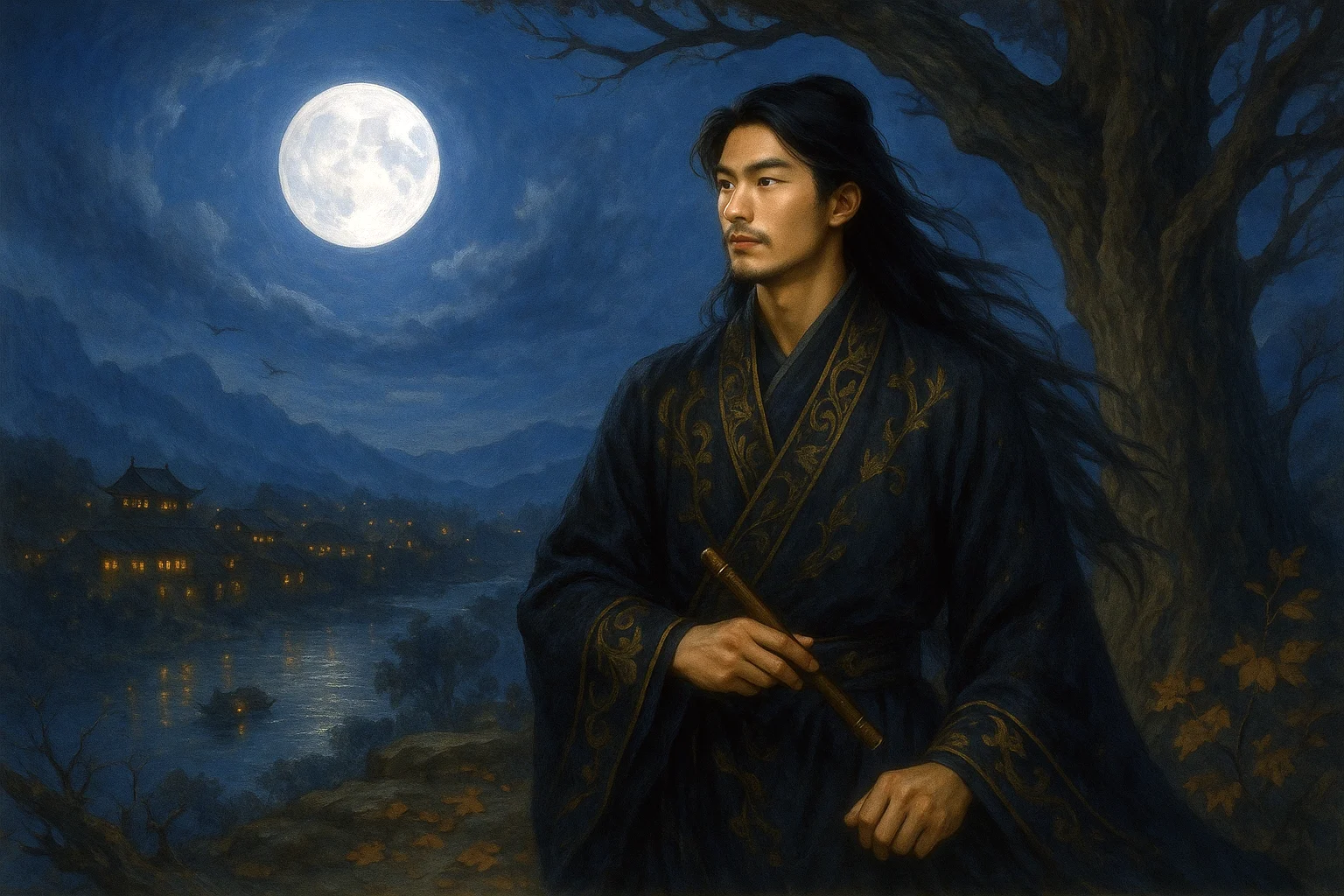
Li He (李贺 790 - 816), a native of Yiyang, Henan, was a Romantic poet of the Mid-Tang dynasty. A descendant of the Tang imperial clan, he was barred from taking the national jinshi civil service examination due to a naming taboo (his father's name contained a character homophonous with "Jin"), which led to a life of frustration and poverty. He died at the age of twenty-seven. His poetry, renowned for its bizarre grandeur, chilling elegance, and fantastical imagination, earned him the title "Ghost of Poetry." He pioneered the distinctive "Changji Style" within Tang poetry, exerting a profound influence on later poets like Li Shangyin and Wen Tingyun and on the expansion of poetic imagery in subsequent eras.