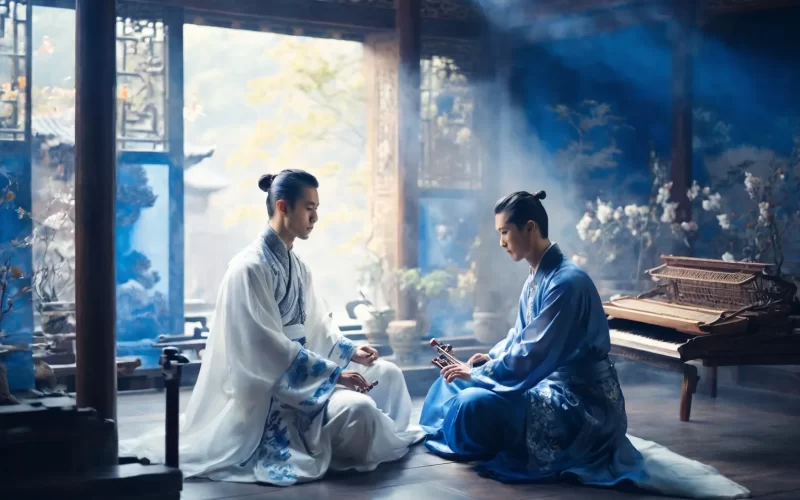


Our host, providing abundant wine to make the night mellow,
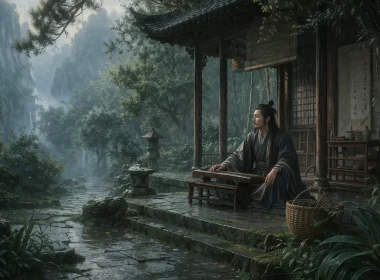
Asks his guest from Yang-chou to play for us on the lute.
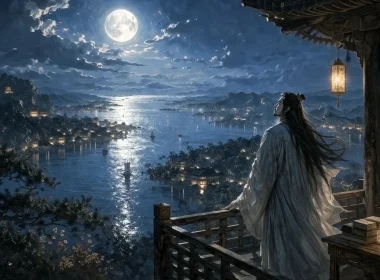
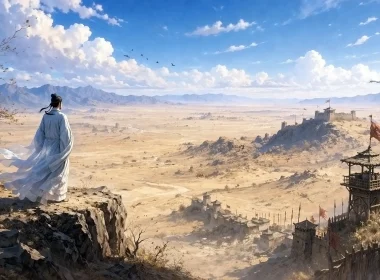
Toward the moon that whitens the city-wall, black crows are flying,
Frost is on ten thousand trees, and the wind blows through our clothes;
But a copper stove has added its light to that of flowery candles,
And the lute plays The Green Water, and then The Queen of Ch'u.

Once it has begun to play, there is no other sound:
A spell is on the banquet, while the stars grow thin...

But three hundred miles from here, in Huai, official duties await him,
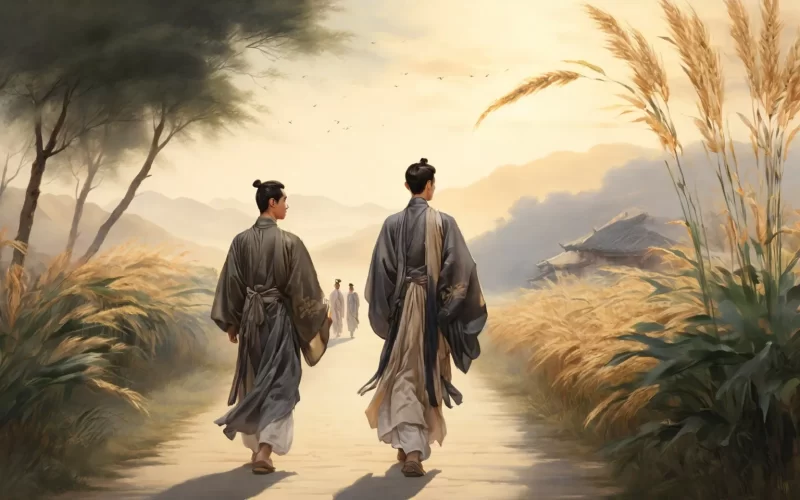
And so it's farewell, and the road again, under cloudy mountains.
Original Poem
「琴歌」
李颀
主人有酒欢今夕,请奏鸣琴广陵客。
月照城头乌半飞,霜凄万木风入衣。
铜炉华烛烛增辉,初弹渌水后楚妃。
一声已动物皆静,四座无言星欲稀。
清淮奉使千余里,敢告云山从此始。
Interpretation
Li Qi, a poet of the High Tang period, experienced an unsuccessful official career. In his early years, he lived in seclusion in Yingyang. Although he later passed the jinshi examination, he only attained a minor post like the County Captain of Xinxiang, ultimately resigning to return to a reclusive life. This experience gave him a deeper insight into the warmth and coldness of human relationships than most. This poem was composed when Li Qi was sent on a mission to Qinghuai. Qinghuai refers to the region of present-day Huaian and Yangzhou in Jiangsu, thousands of miles from Chang'an. Before departure, friends held a farewell banquet for him, where a lutenist performed. Amidst the warmth of the room, listening to the melodious lute music, the poet thought of the long journey beginning the next day. Complex emotions welled up within him—gratitude for the host's generous hospitality, uncertainty about the road ahead, and a veiled resolution: this journey of a thousand miles might lead him away from officialdom forever, towards seclusion among misty mountains.
The line "I dare to tell you: from this night, I begin my life in misty mountains" reveals this sentiment. Li Qi wavered between official service and reclusion throughout his life, ultimately choosing the latter. This poem was written while he was still in office, but the phrase "misty mountains" plants the seed for his future retreat.
First Couplet: "主人有酒欢今夕,请奏鸣琴广陵客。"
Zhǔrén yǒu jiǔ huān jīn xī, qǐng zòu míng qín Guǎnglíng kè.
Our host has wine: tonight we shall be merry;
He bids a lutenist from Guangling play the clear-toned lute.
The opening establishes the banquet setting. The seven characters "Our host has wine: tonight we shall be merry" capture the festive atmosphere. The word "merry" (欢, huān) is both descriptive and preparatory—precisely because tonight is so joyful, tomorrow's parting will feel all the more poignant. The next line introduces the lutenist. "A lutenist from Guangling" (广陵客, Guǎnglíng kè) alludes to Ji Kang's "Guangling Melody" (Guangling San), hinting at the musician's superb skill and suggesting the masterpiece about to be played.
Second Couplet: "月照城头乌半飞,霜凄万木风入衣。"
Yuè zhào chéng tóu wū bàn fēi, shuāng qī wàn mù fēng rù yī.
The moon shines on the city wall, and crows fly scattered;
Frost chills a myriad trees, the wind pierces our clothes.
Here, the poet's brush turns from indoors to outdoors. Moon, crow, frost, tree, wind—five images combine to sketch a cold, autumn night scene. "Crows fly scattered" (乌半飞, wū bàn fēi) depicts crows startled, not yet flown far, signaling the early depth of night. "Frost chills a myriad trees" (霜凄万木, shuāng qī wàn mù) describes deep autumn, with all things bleak. "The wind pierces our clothes" (风入衣, fēng rù yī) conveys a bone-chilling cold penetrating the skin. This couplet starkly contrasts with the preceding one's indoor warmth: inside, wine is warm and the lute's tones are gentle; outside, the wind is desolate and the frost cold. Inside is a joyful gathering; outside lies the journey.
Third Couplet: "铜炉华烛烛增辉,初弹渌水后楚妃。"
Tónglú huá zhú zhú zēng huī, chū tán Lù Shuǐ hòu Chǔ Fēi.
Bronze censer, splendid candles; candlelight grows bright;
He plays first "Green Waters," and then "The Consort of Chu."
The focus returns indoors, continuing to elaborate on the banquet's splendor. "Bronze censer, splendid candles" describes the exquisite implements; "candlelight grows bright" describes the increasing brilliance of the light—a light that is both candlelight and the spiritual illumination brought by the lute music. The next line names the pieces played. "Green Waters" (渌水, Lù Shuǐ) is the name of an ancient lute piece, traditionally attributed to Cai Yong, known for its clear, elegant melody. "The Consort of Chu" (楚妃, Chǔ Fēi) is also an ancient tune, singing the virtues of Consort Fan of King Zhuang of Chu. One is clear, the other elegant, perfectly suited to the needs of a banquet.
Fourth Couplet: "一声已动物皆静,四座无言星欲稀。"
Yī shēng yǐ dòng wù jiē jìng, sì zuò wú yán xīng yù xī.
A first note stirred—and everything was hushed;
No one among the guests would speak; the stars grew thin.
This couplet describes the music's power to move. "A first note stirred" (一声已动, yī shēng yǐ dòng) describes how the first note possesses a soul-stirring force. "And everything was hushed" (物皆静, wù jiē jìng) uses hyperbole to describe the reaction of all things—even the inanimate are quieted, let alone sentient people. The next line, "No one among the guests would speak; the stars grew thin" (四座无言星欲稀, sì zuò wú yán xīng yù xī), deepens the effect: the guests are immersed in the music, silent for a long time; unknowingly, the night deepens and the stars grow sparse. This couplet pushes music's magic to its limit, setting the stage for the "declaration of intent" that follows.
Fifth Couplet: "清淮奉使千余里,敢告云山从此始。"
Qīnghuái fèng shǐ qiān yú lǐ, gǎn gào yún shān cóng cǐ shǐ.
To the clear Huai River, a thousand miles I go, on duty;
I dare to tell you: from this night, I begin my life in misty mountains.
The final couplet turns from the music to reality, from tonight to tomorrow. "To the clear Huai River, a thousand miles I go, on duty" states the mission's distance and the road's length. The line "I dare to tell you: from this night, I begin my life in misty mountains" (敢告云山从此始, gǎn gào yún shān cóng cǐ shǐ) has two meanings: first, bidding farewell to the host, beginning the journey from this night; second, hinting at thoughts of reclusion—"misty mountains" (云山, yún shān) represent the life of a recluse. When the poet says "begin from this night," it is both a farewell and an aspiration.
Holistic Appreciation
This is a farewell poem using music as its thread. The poem's ten lines move from the banquet to the lute music, from the music to the feelings of parting, from parting feelings to a declaration of intent, progressing layer by layer as a seamless whole.
The first four lines describe the banquet's splendor and the autumn night's chill, using the indoor-outdoor contrast to fully set the stage for the music's arrival. The middle four lines extol the beauty of the music, from the pieces played to their effect, employing every descriptive technique. The lines "A first note stirred—and everything was hushed; / No one among the guests would speak; the stars grew thin" push the music's evocative power to its peak. The final two lines shift from the music to reality, stating the mission and hinting at the intention to retire.
Li Qi's uniqueness lies in making the music audible and tangible while letting it act as a catalyst for emotion. That lute music is both the banquet's entertainment and the backdrop for parting, and even more, a reflection of the poet's inner turmoil. As the final note fades, silence reigns among the guests, yet the poet's heart, within that silence, makes a decision—this journey of a thousand miles may indeed be the beginning of retirement.
Artistic Merits
- Vivid Contrasts, Rich Layers: The warmth indoors contrasts with the chill outside; the music's movement contrasts with the guests' stillness; tonight's joy contrasts with the distance of tomorrow. Multiple contrasts deepen the emotion.
- Divine Description of Music: "A first note stirred—and everything was hushed; / No one among the guests would speak; the stars grew thin" uses indirect suggestion to convey the music's power, more moving than a direct description of the sound.
- Atmospheric Setting, Fusion of Feeling and Scene: The use of images—moon, crow, frost, trees, wind—evokes both the cold of the autumn night and the sorrow of parting, fusing emotion and scene.
- Concise Language, Profound Meaning: The poem's language is plain yet endlessly suggestive. The line "I dare to tell you: from this night, I begin my life in misty mountains" is both a farewell and an aspiration, leaving readers ample room for imagination.
- Tight Structure, Clear Progression: The movement from banquet to music, from music to parting feelings, from parting feelings to declared intent—the four sections are interlocked with natural transitions.
Insights
This poem, centered on a farewell banquet, captures the power of music and the turmoil of the human heart. It shows us how music can become a vessel for emotion. When the lute notes sounded, "everything was hushed" and "no one among the guests would speak"—this is not only art's power to move but also resonance between souls. In that moment, lutenist and listeners, host and poet, achieved a wordless understanding through the music. This reminds us: true emotional communication sometimes needs no words; music and art can become bridges between hearts.
Furthermore, the line "敢告云山从此始" reveals the poet's inner decision. Sent on a mission a thousand miles away, thoughts of reclusion arise within him amidst the lute music. This is not escapism but a rethinking of life's direction. It teaches us: life's important decisions are often not made in clamor but take form quietly in moments of stillness—after hearing a piece of music, for instance, or facing the starry sky alone.
On a deeper level, the poem also makes us consider the other side of "parting." Parting is sorrowful, but it is also a new beginning. The poet bids farewell to his host and sets out on his journey, yet carries the idea of "misty mountains" in his heart. This idea transforms parting from a pure loss into a possibility—saying goodbye to an old life to welcome a new self.
Poem translator
Kiang Kanghu
About the Poet
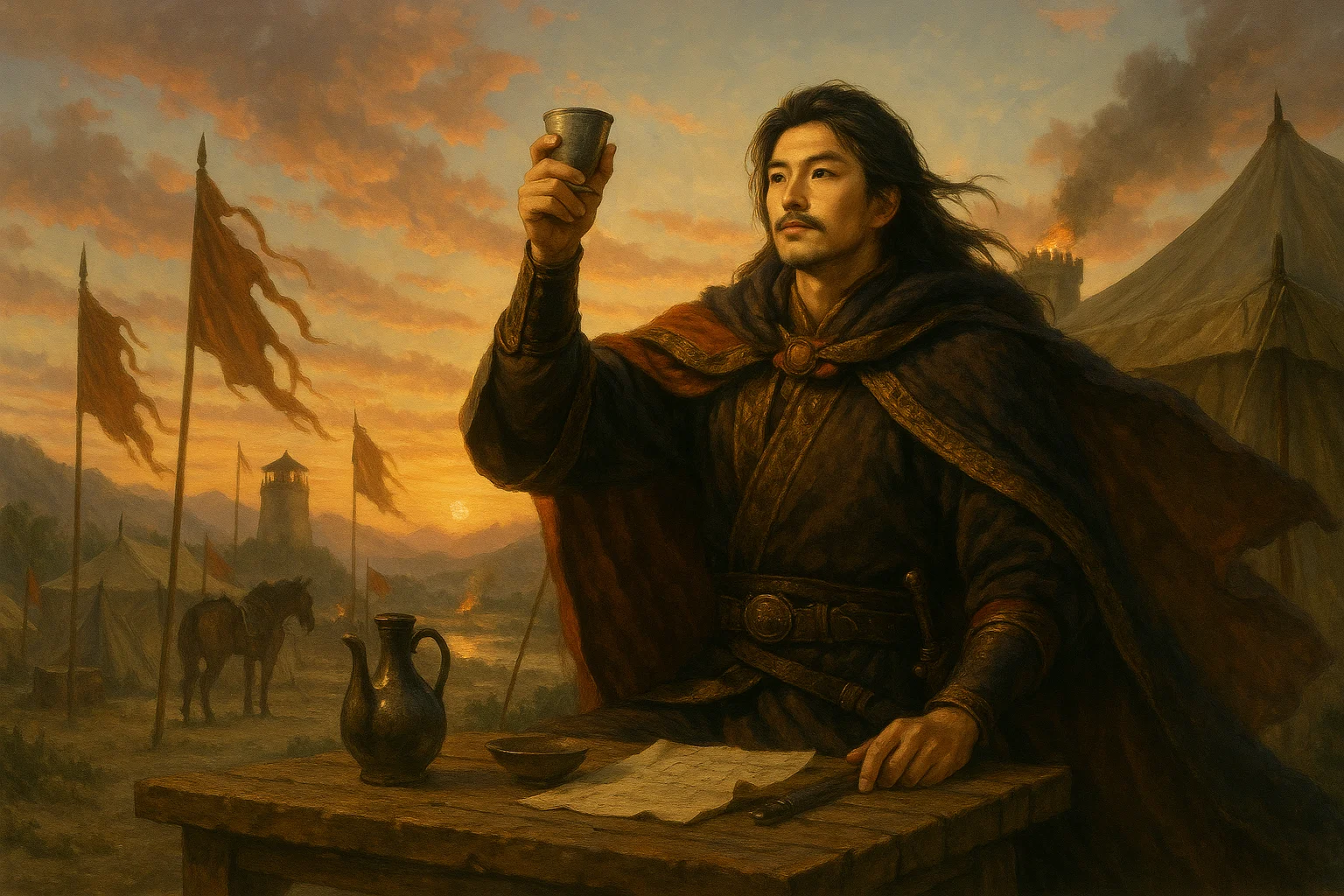
Li Qi (李颀 c. 690 – c. 751), whose ancestral home was in Zhao County, Hebei Province, was a renowned frontier fortress poet of the High Tang period. He became a jinshi (presented scholar) in the 23rd year of the Kaiyuan era (735 AD) and served as the Sheriff of Xinxiang before retiring from official life to live in seclusion. His poetry is best known for its frontier themes, and he excelled particularly in seven-character ancient verse and character portrayal. He had a gift for blending boldness with delicate emotion, and together with Gao Shi and Cen Shen, he collectively shaped the grandeur of High Tang frontier poetry.