A glazed cup full of amber wine,
The strong drink drips like red pearls fine.
The dragon boiled and phoenix roasted would weep;
The fragrant breeze blows into broidered curtains deep.
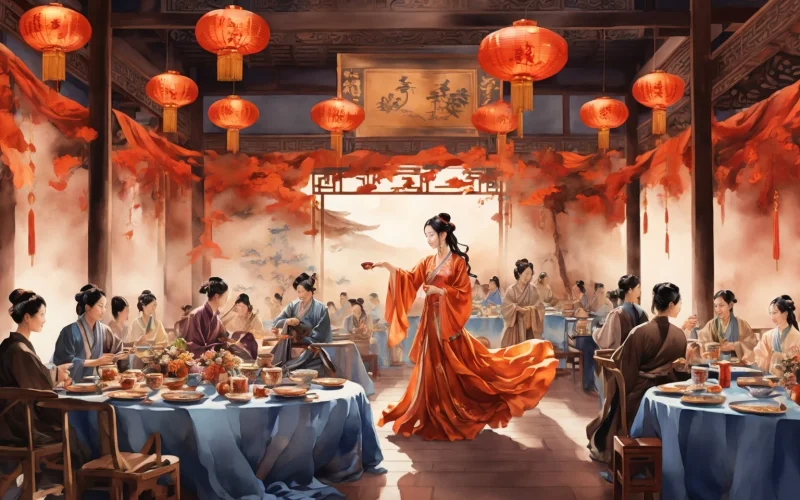
The dragon flute is played;Beaten the drums covered with alligator's skin.
The songstress sings with teeth as bright as jade,
And dancers dance with waist as slender as hairpin.

The prime of your life like the sun on the decline,
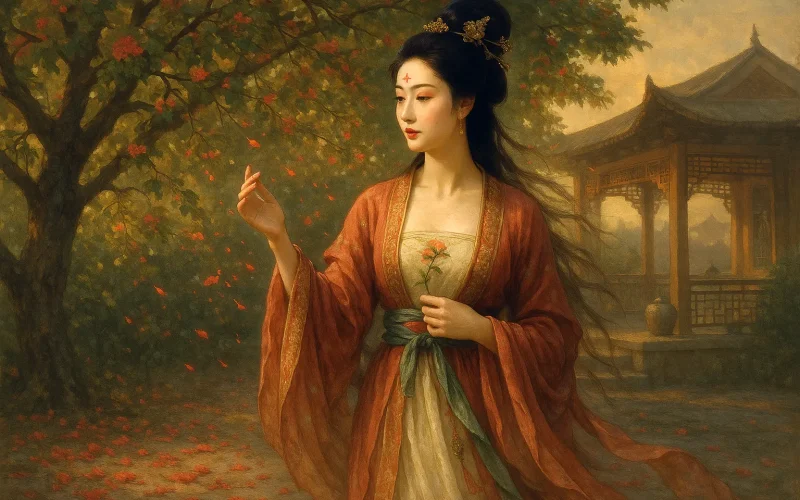
Peach blossoms fall pell-mell like rain of petals pink.
So I advise you to get drunk with wine.
When buried in the grave, what could you take to drink?
Original Poem
「将进酒」
李贺
琉璃钟,琥珀浓,小槽酒滴真珠红。
烹龙炮凤玉脂泣,罗帏绣幕围香风。
吹龙笛,击鼍鼓;皓齿歌,细腰舞。
况是青春日将暮,桃花乱落如红雨。
劝君终日酩酊醉,酒不到刘伶坟上土!
Interpretation
This poem was composed by the mid-Tang poet Li He. Li He's life was brief; he died young at the age of twenty-seven, yet with his uniquely extraordinary and magnificent poetic style, he carved a distinct niche in the poetic world, earning the name "Ghost of Poetry." He possessed exceptional talent, but because his father's name, "Jinsu," sounded similar to "jinshi" (presented scholar), he was slandered and forced to abandon the imperial examinations, living a life of frustration and unfulfilled ambitions. This resentment at unrecognized talent, combined with a sensitivity to life's brevity, often causes his poetry, after the most lavish descriptions, to abruptly turn toward profound reflection on death and nothingness.
Bring in the Wine ("Qiang Jin Jiu") was originally an old yuefu title, often expressing the intent to drink, sing freely, and seize the day. Li He's poem, however, breaks new ground—he elaborates on the extravagance of a feast with rich colors, yet at the peak of joy, he plummets abruptly, pushing the transience of youth and the impermanence of life suddenly before the reader with the poignant image of "peach petals fall confused as red rain." The carefree exhortation, "I urge you, sir, to stay dead drunk all day long," ultimately lands on the cold reality of "but wine never reaches the soil on Liu Ling's grave," juxtaposing the revelry of life with the nothingness of death, creating breathtaking artistic tension. This poem is precisely Li He's ultimate questioning of life's essence: since death will ultimately swallow everything, then what, after all, is the meaning of life?
First Couplet: "琉璃钟,琥珀浓,小槽酒滴真珠红。"
Liúlí zhōng, hǔpò nóng, xiǎo cáo jiǔ dī zhēnzhū hóng.
A crystal wine-cup, amber rich;
From the small vat, wine drips, a ruby red.
The poem opens with three parallel images, lavishly describing the exquisite beauty of the wine vessel and the richness of the wine's color. "Crystal" depicts its clarity, "amber" metaphorizes its richness, "ruby" simulates its hue—layering and piling, pushing the feast's extravagance to the extreme. This technique of juxtaposition, omitting verbs, allows the images to directly strike the reader's senses, as if the wine's aroma, that luster, is already rushing towards the face.
Second Couplet: "烹龙炮凤玉脂泣,罗帏绣幕围香风。"
Pēng lóng pào fèng yù zhī qì, luó wéi xiù mù wéi xiāng fēng.
They cook the dragon, roast the phoenix, and jade-fat weeps;
Gauze drapes, embroidered curtains, hold the scented breeze.
This couplet moves from wine to delicacies, from vessels to setting. "They cook the dragon, roast the phoenix" speaks hyperbolically of the rarity of the dishes, as if not of this world; the three characters "jade-fat weeps" are especially extraordinary—the sound of fat sizzling during cooking is likened to weeping. This character "weeps" (泣) conceals a note of sorrow within extreme extravagance, foreshadowing the turn later in the poem. The next line, "Gauze drapes, embroidered curtains, hold the scented breeze," uses the character "hold" (围) to depict the enclosed, private space of the feast, as if trying to forever keep this moment of joy.
Third Couplet: "吹龙笛,击鼍鼓;皓齿歌,细腰舞。"
Chuī lóng dí, jī tuó gǔ; hào chǐ gē, xì yāo wǔ.
They play the dragon flute, pound the crocodile drum;
White teeth sing, slender waists dance.
This couplet shifts from static scenes to dynamic ones, using a rapid rhythm to convey the abandon of song and dance. The three-character and seven-character lines alternate, creating a musical cadence. "White teeth" and "slender waists" are synecdoche, using parts to represent the whole, depicting the youth and beauty of the singers and dancers. Here, the joy of the feast reaches its peak: fine wine, rare delicacies, luxurious drapes, enchanting music, alluring dance—the sensory feast climaxes.
Fourth Couplet: "况是青春日将暮,桃花乱落如红雨。"
Kuàng shì qīngchūn rì jiāng mù, táohuā luàn luò rú hóng yǔ.
And even more, our springtime youth nears sunset soon,
While peach petals fall confused as red rain.
This couplet turns abruptly, plummeting from extreme joy to extreme sorrow. The phrase "and even more" (况是) forcibly juxtaposes the preceding joy with the ensuing sadness, creating a vast emotional disparity. "Our springtime youth nears sunset" refers not only to the late spring season but also serves as a metaphor for the passing of youthful years. The next line, "while peach petals fall confused as red rain," employs an extraordinary image to depict the withering of life—the chaotic falling of petals, their urgent rain-like descent, offers a striking visual representation of youth's sudden passing. The character "confused" (乱) conveys utter helplessness; "red rain" (红雨) expresses poignant sorrow, shocking to behold.
Fifth Couplet: "劝君终日酩酊醉,酒不到刘伶坟上土!"
Quàn jūn zhōngrì mǐngdǐng zuì, jiǔ bù dào Liú Líng fén shàng tǔ!
I urge you, sir, to stay dead drunk all day long,
But wine never reaches the soil on Liu Ling's grave!
The closing couplet concludes with an exhortation to drink, yet states the coldest truth. "Stay dead drunk all day long" is a continuation of the preceding revelry, yet also a negation of it—why get drunk? Because awakening means facing reality. The next line, "but wine never reaches the soil on Liu Ling's grave," borrows the allusion to Liu Ling, a famed drinker, but reverses its meaning: though Liu Ling accompanied himself with wine all his life, not a single drop can reach his mouth after death. This line juxtaposes the joy of life with the nothingness of death, contrasts the warmth of wine with the coldness of the grave, instantly dissolving all the previous splendor and fervor. So, that crystal cup, rich amber, ruby red wine, that cooking of dragon and roasting of phoenix, those white teeth and slender waists—all will ultimately be gently covered by a handful of yellow earth.
Holistic Appreciation
This work is a model of Li He's poetry where boldness and desolation coexist. The entire poem takes the feast as its surface and life-and-death as its core. Following the most extravagant descriptions, it abruptly turns to profound reflection on life's impermanence, creating breathtaking artistic tension.
Structurally, the poem exhibits a clear progression of "introduction, elaboration, turn, conclusion." The first three couplets elaborate on the feast's magnificence with rich colors—this is the "introduction" and "elaboration." The fourth couplet, with "while peach petals fall confused as red rain," turns abruptly, plummeting from extreme joy to extreme sorrow—this is the "turn." The closing couplet, with "but wine never reaches the soil on Liu Ling's grave," concludes the poem, juxtaposing the revelry of life with the nothingness of death—this is the "conclusion." Between these four layers, the emotion rises and falls dramatically, the structure is tightly ordered.
Conceptually, the poem's core lies in the word "contrast." The joy of life is set against the coldness of death; the warmth of wine reflects the desolation of the grave; the brilliance of youth is contrasted with the poignant beauty of falling petals. This contrast is not to negate the value of life but to question its meaning—since death will ultimately swallow everything, what, then, is the meaning of this brief joy? The poet gives no answer, only places the image of "peach petals fall confused as red rain" and the reality of "wine never reaches the soil on Liu Ling's grave" before the reader, allowing each person to ponder for themselves.
Artistically, the poem's most moving aspects are the originality of its imagery and the layering of its emotion. The extraordinariness of "jade-fat weeps," the poignant beauty of "peach petals fall confused as red rain," the stark coldness of "wine never reaches the soil on Liu Ling's grave" are all unique creations of Li He's style. And the emotional layers progress from fervor to desolation, from brilliance to nothingness, step by step, finally returning to a cold silence.
Artistic Merits
- Extraordinary Imagery, Intense Colors: Images like "crystal," "amber," "ruby," "red rain" are colorful, extremely gorgeous, forming a strong visual impact. Within the rich colors, desolation is concealed.
- Abrupt Turn, Stark Contrast: The sudden shift from the feast's exuberant joy to a meditation on death creates an immense emotional plunge—one that startles the reader. Ingenuity lies in the turn; depth resides in the contrast.
- Refined Diction, Rich Connotation: The character "weeps" (泣) describes the sound of cooking but implies sorrow; "confused" (乱) describes the state of falling petals but expresses utter helplessness; the two characters "never reaches" (不到) are resolute, icy, and merciless. Each word carries great weight, inviting contemplation.
- Varied Line Length, Distinct Rhythm: The alternating use of three-character and seven-character lines creates a musical cadence, complementing the feast's scene of song and dance. Variation in form echoes variation in emotion.
- Innovative Allusion, Fresh Meaning: Borrowing the Liu Ling allusion but reversing its meaning—not admiring his love of drink, but lamenting that no wine reaches him after death. Transforming the old to create the new, forging majestic words.
Insights
This poem, through the depiction of an extravagant feast, articulates one of life's deepest paradoxes: we know death will ultimately claim us, yet we still pursue joy and meaning within our finite time. It compels us to confront the inevitability of death—and in doing so, to examine the meaning of life with greater clarity. The seven characters "wine never reaches the soil on Liu Ling's grave" strike with cold finality, dissolving in an instant all the splendor of existence. Yet the poet does not advocate negation; rather, he uses this stark truth to remind us: precisely because death will ultimately come, every moment of life becomes infinitely precious. It offers a quiet revelation: true clarity lies not in evading death, but in facing it—and then, against that cold backdrop, living, loving, and creating with even greater fervor.
The imagery of "peach petals fall confused as red rain" in the poem allows us to see the brevity and fragility of beauty. Peach blossoms in full bloom are so brilliant, yet when they fall, it is as sudden as a swift rain. This is a metaphor for youth and the fate of all beautiful things. Yet, it is precisely this transience that gives beauty its tragic depth and provides a reason for cherishing to exist. It tells us: True beauty lies not in eternity, but in the full burst of life's force within that instant of "confused falling."
This poem also leads us to ponder: under the shadow of death, what, after all, is the meaning of life? The poet gives no answer, but with that crystal cup, rich amber, ruby red wine, that cooking of dragon and roasting of phoenix, those white teeth and slender waists, that confused falling of peach blossoms, that swirling red rain, he shows us all of life's brilliance and sorrow. Perhaps the answer lies within this juxtaposition of brilliance and sorrow: the meaning of life lies not in evading death, but in facing death while still choosing to live fervently; it lies not in pursuing eternity, but in bursting forth with all of life's light and heat within that brief, fleeting moment.
Poem translator
Xu Yuanchong (许渊冲)
About the Poet
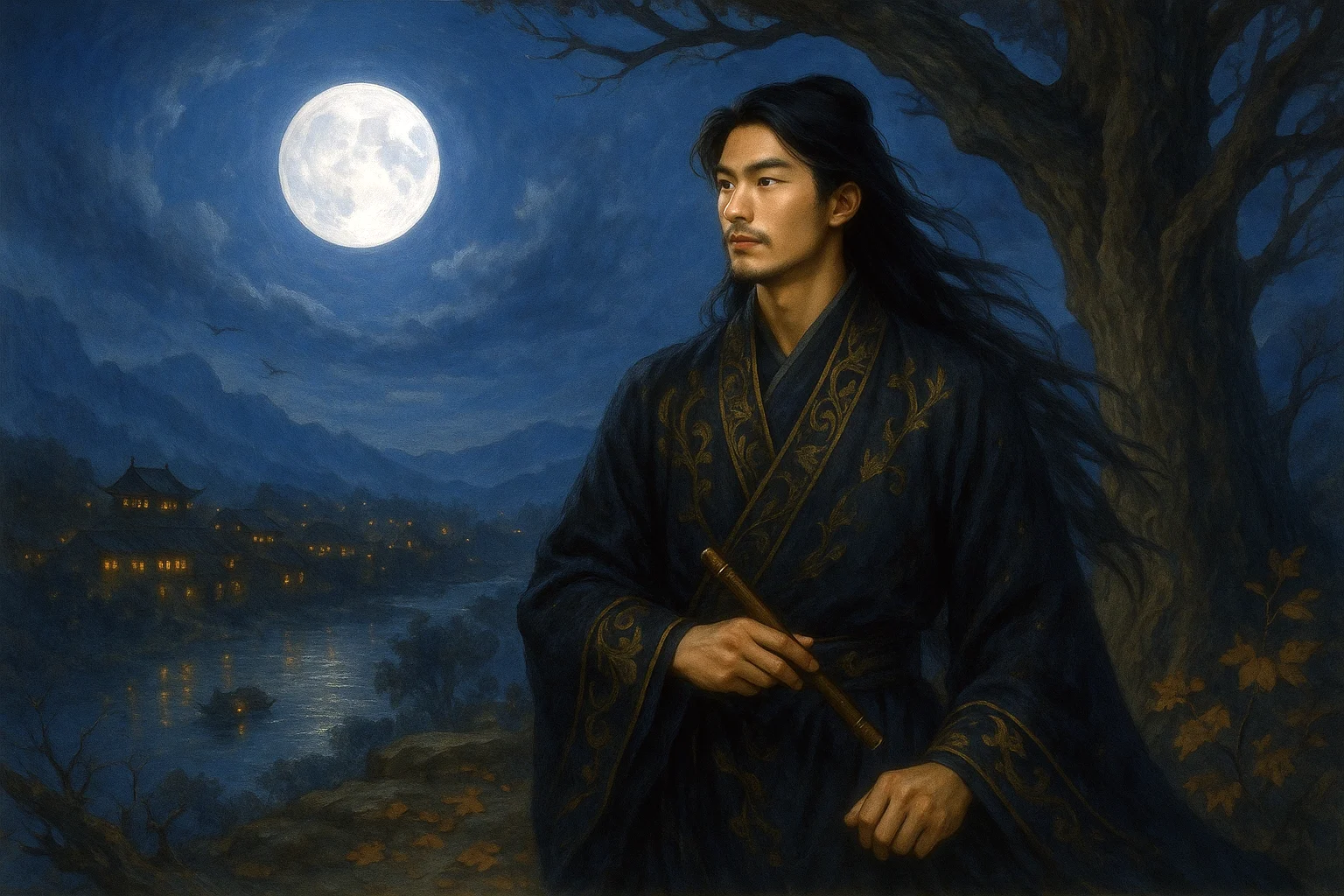
Li He (李贺 790 - 816), a native of Yiyang, Henan, was a Romantic poet of the Mid-Tang dynasty. A descendant of the Tang imperial clan, he was barred from taking the national jinshi civil service examination due to a naming taboo (his father's name contained a character homophonous with "Jin"), which led to a life of frustration and poverty. He died at the age of twenty-seven. His poetry, renowned for its bizarre grandeur, chilling elegance, and fantastical imagination, earned him the title "Ghost of Poetry." He pioneered the distinctive "Changji Style" within Tang poetry, exerting a profound influence on later poets like Li Shangyin and Wen Tingyun and on the expansion of poetic imagery in subsequent eras.