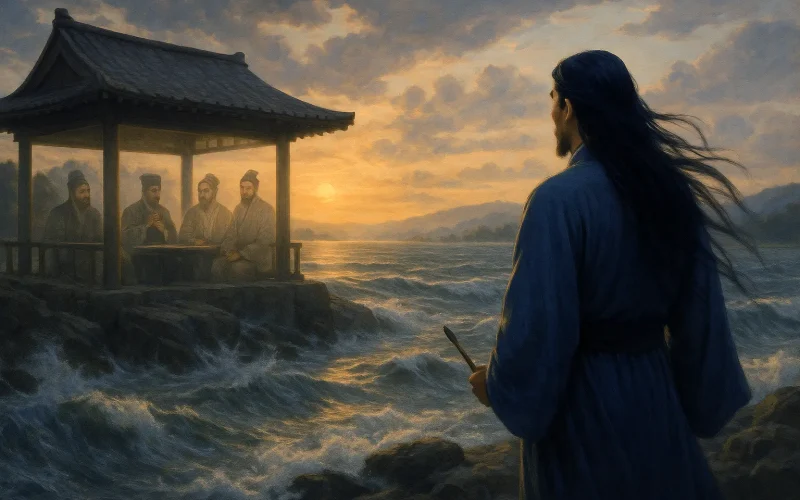



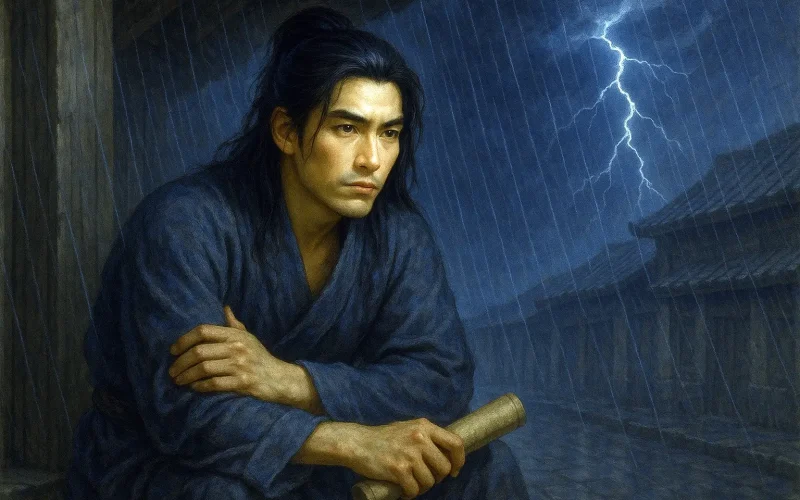
Make friends or foes of men as you will;
Of fickle friends you can’t have your fill.
Have you not heard of friendship true
Between Guan and Bao, ancient and new?
Such friendship now is thrown away
Like dirt on which none care to stay.
Original Poem:
「贫交行」
杜甫
翻手作云覆手雨,纷纷轻薄何须数。
君不见管鲍贫时交,此道今人弃如土。
Interpretation:
This poem stems from Du Fu’s years of hardship in Chang’an, likely composed around 752 CE. Having languished in the capital for nearly a decade, repeatedly failing the imperial examinations, his life had sunk into the dire straits he himself described: “At dawn, knocking at rich men’s gates; at dusk, trailing in the dust of sleek horses.” After personally experiencing the cold disdain of the powerful and the alienation of old acquaintances, he felt to the bone the fickleness of human relations. With a tone as fierce as fire, this poem pierces the hypocritical essence of social connections veiled by an age of prosperity, issuing a desperate cry for sincere friendship and a fierce denunciation of the era’s decadent morals.
First Couplet: “翻手作云覆手雨,纷纷轻薄何须数。”
Fān shǒu zuò yún fù shǒu yǔ, fēnfēn qīngbó hé xū shǔ.
A turn of the palm brings cloud, its flip brings pouring rain; This fickle, shallow crowd—why count them? Count in vain!
The opening strikes like lightning. “A turn of the palm brings cloud, its flip brings pouring rain” has become an immortal line depicting worldly fickleness. The metaphor’s brilliance lies in its depiction of swiftness (the shift between warmth and coldness happens in an instant), capriciousness (“cloud” obscures the sun, “rain” drenches—symbolizing the flattery or scorn that follows changes in status), and a sense of manipulation (those who “bring cloud and rain” seem to control others’ fates at will, exposing the decisive role of power in human connections). “Fickle, shallow crowd” categorizes such people, while “why count them?” hurls forth the poet’s utter contempt—he scorns to associate with or debate them. The emotional charge is extreme.
Second Couplet: “君不见管鲍贫时交,此道今人弃如土。”
Jūn bú jiàn Guǎn Bào pín shí jiāo, cǐ dào jīn rén qì rú tǔ.
Have you not seen Guan and Bao’s bond, in poverty made fast? This way, by men of now, is cast aside like worthless dust.
The poet shifts from castigating the present to gazing intently at a historical ideal. “Guan and Bao’s bond, in poverty made fast” refers to the exemplary friendship recorded in the Records of the Grand Historian: Bao Shuya’s unwavering trust and support for Guan Zhong, regardless of personal gain. Invoking this “bond in poverty” precisely mirrors Du Fu’s own plight and defines true friendship’s core—it should be built on recognition of character, not calculations of interest. “This way… is cast aside like worthless dust” is the poem’s most powerful outcry. “Cast aside like worthless dust” is viscerally shocking, conveying profound indignation. Juxtaposing the “way” treasured by the ancients with the “dust” despised by contemporaries creates a staggering value inversion, delivering the sternest judgment on the era’s moral decay.
Holistic Appreciation
This poem represents a concentrated eruption of critical realism in Du Fu’s early work. Unlike the deep and restrained tone of his later poetry, it attacks the ills of society and human nature with volcanic fury. The poem employs a stark contrastive structure: the first couplet depicts contemporaries’ “changeability” (clouds and rain), the second the ancients’ “constancy” (steadfast in poverty); the first portrays a despicable “multitude,” the second an aspirational “singular archetype.” Through contrasts of past and present, the many and the one, the noble and the base, the poet voices personal anguish while executing a profound social critique.
The language is electrically charged, with a startling metaphor (“clouds and rain”) and a precise historical allusion (Guan and Bao). Emotion swings violently between the cold scorn of “why count them?” and the hot fury of “cast aside like worthless dust,” vividly portraying the inner turmoil and defiance of a sensitive, principled poet facing a callous world. Titled Song of Friendship in Poverty, it refers both to “friendship in hardship” and implies “a ballad sung for such friendship”—a solemn elegy for a lost virtue.
Artistic Merits
- Condensed, Blade-like Critical Language: The seven characters “A turn of the palm brings cloud, its flip brings pouring rain” capture the essence of worldly fickleness with unprecedented concision and force, later becoming a standard idiom.
- The Jarring Effect of Past-Present Juxtaposition: The contrast between the contemporary “fickle, shallow crowd” and the singular historical example of “Guan and Bao’s bond” generates profound moral dissonance, heightening the poem’s critical force.
- Direct and Forceful Emotional Expression: The poem employs no indirection, using exclamations and rhetorical questions like “why count them?”, “have you not seen?”, and “cast aside like worthless dust” to vent its scorn for the world fully, showcasing the vehement aspect of Du Fu’s voice alongside its solemn depth.
- Adaptation of the Music Bureau Tradition: Using the “Song” (xing) title nods to Music Bureau ballads, but the content is pointed social criticism, infusing the old form with new polemical force.
Insights
Though written over a millennium ago, this poem’s exposure of relationships based solely on interest possesses striking modernity. In today’s world of greater material abundance and networked connection, tales of “turning palm to cloud and flip to rain” still unfold in myriad ways. The poem acts as a cold mirror, compelling reflection: in assessing human connections, do we too use overly utilitarian measures?
It teaches that genuine friendship and healthy society are built on trust, understanding, and shared principle—as in the bond of Guan and Bao—not on dependency on power or exchange of benefit. Du Fu’s fury and lament are a plea for an enduring value: no matter how times change, that “ancient way” of authentic connection must not be discarded like dirt. Personally, it reminds us to cherish and guard affections that do not waver with circumstance. Socially, it calls for an interpersonal ethic warmer and healthier than mere calculation
About the poet
Du Fu (杜甫), 712 - 770 AD, was a great poet of the Tang Dynasty, known as the "Sage of Poetry". Born into a declining bureaucratic family, Du Fu had a rough life, and his turbulent and dislocated life made him keenly aware of the plight of the masses. Therefore, his poems were always closely related to the current affairs, reflecting the social life of that era in a more comprehensive way, with profound thoughts and a broad realm. In his poetic art, he was able to combine many styles, forming a unique style of "profound and thick", and becoming a great realist poet in the history of China.