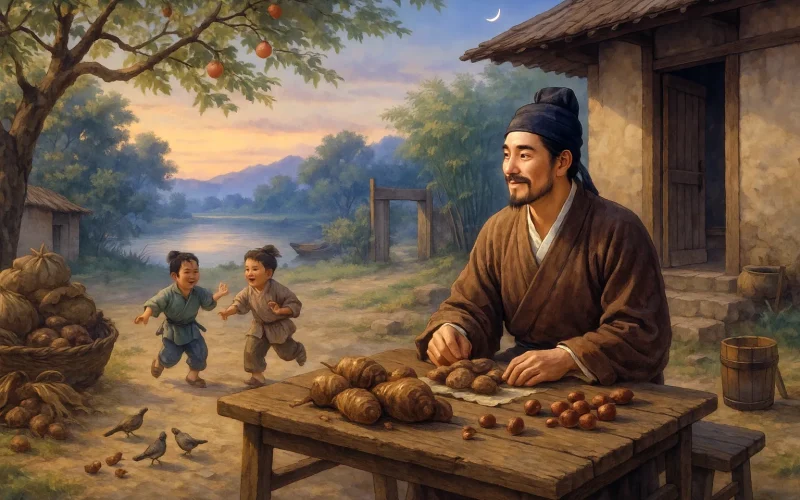
A scholar wearing black hood in our southern town,
He’s not reduced to poverty with nuts and taros grown.
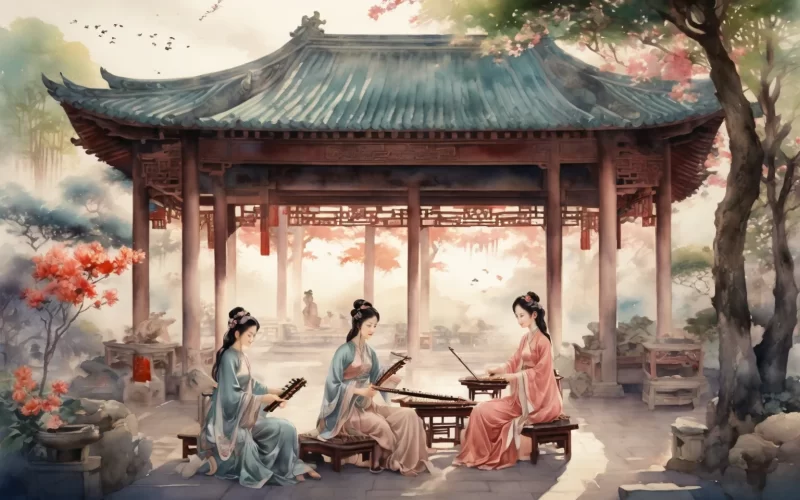
Used to seeing guests, his children are happy and gay;
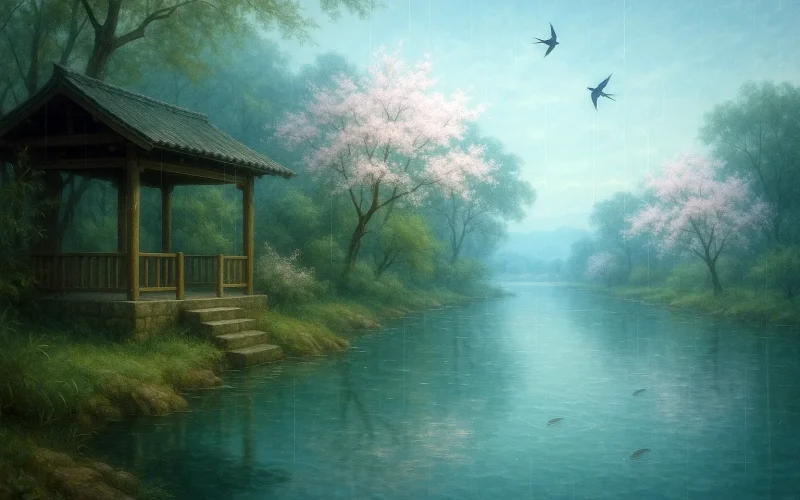
Tamed by frequent feeding, birds hop on steps in play.

In autumn water only four or five feet deep,
Two or three men on a boat along the stream float.
By white sand and green bamboos when night is late and steep,
Before his wicket gate we gaze at the moon new and great.
Original Poem
「南邻」
杜甫
锦里先生乌角巾,园收芋栗未全贫。
惯看宾客儿童喜,得食阶除鸟雀驯。
秋水才深四五尺,野航恰受两三人。
白沙翠竹江村暮,相对柴门月色新。
Interpretation
This work was composed in the autumn of 760 CE, the first year of the Shangyuan era under Emperor Suzong, while Du Fu was living in his thatched cottage by the Huanhua Stream in Chengdu. After a long period of displacement, the poet had finally obtained a settled dwelling here and had developed a warm, friendly rapport with the simple, honest villagers nearby. The title "Southern Neighbor" refers specifically to a hermit living south of the cottage, known as "Master of Brocade Hamlet." This poem resembles a fresh, elegantly simple line-drawing, recording an ordinary visit to a friend in a riverside village. It reveals a precious, idyllic human haven within a war-torn age and the pure yet profound friendship between two kindred spirits.
First Couplet: “锦里先生乌角巾,园收芋栗未全贫。”
Jǐnlǐ xiānsheng wū jiǎo jīn, yuán shōu yù lì wèi quán pín.
The Master of Brocade Hamlet, in his square black cap of yore; / His garden yields some taro, nuts—he’s not entirely poor.
The opening sketches the protagonist’s image with concise strokes. The address “Master of Brocade Hamlet” identifies his residence by the Brocade River and implicitly honors his character. The “square black cap” is the classic headgear of recluses and scholars-retired-from-the-world since the Eastern Han dynasty; this single item establishes his identity and aspirations, indifferent to fame and fortune. “His garden yields some taro, nuts” truthfully depicts a frugal life. The three words “not entirely poor” are especially fine: they acknowledge material simplicity, yet the phrase “not entirely” reveals a sense of spiritual self-sufficiency and composure. This southern neighbor is the image of a wise man maintaining his dignity and integrity amidst chaos.
Second Couplet: “惯看宾客儿童喜,得食阶除鸟雀驯。”
Guàn kàn bīnkè értóng xǐ, dé shí jiē chú niǎoquè xún.
Used to seeing guests, the children greet them with delight; / Fed on the steps, the birds and sparrows are a tame, calm sight.
This couplet illuminates the host’s personal charm and the quality of his life from two angles: the family atmosphere and the natural environment. “Used to seeing guests” shows his refined social circle and good rapport with people; “the children greet them with delight” reflects the family’s benevolence and warmth—the arrival of guests is a joy, not a bother, to the children, revealing the household’s character. “The birds and sparrows are a tame, calm sight” is a stroke of genius. It not only depicts harmony between humans and nature (birds become “tame” because they are “fed”) but also uses the creatures’ tameness to reflect the host’s benevolent heart and the dwelling’s aura of peace. A home where birds feel secure enough to linger must be a place filled with compassion and tranquility.
Third Couplet: “秋水才深四五尺,野航恰受两三人。”
Qiūshuǐ cái shēn sì wǔ chǐ, yě háng qià shòu liǎng sān rén.
The autumn stream runs just four or five feet deep; / The rustic skiff can two or three persons keep.
The perspective shifts from the host’s home to the outdoors riverside, indicating the mode of transport for the poet’s visit or departure and outlining the uniquely serene scenery of the riverside village. “Autumn stream” marks the season, clear and calm. “Just four or five feet deep” and “can two or three persons keep” use seemingly casual yet precise numbers to convey a sense of natural, perfect proportion. This boat is not a lavish pleasure craft but a “rustic skiff,” perfectly matching the host’s hermit identity (signified by the “square black cap”) and the simple life of “taro, nuts.” The detail of crossing the river quietly foreshadows the farewell in the final couplet.
Fourth Couplet: “白沙翠竹江村暮,相对柴门月色新。”
Báishā cuìzhú jiāngcūn mù, xiāngduì cháimén yuèsè xīn.
White sand, green bamboos, dusk on the river-side; / We face each other at the wicket gate—the moon shines new and wide.
This couplet is like an ink-wash painting of serene depth, bringing the poem to its climax. A series of pure, clean images—“white sand,” “green bamboos,” “river-side,” “wicket gate,” “moon shines”—together construct a lucid, tranquil world unsullied by worldly dust. The word “dusk” tinges the scene with a warm hue; “new” imbues the moonlight with a sense of freshness and hope. Within this beautiful setting, the farewell “face each other at the wicket gate” holds no sorrow of parting, only the tranquility and mutual understanding of friendship between gentlemen. Host and guest, along with the white sand, green bamboos, new moon, and riverside village, merge into one, constituting a complete, self-sufficient world of reclusion.
Holistic Appreciation
This work is a masterpiece among Du Fu’s pastoral “visiting a friend” poems. Its brilliance lies in “using the visit as a mirror, reflecting the resonance of two ideal personalities.” The structure is exquisite: the first four lines focus on the “person” (the southern neighbor and his household), the latter four emphasize the “scene” (the riverside dusk and the parting). Yet person and scene are seamlessly integrated, jointly serving to present the theme of “secluded dwelling.”
The poem’s core charm is the unity of “ultimate simplicity” and “ultimate richness.” The poem contains no precious objects (square black cap, taro and nuts, wicket gate, rustic skiff) and no dazzling scenery (autumn stream, white sand, green bamboos, new moon). However, through the human warmth of “children greet them with delight” and “birds and sparrows are a tame, calm sight,” through the natural freshness of “the moon shines new,” and through the silent mutual understanding of host and guest “face each other at the wicket gate,” the poem is filled with an immense spiritual richness and peace. This is precisely the simple yet noble way of life that Du Fu admired and celebrated, a way of maintaining integrity amidst chaos.
Artistic Merits
- Vivid Portrayal through Plain Description: The entire poem employs a descriptive technique of unadorned simplicity, narrating as naturally as speaking of everyday matters—from the host’s attire and domestic scenes to the farewell by the river—without rhetorical embellishment. Yet, through its selection of representative details (such as “children greet them with delight” and “birds and sparrows are a tame, calm sight”), the imagery is infused with emotional warmth and the palpable breath of life.
- Natural and Precise Use of Numbers: Expressions like “not entirely poor,” “four or five feet,” and “two or three persons” avoid exaggeration, using simple, plain measurements to accentuate the austere authenticity of the hermit’s life and the harmonious scale of the natural surroundings. This creates a sense of亲切, accessible realism.
- Pure Aesthetic Harmony in Imagery: “White sand,” “green bamboos,” “river-side,” “wicket gate,” “new moon”—these images are elegant in color (white, green) and pure in texture (sand, bamboo). Together, they construct a pristine, tranquil, and deeply resonant world of reclusion, possessing both visual beauty and spiritual potency.
- The Open-Ended and Timeless Quality of the Conclusion: The line “We face each other at the wicket gate—the moon shines new and wide” concludes with an action (facing each other) and a scene (the new moon shining), solidifying a specific farewell into an eternally poetic moment. The “new” of the moonlight refers to the crescent while also suggesting the freshness and beauty of friendship and life itself, leaving a lasting, resonant aftertaste that invites quiet reflection.
Insights
This work offers insight concerning “how to define and attain true abundance.” In a state of material scarcity described as “not entirely poor,” the Master of Brocade Hamlet achieves self-sufficiency through his garden’s yield, enjoys human warmth through being “used to seeing guests,” achieves harmony with nature evidenced by the “tame” birds, and finally, amidst “white sand, green bamboos” and the “new” moon, obtains spiritual fulfillment and aesthetic pleasure. This is a profound abundance that transcends material possession, rooted in daily life and a harmonious relationship with the natural world.
It reminds us that, while pursuing prosperity and efficiency, we may need to look back from time to time to this kind of “riverside” wisdom. True peace and happiness may reside in the simple steadfastness symbolized by the “square black cap,” in the subtle warmth of “children greet them with delight” and “birds and sparrows are a tame, calm sight,” in the simplicity of a journey in a skiff that “can two or three persons keep,” and in the silent mutual understanding and deep appreciation of natural beauty found in standing together “at the wicket gate” under a widening new moon. Through their lives and friendship, Du Fu and his southern neighbor demonstrate a realm of existence where true abundance is found in simplicity, and a sense of the eternal is discovered within the ordinary.
About the poet

Du Fu (杜甫), 712 - 770 AD, was a great poet of the Tang Dynasty, known as the "Sage of Poetry". Born into a declining bureaucratic family, Du Fu had a rough life, and his turbulent and dislocated life made him keenly aware of the plight of the masses. Therefore, his poems were always closely related to the current affairs, reflecting the social life of that era in a more comprehensive way, with profound thoughts and a broad realm. In his poetic art, he was able to combine many styles, forming a unique style of "profound and thick", and becoming a great realist poet in the history of China.