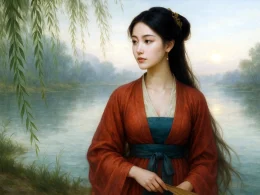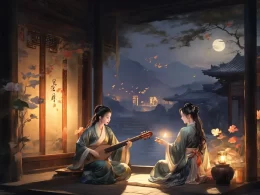



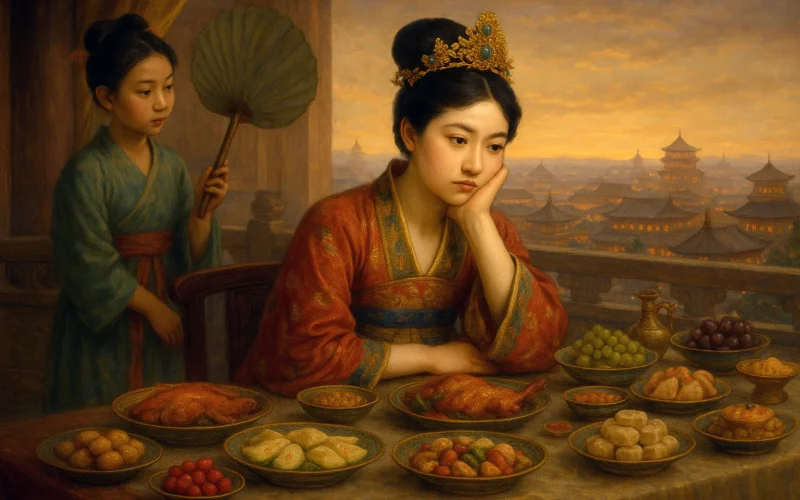
There lives a maiden from Luoyang right across the street,
She seems about fifteen, perhaps a little more.
While her lord rides his swift horse with bit and bridle of jade,
Her maid brings up the feast on plates of gold.

Her painted towers face vermilion mansions nearby;
Eaves blush with peach bloom and gleam with willow-green.
Silk canopies shade her carriage of seven scents,
And precious fans escort her to curtains of nine flowers.

Her lord, with rank and wealth and in youth’s early prime,
Outshines in lavishness the richest men of old.
He dotes on this low-born maid, has her taught to dance,
And gives away his coral trees as if they were mere twigs.

At break of dawn, when his nine soft lamps burn out —
Those lamps like petals linked in a flying chain —
She barely finishes a song between her dances,
And is dressed anew ere incense fills the air.
In town she knows only the rich and the prodigal;
Day and night she calls on masters of the gayest halls.

…But who pities the girl from Yue, with her jade-white face,
So humble, poor, alone, washing silk by the stream?
Original Poem
「洛阳女儿行」
王维
洛阳女儿对门居,才可容颜十五余。
良人玉勒乘骢马,侍女金盘脍鲤鱼。
画阁朱楼尽相望,红桃绿柳垂檐向。
罗帷送上七香车,宝扇迎归九华帐。
狂夫富贵在青春,意气骄奢剧季伦。
自怜碧玉亲教舞,不惜珊瑚持与人。
春窗曙灭九微火,九微片片飞花璅。
戏罢曾无理曲时,妆成祇是薰香坐。
城中相识尽繁华,日夜经过赵李家。
谁怜越女颜如玉,贫贱江头自浣纱。
Interpretation
This poem is a dazzling work of Wang Wei's youth, a satirical masterpiece that uses resplendent language as a blade to dissect the social inequities and spiritual barrenness festering beneath the prosperous surface of the High Tang. Composed around the time of his first arrival in Chang'an, brimming with ambition and vitality, the young poet displays astonishing precocious insight and sweeping narrative skill. He paints an extravagantly lavish panorama of aristocratic life, yet behind the dazzling colors lies a stark social critique and profound existential questioning. The entire poem resembles a grand but hollow spectacle; behind its opulent curtain echoes the heavy sigh of deep-seated anxiety for an era where values are inverted and souls impoverished.
First Couplet: 洛阳女儿对门居,才可容颜十五余。
Luòyáng nǚ'ér duìmén jū, cái kě róng yán shíwǔ yú.
A maiden of Luoyang dwells just across the way;
Her features fair, her years but slightly past fifteen.
The opening resembles a storyteller's beginning, simple yet artful. "Just across the way" establishes an intimate, almost voyeuristic observational perspective, implying this is not imagination, but the poet's firsthand witness of a privileged class's reality. "Her years but slightly past fifteen" highlights her youth, a time of infinite potential, which will later be portrayed as capital to be priced and squandered within a gilded cage. The emphasis on age sets up a powerful contrast for the critique to follow.
Second Couplet: 良人玉勒乘骢马,侍女金盘脍鲤鱼。
Liángrén yù lè chéng cōngmǎ, shìnǚ jīn pán kuài lǐyú.
Her lord rides a dappled steed with jade-adorned bridle;
His handmaid bears a golden plate of sliced carp fine.
The focus shifts from the maiden to her household, sketching its opulence with typical details. "Jade-adorned bridle" and "dappled steed" display the husband's noble status and dashing manner; "golden plate" and "sliced carp fine" speak of culinary luxury, alluding to the Book of Songs. Here, they become symbols of conspicuous consumption. The parallel couplet, covering the basic spheres of "travel" and "sustenance," instantly establishes this family's pinnacle material world.
Third Couplet: 画阁朱楼尽相望,红桃绿柳垂檐向。
Huà gé zhū lóu jìn xiāng wàng, hóng táo lǜ liǔ chuí yán xiàng.
Painted towers, vermilion mansions gaze at one another;
Peach blooms rosy, willows green trail towards the eaves.
The lens pulls back to show the macro view of their living environment. "Painted towers, vermilion mansions" suggest dense, lavish architecture; "Peach blooms rosy, willows green" imply manicured gardens and an illusion of perpetual spring. This is not just natural scenery, but an artificial paradise built with wealth, isolated from true nature. "Gaze at one another" hints at the internal rivalry and closed-circuit existence of this class.
Fourth Couplet: 罗帷送上七香车,宝扇迎归九华帐。
Luó wéi sòng shàng qī xiāng chē, bǎo shàn yíng guī jiǔ huá zhàng.
Silken drapes escort her to a coach of seven scents;
Jeweled fans welcome her back to a nine-flower tent.
This describes the ceremonial pomp of her comings and goings. "Escort her to" and "welcome her back" form a closed loop, implying a fixed, insulated life trajectory. "Coach of seven scents" and "nine-flower tent" emphasize the preciousness and exquisiteness of her possessions. This lifestyle of complete immersion in and encapsulation by rare objects marks the beginning of the loss of genuine life experience.
Fifth Couplet: 狂夫富贵在青春,意气骄奢剧季伦。
Kuángfū fùguì zài qīngchūn, yìqì jiāoshē jù Jì Lún.
Her wild young lord, in blooming youth, is rich and grand;
In pride and luxury, he rivals Ji Lun of old.
The focus shifts from objects to the man—her husband. The label "wild young lord" is sharply critical. "In blooming youth, is rich and grand" states a fact, also implying the satire of "virtue unequal to position." "Rivals Ji Lun" alludes to Shi Chong (style name Jilun) of the Western Jin, a historical byword for extravagance and ruin. This comparison confirms his prodigality and foretells the inherent unsustainability of such a life.
Sixth Couplet: 自怜碧玉亲教舞,不惜珊瑚持与人。
Zì lián bìyù qīn jiào wǔ, bùxī shānhú chí yǔ rén.
She pities her jade-self, teaching dances to her maids;
Spares not the coral trees she gives to show her hand.
This delves into the mistress's mental state and behavior. "Pities her jade-self" shows distorted self-perception and vacuous self-absorption; "teaching dances" degrades art into a tool for amusement. "Spares not the coral trees" vividly paints her shallow vanity and arrogance in treating profligacy as honor and wealth as her sole social currency, echoing the "rivals Ji Lun" above.
Seventh Couplet: 春窗曙灭九微火,九微片片飞花璅。
Chūn chuāng shǔ miè jiǔ wēi huǒ, jiǔ wēi piàn piàn fēi huā suǒ.
By her spring window, dawn extinguishes the nine-flame light;
Nine-flame sparks fly like falling, trivial petals bright.
This couplet, with its gorgeous yet decaying imagery, hints at a life of reversed days and nights and spiritual decay. "Dawn extinguishes" reveals all-night revelry; "nine-flame light" is a palace lamp, symbolizing the mimicry of courtly life and its illusion. "Fly like falling, trivial petals" metaphorically suggests the trivial, illusory, and soon-to-fade nature of this opulent existence.
Eighth Couplet: 戏罢曾无理曲时,妆成祇是薰香坐。
Xì bà céng wú lǐ qǔ shí, zhuāng chéng zhǐ shì xūn xiāng zuò.
Past playful games, no time to practice melody or song;
Once fully adorned, she merely sits where incense coils.
This directly points to the extreme poverty of their spiritual world. "Past playful games" and "once fully adorned" are the core, repetitive "occupations" of their days; "no time to practice melody" indicates a lack of genuine artistic cultivation or inner pursuit; "merely sits where incense coils" is the ultimate portrait of a hollow soul within a splendid shell—beyond consumption and display, life holds nothing else.
Ninth Couplet: 城中相识尽繁华,日夜经过赵李家。
Chéng zhōng xiāngshí jìn fánhuá, rìyè jīngguò Zhào Lǐ jiā.
Within the town, her company is all pomp and show;
By day, by night, she visits houses of Zhao and Li.
This outlines the insular, homogenous nature of her social circle. "All pomp and show" means social interaction is based entirely on wealth and status; "by day, by night" shows a busy yet empty social calendar; "houses of Zhao and Li" alludes to powerful consort families of the Han dynasty, referring to the top echelon while subtly implying a historical analogy and warning about lives built on transitory power and hollow splendor.
Final Couplet: 谁怜越女颜如玉,贫贱江头自浣纱。
Shuí lián Yuè nǚ yán rú yù, pínjiàn jiāngtóu zì huànshā.
Who pities now the girl of Yue, whose face is jade-fair,
Yet poor, by the riverbank, must wash the gauze alone?
The poem concludes abruptly with this earth-shattering contrast, the climax of its theme and the locus of the poet's compassion. The "girl of Yue" contrasts with the "maiden of Luoyang"; "whose face is jade-fair" contrasts with "her features fair"; "poor, by the riverbank, must wash the gauze alone" contrasts with the extreme luxury detailed before. This is not merely a class contrast, but a cruel interrogation of value and fate: true beauty ("face is jade-fair") and virtue are buried and ignored due to poverty, while hollow opulence occupies society's center and attention. The two words "Who pities" are the poet's indignant question on behalf of the silent multitude, a cold indictment of the entire social value system turned upside down.
Holistic Appreciation
This is a grandly structured, brilliantly penned, and sharply conceived "warning for a prosperous age." The poem reads like a miniature epic. The first eighteen lines employ the descriptive techniques of fu poetry to lavishly depict every facet of the Luoyang maiden's life: her looks, family, residence, carriage, husband, entertainment, social circle… Like a precise sociological camera, it scans the complete panorama of this privileged class's material existence. Yet, this description is not admiration, but a careful accumulation of potential energy for the final critique.
Wang Wei's brilliance lies in avoiding simple moralizing. Through highly objective, even appreciative-seeming description, he lets the hollowness of the luxurious life and the spiritual barrenness of its people reveal themselves. Only in the final two lines does the poet, using the image of the "girl of Yue," pierce the bubble of vanity like a sharp sword. Through this stark contrast, he reveals the nature of social injustice and the profound crisis beneath the splendor. This structure of "elaborate description—sudden turn" generates tremendous artistic shock and intellectual force.
Artistic Merits
- Synthesis of Descriptive Exposition and Poetic Critique: The poem extensively uses the enumerative techniques of fu (e.g., "painted towers, vermilion mansions," "peach blooms rosy, willows green," "silken drapes… jeweled fans"), with resplendent diction and dense imagery, constructing a dizzying world of objects. This gorgeous form itself becomes an ironic critique of its own hollow content.
- Deepening Effect of Dual Allusions: The allusions to "Ji Lun" and the "houses of Zhao and Li" are not for scholarly display, but to introduce a historical dimension for analogy and warning, suggesting such arrogance and extravagance are age-old and often lead to ruin, thereby deepening the poem's critical gravity.
- Symbolic Detail and Psychological Insight: Details like "teaching dances," "merely sits where incense coils," "nine-flame sparks fly like falling petals" transcend surface description to reveal the characters' psychology of being alienated by material desire, spiritually vacant and bored, possessing the depth of psychological portrayal found in modern fiction.
- Ultimate Impact of Contrastive Structure: The vast majority of the poem describes the "maiden of Luoyang," the final two lines the "girl of Yue." This is not merely a contrast in length, but a chasm in fate, value, and societal attention. This imbalanced structural design is, in itself, the most powerful expression of the poem's theme.
Insights
This work is a mirror spanning a millennium, reflecting not only the rigid class stratification and spiritual crisis of Tang society but also phenomena possible in any age: material prosperity alongside spiritual poverty, surface glamour masking inner emptiness, social injustice coupled with distorted values. It warns us: a society that worships only the wealth and status represented by "jade-adorned bridles" and "golden plates of sliced carp," while ignoring the talent, virtue, and fairness embodied by those with "faces of jade" who must "wash the gauze alone," builds its prosperity on fragile, dangerous ground.
For the individual, this poem poses a profound question about life's value: Do we pursue a "life-spectacle" of being wrapped and displayed, like the "coach of seven scents" and "nine-flower tent," or do we, like the "girl of Yue," preserve our authentic value and life dignity ("face of jade") even by the "riverbank"? The insight and compassion Wang Wei displayed in this poem, written around age eighteen, can still strike at the spiritual maladies of our own time, reminding us, amidst the torrent of materialism, not to forget the pursuit of fairness and the care of the soul.
Poem translator
Kiang Kanghu
About the poet
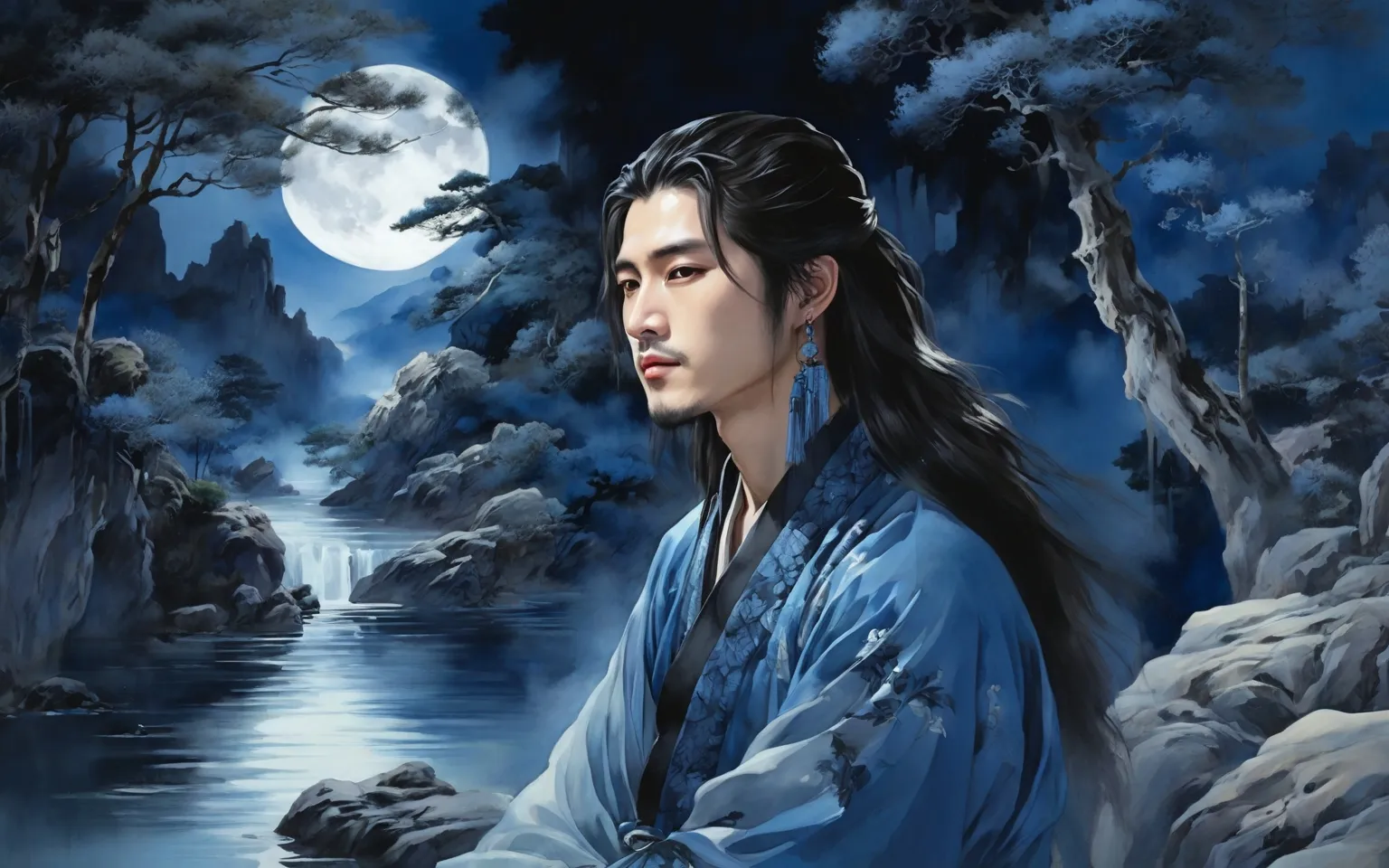
Wang Wei (王维), 701 - 761 A.D., was a native of Yuncheng, Shanxi Province. Wang Wei was a poet of landscape and idylls. His poems of landscape and idylls, with far-reaching images and mysterious meanings, were widely loved by readers in later generations, but Wang Wei never really became a man of landscape and idylls.