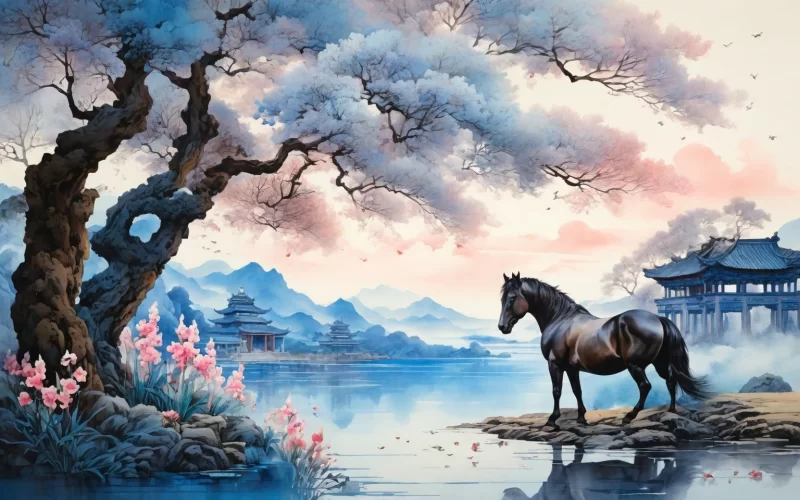



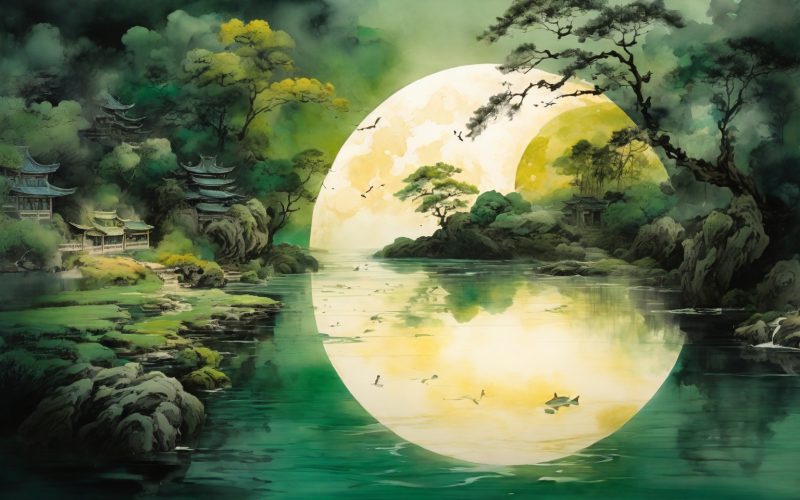
The eyebrow-like cool moon hangs over Willow Bay,
The southern mountains seem in the mirror to sway.
Three days rain's fallen with peach petals on the stream;
At midnight on the beach leap the fish, carp and bream.
Original Poem
「兰溪棹歌」
戴叔伦
凉月如眉挂柳湾,越中山色镜中看。
兰溪三日桃花雨,半夜鲤鱼来上滩。
Interpretation
This poem was composed by the Mid-Tang poet Dai Shulun during his travels in the Jiangnan region. Lanxi, located in present-day Lanxi City, Zhejiang Province, lies in the middle reaches of the Qiantang River. Known for its clear waters and picturesque banks, it has long been a place of lingering charm for literati. Dai Shulun’s official career was fraught with setbacks—he served as magistrate of Dongyang and prefect of Fuzhou, among other posts—yet he developed a deep familiarity with the scenery and customs of Jiangnan. During the Mid-Tang period, though the Tang Empire had declined from its peak after the An Lushan Rebellion, the Jiangnan region remained relatively stable, with its economy and culture still flourishing. The daily life of fishing villages along the waterways continued to thrive with vitality. Immersed in this setting, hearing the boatmen’s songs and beholding the beauty of the landscape, the poet captured the quiet of a spring night on Lanxi and the joy of the fishermen in a fresh, lively style. "Zhaoge" refers to folk songs sung by boatmen while rowing, and the title itself highlights the poem’s strong folk-song character. Dai Shulun intentionally drew upon the expressive techniques of Southern Dynasty folk songs, using simple, natural language to depict local scenery and convey his affection for ordinary life, making this poem a model of Tang literati learning from folk traditions.
First Couplet: "凉月如眉挂柳湾,越中山色镜中看。"
Liáng yuè rú méi guà liǔ wān, Yuè zhōng shān sè jìng zhōng kàn.
A cool moon, like an eyebrow, hangs over the willow-lined bay;
The hills of Yue are mirrored, as in a glass, for eyes to gaze upon.
The opening line, "a cool moon like an eyebrow," is a stroke of genius. The poet compares the slender crescent moon to a woman’s arched brow, capturing not only the moon’s delicate form but also imbuing the moonlight with a gentle emotional warmth. The word "cool" conveys both the physical chill of a spring night and a sensory experience steeped in moonlight—this coolness is not a desolate cold, but the refreshing coolness after a spring rain, the clear, crisp coolness unique to waterside nights. The phrase "hangs over the willow-lined bay" is especially exquisite: the moon is in the sky, yet seems to hang from the willow branches, as if placed there by nature’s hand, blending sky and shore into one.
The second line, "The hills of Yue are mirrored, as in a glass, for eyes to gaze upon," shifts the gaze from above to below. Instead of directly describing the verdant hills or clear water, the poet uses "mirror" to metaphorize the stream, suggesting its calm and clarity. "Mirrored, as in a glass, for eyes to gaze upon" carries a dual charm: first, the reflection of the hills in the water creates a dreamlike symmetry between reality and illusion; second, the subject who "gazes" could be the poet, the moon in the water, a person by the stream, or even the reader themselves—this openness of perspective makes everyone feel as if standing by the stream, contemplating the landscape washed clean by moonlight. The first two lines depict stillness, yet within that stillness there is motion: the moon hanging over the bay is a static image, while "gazing into the mirror" implies the shifting of the gaze and the wandering of the mind.
Second Couplet: "兰溪三日桃花雨,半夜鲤鱼来上滩。"
Lán xī sān rì táo huā yǔ, bàn yè lǐ yú lái shàng tān.
For three days on Lanxi, peach-blossom rain has fallen;
At midnight, carp come leaping up the sandy shore.
The latter couplet shifts from stillness to motion, instantly animating the scene. "Peach-blossom rain" not only indicates the season—mid-spring when peach blossoms bloom—but also alludes to the folk wisdom of "peach-blossom flood": spring rains raise the water, and rising waters draw fish leaping. Instead of stating "spring waters rise," the poet says "peach-blossom rain," merging natural phenomena with seasonal beauty, endowing the rain with color and poetry.
The most marvelous touch is "at midnight, carp come leaping up the sandy shore." In the deep quiet of midnight, when all is silent, the sound of carp breaking the water is like a stone cast into a still lake, shattering the night’s silence and animating the entire scene. "Leaping up the shore" is vividly dynamic and pictorial: we can almost see the silvery scales glinting as the fish churn in the moonlight, hear the clear splash of water, and sense the irrepressible vitality in the surging spring currents. The poet does not mention the fishermen, yet their delight at dawn is already implied; he does not speak of life’s vigor, yet that vigor bursts forth from between the lines.
Viewed as a whole, the first two lines present a "realm of stillness," composing an ink-wash painting with moon, willows, hills, and water; the latter two lines form a "realm of motion," a hymn to life with rain, fish, shore, and night. The stillness is the backdrop of Lanxi’s night scene; the motion is the vibrant brilliance of nature’s rhythms. Between motion and stillness, the poet completes both a pilgrimage to the beauty of landscape and a tribute to the power of life.
Holistic Appreciation
This is a fresh, elegant riverscape painted by the Mid-Tang poet Dai Shulun. The poem begins with the "moon" and ends with the "fish." In just four lines and twenty-eight characters, it sketches both the tranquil beauty of a spring night on Lanxi and captures the vibrant pulse of nature’s rhythms, reading like a folk song flowing with the sounds of water and moonlight. With minimalist brushstrokes, the poet constructs an artistic world where reality and illusion, motion and stillness intertwine, allowing the reader, in these few words, to glimpse the unique charm and vitality of the Jiangnan waterlands.
Artistic Features
- Fresh, Vivid Imagery, Natural and Unforced Metaphors: "A cool moon like an eyebrow" transforms an astronomical phenomenon into an intimate aesthetic image, both vivid and apt, and filled with tender affection. "Mirrored, as in a glass" uses an everyday object to describe a natural scene, making the abstract beauty of the hills tangible. These metaphors, though unadorned, are precise and evocative, demonstrating the poet’s superb ability to capture the spirit of nature.
- Dynamic Interplay of Motion and Stillness, Rich Layering of Imagery: The first two lines emphasize stillness, the latter two abruptly shift to motion. Yet upon closer reading, stillness contains motion (the implied shifting gaze in "mirrored, as in a glass, for eyes to gaze upon"), and motion contains stillness ("midnight" marks the depth of a quiet night). This dialectic of motion and stillness allows the poem to maintain the harmony of its overall atmosphere while creating an internal aesthetic tension.
- Emotion Conveyed Through Scene, Meaning Born from Suggestion: The entire poem does not directly mention a single person, yet human presence is everywhere. The moon’s soft beauty is a beauty projected by the human heart; the fish’s joyous leaping is a joy anticipated by the human heart. The poet completely submerges his own feelings behind the scenery, letting the scenery itself become the vessel for emotion, so that while savoring the landscape, the reader naturally develops a yearning and love for the life of fishermen and the beauty of nature.
- Simple, Fluent Language, Strong Folk-Song Flavor: "Zhaoge" originally refers to songs sung by boatmen while rowing, possessing a distinct folk-literary character. The language of this poem is fresh and natural, its lines rhythmically varied, making it highly recitable. It retains the subtle elegance of literati poetry while preserving the liveliness and sincerity of folk songs, a model of perfect fusion between literati creation and folk tradition.
Insights
This poem reveals a simple yet profound truth: Poetry does not lie in distant places; it is hidden in the most ordinary corners of daily life. That "cool moon," that "peach-blossom rain," those carp leaping onto the shore at midnight—all are utterly ordinary sights and occurrences in a waterside village. Yet in the poet’s eyes, they form a complete, self-sufficient poetic world. This teaches us: the core of aesthetic sensibility is not seeking rare wonders, but learning to gaze at everything around us with an eye for beauty. Why is the moon beautiful? Not because of its brightness, but because its eyebrow-like curve stirs soft feelings in our hearts. Why are the fish delightful? Not because they are rare, but because of the burst of life-force in the moment they leap from the water.
On a deeper level, this poem also teaches us how to understand the relationship between humanity and nature. The people in the poem never appear, yet are everywhere—the moon is beheld by people, the hills are seen by people, the fish are awaited by people. This "writing by not writing" precisely articulates the supreme realm of "unity of heaven and humanity" in traditional Chinese aesthetics: humans are not conquerors of nature, nor mere observers, but part of nature itself; human emotions and natural rhythms echo and fulfill one another.
True poetry never belongs to somewhere far away; it belongs to those hearts willing to discover the extraordinary within the ordinary.
Poem translator
Xu Yuanchong (许渊冲)
About the Poet
Dai Shulun (戴叔伦), 732 - 789 AD, was a native of Jintan, Jiangsu Province. During the Anshi Rebellion, he lived in Poyang and studied behind closed doors, and was later recruited by Liu Yan to serve in the Transit House. Dai Shulun's poems mostly express the leisure of a secluded life, and there are also some poems exposing social contradictions and reflecting the people's hardships, with a broader content, and his poetic style is elegant and clear.