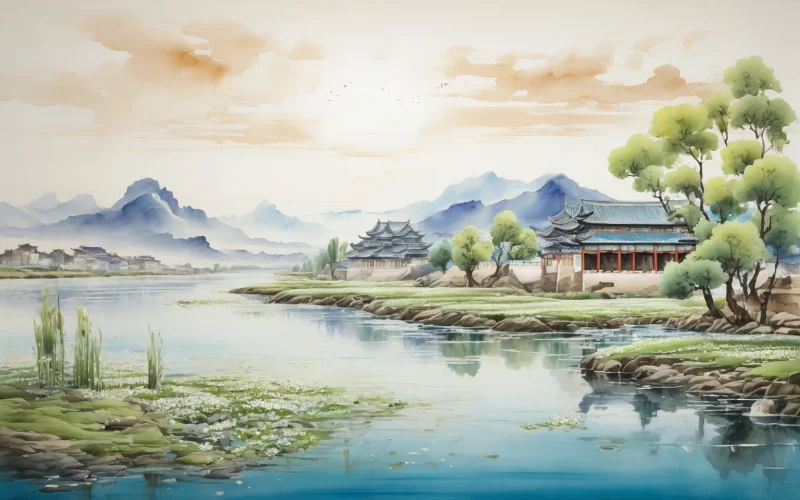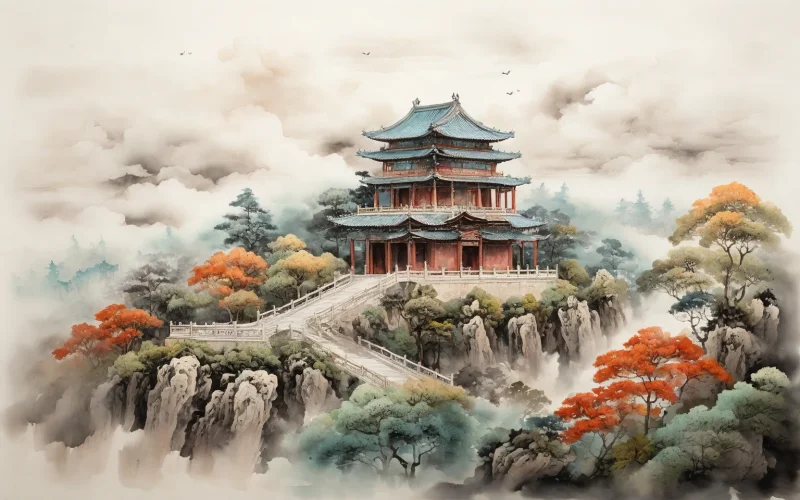



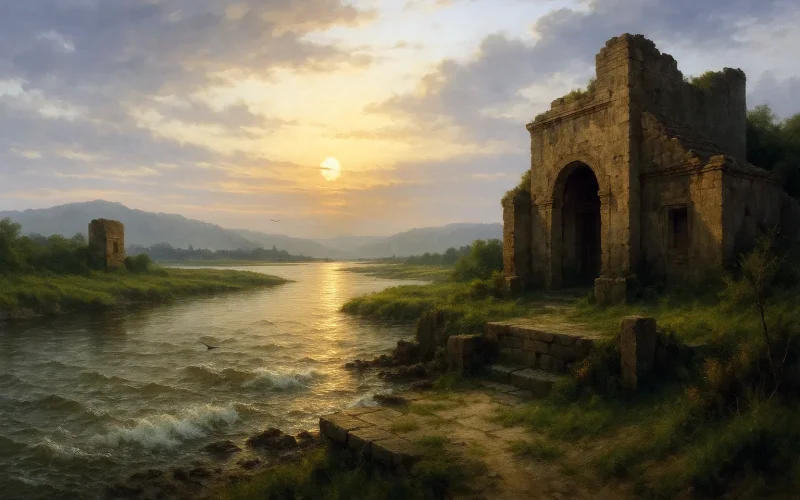
The tide overwhelms the forge's site,
The tower drowned in slanting sunlight.
The islet covered with grass green,
And hills are veiled by a smoke screen.

Man decides a state's rise and fall,
Hills and streams can do nothing at all.
O hear the captive ruler's song!
How can you bear his grief for long?
Original Poem
「金陵怀古」
刘禹锡
潮满冶城渚,日斜征虏亭。
蔡洲新草绿,幕府旧烟青。
兴废由人事,山川空地形。
后庭花一曲,幽怨不堪听。
Interpretation
This poem was composed in the third year of the Baoli era (827 AD), when Liu Yuxi was fifty-six. Having completed his tenure as the Regional Inspector of He Prefecture, he was traveling north to Luoyang and passed through Jinling (modern-day Nanjing). Jinling, the former capital of the Six Dynasties (Eastern Wu, Eastern Jin, Song, Qi, Liang, and Chen), had witnessed three centuries of dynastic rise and fall. Sailing past places laden with historical memory—Ye City, Zhenglu Pavilion, Cai Islet, Mufu Mountain—Liu Yuxi felt the echoes of those vanished dynasties mingle with his concerns about the Tang dynasty's visible decline.
By then, Liu Yuxi had endured the failure of the Yongzhen Reform, a decade of exile in Lang Prefecture, and further postings to the distant Lian, Kui, and He Prefectures. A life of such hardship had sharpened his sensitivity to the words "rise and fall" far beyond the ordinary. Standing by the river in Jinling, he saw not just green spring grass and lingering haze, but the trajectory of dynasties from zenith to collapse. "States rise or fall by human deed alone; / In vain the strategic pass, the hill, the stone." This was not merely an elegy for the Six Dynasties, but a warning to the rulers of his own time, and a summation of his own life's journey.
First Couplet: "潮满冶城渚,日斜征虏亭。"
Cháo mǎn Yě chéng zhǔ, rì xié Zhēnglǔ tíng.
The tide now floods the isle by Ye City's site;
The sun slants o'er the Tower for General's delight.
The opening lines juxtapose two historical sites. "Ye City" was an ancient metallurgy center dating back to the Spring and Autumn period and a strategic commandery in the Eastern Jin. "Zhenglu Pavilion" was built by the Eastern Jin General Xie An. The poet describes not their former glory, but only the present-day tide and setting sun. The tide's eternal ebb and flow mirrors time's cycle; the daily setting sun symbolizes inevitable dynastic decline. "Floods" and "slants"—one rising, one falling; one in motion, one still—superficially depict scenery, but fundamentally convey time's relentless passage.
Second Couplet: "蔡洲新草绿,幕府旧烟青。"
Cài zhōu xīn cǎo lǜ, Mùfǔ jiù yān qīng.
On Cai Islet, fresh grass spreads emerald-green;
O'er Mufu Mount, old mist hangs blue, serene.
"Fresh grass spreads emerald-green" is spring's punctual, unchanging gift. "Old mist hangs blue" describes the perennial haze over the mountains. Placed side by side, these images convey nature's timeless, cyclical constancy. Yet this very "unchanging" quality throws the mutability of "human affairs" into sharp relief. The once-mighty figures of the Six Dynasties are long gone, buried by the ever-green grass and scattered by the eternal mist. The poet states no "fall," no "emptiness"—only the green grass and blue haze—leaving the weight of history for the reader to feel.
Third Couplet: "兴废由人事,山川空地形。"
Xīng fèi yóu rénshì, shānchuān kōng dìxíng.
States rise or fall by human deed alone;
In vain the strategic pass, the hill, the stone.
This couplet is the poem's ideological core. In the starkest terms, Liu Yuxi proclaims a historical truth: A dynasty's fate is determined not by the natural barrier of the Yangtze or the fortress of Stone City, but by the virtue and actions of its rulers. The word "in vain" is key. All Six Dynasties possessed the Yangtze's strategic advantage, yet all fell. History proves terrain is "vain"—only "human deeds" are substantive. This is not just historical commentary but a pointed warning. Since the Mid-Tang, the court had been weakened by rebellious military governors, powerful eunuchs, factional strife, and deepening corruption. Gazing at Jinling's "vain" terrain, the poet seems to ask: what does our present court rely upon?
Fourth Couplet: "后庭花一曲,幽怨不堪听。"
Hòutínghuā yī qǔ, yōuyuàn bùkān tīng.
The song "Backyard Flowers" with its plaintive air
Is more than any fragile heart can bear.
"Backyard Flowers" refers to "Jade Trees and Backyard Flowers," a song composed by the last emperor of the Chen dynasty, historically condemned as a "decadent tune that doomed a state." Indulging in pleasure and neglecting governance, that ruler led Chen to ruin. Liu Yuxi invokes this tune not for nostalgic effect, but to thrust the lesson of the Six Dynasties directly before his contemporaries. "Is more than… can bear" speaks of the song's mournful quality, but even more, of the anguish in seeing history repeat. The people of the Six Dynasties heard it; the last emperor of Chen heard it. Are the rulers of Tang listening now? Must they, too, fail to hear the warning within "States rise or fall by human deed alone"?
Holistic Appreciation
This is perhaps the most philosophically incisive of Liu Yuxi's poems on the past. Its eight lines divide clearly: the first four describe scenery, the last four present argument. The description focuses solely on place names steeped in history, yet the touch is light—flooding tide, slanting sun, green grass, blue haze. No line explicitly mourns, yet the desolation of history emanates from the scenery itself. The argument is direct and powerful: "States rise or fall by human deed alone; / In vain the strategic pass, the hill, the stone." These ten words carry the weight of a political treatise.
This poem's distinction lies in it being not merely a "meditation on the past" but a "discourse on history." Liu Yuxi is not merely sighing; he is distilling a principle. He compresses three centuries of dynastic cycles into a single, stark maxim, which he then, as it were, presents to the rulers of his day. The final couplet's reference to "Backyard Flowers" sharpens the critique. The last Chen emperor is forever shamed by a song, but was the cause of ruin the song or the decadence it represented? Liu Yuxi does not spell it out, for the answer lies in "human deed alone."
Stylistic Features
- Direct Conjunction of Scene and Argument: The first four lines are pure description, the last four pure argument, with no transitional device. This seemingly abrupt structure is potent—the poet lets the scenery speak, then states the conclusion plainly. This is not clumsy technique but the clearest expression of a powerful idea.
- Historically Encoded Place Names: Ye City, Zhenglu Pavilion, Cai Islet, Mufu Mountain—each name carries a specific historical legacy. The poet does not explain but simply presents them, letting their weight resonate with those who know.
- Philosophical Distillation of "Vain Terrain": The poem's most brilliant phrase is "in vain the strategic pass." It does not deny terrain's tactical value but establishes a hierarchy: human action is primary; geography is secondary. This judgment is concise, hard, and incontrovertible.
- Allusion as Direct Critique: The allusion to "Backyard Flowers" is common in classical poetry, but here Liu Yuxi uses it not just for historical color but as a direct warning to his era. It transforms the line from nostalgic reflection into contemporary satire.
- Parallelism with a Hard Edge: "On Cai Islet, fresh grass spreads emerald-green; / O'er Mufu Mount, old mist hangs blue, serene." "Fresh" parallels "old"; "grass…green" parallels "mist…blue." The parallelism is precise yet unadorned, its austere quality matching the poem's intellectual rigor.
Insights
This poem teaches: Do not blame external conditions for failure; seek the cause within. The Six Dynasties possessed the formidable Yangtze, yet fell one by one. Liu Yuxi states it clearly: terrain, in the end, is "vain." However strong the defenses, they cannot compensate for human failure. This truth applies to states and to individuals alike.
Another line to remember is "more than any fragile heart can bear." The last emperor of Chen surely found his "Backyard Flowers" beautiful. He did not understand that beauty could destroy a state. Listening to the same tune three centuries later, Liu Yuxi heard its plaintive notes as a tolling bell. He passes that warning on. If later generations also fail to hear, it signals the start of the next "Backyard Flowers." When Liu Yuxi wrote this, the Tang was in decline. He did not know it would last another eighty years, but he knew its fate hinged on "human deed alone," not heavenly mandate. This was the hard, unwavering conviction of a lifetime.
Poem translator
Xu Yuanchong (许渊冲)
About the poet
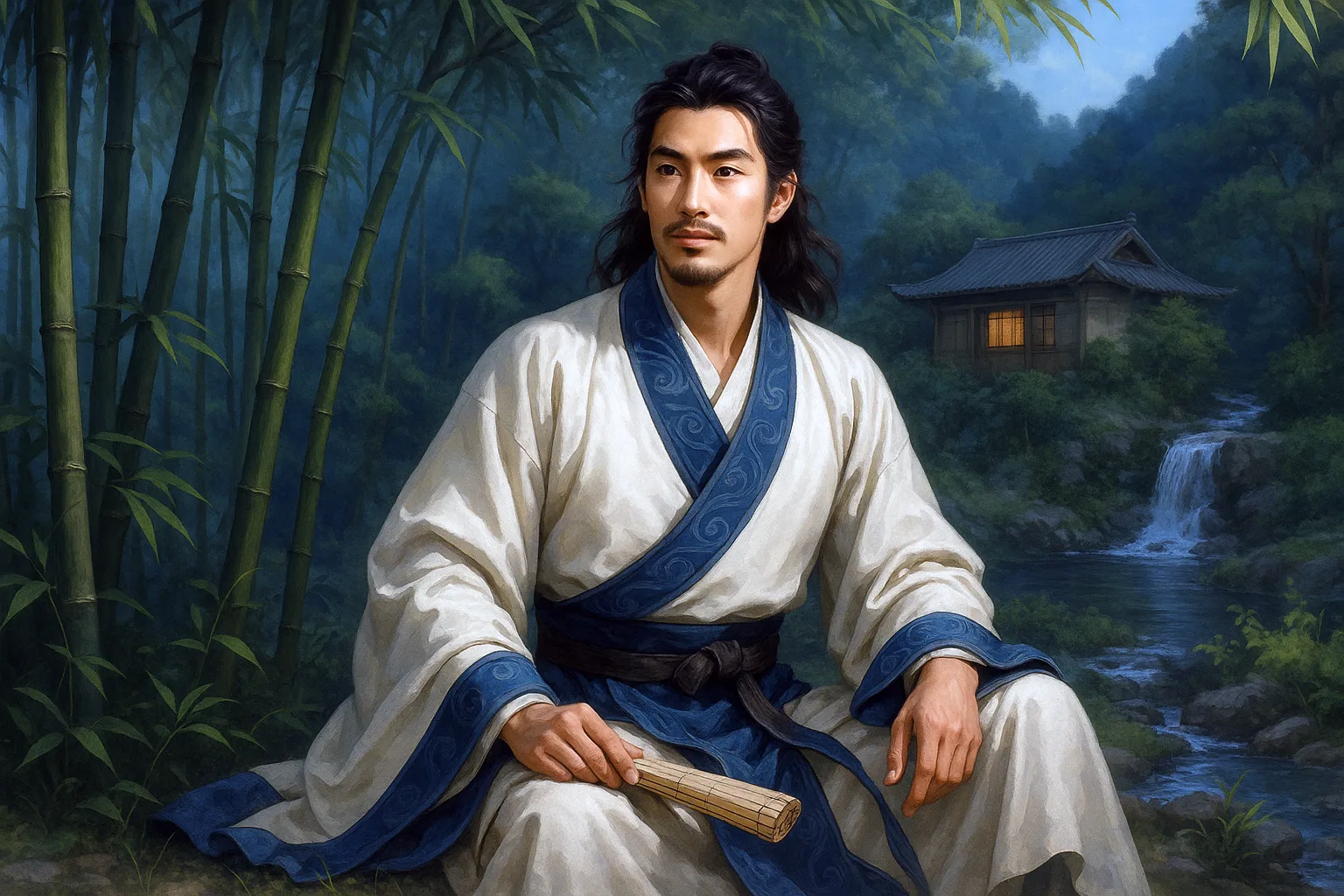
Liu Yuxi(刘禹锡), 772 - 842 AD, was a native of Hebei. He was a progressive statesman and thinker in the middle of the Tang Dynasty, and a poet with unique achievements in this period. In his compositions, there is no lack of poems reflecting current affairs and the plight of the people.