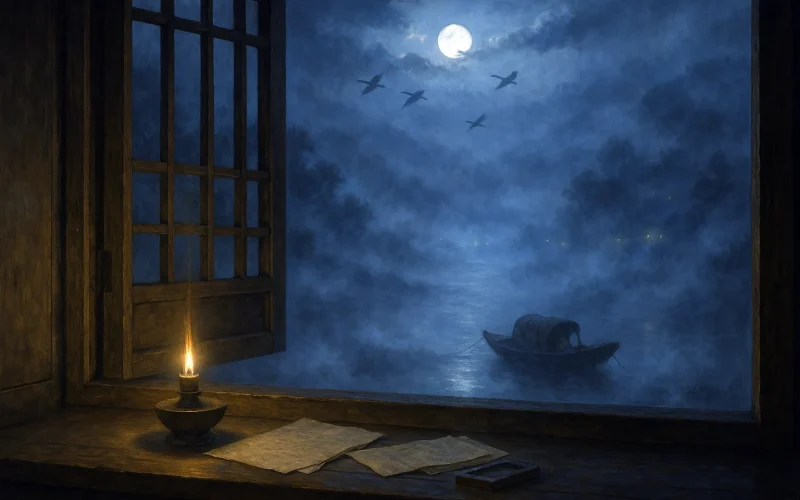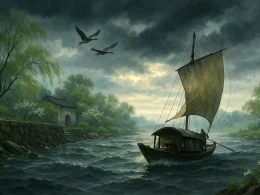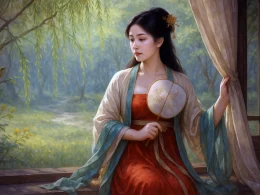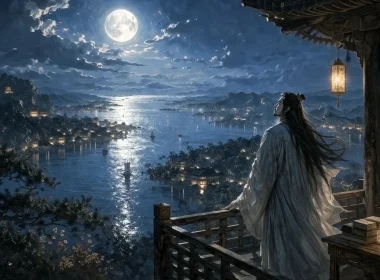
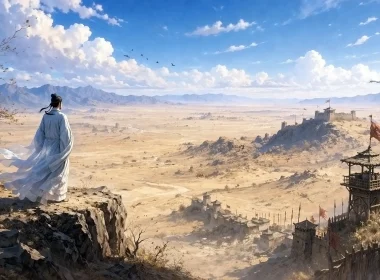
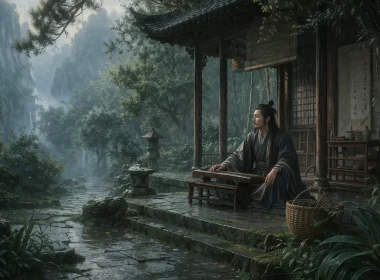
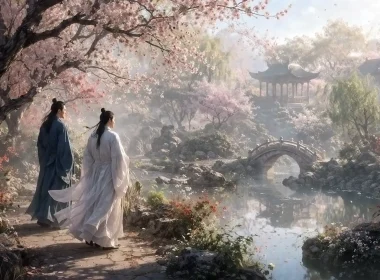
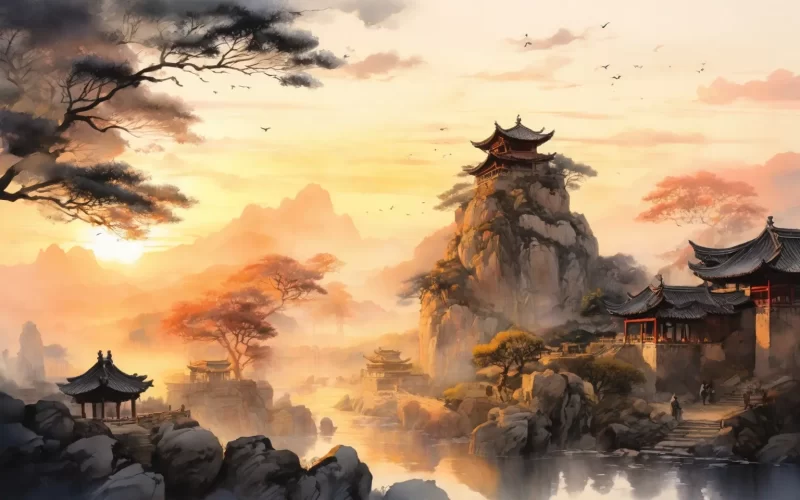
Gone with the scented dust is all the garden’s pride;
The careless stream still flows, spring grass grows green aside.
At dusk the east wind grieves o’er birds’ unjust refrain;
The falling blooms recall the maid who leaped in vain.
Original Poem
「金谷园」
杜牧
繁华事散逐香尘,流水无情草自春。
日暮东风怨啼鸟,落花犹似坠楼人。
Interpretation
This poem was composed during Du Mu's service in Luoyang (likely while holding the post of Investigating Censor or shortly thereafter), a period when the poet, in his intellectual prime, was developing increasingly profound reflections on history and human existence. The Golden Valley Garden was a legendary pleasure park built by Shi Chong, an immensely wealthy aristocrat of the Western Jin Dynasty. It once represented the pinnacle of luxury, and its splendor and its attendant tragedy—Shi Chong was executed in a political purge, and his beloved concubine, Green Pearl, leapt to her death from a tower to preserve her fidelity—had long since solidified within Luoyang's historical consciousness as a defining cultural symbol. When Du Mu wandered these ruins, all he saw was overgrown grass and flowing water, yet what he felt was a spiritual dialogue spanning over three centuries, centered on themes of extravagance, loyalty, and destruction.
The poem's creation exemplifies a hallmark of Du Mu's historical contemplation poetry. He does not merely lament the physical ruins but forges a potent poetic link between the most arresting moment from the historical tragedy (Green Pearl's fatal leap) and the most evocative natural phenomenon before his eyes (the blossoms falling at dusk). This technique allows the historical "effect" (present desolation) and its "cause" (past splendor and fatal resolve) to develop simultaneously within the same contemplative space. The story of the Golden Valley Garden encompasses ultimate wealth, aesthetic decadence, political brutality, and personal constancy. By choosing it as his subject, Du Mu's reflections transcend a simple lament over dynastic change to touch upon the fragility and tragic beauty inherent in all things of beauty—whether lavish gardens or peerless individuals—when confronted by historical violence and the inexorable passage of time.
First Couplet: 繁华事散逐香尘,流水无情草自春。
Fánhuá shì sàn zhú xiāng chén, liúshuǐ wúqíng cǎo zì chūn.
All pomp and revelry dispersed, gone with the fragrant dust; The heartless stream flows on, grass greens in its own spring trust.
The opening lines employ a historian's concise brush to summarize the cycle of prosperity and ruin. "All pomp and revelry dispersed" states the outcome directly, while "gone with the fragrant dust" renders the process through poetic imagination. Shi Chong famously had powdered precious incense spread on an ivory bed for his concubines to tread upon, rewarding those who left no footprint with pearls. This epitome of extravagance, the "fragrant dust," becomes here a masterful metaphor for all worldly glory and desire vanishing into emptiness. The following line turns toward eternal nature: "The heartless stream flows on" symbolizes time's impassive march; "grass greens in its own spring trust"—the phrase "its own" expresses the vegetation's complete indifference and the constant, autonomous cycle of the natural world. The dramatic upheavals and clamor of human affairs appear especially transient and illusory against this backdrop of timeless, impersonal rhythm. This couplet contrasts "dispersed" with "greens," and the insubstantiality of "gone with the fragrant dust" with the tangible reality of "grass greens in its own spring trust," establishing a tone of bleak philosophical observation.
Final Couplet: 日暮东风怨啼鸟,落花犹似坠楼人。
Rìmù dōngfēng yuàn tí niǎo, luòhuā yóu sì zhuì lóu rén.
At sunset, in the east wind, plaintive seems the birds' lament; The falling blossoms yet recall the fair one from the tower sent.
The poet's emotion coalesces and intensifies within the twilight. "At sunset" casts the scene in a vast, melancholy light. "The east wind," typically a bearer of spring, is here connected to "plaintive seems the birds' lament," imbuing both the wind's sound and the birds' cries with a quality of sorrow. This is the poet powerfully projecting subjective feeling onto the objective scene, creating an atmosphere where heaven and earth seem to share a pervasive grief. The final line is the poem's climactic stroke, a brilliant associative leap. "The falling blossoms" are the tangible reality before him, the inevitable fading of spring's glory. "The fair one from the tower sent" is the historical allusion, the outcome of Green Pearl's fatal act of loyalty. The poet connects the two with the phrase "yet recall." This not only finds a perfect vessel for his emotional focus but accomplishes a profound symbolic transference: Green Pearl's life was as beautiful and brief as a blossom, and her fall was as decisive and heartbreakingly poignant as petals dropping. The drifting falling blossoms thus become a poetic symbol of life's tragedy, echoing poignantly across time.
Holistic Appreciation
This heptasyllabic quatrain stands among Du Mu's most poignantly beautiful and artistically seamless poems on historical themes. It skillfully eschews direct commentary, instead guiding the reader on an aesthetic journey from historical recognition to emotional resonance via a meticulously chosen chain of imagery.
The poem's structure follows a refined progression of "general statement — specific focus — symbolic fusion." The first couplet offers a general statement on vanished splendor and nature's indifference, presenting a macroscopic historical-philosophical perspective. The final couplet zooms into specific, emotionally charged images: the sorrowful birds at dusk and the blossoms recalling the fatal leap. The line "The falling blossoms yet recall the fair one from the tower sent" perfectly fuses the preceding natural imagery (falling blossoms) with the historical human event (the leaping beauty), achieving a state of perfect integration where scene and sentiment, past and present, become indivisible. Within the poem, images like "fragrant dust," "flowing stream," "spring grass," "plaintive birds," and "falling blossoms" are all common in classical poetry. However, Du Mu organizes and illuminates them with masterfully chosen words like "gone with," "its own," "plaintive seems," and "yet recall," weaving them together into a unique imaginative fabric, resonant with historical echoes and profound mortal sorrow.
Artistic Merits
- A Two-Tiered Construct of Imagery: The poem's imagery operates on two levels: a "natural layer" (fragrant dust, flowing stream, spring grass, sunset, east wind, birds, falling blossoms) and a "historical-human layer" (pomp and revelry, the leaping beauty). Du Mu's genius lies not in merely juxtaposing them but in having the natural imagery bear the weight of and articulate the historical-human content. For instance, "fragrant dust" metaphorically represents past splendor, and "falling blossoms" allude to Green Pearl. This grants the abstract sense of historical change and the specific tragic figure tangible, poetic form.
- The Emotional Dialectic of "Heartlessness" and "Feeling": The line "The heartless stream flows on, grass greens in its own spring trust" describes the "heartlessness" of natural law, while "plaintive seems the birds' lament" and "falling blossoms yet recall the fair one" express the "feeling" projected by the poet and, by extension, perceived in nature. This contrast reveals the poet's dual awareness: a clear-eyed recognition of history's inevitable effacement within nature's indifferent timeline (heartlessness), coexisting with an irrepressible impulse to infuse the specific beauty and tragedy of that history with deep sympathy and remembrance (feeling). This tension is a key source of the poem's emotive power.
- Subtle Mastery of Diction and Synesthesia: The verb phrase "gone with" lends "all pomp and revelry dispersed" a dynamic sense of motion and direction, as if one can see glory scattering like smoke. "Its own" highlights nature's utter detachment, throwing the futility of human endeavor into sharp relief. "Plaintive seems" infuses the auditory scene with emotion—a skillful use of synesthesia. "Yet recall" serves as the crucial hinge of association, simple yet precise, bridging object and observer, present and past.
- Concentrated Expression of Tragic Beauty: This poem can be viewed as a distilled expression of classical Chinese "tragic beauty." It contains the core elements of tragedy: past perfection (the splendid Garden, the peerless Green Pearl), inevitable destruction (dispersion, the fatal leap), and the desolate remnants and endless reflection left in destruction's wake. By likening the falling blossoms to the leaping beauty, the poet transforms a violent death into a heartbreakingly beautiful fading, sublifting grief into a deeply moving aesthetic realm.
Insights
This work resembles a requiem for lost beauty, its insights profound and multifaceted. First, it concerns time and memory. The poem reveals an eternal paradox: material splendor (the Golden Valley Garden) must inevitably "go with the fragrant dust," yet a resonant image (the leaping beauty) can, through the alchemy of poetry (the associative link of "yet recall"), find renewal and permanence in the minds of later generations. This reminds us what is truly worthy of contending with time and of being refined by memory—often not wealth and power themselves, but the human qualities (like Green Pearl's fidelity) or profound lessons associated with them.
Secondly, it concerns historical perspective and empathetic imagination. Du Mu does not stop at the general sigh over "all pomp and revelry dispersed." Instead, he focuses on a specific tragic figure, "the fair one from the tower sent." This reflects a valuable historical sensibility: history is not merely the succession of dynasties but the intricate tapestry of countless individual destinies. The poet's deep empathetic connection (seeing her in the falling blossoms) with Green Pearl's fate across centuries suggests that true historical understanding requires this capacity for imaginative and compassionate engagement with specific lived experiences.
Ultimately, it touches upon a philosophy of life and beauty. The associative link in "The falling blossoms yet recall the fair one from the tower sent" is striking precisely because it reveals a shared essence between life and beauty: both are immensely precious, profoundly fragile, and their passing often carries a poignant, decisive grace. This poem makes us, while acknowledging that "the heartless stream flows on," also cherish more deeply those "beautiful moments" in life that bloom like flowers and must inevitably fade, and prompts us to consider how to endow them with meaning that transcends "fragrant dust." It suggests that true remembrance is not indulgence in loss but, while recognizing the autonomous, uncaring cycle of "grass greens in its own spring trust," still preserving a sense of compassion and memory for "the fair one from the tower sent." This act of remembrance is, in itself, an affirmation of life's dignity.
About the poet
Du Mu (杜牧), 803-853 AD, was a native of Xi'an, Shaanxi Province. Among the poets of the Late Tang Dynasty, he was one of those who had his own characteristics, and later people called Li Shangyin and Du Mu as "Little Li and Du". His poems are bright and colorful.
Poem translator:
Kiang Kanghu