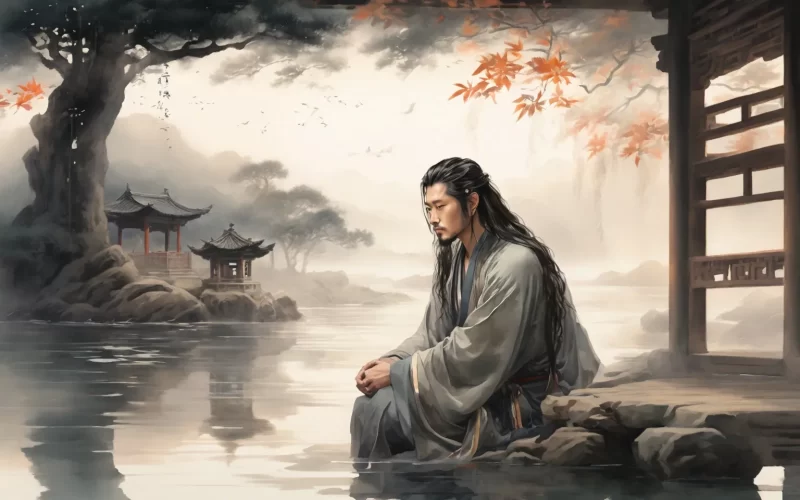

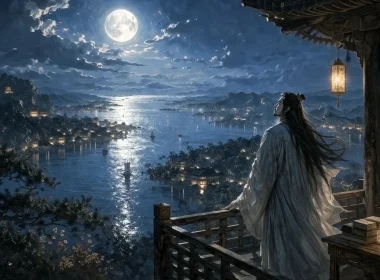
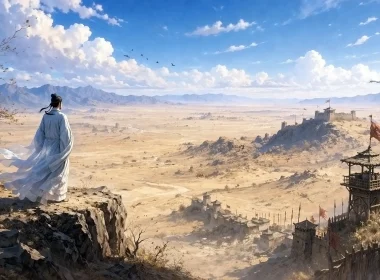
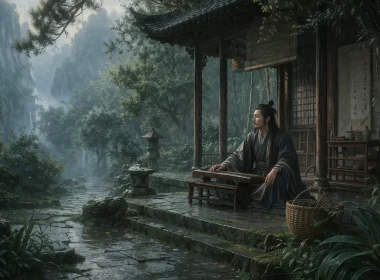
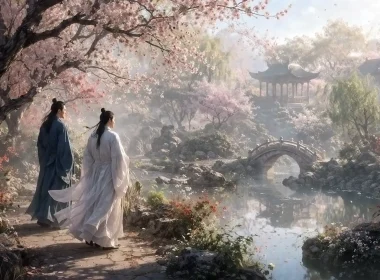
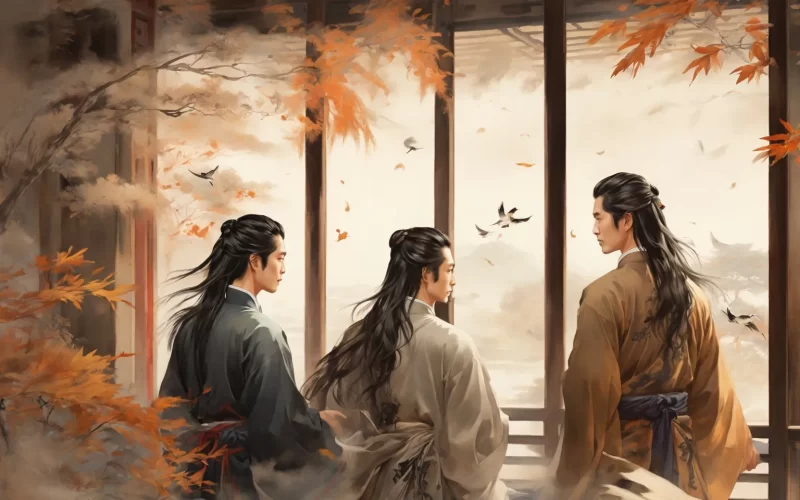
While the autumn moon is pouring full
On a thousand night-levels among towns and villages,
There meet by chance, south of the river,
Dreaming doubters of a dream....

In the trees a wind has startled the birds,
And insects cower from cold in the grass;
But wayfarers at least have wine
And nothing to fear -- till the morning bell.
Original Poem
「江乡故人偶集客舍」
戴叔伦
天秋月又满,城阙夜千重。
还作江南会,翻疑梦里逢。
风枝惊暗鹊,露草覆寒虫。
羁旅长堪醉,相留畏晓钟。
Interpretation
This poem was composed by the Mid-Tang poet Dai Shulun during a journey away from home. Throughout his life, Dai Shulun’s official career was peripatetic—he served as magistrate of Dongyang, prefect of Fuzhou, and other posts—and he spent many years drifting in foreign lands. During the Mid-Tang period, literati and officials often left their hometowns due to official duties, making the sorrow of travel a significant theme in poetry. On an autumn night with a full moon, the poet, lodging in Chang'an (the "city walls and towers" in the poem), unexpectedly met an old friend from Jiangnan. Meeting an old acquaintance in a strange land brought both surprise and delight, yet the joyous gathering was brief, and parting would come again at dawn. The poet condensed this complex emotion into his brush, writing this deeply moving five-character regulated verse where scene and feeling blend. The poem contains both the dazed joy of reunion and the desolate helplessness of wandering, making it a rare gem among Tang dynasty travel poems.
First Couplet: "天秋月又满,城阙夜千重。"
Tiān qiū yuè yòu mǎn, chéng què yè qiān chóng.
The sky is autumn, the moon is full again;
City walls and towers, a thousand folds of night.
The opening couplet uses scenery to set the mood, establishing the season and location. "The sky is autumn" both names the season and evokes autumn's bleak atmosphere. The word "again" in "the moon is full again" is especially exquisite: a full moon is traditionally a symbol of reunion, yet this "again" suggests the poet has witnessed countless full moons, each one meaning the continuation of his wandering and the vanishing of hope for return. The moon is full, but people are not reunited—this is the deeper sorrow of the line. The next line, "City walls and towers, a thousand folds of night," describes the profound night of Chang'an, where palaces and towers layer upon layer in the darkness, giving a sense of oppression and distance. "A thousand folds" is both a concrete description of the thick night and an abstract expression of the poet's psychological feeling of the many barriers between himself and his homeland. This couplet uses a vast scene to convey a lonely heart, establishing the poem's tone of mingled delight and sorrow.
Second Couplet: "还作江南会,翻疑梦里逢。"
Hái zuò jiāngnán huì, fān yí mèng lǐ féng.
Yet we manage a meeting, here, of southerners;
And wonder whether this is real, or we meet in dream.
This couplet describes the surprise and unreality of the meeting. The two words "manage a meeting" convey unexpected joy—they thought they were worlds apart, yet unexpectedly reunite here. "Of southerners" clarifies that the old friend is from the poet's homeland, further stirring his boundless longing for Jiangnan. The next line, "And wonder whether this is real, or we meet in dream," pushes this surprise to its extreme: because it is too unexpected, too beautiful, one begins to doubt its reality—could this merely be a dream? The phrase "wonder whether" captures that incredulous psychology perfectly. The interweaving of dream and reality not only expresses the preciousness of the meeting but also implies a sigh that life is like a dream—in a life of wandering, beautiful moments are always brief and fleeting, as if in a dream.
Third Couplet: "风枝惊暗鹊,露草覆寒虫。"
Fēng zhī jīng àn què, lù cǎo fù hán chóng.
Wind in the branches startles roosting crows;
Dew-laden grass shrouds chilled insects' cries.
This couplet shifts the focus from the gathering indoors to the autumn scene outside, the brushstroke turning abruptly cold. "Wind in the branches startles roosting crows" alludes to Cao Cao's "Short Song Style": "The moon is bright, stars are few, / The crows south flying. / They circle a tree three times— / What branch to settle on?" Using the crow with no branch to rely on as a metaphor for the poet's own unsettled, wandering state. The word "startles" describes both the movement of the autumn wind and the palpitation of the heart. "Dew-laden grass shrouds chilled insects' cries": autumn insects emit mournful chirps from grass soaked with cold dew; the word "chilled" describes both the cold of the autumn night and the cold of the heart. These two lines, with their bleak night scene, contrast with the poet's inner loneliness and the pain of wandering. One moment it was the joy of meeting; the next, it is enveloped by the chill of the autumn night. This emotional rise and fall is the true portrayal of a traveler's soul.
Fourth Couplet: "羁旅长堪醉,相留畏晓钟。"
Jīlǚ cháng kān zuì, xiāng liú wèi xiǎo zhōng.
A wanderer finds long drowning in drink best;
We cling together, dreading the temple's dawn bell.
The final couplet directly expresses the heart, stating the theme. "A wanderer finds long drowning in drink best"—drifting in a foreign land, one can only drown sorrows in wine, wishing to stay drunk forever. This "drowning" refers literally to the drinking during the joyful gathering, but also metaphorically to an escape from reality. The three words "finds… best" express completely the wanderer's yearning for stability and weariness with wandering. The next line, "We cling together, dreading the temple's dawn bell," is the poem's most moving part: the gathering is so precious, everyone wishes to linger a moment longer, and thus most fears hearing the bell heralding dawn. For when the dawn bell sounds, it means daybreak, and also the moment of parting. The word "dreading" thoroughly expresses that fear of parting, that reluctance to let the joyous gathering end. The poem ends abruptly on the helplessness of "dreading the dawn bell," leaving behind endless melancholy.
Holistic Appreciation
This is a five-character regulated verse on the theme of meeting while traveling. In its eight lines and forty characters, it unfolds layer by layer the surprise of reunion, the desolation of wandering, and the helplessness of parting. The emotions rise and fall, moving readers deeply.
Structurally, the poem shows a clear progression of "introduction, development, turn, and conclusion." The first couplet "introduces," using the scene of an autumn night with a full moon and layered city towers to create an atmosphere of vast emptiness and solitude, setting the tone for the whole poem. The second couplet "develops," writing of the joy of meeting: "Yet we manage a meeting, here, of southerners; / And wonder whether this is real, or we meet in dream," expressing that unexpectedness and unreality vividly and movingly. The third couplet "turns," the brush shifting sharply from the joyful gathering indoors to the autumn scene outside: "Wind in the branches startles roosting crows; / Dew-laden grass shrouds chilled insects' cries," using a bleak scene to hint at the pain of wandering, the emotion turning from joy to sorrow. The fourth couplet "concludes," drawing the poem together: "A wanderer finds long drowning in drink best; / We cling together, dreading the temple's dawn bell," condensing the conflicting emotions of joyful gathering and parting into the three words "dreading the dawn bell," with a resonance that lingers.
Emotionally, the poem's greatest feature is the "interweaving of sorrow and joy." The first two couplets write of joy, but joy contains sorrow—"the moon is full again" implies the regret of a full moon without reunion, "meet in dream" suggests the illusion of reality being like a dream; the latter two couplets write of sorrow, but sorrow hides joy—even though the autumn night is bleak and cold, at least for this moment there is still the company of an old friend, and wine to drown in. It is precisely this complexity of interwoven sorrow and joy that elevates the poem beyond simple homesickness and longing for people, giving it the flavor of universal human experience: those brief moments of warmth on the journey are all the more precious precisely because they are brief; and those unavoidable partings are all the more poignant precisely because of the warm gatherings.
In terms of artistic conception, the poet skillfully blends indoors and outdoors, reality and dream, nature and the human heart. The joyful gathering indoors contrasts with the bleakness outside; the reality of meeting interweaves with the unreality of dream; the cold of the autumn night and the warmth of the human heart reflect each other. This multiplicity of contrasts gives the poem, within its limited length, a rich sense of layering and profound emotional depth.
What is especially moving is the poem's acute perception of the passage of time. From the cycle of "the moon is full again" to the fear of "dreading the dawn bell," the poet is perpetually troubled by time—the full moon reminds him that his return is not yet; the dawn bell threatens that the joyful gathering will soon disperse. This sensitivity to time is precisely the shared psychological wound of travelers: they are forever on the road, forever saying goodbye, forever unable to truly stop. The value of the poem lies in presenting this universal human experience in the most condensed, most moving way.
Artistic Features
- Blending of Scene and Emotion, Harmony of Heart and Object: The entire poem projects emotion onto the scenery. "The moon is full again" implies longing for home; "a thousand folds of night" symbolizes barriers; "wind in the branches startles roosting crows" metaphors wandering; "dew-laden grass shrouds chilled insects' cries" evokes desolation. The scenes are all expressions of feeling; feeling is born from the scenes, achieving a state where object and self unite.
- Interplay of Real and Illusory, Interweaving of Dream and Reality: "And wonder whether this is real, or we meet in dream" makes the real meeting seem dreamlike, intensifying the feeling of surprise while also hinting at the sigh that life is like a dream. This shifting between real and illusory enhances the artistic tension of the poem.
- Natural Use of Allusion, Deepening Meaning: "Wind in the branches startles roosting crows" adapts the poetic idea from Cao Cao's "Short Song Style," using the crow with no branch to rely on as a metaphor for the poet's own wandering, both subtle and profound. Using allusion without leaving a trace demonstrates the poet's deep erudition.
- Precise Structure, Progressive Emotion: The first couplet introduces, the second develops, the third turns, the fourth concludes. Between the four couplets, the emotions rise and fall, yet form a seamless whole, exemplifying the paradigmatic structure of introduction, development, turn, and conclusion in regulated verse.
- Condensed Language, Lingering Resonance: The entire poem has no superfluous words. Characters like "again," "wonder," "startles," and "dreading" are precise, vivid, and rich in meaning. Much is encompassed with little; the words end but the meaning is endless.
Insights
This poem, through an accidental meeting with an old friend, articulates the universal human experience of travel and the pain of parting. First, it reveals to us: The meetings and separations of life are unpredictable; every encounter could be the last, and is therefore precious beyond measure. The poet's dazed "wonder whether this is real" is precisely the best annotation of this preciousness—when something beautiful is too rare, we instead cannot believe it is real.
Second, the imagery of "风枝惊暗鹊" in the poem makes us contemplate the spiritual dilemma of the wanderer. The crow with no branch to rely on is like the traveler with no place to call home. This reminds us: True peace is never somewhere far away, but in belonging of the heart. Wherever one is, if the heart has no anchor, one is forever a "startled crow" or a "chilled insect."
On a deeper level, the fear of "畏晓钟" reveals humanity's instinctive resistance to the passing of beautiful moments. But the poet does not remain in resistance; instead, he chooses "finds long drowning in drink best"—to prolong the gathering through drunkenness, to resist time through cherishing. It teaches us: Faced with unavoidable parting, the best attitude is not lamentation, but to feel wholeheartedly each present moment, to let the brief gathering become an eternal memory.
In this era of hurried meetings and partings, this poem still holds strong contemporary meaning. It reminds us: No matter how busy life gets, do not forget to pause, to cherish those chance encounters, to guard those warm friendships. For it is precisely these moments that constitute the true light in our lives.
Poem translator
Kiang Kanghu
About the Poet
Dai Shulun (戴叔伦), 732 - 789 AD, was a native of Jintan, Jiangsu Province. During the Anshi Rebellion, he lived in Poyang and studied behind closed doors, and was later recruited by Liu Yan to serve in the Transit House. Dai Shulun's poems mostly express the leisure of a secluded life, and there are also some poems exposing social contradictions and reflecting the people's hardships, with a broader content, and his poetic style is elegant and clear.