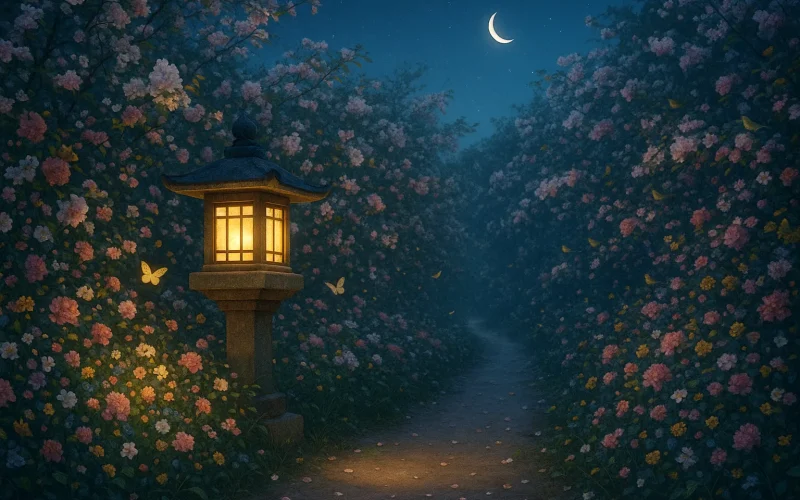

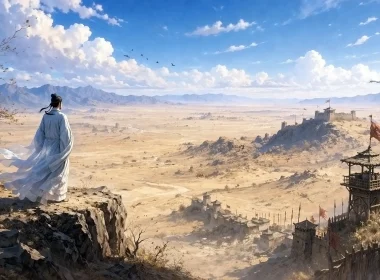
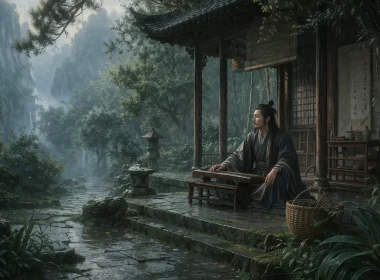
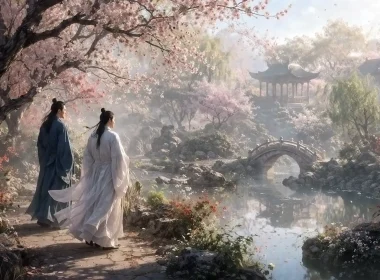
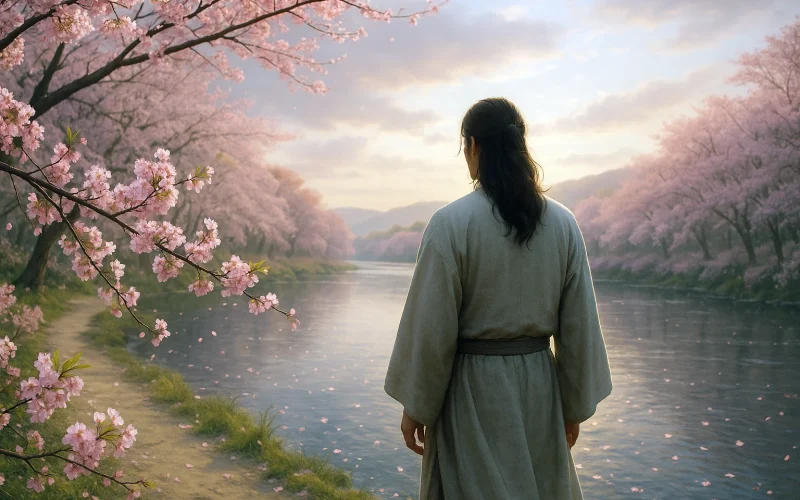
Eastward by riverside tower the waters flow;
Spring, lazy and weary, leans on breeze soft and slow.
A cluster of peach blossoms run riot, no master nigh.
Which do you prefer, tell me, the deep or the shy?
Original Poem
「江畔独步寻花 · 其五」
杜甫
黄师塔前江水东,春光懒困倚微风。
桃花一簇开无主,可爱深红爱浅红?
Interpretation
This work serves as the prologue to the series of seven poems titled Along the River for Flowers Alone. It was composed in the spring of 762 CE, the first year of the Baoying era under Emperor Daizong, while Du Fu was residing in his thatched cottage by the Huanhua Stream in Chengdu. Having endured a long period of warfare and displacement, the poet had found a temporary respite here. Though his life at the cottage was modest, it offered relative peace. However, the loss of old friends, the scarcity of kindred spirits, the shadow of a glorious age that was no more, and the loneliness of his own advancing years persistently haunted him. This poem, using the seemingly paradoxical emotion of being "vexed by the blossoms" as its point of departure, initiates a profound dialogue with spring, with the flowers, and with solitude itself, setting the tone of complex feeling and deep resonance for the entire series.
First Couplet: “江上被花恼不彻,无处告诉只颠狂。”
Jiāng shàng bèi huā nǎo bù chè, wú chù gàosù zhǐ diānkuáng.
By riverside, the blooms bring a vexation without end; / With no one to tell, I'm driven to distraction, friend.
The opening line arrives with startling intensity. "The blooms bring a vexation" is a uniquely Du Fu sensation—not annoyance, but a feeling that arises because the beauty of the flowers is so overwhelming, so moving, that it becomes a kind of sweet "burden," a "vexation" akin to being unable to fully partake of it. The phrase "without end" emphasizes the depth and persistence of this feeling, its inescapability. Scenery that should bring delight, because there is no one to share it with, no one to confide in ("With no one to tell"), instead provokes a powerful sense of isolation, ultimately manifesting in outwardly "distracted" behavior. This "distraction" is the external eruption of emotions that have nowhere to settle; it is also the forthright revelation of the poet's childlike sincerity, subtly foreshadowing the subsequent search for companionship.
Second Couplet: “走觅南邻爱酒伴,经旬出饮独空床。”
Zǒu mì nán lín ài jiǔ bàn, jīng xún chū yǐn dú kōng chuáng.
I rushed to find my southern neighbor, a fellow lover of the cup; / For ten days he's been out drinking—his lonely bed is offered up.
Amidst this extreme emotional agitation, the poet instinctively seeks a kindred spirit for solace. The words "rushed to find" reveal the urgency of his mood. This "southern neighbor, a fellow lover of the cup" is perhaps a similarly unrestrained soul, an understanding friend who seeks release in wine. Yet, what awaits the poet is an even greater emptiness: "For ten days he's been out drinking—his lonely bed is offered up." The phrase "for ten days" indicates a prolonged absence, hinting at the friend's free-spirited, unrestrained nature, while also reflecting, by contrast, the poet's own confined loneliness. The three words "his lonely bed" are powerfully visual, freezing the disappointment of "seeking but not finding" into a highly symbolic scene—the resonance and companionship he seeks remain, like this empty bed, ultimately absent.
Holistic Appreciation
This work is a masterpiece in which Du Fu presents a complex inner world through a highly condensed, dramatic vignette. It is not a simple record of failing to find a friend, but a miniature psychodrama depicting "emotions seeking an outlet only to encounter a greater void."
The poem's central conflict lies in the violent clash between "the passion for life ignited by consummate natural beauty (the flowers)" and "the consummate reality of personal loneliness (having no companion)." The river of spring flowers is external, abundant, clamorous "presence"; the poet's having no one to tell, his failed search for a companion, is internal, empty, silent "absence." The poet's state of "distraction" in the cleft between presence and absence is precisely the most authentic, most moving state of being—he is not numbed by loneliness but, stimulated by beauty, feels the heart-gnawing pain of isolation all the more acutely.
As the opening poem of the series, this work skillfully establishes the inevitability of the "solitary stroll." The failure to find a companion objectively forces the poet to face the profusion of flowers alone, thereby leading to the deep and detailed dialogues with flowers, butterflies, orioles, and stupas in the following six poems. Therefore, this "lonely bed" is not merely a result in reality but also, poetically, a starting point. It compels Du Fu's gaze to turn completely from social bonds (friends) toward the universe of nature, initiating the more pure and profound aesthetic exploration that follows.
Artistic Merits
- The Paradox and Tension of Emotional Expression: "Vexation without end" is an alternative expression of deep affection; "distraction" is the natural form emotion takes when it overwhelms reason. Using negative terms ("vexation," "distraction") to express a positive passion creates strong artistic tension, resulting in a more nuanced, profound, and powerful conveyance of feeling.
- The Swift and Jarring Narrative Rhythm: The movement from "vexation" to "distraction" is a rapid escalation of emotion; from "rushed to find" to "lonely bed" is the abrupt collapse of hope. Within these four lines, emotion rises and falls sharply, creating a vivid, dramatic effect.
- The Realist Power of Detail: The line "For ten days he's been out drinking—his lonely bed is offered up" is an extremely quotidian detail, yet it contains immense emotional weight. It is both a record of a specific event and an epitome of the poet's habitual state of being (lonely, waiting, disappointed), demonstrating Du Fu's ability to "write of a great state of mind using the language of everyday life."
- The Sincerity and Vibrancy of Colloquial Diction: Words and phrases like "vexation… without end," "to tell," "distraction," and "rushed to find" are vivid, colloquial expressions. Eschewing ornate refinement, they allow the poet's emotion to strike the reader with immediacy, presenting a raw, unvarnished, and utterly sincere emotional texture.
Insights
This work illuminates a universal human spiritual condition: in the face of consummate beauty, we often feel our own solitude most profoundly; and the failure to find resonance can sometimes compel us toward deeper self-discovery and dialogue with a broader world.
It reveals that loneliness is not necessarily an emotional impoverishment; sometimes it is precisely the state of having emotions too rich and abundant with nowhere to place them. Du Fu's "distraction" and his "search for a companion" are not signs of weakness but the authentic reactions of a rich soul colliding with the world. Ultimately, the outcome of the "lonely bed" does not make him withdraw but rather strengthens his resolve to undertake the "solitary stroll"—to transform the passion that cannot be shared into poetic dialogues with all things.
In modern society, we too may often feel the loneliness of having "no one to tell." This poem reminds us that when we cannot find an echo among people, we might, like Du Fu, turn our gaze toward the "blooms by the riverside," toward nature and art. In the contemplation and creation of a "solitary stroll," we can temper loneliness into a means of deeply understanding the self and connecting with a vaster existence. This initial "vexation" and "emptiness" may well be the starting point on the path toward genuine spiritual freedom and abundance.
About the poet

Du Fu (杜甫), 712 - 770 AD, was a great poet of the Tang Dynasty, known as the "Sage of Poetry". Born into a declining bureaucratic family, Du Fu had a rough life, and his turbulent and dislocated life made him keenly aware of the plight of the masses. Therefore, his poems were always closely related to the current affairs, reflecting the social life of that era in a more comprehensive way, with profound thoughts and a broad realm. In his poetic art, he was able to combine many styles, forming a unique style of "profound and thick", and becoming a great realist poet in the history of China.