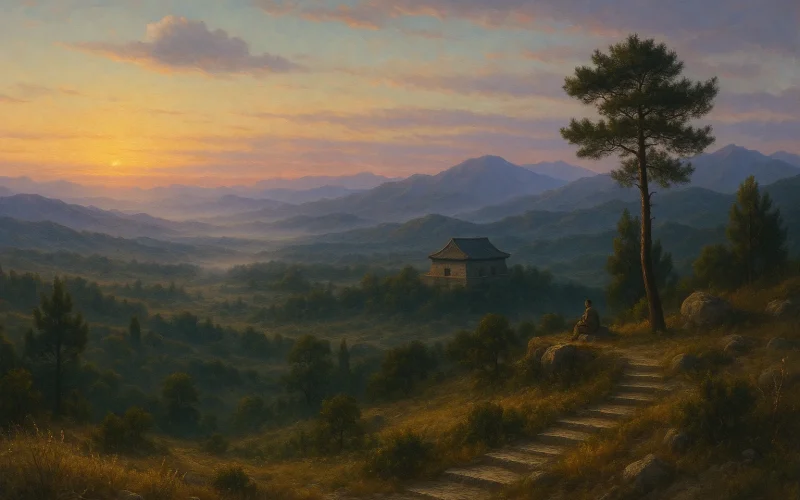




There are faint green mountains and far green waters,
And grasses in this river region not yet faded by autumn;
And clear in the moon on the Twenty-Four Bridges,
Girls white as jade are teaching flute-music.
Original Poem
「寄扬州韩绰判官」
杜牧
青山隐隐水迢迢,秋尽江南草未凋。
二十四桥明月夜,玉人何处教吹箫?
Interpretation
This poem was composed in the autumn of 835 AD during the Taihe reign of Emperor Wenzong. At that time, Du Mu had already left Yangzhou and was serving in Chang'an as an Investigating Censor. The recipient, Han Chuo, was a former colleague and friend from Du Mu's tenure on the staff of the Military Governor of Huainan, who was then serving as a Judge in Yangzhou. For Du Mu, Yangzhou was not merely the backdrop for a carefree and romantic youth; it was a spiritual wellspring for his poetic creation. This short missive to a friend, renowned for its limpid pictorial beauty, ethereally wistful sentiment, and subtly enduring wit, has become one of Du Mu's most celebrated and widely circulated heptasyllabic quatrains. The line "on the Twenty-four Bridges bright" has, in particular, crystallized into the quintessential poetic symbol of Yangzhou in classical literature.
Though physically present in Chang'an, the poet's heart remained in the South. As the factional strife between the Niu and Li parties began to surface and the capital's political atmosphere grew increasingly complex, looking back upon his relatively free and unfettered years in Yangzhou inevitably stirred a nostalgic longing across the distance. This poem is not one of profound melancholy; rather, within its lively greeting and exquisite imagery, it lightly weaves together personal memories of the Southland, the affectionate banter of friendship, and an enduring cultural ideal of Yangzhou, revealing another facet of Du Mu's poetic talent—one of deep feeling and graceful charm, distinct from his characteristic vigorous brilliance.
First Couplet: 青山隐隐水迢迢,秋尽江南草未凋。
Qīng shān yǐnyǐn shuǐ tiáotiáo, qiū jìn Jiāngnán cǎo wèi diāo.
Green hills fade into the distance, far, far the river flows; Though autumn in the South is done, the grass still greenly grows.
The opening lines paint with broad strokes, sketching a panoramic view of the Southland from memory and imagination. The reduplicated phrases describing the hills "fading" and the river flowing "far, far" do not merely depict their winding forms but imbue the scene with a sense of vast, hazy distance and an enduring mood of longing. The following line, "Though autumn in the South is done, the grass still greenly grows," captures the unique essence of the southern landscape in the wake of the season's change. While the North would have been stark and bare, the South retained its verdure. This "still green" grass is both an accurate climatic detail and, more potently, a vivid metaphor for the poet's own vibrant, lush, and unfading memory of Yangzhou. The two lines—one distant and suggestive, the other nearer and concrete—together establish the poem's refreshingly expansive tone.
Final Couplet: 二十四桥明月夜,玉人何处教吹箫?
Èrshísì qiáo míngyuè yè, yùrén hé chù jiào chuī xiāo?
On the Twenty-four Bridges bright, bathed in the moonlight's glow, Where does the lovely one teach her flute's sweet notes to flow?
This couplet is the focus of its enduring fame. The poet narrows his focus from the broad natural panorama to the most iconic and charming scene of Yangzhou. "The Twenty-four Bridges" were famed scenic spots in Tang-era Yangzhou, geographical markers of both prosperity and poetic charm; "bathed in the moonlight's glow" casts this setting in a layer of clear, crystalline, dreamlike light. Amidst such beauty, the poet deftly shifts: instead of lingering on the scenery, he turns directly to his friend with a question: "Where does the lovely one teach her flute's sweet notes to flow?" "The lovely one" could refer to the handsome and talented Han Chuo himself or, by playful association, to a fair musician. This artful ambiguity is delightful. The detail of "teach her flute" alludes subtly to Yangzhou's renowned tradition of music and song, while also, in a teasing tone, affectionately nodding to his friend's refined tastes. This query instantly animates the static scene, infusing it with the warmth of friendship, the savor of past life, and a touch of gentle mockery. It transforms moonlit Yangzhou from merely a beautiful city into one alive with the laughter of kindred spirits and cultured pleasures.
Holistic Appreciation
This heptasyllabic quatrain serves as both a poetic letter of greeting and a word-painted scroll of the Southland. Its artistic charm lies in its ability to dissolve the faint melancholy born of physical distance, the passage of time, and separation from friends entirely within a realm of crystalline, beautiful imagery, transforming it into a light-hearted recollection and warm reverie of beautiful things and shared bonds.
The poem's structure is exquisite, rich with emotional layers. The first two lines depict the scene—the poet's distant gaze and remembrance from his solitary place in Chang'an. The imagery is serene, touched with a hint of wistfulness. The last two lines convey sentiment—a direct inquiry to his friend across time and space, the tone lively and intimate. The focus moves from the natural backdrop of "green hills and far-flowing water" to the cultural landmark of "the Twenty-four Bridges," and finally to the personal detail of "the lovely one" teaching the flute. The perspective narrows from the vast to the specific, the imagery from sparse to rich, and the emotion evolves from general nostalgia to particular fond regard, accomplishing a poetic journey from geographical longing to a dialogue of the heart.
What is especially noteworthy is the poem's delicate emotional balance. It conveys remembrance without indulgence, teasing without frivolity, and a refined romantic sensibility without compromising its elegant tone. The "fading, far-flowing" hills and water signify distance, yet also beauty. The Southland where "grass still greenly grows" is the past, yet also an evergreen memory. The inquiry posed "on the Twenty-four Bridges bright" is playful, yet also a profound affirmation of deep friendship. With masterful skill, Du Mu blends these elements perfectly.
Artistic Merits
- A Spatial Structure Blending Substance and Suggestion: The poem constructs two spaces: the real scene of the poet's location (late autumn in Chang'an) and the imagined scene of his longing (the undying green of the Southland, the moonlit bridges). These are connected through the visual reach of "fading, far-flowing" and the conceptual leap of "where," forming a poetic space where reality and imagination intertwine and resonate, greatly expanding the quatrain's expressive capacity.
- The Classic Creation of Composite Imagery: The juxtaposition of the four images—"Twenty-four Bridges," "moonlit night," "lovely one," and "teach her flute"—acts like a carefully edited sequence, together generating a timeless literary tableau of Yangzhou's romantic charm that transcends its specific moment. It is so vividly compelling that later readers, upon hearing Yangzhou's name, instinctively conjure this very scene.
- A Lucid and Graceful Poetic Style: The poem's diction is clear and fresh, its palette restrained (green hills, flowing water, bright moon), its cadence musical ("fade into the distance," "far, far"). In expression, it favors implication over direct statement and elegant simplicity over ornate flourish. It conveys deep friendship and complex feeling through language that is both effortlessly light and spiritedly fresh, exemplifying the distinctive grace of Du Mu's heptasyllabic quatrains.
- Dual Dimensions of Emotional Expression: The poem's feeling is directed simultaneously toward two objects: a cultural nostalgia and scenic admiration for the city of Yangzhou, and an affectionate remembrance and humorous greeting for his friend Han Chuo. The two are seamlessly fused, perfectly unifying attachment to place with fondness for a person, resulting in a richer, more multi-dimensional emotional core.
Insights
This exquisitely crafted short poem demonstrates how friendship and remembrance can assume such graceful and poetic forms. It suggests that sincere emotion need not always be expressed through heavy lament; it can sometimes be a shared landscape painting accompanied by a lighthearted question. Du Mu distilled his myriad thoughts of Yangzhou and his friend into the image of "green hills fading, the river flowing far" and the playful query, "where does the lovely one teach her flute?" This mode of expression is deeply respectful and considerate, offering the recipient space for imagination and reflection while preserving the subtlety and dignity of mutual affection.
The poem also reveals a poetic principle of cultural geography: a city's enduring image in the collective mind is often defined by a few classic poetic moments. Du Mu's "on the Twenty-four Bridges bright" and, for instance, Xu Ning's famous line about Yangzhou claiming "two parts out of three of the world's bright moonlight" together shaped Yangzhou's eternal identity as the "City of Moonlight" and the "City of Poetry." This reminds us that our perception and memory of place are always filtered through emotion and aesthetic sensibility.
Ultimately, the poem offers wisdom on sustaining connections and preserving memories across separation and distance. By placing human affairs within the clear, luminous realm of "fading hills, far-flowing water" and "moonlight's glow," the poet sublimates specific longing into an aesthetic experience that can be shared and savored. It reminds us that amidst life's inevitable partings and backward glances, we might learn from Du Mu to use a poetic gaze to crystallize the past into "green hills and flowing water" and "moonlight and flute song," allowing remembrance itself to become a form of beauty, thereby transcending the barriers of time and space to touch something timeless in our affections.
Poem translator
Kiang Kanghu
About the poet

Du Mu (杜牧), 803 - 853 AD, was a native of Xi'an, Shaanxi Province. Among the poets of the Late Tang Dynasty, he was one of those who had his own characteristics, and later people called Li Shangyin and Du Mu as "Little Li and Du". His poems are bright and colorful.