

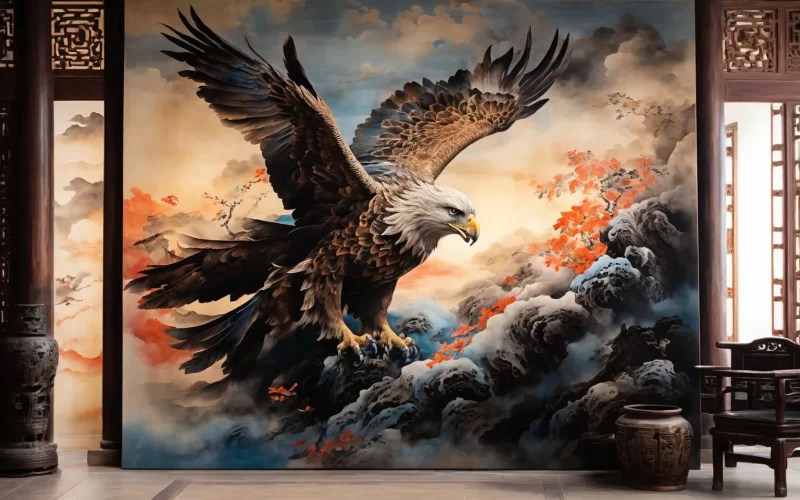
Upon white silk there rise the winds of frost—
How vividly this painted hawk is drawn!
It stiffens, poised to pounce on hare, and casts
A sidelong glance like that of a grieved man.

Bright are the rings upon the silken cord;
Upon the painted rail it stands, alive.
When will it strike at common birds and lord
Its bloody plumage o'er the plain where crows dive?
Original Poem
「画鹰」
杜甫
素练风霜起,苍鹰画作殊。
㧐身思狡兔,侧目似愁胡。
绦镟光堪擿,轩楹势可呼。
何当击凡鸟,毛血洒平芜。
Interpretation
This work was composed in the late Kaiyuan era of Emperor Xuanzong (around 741 CE), representing Du Fu's early style of using the description of an object to voice his aspirations. It was a time known as the "flourishing zenith of Kaiyuan." The young Du Fu was roaming the regions of Qi and Zhao, leading a spirited and untrammeled life, his heart filled with the grand ambition to "make my sovereign surpass the sage-kings Yao and Shun, and restore anew the customs pure and true." The painting of an eagle celebrated in this poem, though its artist is unknown, possessed a heroic, keen spirit that resonated deeply with the poet's own youthful longing to display his prowess and sweep away the mediocre. This painting was not merely an artistic subject but a projection of the poet's ideal self and a declaration of his vibrant, youthful vitality.
First Couplet: “素练风霜起,苍鹰画作殊。”
Sù liàn fēngshuāng qǐ, cāng yīng huà zuò shū.
From the plain silk, a wind-and-frosty air begins to rise; / This painting of a grey hawk stands peerless, wondrous in our eyes.
The opening is imposing and arresting. "Plain silk" is the painting's material ground, while "a wind-and-frosty air begins to rise" captures the initial psychological impression upon viewing it. Instead of describing the eagle directly, the poet uses the environmental effect it generates—an aura of stern, chilling austerity—to set off its formidable spirit. This attests to the painting's vigorous brushwork and compelling presence. The three words "stands peerless, wondrous" offer a summarizing exclamation, directing focus to the artistic creation itself and thereby setting the stage for the detailed appreciation and impassioned associations that follow.
Second Couplet: “㧐身思狡兔,侧目似愁胡。”
Sǒng shēn sī jiǎo tù, cè mù shì chóu hú.
It stiffens its frame as if intent upon some crafty hare; / It casts a sidelong glance, like some deep-brooding foreigner's stare.
This couplet focuses on the painting's most tension-filled aspects: the eagle's posture and gaze. "Stiffens its frame" suggests a coiling and concentration of power, a dynamic readiness to strike; "casts a sidelong glance" conveys vigilant reconnaissance and a look of disdain, a form of static menace. "As if intent upon some crafty hare" gives the eagle a clear combat objective and suggests a hunter's cunning. The simile "like some deep-brooding foreigner's stare" is particularly masterful. It compares the eagle's gaze to the deep-set, intently focused eyes of a non-Hu person, capturing not only their sharpness but also imbuing them with a complex quality of depth, alertness, and even a tinge of melancholy. This elevates the eagle's image beyond simple ferocity, granting it greater psychological and spiritual depth.
Third Couplet: “绦镟光堪擿,轩楹势可呼。”
Tāo xuàn guāng kān tī, xuān yíng shì kě hū.
Its silken jess and swivel gleam, as if one's hand could them untie; / From porch and pillar where it clings, one could call forth its form to fly.
The descriptive focus shifts from the eagle's own form to its relationship with the depicted objects around it, further "animating" the painted scene. "Its silken jess and swivel gleam, as if one's hand could them untie" describes the convincing, lifelike quality of its tethers, implying the bonds are on the verge of being loosed, that freedom is within reach. "From porch and pillar where it clings, one could call forth its form to fly" depicts the eagle's relationship to its architectural environment. Though temporarily perched, its entire posture and latent energy seem already connected to the vast sky; it appears ready to answer a summons and soar. This couplet introduces the viewer's own psychological activity ("could… untie," "could call forth"), transforming the static image into a dynamic, dramatic moment. The painted eagle seems on the brink of breaking free from its canvas.
Fourth Couplet: “何当击凡鸟,毛血洒平芜。”
Hé dāng jī fán niǎo, máo xuè sǎ píng wú.
When will it strike those common birds, and on the plain and wide, / Their feathers and their blood bestrew the earth on every side?
Here, the artistic imagination makes a decisive leap into an anticipation of real, consequential action, producing the poem's most powerful and resounding note. The two words "When will…" brim with fervent yearning and an urgency that brooks no delay. "Common birds" refer literally to ordinary fowl but serve more potently as a metaphor for mediocre talents, petty men, and all malign forces in the human world. The visceral image of "their feathers and their blood bestrew[ing] the earth" is fierce and cathartic, representing the utter eradication of the base by the noble, the absolute triumph of excellence over vulgarity. This is both a battle cry uttered on behalf of the painted eagle and the bursting forth of the poet's own ambition to achieve great deeds and cleanse the world of its dross.
Holistic Appreciation
This work is a concentrated expression of the "heroic and untrammeled" aspect within Du Fu's early "deeply poignant and tightly controlled" style. The poem's structure is rigorous and follows a clear, intensifying progression: from the initial sensory impression of the painting (the rising aura), to a close appreciation of its spirit and gaze, to sensing its pent-up, imminent energy, and finally achieving a transcendence into the powerful, aspiration-driven exclamation. It celebrates the painting without being confined by it, ultimately moving beyond the artwork itself to become a passionate and rousing ode to youthful ambition.
Its essence lies in the triple fusion of "painting, eagle, and self." The poet masterfully conveys the painting's artistic power ("stands peerless, wondrous"), vividly captures the formidable spirit of the eagle as a raptor ("intent upon some crafty hare"), and unreservedly infuses the image with his own burgeoning idealism and fervor ("strike those common birds"). The painting is the medium, the eagle the symbolic vessel, and the poet's own aspirational spirit the ultimate destination. This technique of using an object to voice one's will, executed with extreme sincerity of emotion and fullness of rhetorical force, achieves a state where object and self merge in a triumphant, unbridled expression.
Artistic Merits
- The Arresting Effect of the Opening Gambit: Beginning with the virtual sensory impact of a "wind-and-frosty air" is startling and commanding. It instantly places the two-dimensional artwork within a psychologically charged, atmospheric space, demonstrating the young Du Fu's superior ability to command language and create immersive effect.
- Precise Use of Verbs and Striking Simile: Verbs like "stiffens," "intent upon," "casts," and the comparative "like" precisely capture a dynamic, fraught instant. The simile "like some deep-brooding foreigner's stare" is novel, culturally resonant, and remarkably apt, enriching the eagle's symbolic and emotional weight. It reflects the early Du Fu's tendency to seek out the novel, striking, and perceptive.
- Psychological Progression from Static to Dynamic: The poem is threaded with a powerful, implicit line of psychological action: sensing the emanating aura ("begins to rise") → interpreting its spirit and gaze ("intent upon," "like") → feeling the palpable impulse to interact and liberate ("could… untie," "could call forth") → finally erupting into the visceral desire for decisive combat ("strike," "bestrew"). This internal progression fills the poem with a compelling rhythm and forward-driving force.
- The Unabashed, Idealistic Radiance of the Conclusion: The cry of "When will it strike…" brims with the quintessential, optimistic spirit of the High Tang era—active, enterprising, and fervently eager to achieve glory and impose moral order. Unlike the deeply somber, restrained tone characteristic of Du Fu's later poetry, it is sharp-edged, exposed, and soaring in its heroic sentiment, revealing the foundational spiritual temperament of the poet's youth.
Insights
This masterpiece reveals the spirit of a great poet in his youth: an admiration for potent force, a contempt for mediocrity, a burning desire to achieve merit and glory, and the vibrant, primal energy capable of transforming aesthetic passion directly into the driving force of a life's purpose. It reminds us that behind the profoundly reflective, measured, and world-weary figure of Du Fu's later years stood a "heroic and untrammeled" young Du Fu, one who yearned to "bestrew the earth" with the "feathers and blood" of the commonplace.
The poem's enduring lesson is this: in life's early stages, preserving the "eagle's" keenness, focus, and idealism is crucial. It represents a resistance to the mediocre, a yearning for higher purposes, and the courage to "strike those common birds." Even after one has weathered life's storms and gained a nuanced understanding of the world's complexity, the vigilant acuity ("casts a sidelong glance") and the sense of mission ("When will it strike…") forged in youth can remain the deep-seated spiritual engine that drives a person continually upward, guarding against a weary compromise with vulgar currents. Thus, the painted eagle from Du Fu's brush becomes an eternal mirror for all souls who harbor ideals and refuse the fate of being ordinary.
About the poet
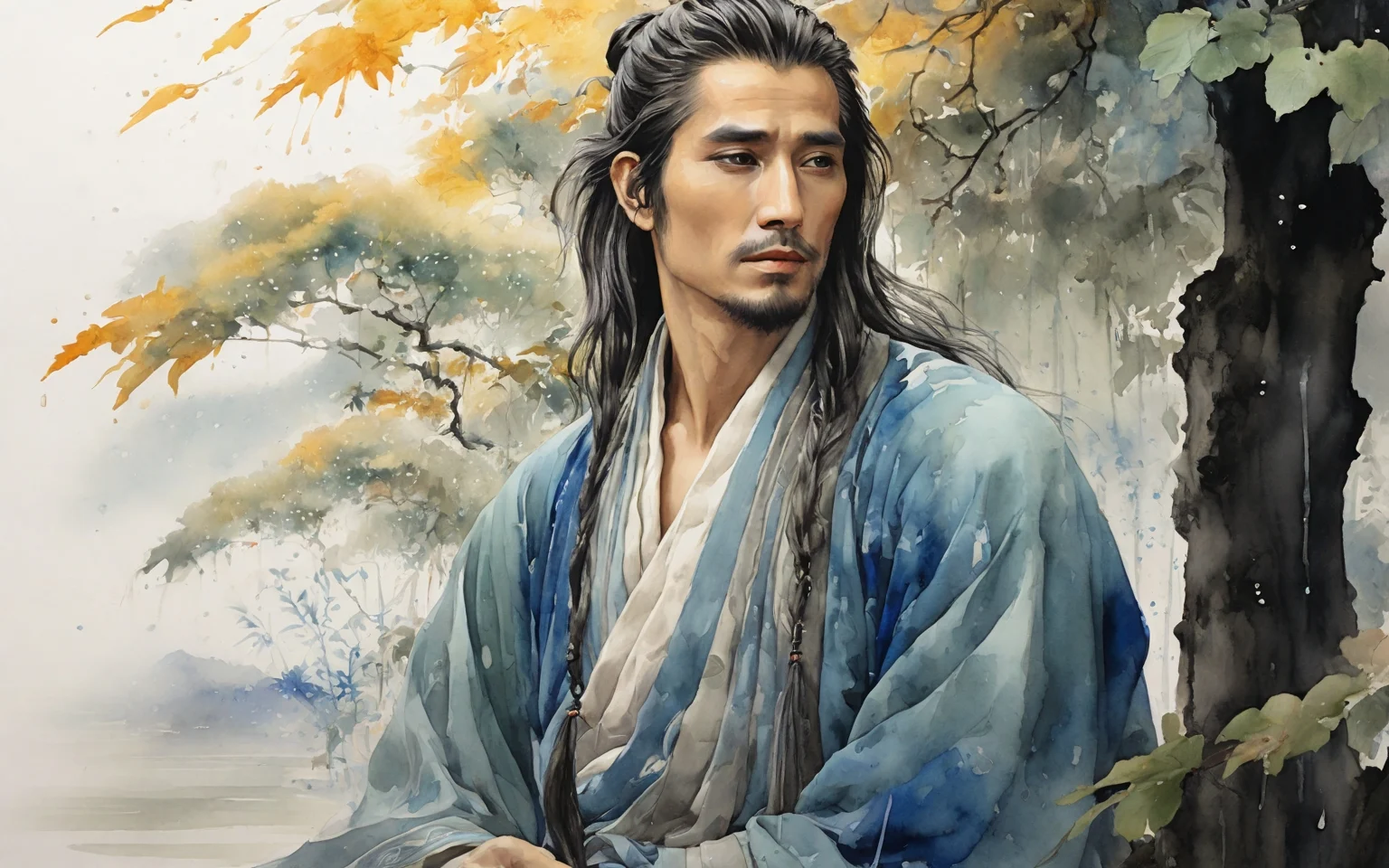
Du Fu (杜甫), 712 - 770 AD, was a great poet of the Tang Dynasty, known as the "Sage of Poetry". Born into a declining bureaucratic family, Du Fu had a rough life, and his turbulent and dislocated life made him keenly aware of the plight of the masses. Therefore, his poems were always closely related to the current affairs, reflecting the social life of that era in a more comprehensive way, with profound thoughts and a broad realm. In his poetic art, he was able to combine many styles, forming a unique style of "profound and thick", and becoming a great realist poet in the history of China.