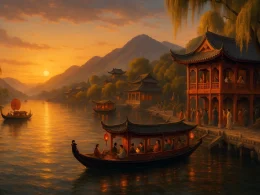



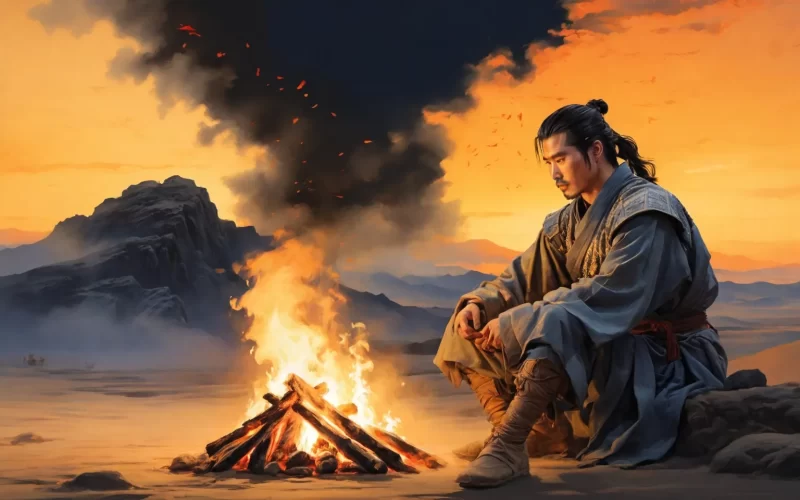
Through the bright day up the mountain, we scan the sky for a war-torch;
At yellow dusk we water our horses in the boundary-river;
And when the throb of watch-drums hangs in the sandy wind,
We hear the guitar of the Chinese Princess telling her endless woe...

Three thousand miles without a town, nothing but camps,
Till the heavy sky joins the wide desert in snow.
With their plaintive calls, barbarian wildgeese fly from night to night,
And children of the Tartars have many tears to shed;

But we hear that the Jade Pass is still under siege,
And soon we stake our lives upon our light war-chariots.

Each year we bury in the desert bones unnumbered,
Yet we only watch for grape-vines coming into China.
Original Poem
「古从军行」
李颀
白日登山望烽火,黄昏饮马傍交河。
行人刁斗风沙暗,公主琵琶幽怨多。
野营万里无城郭,雨雪纷纷连大漠。
胡雁哀鸣夜夜飞,胡儿眼泪双双落。
闻道玉门犹被遮,应将性命逐轻车。
年年战骨埋荒外,空见蒲桃入汉家。
Interpretation
Li Qi, a poet of the High Tang period, experienced an unsuccessful official career. In his early years, he lived in seclusion in Yingyang. Although he later passed the jinshi examination, he only attained a minor post like the County Captain of Xinxiang, ultimately resigning to return to a reclusive life. This experience shaped his attitude towards war, distinguishing him from poets who glorified frontier exploits—he saw not glory, but bleached bones. This poem is Li Qi's masterpiece of frontier poetry and one of the most significant anti-war poems of the Tang dynasty. The word "Old" in the title employs the common Tang practice of using the Han dynasty to allude to the Tang. Superficially, it describes Emperor Wu of Han's belligerent campaigns and his expedition against Dayuan; in reality, it targets the frequent frontier wars during Emperor Xuanzong of Tang's reign. During the Kaiyuan and Tianbao eras, the court waged successive campaigns against the Tibetans and Turks, resulting in countless casualties, with nothing to show but trivial spoils like "grapes brought to the Han house."
The line "we hear the Jade Pass is still barred" alludes to the historical anecdote of Li Guangli's expedition against Dayuan. Emperor Wu of Han ordered Li Guangli on a distant campaign to obtain the famed Ferghana horses. After two years without success, Emperor Wu sent men to bar the Jade Pass, decreeing, "Any soldier daring to enter shall be beheaded." Li Qi uses this to imply: once war is launched, it will not easily stop; soldiers can only entrust their lives to the war chariots and continue this endless slaughter.
First Couplet: "白日登山望烽火,黄昏饮马傍交河。"
Bái rì dēng shān wàng fēnghuǒ, huánghūn yìn mǎ bàng Jiāo Hé.
By day they climb the hill to watch for beacon fires;
At dusk they water horses beside the River of Crossing.
The opening juxtaposes "day" and "dusk," outlining the daily routine of the frontier garrison. Climbing high to watch for beacon fires is vigilance; watering horses by the Jiao River is rest. The two lines encapsulate the monotony and tension of frontier life—even days without combat are merely a repetition of these two states. The Jiao River, located in modern-day Turpan, Xinjiang, was under the jurisdiction of the Tang's Anxi Protectorate; the poet uses it to emphasize the battlefield's remoteness.
Second Couplet: "行人刁斗风沙暗,公主琵琶幽怨多。"
Xíngrén diāodǒu fēngshā àn, gōngzhǔ pípa yōuyuàn duō.
They beat the watches, the wind and sand are dreary;
The Princess’s pipa is filled with endless gloom.
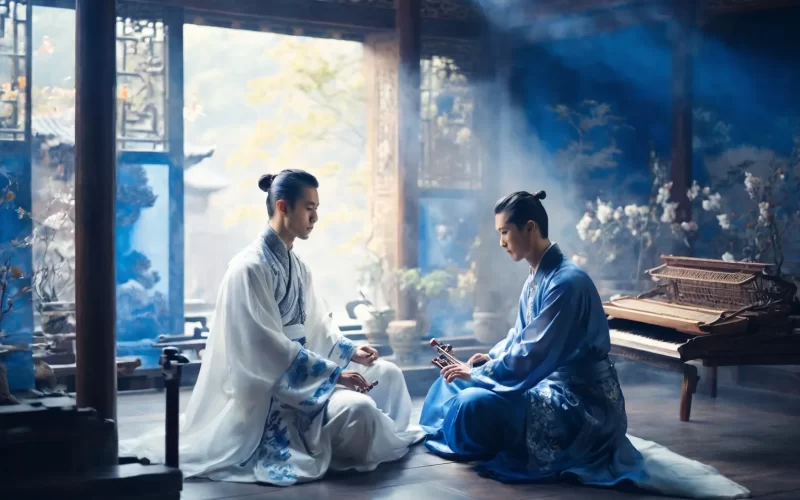
This couplet places two sounds side by side. The watch (刁斗, diāodǒu) is a bronze military vessel used as a cooking pot by day and struck to mark the night watches; its clear, cold sound feels even more desolate amid the wind and sand. "The Princess’s pipa" refers to Princess Xijun of Han, who married the Wusun chieftain and played the pipa on her journey to express her sorrow. The poet superimposes the actual sound of the present with the historical echo, making the hardship of contemporary soldiers resonate with the grief of the Han princess sent for political marriage. Both the sound of the watch and the sound of the pipa are inexpressible sorrows upon this desert.
Third Couplet: "野营万里无城郭,雨雪纷纷连大漠。"
Yě yíng wàn lǐ wú chéngguō, yǔxuě fēnfēn lián dàmò.
A thousand miles from the wall, in a wild camp,
Rain and snow fall thick, merging with the vast desert.
This couplet describes the harshness of the frontier environment. "A thousand miles from the wall" highlights the desolation of the station—no city walls for support, no inhabitants to rely upon, only the boundless wilderness. "Rain and snow fall thick, merging with the vast desert" uses visual expanse to depict the bitter cold and vastness; between heaven and earth, there is only wind, snow, and yellow sand, against which man appears almost negligible.
Fourth Couplet: "胡雁哀鸣夜夜飞,胡儿眼泪双双落。"
Hú yàn āi míng yèyè fēi, hú ér yǎnlèi shuāng shuāng luò.
Tartar geese fly past each night, crying in sorrow;
Tartar boys’ tears fall in double streams.
The poet shifts perspective from the Han soldiers to the common people of the Tartar lands. The sorrowful cries of Tartar geese are a natural phenomenon of migratory birds, but against the backdrop of perpetual war, even this sound takes on grief. The Tartar boys' tears directly depict the harm war inflicts on ordinary people—they are not the enemy, merely people living on the battlefield. This couplet breaks the simplistic narrative of Han versus Tartar opposition, extending the cruelty of war to everyone.
Fifth Couplet: "闻道玉门犹被遮,应将性命逐轻车。"
Wén dào Yùmén yóu bèi zhē, yīng jiāng xìngmìng zhú qīngchē.
We hear the Jade Pass is still barred;
They must go on, staking life against the light chariots.
This couplet uses a historical allusion. Emperor Wu of Han ordered Li Guangli to campaign against Dayuan. After a long, unsuccessful siege, Emperor Wu had the Jade Pass barred, decreeing that anyone daring to enter would be beheaded. The poet alludes to this to imply: once war is launched, it will not easily cease; the soldiers have no way back and can only entrust their lives to the war chariots, pressing forward. "'They must go on, staking life...'—the word 'must' (应) does not mean 'should' but 'have to'; it is the absence of choice.
Sixth Couplet: "年年战骨埋荒外,空见蒲桃入汉家。"
Nián nián zhàn gǔ mái huāng wài, kōng jiàn pútáo rù Hàn jiā.
Every year, in the desert, war bones are buried;
They only see the grapes of China brought to the Han house.
The final couplet concludes the poem with a stark contrast. On one side are the bleached bones of countless soldiers, forever buried in the wilderness of a foreign land; on the other are a few grapevines brought back to the Central Plains as exotic tribute. "Grapes" (蒲桃, pútáo) were introduced from Dayuan during Emperor Wu of Han's reign. The poet uses this seemingly insignificant "result" to form a cruel counterpoint to the "war bones" buried year after year—were all those young lives exchanged for just these few grapevines? The phrase "only see" (空见) expresses the poet's utmost indignation and sorrow.
Holistic Appreciation
This is the pinnacle of anti-war poetry within the Tang frontier tradition. The poem's twelve lines proceed chronologically, from day to dusk, from dusk to night, building layer by layer; spatially, they move from the Jiao River to the great desert, from the Jade Pass to beyond the frontier, delving deeper with each step.
The first four lines depict the hardship and isolation of frontier life, juxtaposing the sound of the watch and the pipa to blend reality and history. The middle four lines describe the harsh environment and the universal harm of war, using the sorrowful cries of Tartar geese and the falling tears of Tartar boys to break the Han-Tartar opposition. The final four lines address the inexorable nature of war and the absurdity of its cost, using "the Jade Pass is still barred" to indicate the cut-off retreat, and "war bones are buried" contrasted with "grapes... brought to the Han house" to form a shocking comparison.
Li Qi's uniqueness lies in writing not only of the Han army's suffering but also the Tartars' grief; not only of the immediate war but also of historical pain. This compassion that transcends perspective gives the poem a timeless, devastating power.
Artistic Merits
- Narrative Pacing, Building Layers: The poem unfolds sequentially in time and space, from day to dusk, from close-up to distant view, from Han soldiers to Tartar people, building layers and deepening emotion.
- Vivid Contrasts, Sharp Point of View: The conclusion juxtaposes "war bones are buried" with "grapes... brought to the Han house," directly contrasting war's cruel cost with its meager return, bringing the anti-war theme to a climax.
- Using the Past to Satirize the Present, Profound Intent: Superficially about Han campaigns against Dayuan, it actually alludes to the Tang's frequent frontier wars, avoiding direct political criticism while achieving its aim.
- Auditory Imagery, Creating Atmosphere: The sounds of the watch, the pipa, and the Tartar geese's cries run through the poem, creating the unique desolate atmosphere of the frontier and making the abstract "suffering" audible and palpable.
- Broad Perspective, Transcending Sides: It describes both the Han army's hardship and the Tartar children's tears, universalizing war's cruelty and giving the anti-war theme broader resonance.
Insights
This poem, through a war on a distant frontier, speaks to humanity's deepest tragedy: the "results" bought with lives are often unworthy of the weight of those lives. It makes us re-examine the word "cost." Year after year, war bones in exchange for grapes brought to the Han house—this is Li Qi's indictment of war. This indictment echoes across a thousand years, still valid: any war, regardless of its banner, ultimately demands specific lives. And those who launch wars often do not have to go to the front lines themselves, nor do they feel the pain of "war bones buried in the desert."
The line "胡儿眼泪双双落" breaks the simplistic narrative of "us versus them." War's cruelty falls not only on "us" but also on "them." Children in Tartar lands also cry; Tartar parents also grieve. This compassion that transcends perspective is especially worth pondering in today's world, still rife with conflict.
On a deeper level, the poem also shows us: some tragedies are tragedies of "having to." "They must go on, staking life..."—not out of bravery, not out of loyalty, but simply because there is no way back. The Jade Pass is barred; they cannot return; they can only go forward. This predicament exists not only on the battlefield but in many moments of life. It reminds us: true tragedy is often not choosing wrongly, but having no choice at all.
Poem translator
Kiang Kanghu
About the Poet
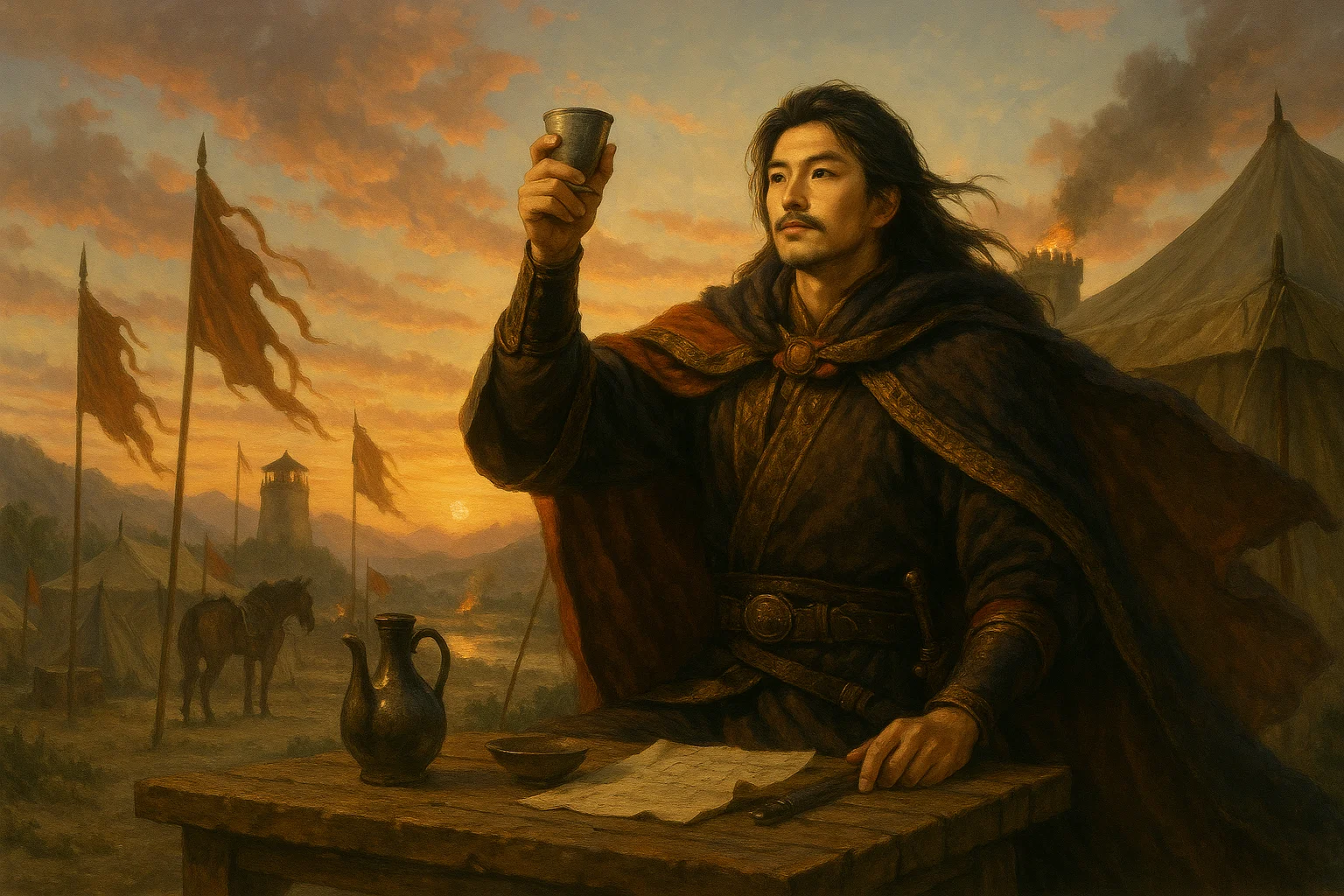
Li Qi (李颀 c. 690 – c. 751), whose ancestral home was in Zhao County, Hebei Province, was a renowned frontier fortress poet of the High Tang period. He became a jinshi (presented scholar) in the 23rd year of the Kaiyuan era (735 AD) and served as the Sheriff of Xinxiang before retiring from official life to live in seclusion. His poetry is best known for its frontier themes, and he excelled particularly in seven-character ancient verse and character portrayal. He had a gift for blending boldness with delicate emotion, and together with Gao Shi and Cen Shen, he collectively shaped the grandeur of High Tang frontier poetry.