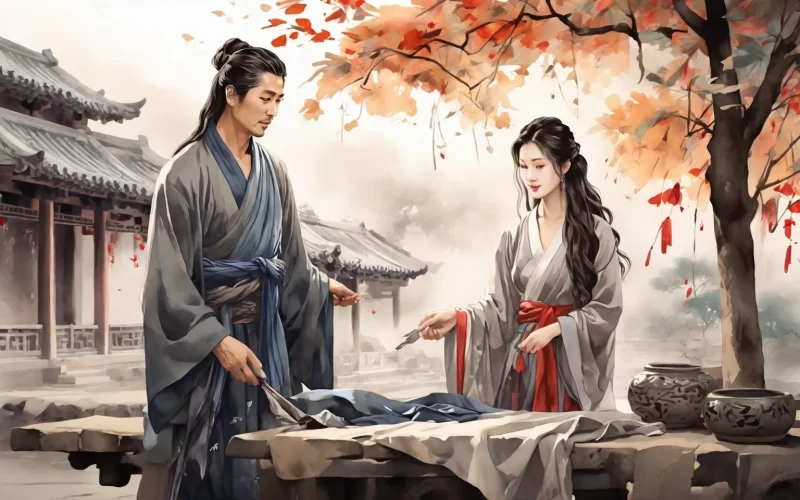
I hold your robe lest you should go.
"Where are you going, dear, today?
Your late return brings me less woe
Than your heart being stolen away."
Original Poem
「古别离」
孟郊
欲别牵郎衣,郎今到何处?
不恨归来迟,莫向临邛去。
Interpretation
This poem is an ancient-style work by the Mid-Tang poet Meng Jiao. Meng Jiao's life was marked by poverty and hardship; he repeatedly failed the imperial examinations, finally passing at the age of forty-six. In his later years, he suffered the loss of a son. His poetry often portrays the hardships of poverty, loneliness, and the fickleness of the world, earning him a reputation for "bitter chanting" and frequent comparison with Jia Dao, leading to the saying "Meng's austerity, Jia's leanness." He excelled at expressing profound emotions with concise language, particularly adept at capturing the subtle, unspoken thoughts within romantic relationships.
This poem expresses the feelings of parting from a woman's perspective. The "Linqiong" in the poem alludes to the Han Dynasty story of Sima Xiangru and Zhuo Wenjun. Linqiong was Zhuo Wenjun's hometown; the wandering scholar Sima Xiangru visited, captivated her with his zither's heart, and their union became a celebrated romance. However, in the woman's words, "Do not go to Linqiong!" becomes an anxious entreaty—she fears her lover, once gone, might also have his heart captured by another woman, just as Sima Xiangru was once captivated. These five short words articulate the insecurity and helplessness felt by women in love in ancient times: unable to control their lover's path, they could only express their deepest fear in this indirect, gentle way. Meng Jiao captures this delicate moment, freezing in the instant of a woman pulling at a sleeve to ask a question, a pain shared by separated lovers across the ages. The sensitivity of his brushstrokes and the sincerity of the emotion showcase the particular subtlety and depth of feeling Meng Jiao brought to romantic themes, beyond his famous "bitter" style.
First Couplet: "欲别牵郎衣,郎今到何处?"
Yù bié qiān láng yī, láng jīn dào hé chù?
I tug your sleeve, as you are set to part:
"My love, just where is it that you'll go?"
The poem opens with a highly visual action. "I tug your sleeve" perfectly conveys the woman's attachment and reluctance—it is not a wave goodbye, not a tearful gaze, but a subconscious reaching out to grasp the corner of his robe, as if that alone could keep him a moment longer. This single tug pulls forth a heart full of tender feeling, and a mind full of worries. The following line, "My love, just where is it that you'll go?", follows with a question. Seemingly an ordinary inquiry, it conceals a deep unease: what she truly wants to know is perhaps not the direction of his journey, but whether his heart might lose its way elsewhere. This question is asked with the utmost care, with gentle circumspection, yet allows the reader to feel distinctly the undercurrents swirling beneath the calm tone.
Final Couplet: "不恨归来迟,莫向临邛去。"
Bù hèn guī lái chí, mò xiàng Línqióng qù.
"I do not mind at all your late return;*
I only ask: do not to Linqiong go!"
This couplet is the soul of the entire poem. "I do not mind at all your late return"—five words that seem tolerant and magnanimous. She is willing to wait, even if her hair turns white, as long as he eventually returns. Yet, the more lightly this tolerance is stated, the heavier the deep feeling behind it becomes. The next line, "I only ask: do not to Linqiong go!", shifts the tone, articulating the true fear. Linqiong, the place where Sima Xiangru met Zhuo Wenjun, symbolizes, in the woman's mind, the site where hearts are easily changed. She does not directly say "do not change your heart," or "do not fall for another"; she only says, "do not to Linqiong go"—using a place name as a substitute, an expression both subtle and pointed. This line is at once a plea and a probe; it is both an instruction and an expression of helplessness. For she knows the only thing she can do is speak this one gentle sentence; whether her lover listens or not, she cannot control.
Holistic Appreciation
This is an excellent example of Meng Jiao's ancient-style Music Bureau poetry. In four lines and twenty characters, using a woman bidding farewell to her lover as its point of entry, it blends attachment, worry, forbearance, and hope, revealing the complex psychology of ancient women in love—at once deeply devoted and profoundly powerless.
Structurally, the poem presents a progression from the surface to the core, from the shallow to the deep. The first couplet opens with the action of "tugging the sleeve," expressing the reluctance of parting, and uses the question "where will you go?" to introduce worry. The final couplet continues with the apparent tolerance of "I do not mind your late return," then concludes with the entreaty "do not to Linqiong go," directly voicing the anxiety hidden in the previous lines. Between the two lines, the movement is from action to speech, from surface to depth, from reluctance to worry, deepening layer by layer into a seamless whole.
Thematically, the poem's core lies in the unspoken meaning behind the five words, "do not to Linqiong go." The poet does not have the woman utter straightforward phrases like "do not change your heart" or "do not fail me"; instead, he uses the place name "Linqiong," with its specific cultural connotations, to subtly express her deepest fear. This technique of "using a place name to stand in for a heart's worry" makes a simple entreaty bear a weight of immense significance. The apparent tolerance of "I do not mind your late return" appears all the more poignant because of the worry in "do not to Linqiong go"—it is not that she does not mind, but that she has swallowed all resentment, daring only to voice this one gentle request.
Artistically, the poem's most moving feature is its subtle technique of "revealing the large through the small, expressing the profound through the seemingly shallow." The poet does not describe the woman weeping or lamenting her troubles; he only describes her action of tugging the sleeve, the tone of her question, the content of her plea. It is precisely these seemingly ordinary details that lay bare her deep affection, her anxiety, her forbearance, and her helplessness. That moment of "tugging the sleeve" is a gesture shared by all parted lovers through the ages; that line, "do not to Linqiong go," is the hidden pain shared by all devoted, anxious hearts. In a mere twenty characters, Meng Jiao captures the deepest fear and the most helpless self-restraint found in love.
Artistic Merits
- Vivid Detail, Revealing the Large through the Small: The three words "tug your sleeve" render the woman's attachment and reluctance with such immediacy it feels as if we are there, conveying more than a thousand words could.
- Implied Meaning, Subtle and Profound: Using "do not to Linqiong go" to stand for "do not change your heart" hides the deepest fear within the lightest words, where the line ends but the meaning resonates endlessly.
- Rising then Falling, Emotional Undulation: First, the apparent tolerance of "I do not mind your late return" sets the stage, then the entreaty "do not to Linqiong go" concludes. It seems placid on the surface, but is deeply unsettling within.
- Concise Language, Lingering Resonance: Within twenty characters, there is action, a question, tolerance, and an entreaty. Each word is ordinary, yet each bears immense weight.
Insights
Through a scene of farewell, this poem speaks to an eternal theme: What the deeply loving heart most fears is never waiting, but loss.
First, it allows us to perceive the deep love within the "tugging of the sleeve." That gentle tug holds not just the corner of a robe, but her last line of defense. In the moment of impending separation, all words seem pale; only this subconscious action betrays the deepest reluctance in her heart. True depth of feeling often needs no grand declaration; a single subtle action is enough to break a heart.
On a deeper level, the poem prompts us to consider the forbearance behind "I do not mind." "I do not mind at all your late return"—does she truly not mind? She has merely swallowed all her resentment, daring only to speak this seemingly tolerant line. For she knows that minding is useless, that complaint is futile; the only thing she can do is gently say, as he leaves, "do not to Linqiong go." This forbearance was the shared fate of women in love in ancient times, and it is also the aspect of their devotion that is most heartbreaking.
And most moving is the poem's sense of "persistent speaking even while knowing it may be useless." She knows her single sentence may not keep his heart; she knows that even if he promises not to go to Linqiong, it does not guarantee he will not change. Still, she must say it. For if she does not speak, there will never be a chance; because this one sentence is the only thing she can do at this moment. True depth of feeling is often just so: knowing it may be useless, yet still exerting the last bit of effort.
This poem writes of an ancient parting, yet it allows everyone who has ever been anxious and insecure in love to find an echo within it. That moment of "tugging the sleeve" is the subconscious action of every reluctant heart; that question, "where will you go?" is the cautious probe of every worried mind; that plea, "do not to Linqiong go," is the final entreaty of every devoted soul. This is the vitality of poetry: it writes the heart's worry of one woman, but it reads the souls of all who have loved deeply and feared deeply, in every age.
Poem translator
Xu Yuanchong (许渊冲)
About the Poet

Meng Jiao (孟郊 751 - 814), a native of Deqing, Zhejiang Province, was a renowned poet of the Mid-Tang Dynasty. In his early years, he repeatedly failed the imperial examinations and only obtained the jinshi degree at the age of forty-six. He held minor posts such as Sheriff of Liyang, living a life of poverty and hardship. In his later years, he suffered the loss of his son and died while en route to a new official post. His poetry is renowned for its "bitter chanting" style, and he was often mentioned alongside Jia Dao, with Su Shi coining the famous phrase: "Jiao is lean, Jia is thin." His yuefu (Music Bureau) poems inherited the tradition of Du Fu and paved the way for Yuan Zhen and Bai Juyi, establishing a unique and distinctive place in the history of Tang poetry.