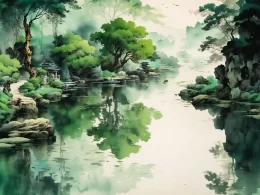



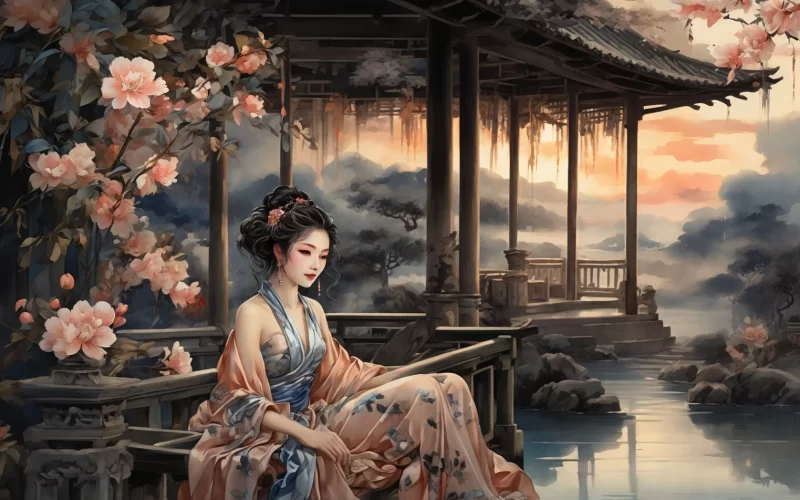
Dew dampens sunny flowers, spring halls sweet with scent;
The moon shines bright, songs and pipes in Zhaoyang Palace are sent.
It seems as if the sea‑water were poured to fill the palace clepsydra’s hold,
Dripping together through the night in Changmen Palace, a story untold.
Original Poem
「宫怨」
李益
露湿晴花春殿香,月明歌吹在昭阳。
似将海水添宫漏,共滴长门一夜长。
Interpretation
Li Yi, renowned for his frontier poems, was also deeply versed in the theme of palace lament. He lived during the Tang dynasty after the An Lushan Rebellion, witnessing firsthand the empire's decline from its peak. This sense of historical vicissitude lent him a particular sensitivity to the fates of women within the deep palace.
Zhaoyang Hall and Changmen Palace were two iconic structures in the Han dynasty imperial court. Zhaoyang Hall was the residence of Emperor Cheng of Han's favorite consort, Zhao Feiyan, where lamps burned all night and revelry with song and dance never ceased. Changmen Palace, in contrast, was where Empress Chen Ajiao, deposed by Emperor Wu of Han, was neglected and left in desolate solitude, a place so quiet one could catch sparrows at the gate. Later poets often used these two palaces to represent the two diametrically opposed destinies of receiving favor and falling from favor.
Li Yi's poem precisely borrows the scenery of the Han palaces to write of affairs within the Tang court. The first two lines depict a spring night in Zhaoyang Hall—dew dampening sunlit flowers, moonlight bright on songs and pipes, a scene of utter prosperity and joy. The last two lines shift to describe the deep night in Changmen Palace—the endless drip of the water-clock, the interminably long night, a room full of desolation. Two images are placed side by side; without a single word of judgment, the world of difference between favor and neglect leaps off the page. The poet Li Yi experienced a lifetime of hardship and an unsuccessful official career, giving him a personal understanding of the word "neglect." He poured this understanding into his poetry, allowing the drip of the water-clock in Changmen Palace on that one night to drip for over a thousand years, its echo still resonating in readers' hearts today.
First Couplet: "露湿晴花春殿香,月明歌吹在昭阳。"
Lù shī qíng huā chūn diàn xiāng, yuè míng gē chuī zài zhāoyáng.
Dew dampens the sunlit blooms, the spring hall filled with their scent;
Moonlight bright, songs and pipes resound in Zhaoyang Hall.
The poem opens with a delicate brushstroke painting a spring night in Zhaoyang Hall. "Dew dampens the sunlit blooms" captures sight and touch—flower petals, moistened by night dew, appear even more delicate, carrying a hint of dampness; "the spring hall filled with their scent" captures smell—the fragrance of flowers permeates, lingering without dissipating. The next line, "Moonlight bright, songs and pipes resound in Zhaoyang," shifts from stillness to movement, from scene to people. Beneath the moonlight, the sound of strings and pipes in Zhaoyang Hall never ceases; this is the night of the favored, the ultimate earthly joy. These two lines write of prosperity to the extreme; the more vividly it is rendered, the more bone-chilling the desolation that follows becomes.
Second Couplet: "似将海水添宫漏,共滴长门一夜长。"
Sì jiāng hǎishuǐ tiān gōng lòu, gòng dī chángmén yī yè cháng.
As if the sea's water were poured to fill the palace clepsydra,
Dripping with me in Changmen Palace, making the night so long.
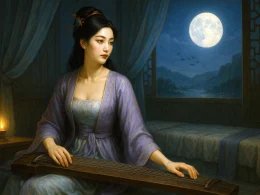
This couplet takes a sharp turn, shifting from Zhaoyang Hall to Changmen Palace. The "palace clepsydra" (宫漏, gōng lòu) was a timekeeping device in ancient palaces, marking time with dripping water. "As if the sea's water were poured to fill the palace clepsydra" is an extreme, hyperbolic imagining—the water in that clepsydra seems not to drip drop by drop, but as if the entire ocean were pouring out, never to be exhausted. The next line, "Dripping with me in Changmen Palace, making the night so long," reveals the listener to this endless dripping—the forgotten woman in Changmen Palace. The words "dripping with me" (共滴, gòng dī) are supremely clever, as if the water-clock has gained a spirit, deliberately keeping her company, enduring together this night that seems to have no end.
Holistic Appreciation
This is an excellent heptasyllabic quatrain that uses contrast to express the sorrow of palace life. The poem's four lines and twenty-eight characters present two juxtaposed images: the first two lines describing the joy of receiving favor in Zhaoyang Hall, the last two lines depicting the suffering of falling from favor in Changmen Palace. Through this strong contrast, the theme of palace lament is thrown into sharp relief.
Structurally, the poem presents a clear "two-part" progression. The first two lines depict prosperity to the extreme—dew dampens the sunlit blooms, the spring hall is fragrant, moonlight brightens the songs and pipes, ceaseless throughout the night. This is the world of the favored, the ultimate earthly joy. The last two lines abruptly shift; the lens cuts to Changmen Palace. There, there is no floral scent, no song and dance, only the endless drip of the water-clock and a night so long it seems dawn will never come. The strikingly unusual metaphor, "as if the sea's water were poured to fill the palace clepsydra," magnifies the sorrow of the neglected one to the extreme—the water in that clepsydra seems not to drip drop by drop, but as if the entire ocean were pouring out, never to be exhausted, forever awaiting the dawn.
In terms of conception, the core of this poem lies in the word "long" (长, cháng) in "making the night so long" (一夜长, yī yè cháng). The night in Zhaoyang Hall is short—revelry with song and dance makes the fine night feel all too brief. The night in Changmen Palace, however, is interminably long—the constant drip of the water-clock makes each day feel like a year. The same night has an entirely different length for different people. This sense of temporal distortion is precisely what is most moving about the theme of palace lament—it is not that the environment has truly changed, but that the human heart has changed, and with it, the flow of time.
Artistically, the poem's most exquisite aspect lies in "using a scene of joy to write of sorrow" (以乐景写哀, yǐ lèjǐng xiě āi). The more vividly the joy of Zhaoyang Hall is written in the first two lines, the more piercing the desolation of Changmen Palace becomes in the last two. The poet does not directly describe how the person in Changmen Palace suffers; he only writes of the endless drip of the water-clock, thereby conveying the torment of that interminably long night. That dripping sound is the sound of time passing, and also the sound of a lonely person counting time. Each drop falls upon the heart.
Artistic Merits
- Vivid Contrast, Strong Juxtaposition: The joy of Zhaoyang Hall and the desolation of Changmen Palace form a sharp contrast, allowing the emotion of palace lament to reach its climax through this opposition.
- Striking Metaphor, Powerful Hyperbole: "As if the sea's water were poured to fill the palace clepsydra" uses the sea to metaphorize the water in the clepsydra, magnifying the torment of the forsaken one's interminable days to the extreme. The imagination is striking, the force piercing the page.
- Using Joy to Write Sorrow, Doubling the Sorrow: The first two lines describe the joy of receiving favor to the extreme, the last two lines depict the suffering of falling from favor to the extreme. The more delightful the scene of joy, the deeper the sorrow appears.
- Temporal Distortion, Psychological Truth: Through the description of "making the night so long," the subjective, distorted experience of time by the forsaken one is expressed, touching the reader's heart more effectively than objective description.
- Using the Small to See the Large, Far-reaching Meaning: Starting from the minute detail of the dripping water-clock, the entire fate of women in the deep palace is revealed. A weighty theme is handled with a light touch, leaving a lasting resonance.
Insights
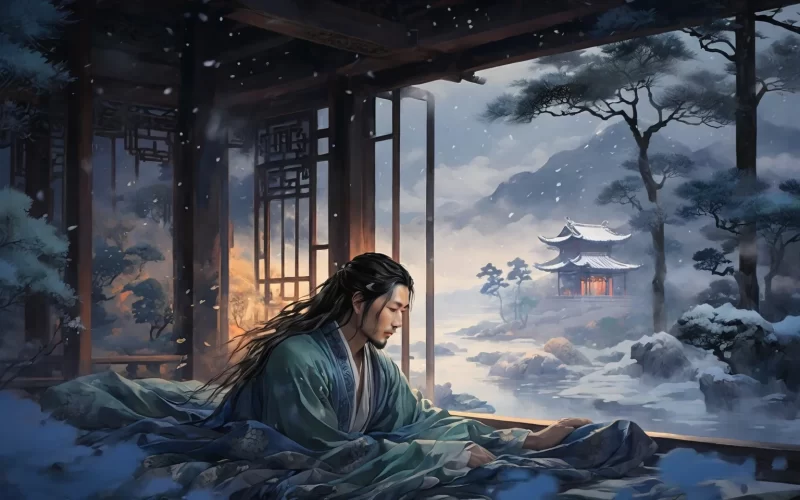
This poem speaks of one thing only: the same night is of different lengths for different people. First, it allows us to see how a person's situation alters the flow of time. Over in Zhaoyang Hall, with flowers, moonlight, and song and dance, the night passes quickly, so quickly it feels insufficient. Here in Changmen Palace, there are no people, no sound, no activity, only a single water-clock, dripping incessantly, from dusk until dawn. The night is the same night, but the people experiencing it are different. It is not time that has changed, but the state of the human heart.
The line, "似将海水添宫漏" expresses that feeling of each day dragging on like a year to the extreme. The water-clock is only a few inches deep; where is the sea? But for a person in torment, time truly slows. It is not that the water in the clepsydra has actually increased, but that the person listening to it suffers too greatly in their heart. The suffering is so great that each drop is heard distinctly, each drop feeling like a year. This hyperbole makes the taste of that night in Changmen Palace more comprehensible than realism ever could.
On a deeper level, this poem also reveals: what is harder to endure than a long night is endless repetition. The water will finish dripping, the night will pass, the sky will eventually lighten. But what after dawn? It is still Changmen Palace, still no one comes, still a water-clock dripping from dusk until dawn. What drives the people of Changmen Palace to despair is not this one night, but that every night is like this, not knowing how many more such nights await them.
Li Yi does not write of that woman's weeping; he only writes of a water-clock. He does not speak of bitterness; he only speaks of the sound of dripping water. And that dripping sound is heavier than a thousand streams of tears. Tears have an end; the sound is endless.
About the poet
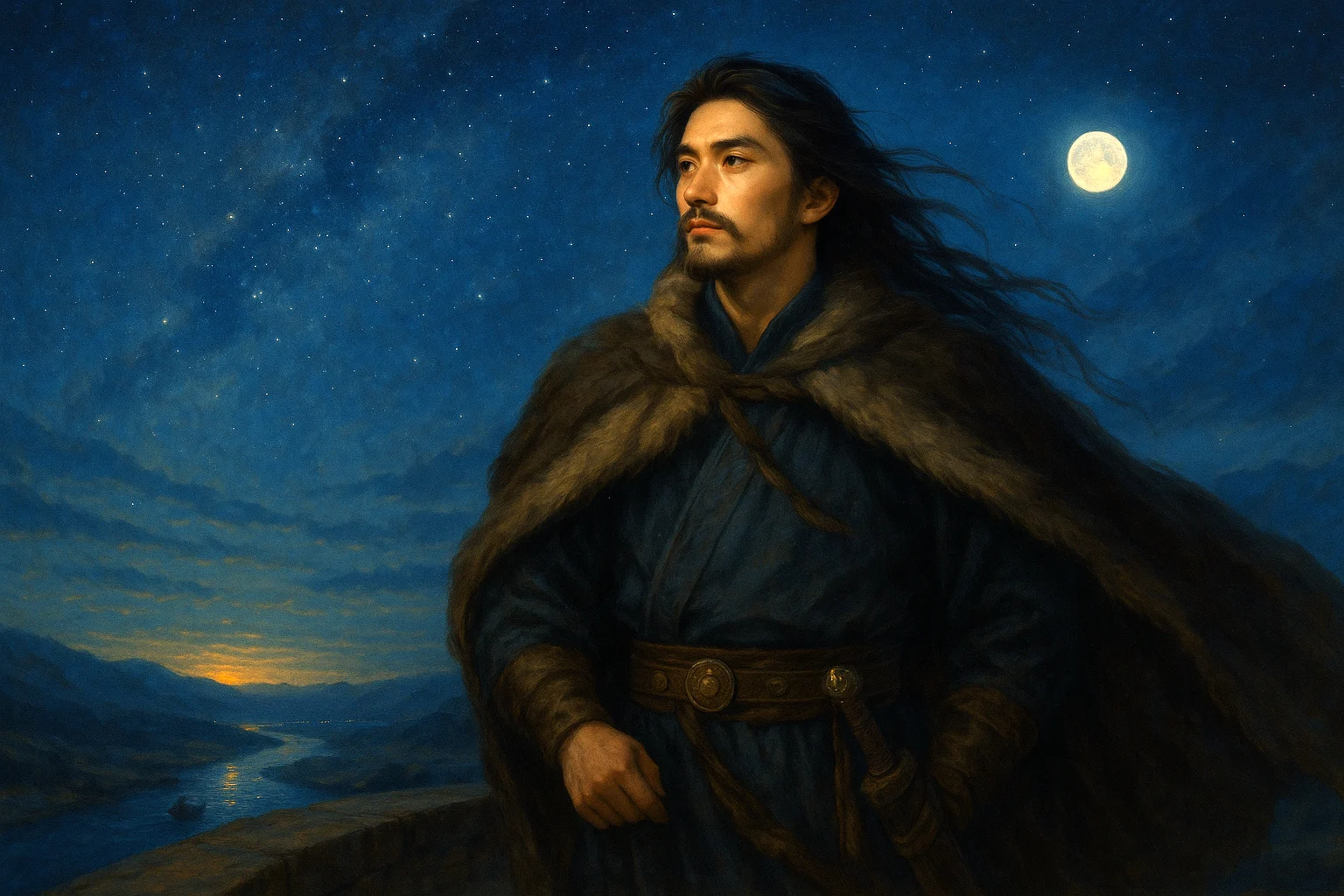
Li Yi (李益 748 - 829), a native of Wuwei, Gansu Province, was a representative poet of the Frontier Fortress School in the Mid-Tang period. He became a jinshi (presented scholar) in the fourth year of the Dali era (769 AD) and served through the reigns of Emperor Xianzong and Emperor Wenzong, eventually rising to the position of Minister of Rites. His poetry is particularly renowned for its seven-character quatrains, characterized by a style that is both solemn and poignant, blending the grandeur of High Tang frontier poetry with the plaintive elegance of the Mid-Tang. Inheriting the legacy of Wang Changling and inspiring later poets like Li He, his frontier poems carved out a unique and distinctive place in the Mid-Tang literary world.